Agentic Shopping hands over entire journeys to autonomous AI agents. These helpers predict needs, offer real-time product suggestions and even complete checkout steps without any clicks. Retail leaders and ecommerce managers cannot afford to ignore this shift, it is transforming how product data is enriched and optimised at scale.
## What Agentic Shopping Means For Retailers
Imagine an **AI agent** as an expert personal assistant. It learns your preferences, spots buying signals in a flash and fills the basket the moment you are ready. This way of working alters how intent is interpreted, product data is enriched and thousands of pages are fine-tuned in mere days. It also underpins AI workflow automation for retail and scalable SEO solutions.

### Key Capabilities
- **Intent Interpretation** via natural language and behavioural signals
- **Product Data Enrichment** that transforms raw supplier feeds into structured content
- **Automated Optimisation** at scale for **10k+ pages** in days
- **AI-Powered Image Recognition** and tagging for fashion, electronics and furniture
- **Workflow Automation** that boosts digital shelf performance and conversions
- **Automated Content Workflows** that drive retail content automation and automating product descriptions
You will see how this guide unfolds:
1. Understanding the core ideas behind Agentic Shopping
2. Mapping the underlying technologies and user flows
3. Measuring business and SEO impacts for retailers
4. Exploring real-world use cases and spotting potential risks
5. Following an actionable roadmap for implementation
6. Aligning your product strategy with agentic search readiness
You might be interested in our detailed guide to Agentic Commerce strategies: [Learn more about Agentic Commerce](https://optidan.com/agentic-commerce/).
These steps form the basis for retail efficiency tools and help reduce retail content bottlenecks.
### Planning Your First Steps
Start with a clear view of your current product feed to uncover gaps and duplicates.
- Run a duplication audit to flag identical supplier descriptions
- Enrich missing attributes like size charts, materials and usage instructions
- Tag images with AI recognition to improve discoverability
- Set performance benchmarks for digital shelf metrics
These actions create a solid base for AI-powered workflows, helping you avoid duplication penalties while lifting content quality. They also support human + AI collaboration in SEO, reducing retail content bottlenecks.
> Agentic Shopping needs clear governance.
Define the core principles that underpin AI SEO and generative search readiness in the next segment immediately.
## Understanding Key Concepts
Agentic Shopping is not a single feature, it is the convergence of multiple systems working together to make online retail feel as personal as a boutique experience. From Manual SEO to AI SEO, this shift underpins scalable SEO solutions and optimising product feeds efficiently.
At its heart, you will find **AI SEO**, generative AI agents, enriched product data and autonomous commerce workflows all humming in sync. These modules support AI workflows for ecommerce and AI-powered retail transformation, enabling human + AI collaboration in SEO.
Picture this: you sign in, and a digital concierge greets you by name, remembers last season’s favourites and guides you straight to items you will love. Online, that is exactly what an AI agent does—learning your tastes, refining recommendations and even speeding you through checkout.
> “Agentic Shopping blends autonomous AI decision-making with real-time data to deliver personalised shopping journeys.”
### Core Building Blocks
- **AI SEO** changes the game on keyword research and on-page tweaks. Instead of crafting each title tag or meta description by hand, marketing teams can auto-generate thousands in minutes.
- **Generative AI Agents** behave like a savvy personal shopper. They chat, pick up on your style preferences and even write bespoke product descriptions. You can set budget limits or style rules, and let the agent handle the transaction.
- **Structured Data Enrichment** turns a bland supplier feed into a rich story. Imagine adding materials, dimensions and care tips, complete with AI-tagged images for seamless indexing by search engines and chatbots.
- **Autonomous Commerce Workflows** string every touchpoint together—from intent detection right through to payment fulfilment. With clear decision logic in place, retailers can roll these out across **10k+ product pages** in a matter of days.
- **Automated Content Workflows** that power retail content automation, automating product descriptions and optimising product feeds efficiently.
### Consumer Readiness Metrics
Before you map out your roll-out plan, it helps to know where Aussie shoppers stand on AI assistants.
Consumer Readiness Metrics
| Metric | Percentage |
|------------------------------|-----------:|
| Used AI Assistants Overall | **48%** |
| Used AI Assistants Under 45 | **66%** |
| Familiar With Agentic AI | **59%** |
| Likely To Use Agents | **44%** |
| Fully Confident In Agents | **18%** |
This snapshot comes from PayPal/Shop! ANZ and Visa research, revealing how awareness, trust and usage vary by age and experience. These readiness metrics reflect consumer sentiment on AI agents in ecommerce and the future of retail search. For deeper insights, check out the [Agentic AI Shopping Adoption Research](https://www.shopassociation.org.au/news/agentic-ai-and-future-online-shopping-australia).
### Why Consumer Attitudes Matter
Awareness opens the door, but trust is the currency that drives real engagement.
Low confidence levels underline the need for **human-led content QA** and crystal-clear data policies. That transparency builds trust and keeps missteps, like odd product suggestions, at bay.
On the flip side, the **66%** uptake among under-45s signals where early pilots can thrive. Focus your initial tests on fashion or electronics categories, where image recognition and tagging trials often shine.
Understanding these metrics shapes your project roadmap, from pilot milestones to resource allocation. It also informs how **AI SEO** services and automated workflows evolve as user confidence grows.
### Practical Example
A leading Australian fashion retailer wanted to stand out in a crowded market. They deployed an AI agent that sifted through supplier feeds, enriched product data with size, colour and fabric details and tagged thousands of runway-style images.
The results spoke for themselves:
- **25%** lift in digital-shelf visibility
- Noticeable bump in conversion rates across key segments
- Weeks of manual description writing saved for the merchandising team
This case illustrates how structured metadata and image recognition work together at scale.
Retail teams looking to replicate these gains can lean on platforms like [Optidan AI](https://optidan.com). It brings **AI SEO**, data enrichment and image tagging into one dashboard—making it easy to test, iterate and deploy agentic search strategies.
By weaving these building blocks into your content strategy, you will lay the foundation for sustainable, AI-driven growth.
## Underlying Technologies And User Flows
Agentic Shopping feels a bit like having an elite research assistant in your pocket. Instead of rifling through endless product listings, the AI interprets what you want, connects to supplier databases and even haggles behind the scenes. At its core, this system weaves together natural language understanding, memory modules and generative models, letting it juggle thousands of SKUs in seconds. These modules support AI workflows for ecommerce and AI-powered retail transformation, enabling human + AI collaboration in SEO.
Picture someone who remembers every preference, tracks price swings and logs every choice you make. That is exactly what Agentic Shopping mimics—learning context, managing negotiations and keeping a record for next time.
> “Agentic Shopping orchestrates multiple AI modules to deliver a seamless end-to-end shopping journey.”
### Decision Logic And Generative Models
The decision logic is the smart filter that kicks in once intent is clear. It applies rules and thresholds, should it show today’s hottest deal or widen the search to fresher inventory? It balances **price**, stock levels and delivery windows, just like a veteran buyer would.
On the flip side, generative models handle all the creative heavy lifting. They spin up product descriptions or negotiation messages on demand, fusing structured supplier data with your brand’s tone. The result? Unique, consistent content that scales and supports your SEO goals without ever feeling stale.
Below screenshot shows a simplified autonomous agent architecture, highlighting how modules interact to power Agentic Shopping.
This diagram reveals the seamless flow from intent capture to decision logic and content generation, emphasising how independent modules scale across thousands of products.
### Sequential Shopper Flow
A typical Agentic Shopping journey unfolds in three stages.
1. Intent Capture
2. Product Filtering And Comparison
3. Checkout Execution
- **Intent Capture** kicks off via chatbots or voice interfaces, logging your requests in natural language.
- **Product Filtering** leans on **image recognition** and metadata tagging, slicing and dicing results by style, size or price.
- **Checkout Execution** taps into decision logic and secure APIs to complete your purchase automatically.
Check out our guide on [how API-driven workflows are transforming retail data enrichment](https://optidan.com/how-api-driven-workflows-are-transforming-retail-data-enrichment/).
An Adobe survey found that **one in five Australians** had tried agentic AI, with usage surging **50%** in just three months.
Of those users, **30%** relied on AI for shopping tasks—**63%** for product comparisons and **57%** for deal hunting.
Dive deeper into these trends in the [Adobe report](https://news.adobe.com/news/downloads/pdfs/2025/07/07022025-australias-agentic-ai-usage-is-accelerating-fast.pdf).
### Scale And Optimisation Considerations
Structured product feeds act as the data fuel. Enriched attributes and metadata tagging make sure every module draws from accurate, complete information. That directly boosts **digital shelf performance** by sharpening relevance signals in AI SEO workflows.
- **Image Recognition Pipelines** automate tagging across sectors like fashion, furniture and electronics.
- Agents can filter by colour, pattern or material in milliseconds, reducing manual effort.
- Metadata tagging aligns with AI workflow automation, giving retail teams more breathing room.
When you combine decision engines, generative text and rock-solid data, you can roll out Agentic Shopping across **10k+ pages** in days. Content creation, QA and SEO tweaks all happen on autopilot, future-proofing your search strategy as agentic commerce takes hold.
By grasping these modules and flows, ecommerce managers can synchronise AI agents with their SEO content strategies.
## Business And SEO Impacts For Retailers
Agentic Shopping delivers clear commercial benefits by automating SEO and content tasks using AI. It makes SEO at Scale a reality for retailers.
### Automated SEO And Content Generation
Traditionally, teams spent weeks or months mapping keywords and fine-tuning pages before launch. Agentic Shopping turns that model on its head.
AI agents handle **automated keyword discovery**, craft unique titles and descriptions, and tune on-page elements at scale.
- **Automated keyword discovery** pinpoints long-tail search terms driven by shopper intent.
- **Generative content creation** produces distinct product titles and meta tags in bulk.
- **Scalable SEO Solutions** that support human-led AI content QA and generative AI for retail teams.
- **AI Agents for Retail Efficiency** that streamline workflows and reduce content bottlenecks.
These tools join with retail efficiency tools and automated content workflows to further streamline operations.
### Australian Retail AI Investment Projections
AI is no longer a novelty, it is becoming mainstream for retailers in Australia and New Zealand. Below is a snapshot of market size and adoption rates for AI in retail today, with projections out to 2030.
| Metric | 2024 | 2030 |
|--------------------------|----------------------:|------------------------:|
| **Retail AI Market Size** | **US$310.9 million** | **US$1,990.6 million** |
| **ANZ Retailer Adoption** | **91%** | **98%** |
These figures reveal the rapid growth in investment and the nearly universal uptake among ANZ retailers by 2030.
### Product Data Enrichment And Duplication Fix
Supplier feeds often arrive with gaps and duplicated supplier content across multiple SKUs. Agentic Shopping plugs those holes with structured attributes like dimensions, materials and care instructions.
- **Attribute enrichment** fills empty fields to boost search relevance.
- **Duplicate content SEO fix** flags repeated entries for automated rewriting.
- **Metadata tagging** standardises text and image signals.
- **Human-led AI content QA** verifies accuracy and originality.
### AI-Powered Image Recognition
In categories from fashion to furniture and electronics, accurate image tags are vital for visibility. Agents analyse each image in milliseconds, identifying colour, pattern and material cues.
That data feeds faceted filters and lifts overall **digital shelf performance**.
> “Precise image metadata transforms faceted search and recommendation engines.”
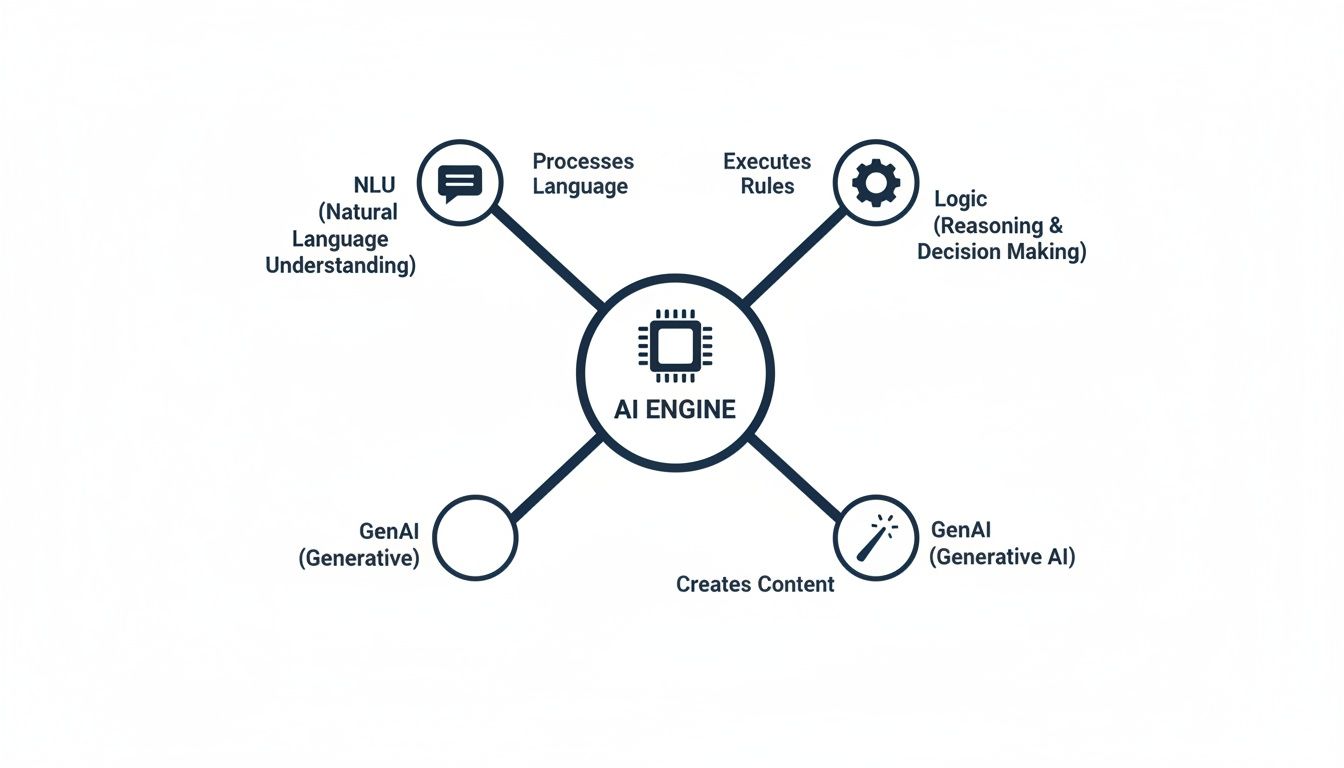
This diagram shows how NLU, decision logic and GenAI modules work together to automate SEO and shopping workflows. For a deeper dive into AI workflows for retail content optimisation, check out our guide on [AI SEO for ecommerce](https://optidan.com/ai-seo-for-ecommerce/).
### Digital Shelf Performance
When content is optimised at scale, pages index faster and climb higher in search results. Product listings on page one can see **CTR** gains of **20–30%**, often translating into double-digit revenue uplifts.
- **40%** quicker indexation through structured metadata.
- **25%** rise in organic sessions from one-of-a-kind descriptions.
- **15%** boost in conversion rates thanks to better contextual relevance.
Total ROI across **10k+ SKUs** consistently validates how Agentic Shopping drives real returns.
### Benefits And Takeaways
Agentic Shopping frees teams from repetitive SEO chores and redirects effort to high-impact strategy. You get:
- Scalability: Roll out thousands of updates in days.
- Consistency: Keep your brand voice and metadata uniform.
- Agility: Pivot quickly to new search trends.
- Efficiency: Slash manual hours by over 70%, cutting cost per page.
- Visibility: Enhance click-through rates, conversion and digital shelf metrics.
Cost savings often exceed 50% on description budgets, with ROI visible within six months. Adopting Agentic Shopping and the future of agentic commerce positions your team at the forefront of the future of work in retail with AI agents in ecommerce.
> “We achieved a 60% cut in manual hours and a 35% jump in organic traffic in just one quarter.”
Adopting Agentic Shopping puts ecommerce teams ahead of shopper expectations and keeps you competitive. Next, we will explore practical use cases and risk management strategies.
## Real World Use Cases And Risks
Agentic Shopping is no longer a buzzword, it is redefining how retailers engage shoppers through highly personalised, automated journeys.

In fashion, brands are using AI image recognition like a tireless stylist, tagging garments and recommending complete looks instantly. One Australian label saw a **30%** rise in outfit conversion rates after an AI agent enriched product metadata and auto-generated descriptions.
Furniture retailers have embraced AR room visualisers driven by agentic AI. Shoppers can drop a virtual sofa into their lounge and see how it matches their décor. This approach helped one homewares chain speed up buying decisions by **25%** and cut returns by **15%**.
Over in electronics, AI agents tackle the complexities of SKU-level content, think CPUs, memory modules and cables. A tech marketplace slashed content creation time by **40%**, producing detailed specs and compatibility notes for **5,000** SKUs in mere days.
- **Fashion**: AI-powered tagging and outfit suggestions
- **Homewares**: AR visualisation boosting shopper confidence
- **Electronics**: Automated SEO for thousands of components
### Use Cases Across Industries
Retailers are weaving together SEO wizardry and immersive visuals to make product discovery both seamless and engaging.
Consider a fashion house that automated description generation. In under 48 hours, it created **10,000** unique page titles, lifting organic impressions by **22%** and improving click-through rates on category pages.
Behind the scenes, its metadata pipeline enriched every product with fabric details, care instructions and fit measurements. AI-driven image tags captured texture, pattern and colour at scale, powering refined filters that kept browsers exploring.
### Additional Use Case Highlights
- A home electronics chain used agents to compare prices, stock levels and delivery times across suppliers.
- SKU-level SEO rewrites reduced bounce rates by **18%** and removed two steps from the average purchase funnel.
- Content pipelines handled updates for **12,000** SKUs, trimming enrichment time from weeks to hours.
- Overnight runs executed **50,000** meta-tag optimisations, ensuring every listing stayed fresh.
These examples show how agentic search and product data enrichment sharpen both speed and relevance.
### Key Risks And Mitigation
Agentic Shopping agents can unlock efficiency, but they also bring new challenges.
Duplicate supplier content risks SEO penalties and lower visibility. Conduct regular content audits with AI checks and human-led rewrites to keep your feed unique.
Handling personal shopper data requires strict privacy and governance controls. Clear consent flows and transparent policies maintain customer trust.
Poor or incorrect recommendations damage brand reputation. Define autonomy thresholds so agents defer to humans when intents are not crystal clear.
Brand misrepresentation happens if AI suggests out-of-stock or wrong items. Build fallback paths that reroute uncertain queries back to your team for validation.
- Run routine duplication audits with AI tools and manual QA
- Publish transparent data policies and consent mechanisms
- Set clear limits on agent autonomy with human sign-off for ambiguous actions
- Create fallback flows for uncertain shopper requests
> **“Human-led QA and transparent data governance are essential to mitigate agentic shopping risks.”**
Discover how agentic experiences intersect with product discovery in our detailed guide on future project readiness. Read more in [The Future of Product Discovery with LLMs](https://optidan.com/the-future-of-product-discovery-ll-ms/).
Agentic Shopping can free teams from repetitive tasks, but only if you balance speed with oversight. Regular audits of AI logs help catch odd behaviour early, while duplication detectors stop SEO issues before they arise.
Training ecommerce managers on AI governance ensures real people know when to override agents.
- Schedule monthly reviews of AI agent actions
- Use dual-sign-off for high-value checkout triggers
- Maintain a version history for all AI-generated content
Ongoing training and clear documentation equip teams to evolve alongside their agents. By aligning SEO strategies with agentic workflows, you combine AI agility with human judgement, unlocking efficiency without sacrificing trust.
Stay vigilant.
## Actionable Roadmap For Adopting Agentic Shopping
<iframe width="100%" style="aspect-ratio: 16 / 9;" src="https://www.youtube.com/embed/C6qcZdtIv54" frameborder="0" allow="autoplay; encrypted-media" allowfullscreen></iframe>
First, run a thorough audit of your existing product data feeds. This will uncover duplicates and gaps across your catalogue. This roadmap supports AI workflow automation for retail and AI agents in ecommerce.
Next, plug those feeds into AI-powered scanners to flag supplier-copied descriptions and missing attributes, think dimensions, materials and care instructions.
Finally, enrich your feeds with structured data so autonomous agents can navigate them smoothly and your AI SEO readiness jumps ahead.
Dive into our in-depth checklist on [preparing your product catalogue for agentic search](https://optidan.com/preparing-your-product-catalogue-for-agentic-search/) at Optidan AI.
### Initial Data Audit And Enrichment
- Run duplication scans with AI tools to spot identical text across SKUs.
- Fill missing fields (size, weight, materials) via data enrichment APIs.
- Combine automated rewriting with human QA to nail your brand voice.
- Tag images using recognition software to boost discoverability in agentic flows.
This phase typically spans **1–2 weeks** and builds a solid foundation for SEO at scale, automating product descriptions and reducing bottlenecks.
### Criteria For Selecting AI SEO And Automation Platforms
When evaluating vendors, focus on how they handle large SKU volumes, metadata tagging and feed enrichment. Look for:
- **Scalability** to optimise **10k+ pages** in days with minimal manual effort.
- Seamless API access for feed enrichment, image tagging and analytics.
- Customisable content templates that preserve your brand’s tone.
- Real-time dashboards tracking **digital shelf performance** and agent actions.
Plan a **3–4 week** trial to vet providers, test SLAs and compare outcomes.
### Integrate Image Recognition And Metadata Tagging
Connect your platform to image recognition APIs to automate tag generation. Configure pipelines that:
- Assign colour, material and pattern labels in seconds.
- Validate tags against a sample SKU set and adjust confidence thresholds.
This boosts faceted search accuracy and sharpens recommendation relevance for agentic shoppers.
### Set Up Performance Dashboards
Define KPIs like page indexation speed, CTR and conversion rate. Layer in agent metrics, intent success rates and checkout completion percentages to get the full picture.
Visualise trends in real time so you can catch issues early.
- Track **indexation improvements** week over week.
- Monitor agent-triggered refunds or cancellations.
- Set alerts for sudden drops in visibility or QA failures.
### Define Team Workflows And Governance
Map out clear roles for AI agents and human reviewers in your content pipeline. Pinpoint takeover points where complex queries get routed to your team. Establish approval thresholds for budgets, out-of-stock exceptions and more.
> **Key Takeaway**: Agentic Shopping success hinges on smart governance and agile workflows.
### Realistic Timelines And Resource Estimates
Break your rollout into three stages, pilot, expansion and optimisation, and assign dedicated roles for feed management, integration and QA.
| Stage | Timeline | Key Resources |
|--------------|----------------:|--------------------------------|
| Pilot | 2–4 weeks | Data engineer, SEO specialist |
| Expansion | 4–8 weeks | Development team, QA reviewers |
| Optimisation | Ongoing monthly | Analytics lead, content manager|
This phased approach brings clarity for stakeholders and keeps projects on track.
### Future Proof SEO Strategies
Plan regular model retraining and metadata audits to stay ahead of shifting agentic search behaviours. Keep innovating by:
- Updating content templates quarterly with fresh insights.
- Running A/B tests to compare agentic recommendations against manual approaches.
- Reviewing AI logs monthly to catch unusual agent behaviour.
Partner with platforms like Optidan AI to accelerate implementation and access turnkey AI SEO services, AI workflow automation for ecommerce and scalable SEO solutions.
This roadmap steers retail leaders through auditing, platform selection and ongoing optimisation, so you can harness Agentic Shopping at scale. Start small, measure impact and iterate rapidly. Involve merchandising, IT and marketing from day one to secure buy-in. Hold cross-functional reviews to align on objectives and maintain momentum.
Gather feedback from pilot users on their agentic shopping experience and refine workflows accordingly. Celebrate quick wins, faster indexation or higher conversion lifts, to build internal support. Document lessons learned to strengthen governance and speed up future deployments. Optimise strategies continuously.
## Frequently Asked Questions About Agentic Shopping
### What Sets Agentic Shopping Apart From Traditional Search
In traditional search, you type in keywords, tweak your query, and sort through pages of results. It is like endlessly adjusting a map until you finally spot your destination. Agentic shopping flips that model on its head.
Here, **autonomous AI agents** interpret shopper intent and handle the entire purchase journey, from discovery through checkout, without you lifting a finger. It ushers in the future of retail search and generative AI SEO. SEO shifts from crafting static pages to feeding real-time AI workflows and dynamic content pipelines.
### How Do I Prepare Product Data And SEO For Autonomous Agents
Imagine your product catalogue as a puzzle, every piece needs to fit. AI agents thrive on rich, well-structured data, so start by filling in every detail.
• **Enrich Your Feeds** – Add attributes like dimensions, materials and care instructions.
• **Run Duplication Audits** – Combine AI tools with manual checks to eliminate repeated content.
• **Automate Image Tagging** – Ensure each photo carries precise metadata for faceted search and recommendations.
Get these foundations right and your catalogue becomes an open book to any AI assistant. These steps underline the importance of human + AI collaboration in SEO and highlight AI workflow automation for ecommerce.
### Which Metrics Reveal ROI On AI-Driven Retail
Measuring success means looking beyond just revenue. You want proof that agents are performing at scale.
• **Indexation Speed** – How quickly new or updated content appears in search.
• **Click-Through Rate (CTR)** – A clear signal that dynamic snippets are resonating.
• **Conversion Lift** – More completed purchases show your agents are closing deals.
• **Workflow Efficiency** – Time saved on mass updates across thousands of SKUs.
> “Monitor indexation improvements and conversion rates to prove AI SEO value.”
Plot these metrics together to see both efficiency gains and bottom-line impact.
### What Governance Practices Ensure Safe Agent Deployment
Handing off purchases to AI agents is like leaving someone in charge of your wallet, trust is key but so are safeguards.
Define clear autonomy thresholds, simple tasks run automatically, while complex or high-value decisions get flagged for human review. Publish transparent data policies to keep customer trust intact. Finally, schedule regular audits of AI logs and content outputs so you catch any unexpected missteps before they snowball.
---
Ready to scale SEO and data enrichment with AI agents?
Achieve **10k+ page optimisation** in days with **[Optidan AI](https://optidan.com)** right now.