

Think of an AI Product Feed as your secret weapon for ecommerce. It’s a smart system that uses artificial intelligence to automatically level up your product data. It takes basic, often boring, info from suppliers and turns it into unique, SEO-friendly content that gets you noticed in search results. More importantly, it gets you ready for the future of agentic search and AI-driven shopping, breaking you free from the slow, manual content slog for good.
The AI Revolution on Your Digital Shelf
For most Australian retailers, the digital shelf is a mess. When you’re juggling thousands of SKUs, it’s easy to fall back on generic supplier data. But this is a trap. It creates massive content bottlenecks and absolutely kills your search visibility. Relying on duplicated, uninspired supplier content is a fast track to poor performance and becoming invisible online.
The real problem here is scale. Who has the time to manually write unique descriptions, optimise every image, and enrich the data for an entire product catalogue? It's a huge, almost impossible task for any retail team. This is exactly why a strategic shift from old-school manual SEO to AI SEO is no longer a "nice to have", it's essential for survival and achieving SEO at scale.
Moving Beyond Manual Bottlenecks
Traditional retail content workflows are painfully slow and full of errors. It feels like you’re always playing catch-up, never getting ahead. This is where AI workflow automation for retail steps in to fix the core issues.
- Automating Product Descriptions: Forget copying and pasting from supplier sheets. Generative AI can write unique, keyword-rich descriptions for every single one of your products, wiping out the supplier content duplication problem that holds so many retailers back.
- Intelligent Product Data Enrichment: AI algorithms are smart enough to scan raw supplier feeds, spot what’s missing, and fill in the gaps automatically. This ensures your data is complete and perfectly structured for modern search engines and the coming wave of AI agents.
- AI Image Recognition and Tagging: In industries like fashion or furniture, this is a game-changer. AI can "see" your product images and instantly generate descriptive alt tags and metadata. That’s a massive boost for image SEO for ecommerce without you lifting a finger.
This isn't just about doing things faster; it's a fundamental shift in how retail teams work, defining the future of work in retail. By automating the grunt work, your team is freed up to focus on what really matters: strategy and growth.
The goal isn’t just to pump out content quicker. It’s about building a smarter, more robust product catalogue. This is how you achieve scalable SEO that was once completely out of reach, even for the biggest players.
This change is already happening. Recent data shows that over 91% of retailers in Australia and New Zealand are now investing in generative AI. The market for AI in Australian retail is on track to explode from $310.9 million in 2024 to $1,990.6 million by 2030. That’s a loud and clear signal that AI-powered content workflows are becoming the new standard. You can find more insights on the AI boom in Australian retail from Appinventiv.
At the end of the day, adopting AI product feeds is about future-proofing your business. It prepares you for what’s coming next, like agentic shopping and the complete reinvention of retail search. It turns one of your biggest operational headaches into your most powerful competitive edge.
How AI Product Feeds Actually Work
To get your head around this, think of a traditional product feed as a static, printed catalogue. It’s a one-size-fits-all document that shows the same thing to every single customer, no matter what they’re looking for.
An AI Product Feed, on the other hand, is like having a dynamic, personal shopper that adapts in real-time. It’s a total shift from manual SEO to AI-driven performance. This process completely changes how retailers manage their digital shelf, turning a massive content bottleneck into a serious engine for growth and improved digital shelf performance.
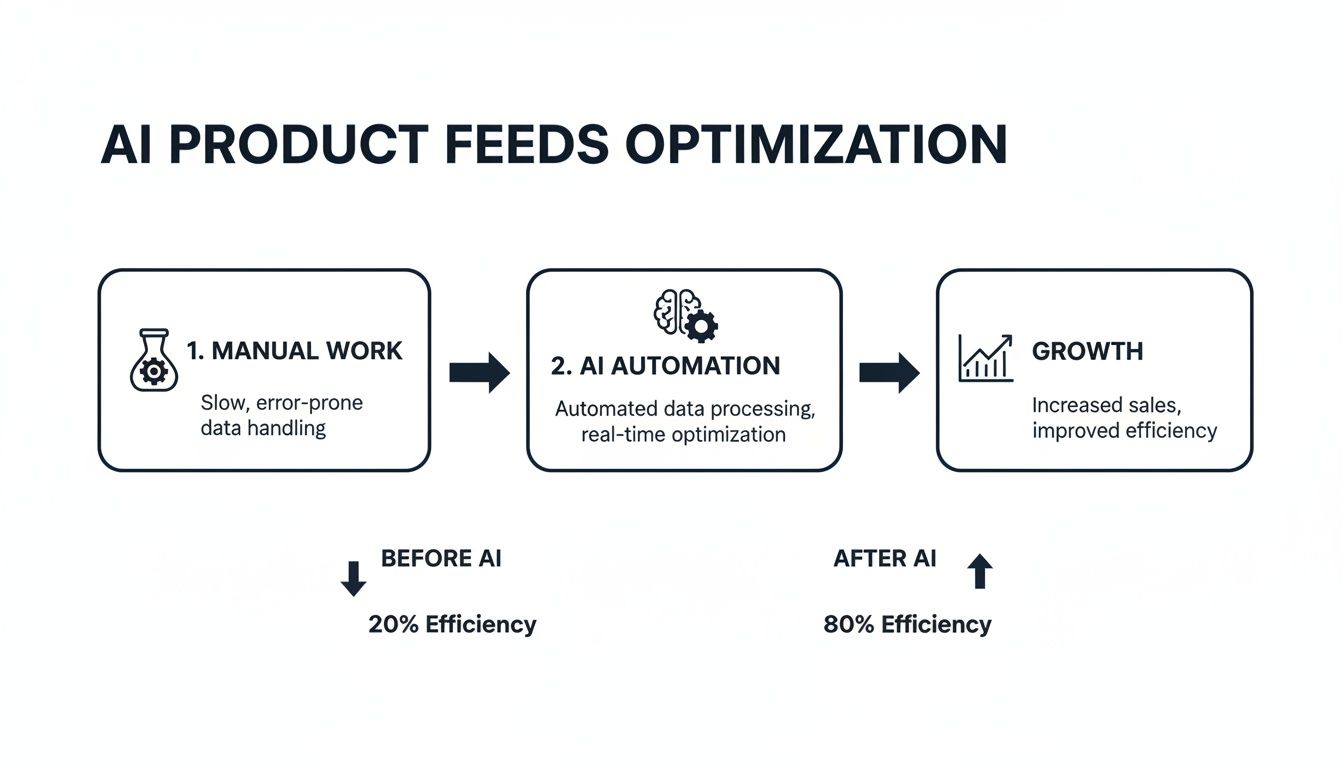
The image above shows a clear line from slow, manual work to efficient AI automation, which ultimately unlocks scalable business growth. It’s all about removing operational friction to accelerate performance.
This isn’t just about speeding things up; it fundamentally changes what’s possible for ecommerce content. We’re talking about the difference between updating a handful of product pages a week versus optimising tens of thousands in a matter of days.
Ingestion and Standardisation of Supplier Data
It all starts with raw data. AI workflows pull in messy, inconsistent, and often incomplete supplier feeds from all over the place. Anyone in retail knows these feeds are a nightmare, they come with different formatting, weird naming conventions, and are usually missing critical information.
The AI system’s first job is to act as a universal translator and organiser. It automatically cleans and standardises this data, fixing typos, mapping categories, and forcing all product information into a single, consistent structure. Getting this foundation right is non-negotiable for building a reliable product catalogue.
Intelligent Product Data Enrichment
Once the data is clean, the real smarts kick in. This is where the system performs product data enrichment on a scale that was previously unimaginable for a human team. The AI scans the existing information and instantly flags crucial gaps that are killing your SEO and frustrating your customers.
- Attribute Extraction: It can pull key attributes like material, colour, and dimensions from vague descriptions or even directly from product images.
- Taxonomy Building: The AI automatically slots products into logical categories and subcategories, which massively improves your site navigation and filtering options for shoppers.
- Specification Completion: For technical products like electronics or furniture, it can source and fill in the missing specs that customers absolutely rely on to make a buying decision.
Generative AI Content Creation
With a fully enriched and structured dataset locked in, the system turns its attention to the content itself. This is where it tackles the massive problem of supplier content duplication that plagues so many online stores. Using generative AI, the platform creates unique, on-brand, and SEO-optimised content for every single SKU.
This includes:
- Unique Product Descriptions: Crafting compelling narratives that focus on benefits and weave in target keywords naturally.
- Metadata Optimisation at Scale: Generating optimised meta titles and descriptions for thousands of pages in an instant.
- Alt Tag Generation: Using AI image recognition to analyse product photos and create descriptive alt tags, a vital and often-missed step for fashion and furniture SEO.
This entire automated workflow is designed to get your catalogue ready for the future of retail search, making every single product page compatible with AI agents and ready for discovery. To see a deeper dive into the mechanics, you can learn more about how API-driven workflows are transforming retail data enrichment.
Ultimately, this process gives every product the best possible chance to rank, connect with the right customers, and drive sales.
Escaping the Duplicate Content Trap at Scale
One of the biggest silent profit killers for retailers is the duplicate content penalty. It's a classic trap. You use the generic supplier descriptions for your product pages, and suddenly your SEO rankings and brand authority plummet. Why? Because you're signalling to search engines that your content offers nothing unique, making it harder for actual customers to find you.

The real challenge has always been one of scale. Who has the resources to manually rewrite thousands of product descriptions? It's a monumental task that creates massive retail content bottlenecks for any team. This is precisely the problem AI-powered content workflows were built to solve, turning a painfully manual process into an automated, strategic advantage.
Instead of getting bogged down in months or even years of rewrites, generative AI can tackle descriptions for tens of thousands of products in mere days. This isn't just about avoiding penalties; it's about building a foundation of unique, valuable content that actually helps you sell.
The AI-Powered Rewriting Process
So, how does this journey from generic to unique actually work? It's a clear, automated content workflow that starts by pulling in the standard supplier feed, the same uninspired, duplicated text used by countless other retailers. Then, the AI gets to work.
- Semantic Analysis: First, the system reads and understands the original description to pinpoint the core features, benefits, and specs of the product.
- Brand Voice Application: Next, it applies your unique brand voice, tone, and style guidelines. This ensures the new content sounds like it came directly from your team, not a robot.
- Keyword Integration: Strategic keywords from your AI SEO framework are then woven seamlessly into the narrative, targeting the exact terms your audience is searching for in sectors like fashion, furniture, or electronics.
- Content Generation: Finally, it generates a completely new, unique product description, optimised for both search engines and the humans who read them.
This automated workflow isn't just about dodging penalties; it’s about creating high-quality content that drives digital shelf performance. To really get why this is so critical, it helps to understand what duplicate content is and why it hurts SEO. That context makes it clear why moving to unique, AI-generated content is such a vital business decision.
To show you the difference in a practical way, here's a quick comparison of the old way versus the new.
Traditional SEO vs AI-Powered SEO Workflow for Product Content
| Task | Traditional SEO Team (Manual Process) | AI-Powered Workflow (Automated Process) |
|---|---|---|
| Initial Research | Manual keyword research per product category (Hours/Days) | AI-driven keyword analysis across entire catalogue (Minutes) |
| Content Creation | Copywriters manually write 10-20 descriptions per day | AI generates thousands of unique descriptions per hour |
| Brand Consistency | Relies on style guides; prone to human error and variation | Brand voice is applied algorithmically for perfect consistency |
| SEO Optimisation | Manual keyword placement and meta tag writing (Slow) | Keywords and metadata are integrated automatically |
| Time to Market | Months or years for a large catalogue | Days or weeks for the same catalogue |
| Scalability | Very limited; requires hiring more writers | Virtually unlimited; scales with computing power |
As you can see, the efficiency gains are enormous. What used to be a resource-draining marathon becomes a streamlined sprint, freeing up your team to focus on higher-level strategy.
Ensuring Quality with Human-Led AI QA
While AI brings the scale, it's human oversight that guarantees the quality. The idea of human-led AI content QA is absolutely central to a successful strategy. This isn't about replacing your team; it's about augmenting their skills. This human + AI collaboration in SEO creates a powerful system of checks and balances.
This blended approach ensures every product page meets rigorous quality standards. The AI handles the heavy lifting of creation, while your team provides the final strategic validation, ensuring brand alignment and factual accuracy at a speed that manual processes could never match.
This workflow turns a huge weakness into a major strength. Your team can review and approve thousands of optimised pages in bulk, catching subtle nuances and making final tweaks far more efficiently. They shift from being content creators to content strategists and quality assurance experts.
Our recent industry analysis highlights just how damaging unaddressed duplication can be. You can explore the hidden costs of duplicate content in our 2024 study to see the real financial impact for yourself.
By embracing AI-powered workflows, retailers can finally achieve SEO at scale for retailers. You can ensure every single product has a unique voice that stands out in the market, ranks higher in search, and ultimately, converts better. This is the future of work in retail, where technology handles the scale, and humans guide the strategy.
Boosting Performance with SKU-Level SEO
An AI product feed does more than just clean up messy data, it’s a direct line to measurable business results. When you transform basic supplier information into a rich, structured asset, you unlock a level of granular optimisation that was once impossible. This is the heart of SKU-level SEO, a strategy that goes beyond broad category keywords to hit the super-specific, long-tail searches that actually convert.

Think about it. Manually optimising a product page for a "women's black leather ankle boot with a block heel" versus just "women's boots" is a huge task. The first one, though, is far more likely to grab a buyer who knows exactly what they want. Now, try applying that level of detail across 10,000 products. That’s the real power of AI-driven content workflows.
From Generic Categories to Specific SKUs
Traditional retail SEO often gets stuck at the category level simply because optimising individual product pages takes too much time and money. AI product feeds completely flip this on its head by automating the grunt work, enabling a hyper-focused approach to ecommerce content optimisation.
This process works through several layers of smart automation:
- Detailed Attribute Enrichment: AI systems pinpoint and add specific attributes like material, style, size, and colour. This turns a generic item into something highly searchable.
- AI Image Recognition SEO: For visual products like fashion and furniture, AI analyses images to create descriptive alt tags (e.g., "mahogany armchair with velvet upholstery"), which is a massive boost for image search.
- Structured Data Implementation: The system automatically wraps all this enriched data in schema markup, making it incredibly easy for search engines and AI agents to understand every last detail of your products.
This granular approach has a direct impact on your digital shelf performance, ensuring every single product can compete for very specific search queries. For a deeper dive into the fundamentals, check out our guide on ecommerce product page SEO.
Driving Tangible Conversions at Scale
When you achieve true SKU-level SEO, every product page becomes its own powerful landing page, perfectly tuned to attract its ideal customer. The impact on your bottom line is direct and significant. To really nail this, understanding practices like SKU rationalization is also key to keeping your product catalogue lean and effective.
Take fashion SEO optimisation, for example. A shopper isn't just looking for a "dress." They're searching for a "linen midi dress with puff sleeves." By optimising at the SKU level, your product shows up for that exact query, and the chance of a conversion skyrockets. The same is true for furniture SEO services, where searches for a "solid oak dining table for six" are infinitely more valuable than just "dining tables."
The power of AI here is its ability to create thousands of these highly specific, conversion-focused pages in days. This isn't just an efficiency gain; it's a fundamental shift in retail search strategy that drives real revenue.
This capability is only becoming more important. The Artificial Intelligence industry in Australia has already hit a market size of $2.6 billion, growing at 8.1% annually over the last five years. The very technologies at the core of AI product feeds, digital assistants and predictive analytics, are the biggest drivers of this growth.
Securing Future Retail Search Visibility
This meticulous, SKU-level work does more than just lift your Google rankings today. It’s about preparing your entire catalogue for the next wave of search, from agentic commerce to generative AI platforms like ChatGPT, Perplexity, and Rufus.
These new AI agents depend on structured, detailed, and accurate data to make their recommendations. A product page packed with rich attributes and specific keywords is far more likely to be surfaced by an AI shopping assistant. By investing in AI-compatible SEO content now, you’re future-proofing your business and making sure your products stay visible as search behaviour continues to evolve. This is how you turn a simple product feed into a strategic asset built for growth.
Preparing Your Business for Agentic Commerce
Switching to an AI product feed isn't just a small tweak to your current SEO strategy. It’s about getting your business ready for the next massive shift in retail: agentic commerce. This is where shopping is heading, a future where AI agents do the heavy lifting for customers, finding and buying products based on complex, conversational requests.
In this new world, a standard product feed might as well be invisible. AI agents won't be scrolling through your website pages; they'll be directly querying structured data. For your products to even make the shortlist, your data has to be deep, accurate, and completely machine-readable. This is where AI-driven content workflows give you a serious head start.
Building for the AI-Powered Shopper
Agentic commerce is built on a foundation of AI-compatible SEO content. The best way to think about it is creating product listings designed specifically for a machine to read, understand, and ultimately trust. The AI agents powering platforms like ChatGPT, Perplexity, and Amazon's Rufus need a lot more than just a few keywords; they're hungry for rich, meaningful context.
This is precisely why product data enrichment is no longer a "nice-to-have." An AI agent needs to know the material, dimensions, compatibility, and the specific use case of a product before it can recommend it with confidence. An AI product feed delivers this structured data at scale, transforming every single SKU into a discoverable asset primed for the agentic shopping future.
In Australia's rapidly growing AI sector, this level of readiness is a massive competitive advantage. Small and medium-sized businesses (SMEs) are actually projected to lift their productivity 22 percent faster than larger companies, mostly by adopting accessible AI tools that simplify complex tasks like managing inventory and customer recommendations.
Human and AI Collaboration is Your Future-Proofing Strategy
Getting ready for this change requires a whole new way of thinking about the future of work in retail. It's not about replacing your team but making them exponentially more powerful. The real, sustainable advantage comes from the collaboration between your human experts and smart AI systems.
- AI Handles the Scale: Automated content workflows can take on the monumental task of enriching and optimising thousands, or even tens of thousands, of product pages.
- Humans Guide the Strategy: Your team provides the essential oversight, brand alignment, and strategic direction, making sure the AI's output hits your business goals and speaks to your customers.
This partnership, this human + AI collaboration in SEO, ensures the machine-readable content you're feeding to AI agents is also compelling and accurate for your human shoppers. It’s a dual-optimisation approach that secures your visibility today while laying the groundwork for tomorrow.
By investing in AI product feeds now, you're essentially building the infrastructure to meet the next generation of customers. The detailed, structured, and unique content you create today becomes the very language that future AI shopping agents will understand and prioritise.
This AI-powered retail transformation is all about turning your product catalogue from a static list into a dynamic, intelligent asset. The AI workflows for ecommerce you put in place today will directly impact how easily you're found in the agentic future. To really get a handle on this evolution, it's worth exploring the core ideas behind what agentic commerce means for retailers. Retailers who lean into this change won't just keep up; they'll be the ones leading the market.
A Strategic Roadmap for Implementing AI Product Feeds
For Australian retail leaders ready to stop wrestling with manual SEO and embrace AI-powered content workflows, a clear strategy is non-negotiable. This isn’t about flipping a switch and hoping for the best; it’s a deliberate evolution that gives your team superpowers and prepares your business for the future of agentic commerce. The journey starts with an honest look in the mirror.
Kick things off with a thorough audit of your current product data and content processes. Where are the real bottlenecks? Are you drowning in duplicated supplier content? Is your product data enrichment process painfully slow and riddled with errors? Getting clear on these pain points will define the scope of your AI rollout and show you where you'll get the quickest wins.
Selecting a Strategic Partner
Once you know what’s broken, the next step is finding the right AI SEO partner. You need someone who gets the nuances of retail SEO automation and has a proven track record in your specific niche, whether it's fashion, furniture, or electronics. A real partner won’t just sell you software; they’ll work with you to build customised, automated content workflows that actually sound like your brand and hit your business goals.
Your chosen partner should be obsessed with a human + AI collaboration model. The goal is to build a system that combines AI's incredible scale with the strategic oversight of your expert team. This means establishing solid, human-led AI content QA processes from day one.
The best AI implementations don't replace human expertise, they amplify it. AI should do the heavy lifting, generating content for thousands of SKUs, freeing up your team to focus on quality control, strategic tweaks, and high-level brand messaging.
Phased Rollout and Measurement
A successful rollout is almost always done in phases. Start small. Pick a single product category or brand to pilot the new workflow, measure the impact, and fine-tune the process. This approach minimises risk and gives your team time to get comfortable with new retail efficiency tools. You can use a structured framework to map this out, and our free downloadable action plan templates are a great way to organise your rollout.
Focus on the metrics that prove this AI-powered retail transformation is working. Track improvements in:
- Digital Shelf Performance: Keep a close eye on organic search rankings, click-through rates, and SKU-level visibility.
- Operational Efficiency: Measure the drop in time and cost it takes to create and optimise product content.
- Conversion Rates: Connect your better-quality content directly to an uplift in sales.
By taking these measured steps, you put your business in a powerful position to achieve SEO at scale, slash operational costs, and lock in a competitive edge in an increasingly automated retail world.
Your Questions Answered: AI Product Feeds
We get a lot of questions from Australian retail leaders about what it actually means to bring AI into their product content workflow. Let’s clear up some of the most common ones.
Will AI Make Our SEO Team Redundant?
This is probably the number one question we hear, and the answer is a clear no. Think of AI as a powerful assistant, not a replacement.
AI product feeds are designed to supercharge your SEO team, not make them obsolete. Instead of being stuck in the endless, manual grind of writing thousands of product descriptions, your team gets to level up. They become the strategists, guiding the AI, defining the brand voice, and running the final, human-led QA on the content. It’s a true human + AI collaboration, freeing them up to focus on high-impact strategy while the AI handles the repetitive heavy lifting.
How Hard Is This to Actually Implement?
It’s surprisingly straightforward. Modern AI SEO platforms are built to plug into what you already have.
The process usually starts by connecting your current supplier data feeds to the AI system. From there, automated content workflows take over, handling the messy jobs of data cleaning, product data enrichment, and content creation. A good partner will work closely with you to tweak the setup to your exact needs, making the switch from manual SEO to an automated model as smooth as possible.
Can an AI Really Capture Our Unique Brand Voice?
Absolutely. This is where today’s generative AI really shines. It’s not about generic, robotic text anymore.
During the setup, the system is trained on your brand guidelines, your best-performing content, and even your marketing campaigns. This allows it to learn and then generate unique product descriptions that sound just like you. Your team is always the final checkpoint, validating the output to ensure every piece of content meets your strict ecommerce content quality assurance standards.
How Fast Can We Expect to See Results?
While every retailer’s catalogue is different, one of the biggest wins with AI workflows for ecommerce is speed. You can achieve SEO at scale in a tiny fraction of the time it would take to do it manually.
Tasks that would normally take a team months, like rewriting an entire catalogue to get rid of supplier content duplication, can often be knocked over in just a few days. This means you can improve your digital shelf performance and see a real impact on rankings and sales much, much faster.
Ready to finally break through your content bottlenecks and get your retail business ready for the future of search? See how Optidan AI can turn your product catalogue into your most powerful, AI-optimised asset.
