

Optimising your ecommerce product page SEO is not about ticking off a checklist of keywords anymore. For Australian retailers, it is a strategic necessity, demanding a significant shift away from slow, manual tasks towards AI-powered, scalable workflows. This is the only way to get ahead on the digital shelf and prepare for the massive changes coming with agentic commerce and the future of work in retail.
The New Reality of Ecommerce Product Page SEO
Thriving in Australian ecommerce means changing how you think about search visibility. Old-school, manual SEO tactics cannot handle the scale and speed the digital shelf demands today.
Many retailers are stuck in a constant battle with duplicated supplier content, a practice that crushes brand authority and creates major duplicate content SEO penalties. At the same time, manual workflows create crippling retail content bottlenecks, making it impossible to optimise thousands of SKUs without an army of writers. This is the difference between traditional SEO teams and modern, efficient AI SEO.
This guide leaves those outdated methods behind. We are laying out a new blueprint built on AI-powered content workflows and retail content automation, turning your biggest operational headaches into a serious competitive edge.
Here is what this next-gen SEO strategy is built on:
- Product Data Enrichment: We are talking about turning raw, duplicated supplier feeds into unique, structured, and fully optimised product content that actually performs, a process known as supplier feed enrichment.
- AI SEO at Scale: Forget one-by-one page tweaks. The goal is to deploy automated content workflows that can refine 10,000+ pages in days, not years, delivering scalable SEO solutions.
- Agentic Search Readiness: This means structuring your content so it is ready for AI shopping agents like ChatGPT and Amazon's Rufus, which are already changing how customers find products online. This is the future of retail search.
From Manual Effort to AI Efficiency
The old SEO model, where human teams manually fix supplier content and write unique descriptions, is fundamentally broken for any retailer with a large catalogue. The future of work in retail is a human + AI collaboration. AI agents for retail efficiency handle the heavy lifting of data processing and content generation, freeing up your team to focus on high-level strategy and quality control. This AI-powered retail transformation is key.
Take image recognition, for instance. AI can automatically analyse thousands of product photos in a fashion or furniture catalogue, generating descriptive alt tags and enriching product data with attributes like "linen blend" or "art deco style." This does not just boost your image SEO for ecommerce; it powers better on-site search and faceted navigation, which has a direct impact on conversions.
This is not just about "AI SEO vs traditional SEO." It is about evolving from a reactive, page-by-page slog to a proactive, catalogue-wide system. The goal is a scalable SEO solution that lifts your entire digital shelf and gets your business ready for the agentic commerce future.
This is the playbook you need to prepare your retail business for what's coming. By embracing AI workflow automation for retail, you can achieve SEO at scale, eliminate those content bottlenecks, and start dominating the digital shelf with an efficiency you never thought possible.
Transform Supplier Feeds into SEO Goldmines
For many Australian retailers, supplier feeds are a double-edged sword. They are a fast way to get a catalogue online, but relying on that generic supplier content duplication is one of the biggest silent killers of an effective ecommerce SEO strategy.
Think about it. When dozens, or even hundreds, of other retailers use the exact same manufacturer descriptions, your product pages become completely indistinguishable in the eyes of search engines.
This is a massive SEO problem. Google's entire goal is to serve up unique, valuable results. If your product pages are just an echo of content found all over the web, they have almost no chance of ranking for competitive keywords. This crushes your digital shelf performance and hurts your brand's authority.
The Problem with Manual Fixes
The old-school approach to fixing this supplier content issue is slow, expensive, and just does not scale. Manually rewriting thousands of unique product descriptions for a large fashion, furniture, or electronics catalogue is an operational nightmare.
This creates a serious retail content bottleneck. Product launches get delayed, and optimisation efforts are always playing catch-up.
What you are left with is a stagnant digital shelf where only a tiny fraction of your catalogue is ever truly optimised for search. For any retailer serious about growth, this manual model is not viable anymore. It simply cannot keep pace with the demands of modern retail.
AI-Powered Product Data Enrichment at Scale
The solution is to shift from manual SEO to AI SEO, specifically through product data enrichment. This process uses AI-driven content workflows to take those raw, generic supplier feeds and systematically transform them into unique, brand-aligned, and keyword-rich product content. This is the essence of optimising product feeds efficiently.
This is not just about a duplicate content SEO fix; it is about turning a huge liability into your most powerful asset. An automated content workflow can enrich the data for tens of thousands of SKUs in a few days, a task that would take an in-house team months, if not years.
Let's look at a real-world scenario for a fashion SEO optimisation project:
- Input: A basic supplier feed with data like 'Blue T-Shirt', 'Cotton', and a generic one-liner.
- AI Enrichment Process: The AI workflow ingests this, uses image recognition to spot features like a 'crew neck' or 'cuffed sleeves', and then generates a compelling, unique description that sounds like your brand through automated product descriptions.
- Output: A fully optimised product page with a title like "Men's Classic Crew Neck T-Shirt in Navy Blue" and a rich description that talks about the soft-combed cotton, modern fit, and what to style it with.
This kind of retail content automation ensures every single product page has a unique voice, boosting your SKU-level SEO and overall search visibility. For a deeper dive into the mechanics, our guide on product page optimization with AI provides deeper insights into how this can supercharge your online store's performance.
By automating the enrichment of supplier feeds, you are not just fixing a duplication problem. You are building a scalable SEO solution that creates AI-compatible SEO content ready for the future of agentic commerce, where AI agents will rely on this structured, detailed data to make purchasing recommendations.
Building a Competitive Edge Through Automation
Fixing duplicated supplier content at scale delivers way more than just better rankings; it creates a cascade of real business benefits. This shift from tedious manual work to smart automation is a core part of the future of work in retail.
Here is the strategic advantage it unlocks:
- Speed to Market: New product lines can be optimised and launched in days, not months.
- Consistent Brand Voice: AI workflows ensure every product description aligns perfectly with your brand�s tone and style guides, creating a cohesive customer journey.
- Enhanced Digital Shelf Performance: Unique, keyword-rich content helps your products stand out from the crowd, driving more organic traffic and, ultimately, more sales.
- Agentic Search Readiness: Enriched product data with detailed attributes makes your entire catalogue easily digestible for AI shopping agents, getting your business ready for the next wave of retail search.
At the end of the day, using AI SEO services for product feed optimisation is about transforming a massive operational headache into a powerful strategic advantage. It allows your retail teams and AI efficiency to collaborate effectively, smashing content bottlenecks and empowering your business to compete on a whole new level.
Optimise Every On-Page Element for AI and Shoppers
A great product page needs to speak two languages fluently, the language of human psychology and the language of machine intelligence. It is no longer enough to just stuff keywords into your copy. You have to build pages that are structurally sound for AI agents while also being emotionally resonant for actual shoppers. This dual focus is the key to effective ecommerce product page seo.
Every single element, from your product title down to the meta description, has to serve this dual purpose. The goal is to create AI-compatible content that future-proofs your digital shelf for the rise of agentic search. AI assistants like ChatGPT and Rufus are already parsing product data to make recommendations, and if your pages are not ready, you will be invisible. This is SEO for AI agents.
This demands a systematic approach, applied consistently across your entire product catalogue SEO. With the right automated content workflows, you can ensure every SKU is optimised for both audiences, a scale that is simply impossible to achieve manually.
Crafting AI-Ready Titles and Descriptions
Product titles are not just for people anymore; they are critical data points for AI agents. A strong title needs to be descriptive, include your primary keyword, and list key attributes that help both users and machines quickly understand what the product is. Think "Men's Merino Wool Crew Neck Jumper in Charcoal Grey" instead of a lazy "Grey Jumper".
Your meta descriptions have to pull double duty, too. They must be compelling enough to earn a click from a human scrolling through search results, while also being structured with keywords that signal relevance to search algorithms.
When it comes to the product descriptions themselves, clarity and structure are everything. As you work on this, it is worth keeping an eye on broader trends like how AI writers are changing the SEO landscape. Use clear headings, bullet points for features, and short paragraphs for the benefits. This scannable format helps shoppers find information fast and makes it easy for AI to extract key product specs. If you need more guidance, we have a detailed guide on writing engaging product descriptions that sell for Shopify.
As retailers move from slow, manual processes to more automated, AI-driven workflows, the efficiency gains become obvious. It is a shift from optimising one page at a time to enhancing the entire catalogue at once, a true retail efficiency tool.
| SEO Element | Manual Optimisation (Per Page) | AI Workflow Optimisation (At Scale) |
|---|---|---|
| Product Titles | Manually writing titles, taking ~5-10 mins each. | Generates thousands of optimised titles in minutes using templates and product attributes. |
| Meta Descriptions | Crafting unique metas, another ~5-10 mins per product. | Instantly creates compelling, keyword-rich metas for the entire catalogue. |
| Product Descriptions | Hours spent writing detailed, benefit-led copy. | Rewrites generic supplier text into unique, structured content across all SKUs. |
| Image Alt Text | Manually adding descriptive alt text to images. | Automatically generates relevant alt text based on product data and image analysis. |
| Schema Markup | Manually coding or using plugins one page at a time. | Deploys structured data templates sitewide, ensuring 100% coverage instantly. |
This transition is not just about saving time; it is about achieving a level of consistency and completeness that is impossible with manual effort alone, future-proofing your content for the next wave of search.
The Technical Foundations of a Great Product Page
Beneath the surface of persuasive copy and slick images lies the technical architecture that powers modern SEO. Getting this right is a non-negotiable part of improving your digital shelf performance, and it directly impacts both your search rankings and your conversion rates.
Technical SEO is a fundamental pillar for ecommerce stores. In Australia, mobile optimisation is especially vital, with 70% of Australian ecommerce traffic now coming from mobile devices. Site speed is just as critical; every second of delay can slash conversions by up to 7%. These are not just vanity metrics, they have a real impact on your bottom line.
Agentic search optimisation hinges on structured data. If an AI agent cannot easily understand your product's price, availability, and reviews, it simply will not recommend it. Getting your technical SEO right is no longer just a best practice; it is a prerequisite for the future of retail search.
This is where structured data, or schema markup, becomes absolutely critical. Implementing schema correctly is how you explicitly tell search engines what your content is about, removing any guesswork.
The process for getting structured data live on your product pages is straightforward, as this infographic shows.
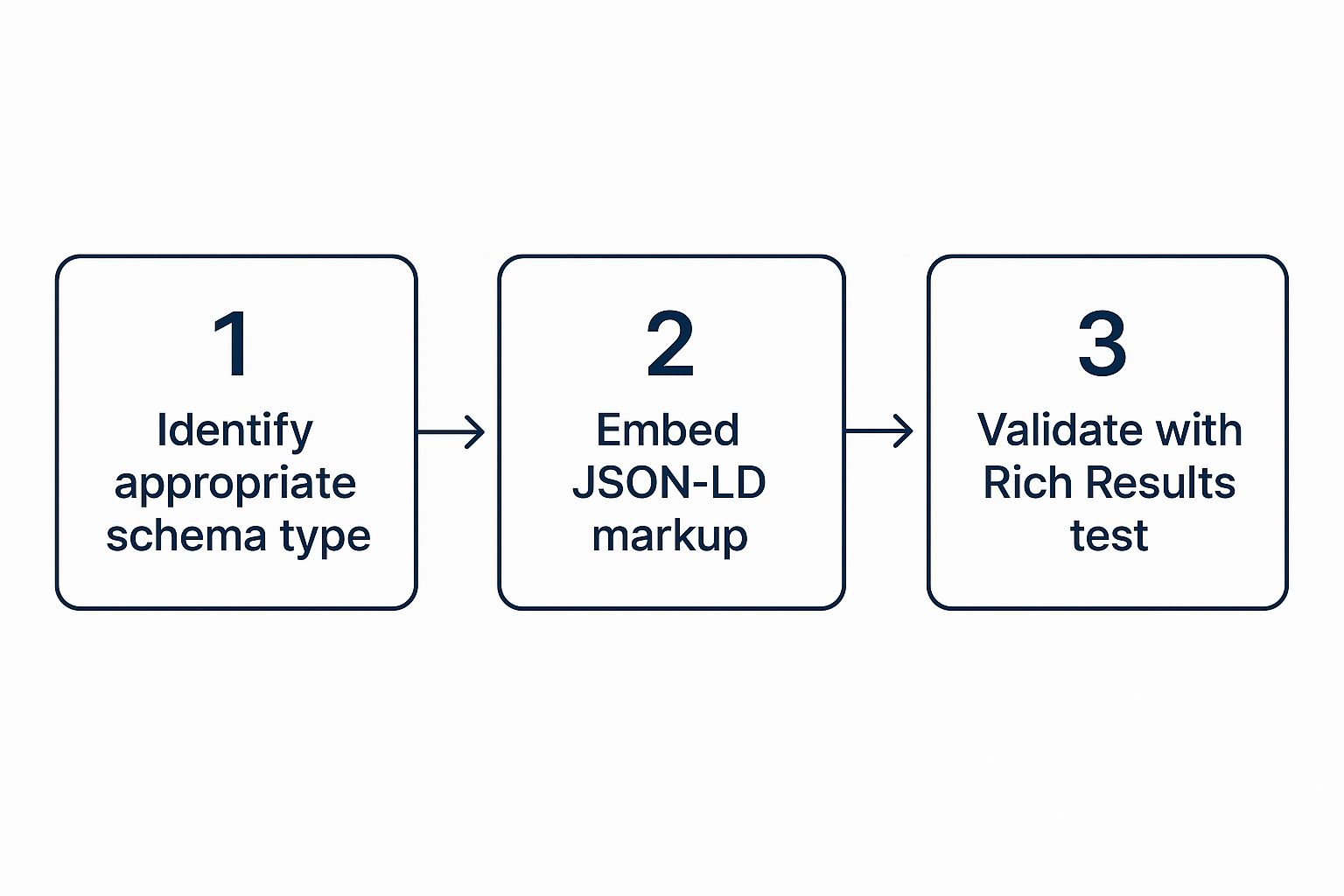
This workflow ensures your product information is machine-readable, making it eligible for rich results in search and easily digestible for AI shopping agents.
By combining persuasive, human-centric content with a technically sound, AI-compatible structure, you create product pages that perform today and are built for tomorrow. This dual focus is the core of a successful SEO strategy that drives real, scalable results.
Prepare for Visual Search with AI Image Optimisation
In retail sectors like fashion, furniture, and electronics, product images are more than just digital assets, they are your front-line salespeople. But traditional image optimisation, limited to basic alt tags and file compression, is just scratching the surface. The real opportunity for Australian retailers is to get ready for the future of visual and agentic search, where AI agents will depend on rich image data to find and recommend your products.
This shift demands a much smarter approach. AI-powered image recognition can scan your entire catalogue at scale, automatically writing highly descriptive, keyword-rich alt text and file names. This goes far beyond generic descriptions, capturing the specific, searchable details that drive both accessibility and organic search visibility, especially for pharmacy ecommerce SEO or beauty & cosmetics SEO.

Moving Beyond Alt Tags with AI Image Tagging
The true power of AI SEO here lies in its ability to perform detailed product image tagging. An AI agent can look at a photo of a dress and instantly identify attributes like 'v-neck', 'floral print', and 'A-line silhouette'. For a piece of furniture, it might recognise a 'mahogany finish', 'brass hardware', and 'mid-century modern design'.
Suddenly, a simple image becomes a goldmine of structured data. These granular tags can then be used to:
- Supercharge Faceted Navigation: Let shoppers filter products with incredible precision, massively improving their experience and your conversion rates.
- Capture High-Intent Long-Tail Traffic: Start ranking for very specific queries like "women's black leather ankle boots with side zip," which almost always come from shoppers ready to buy.
- Sharpen Your Internal Search: Make your on-site search engine smarter and more accurate, helping customers find exactly what they are looking for, fast.
This level of detail is a game-changer for fashion product image SEO and furniture image tagging SEO, where visual attributes are the main driver behind a customer's purchasing decision.
Preparing for an Agentic Commerce Future
The rise of agentic shopping and similar platforms is completely changing how product discovery works. AI agents in ecommerce act like personal shoppers, taking a user's request, "Find me a waterproof jacket with a hood and at least three pockets under $200", and scanning the web for products that fit the bill.
If your product data is not structured and detailed, AI agents will simply ignore your products. AI image recognition SEO and tagging are no longer optional; they are essential for ensuring your catalogue is compatible with this new agentic shopping world.
This is the core of agentic search optimisation. The rich, structured data pulled from your images gives AI agents the exact details they need to make confident recommendations. Without it, your products are invisible in this fast-emerging channel.
The Scalable Advantage of AI Workflows
Let's be realistic, manually tagging thousands of product images is an impossible task for any retail team. It is a classic retail content bottleneck that leaves a huge amount of SEO value on the table. This is where AI workflow automation for retail becomes a necessity, not a luxury.
An automated system can process an entire product catalogue in hours, applying consistent, accurate tags to every single image. This marks a massive leap from old-school SEO teams to a more effective human + AI collaboration in SEO. The AI handles the repetitive, data-heavy lifting, freeing up your team for strategic oversight and quality control.
Of course, to truly win at visual search, mastering the input is just as crucial as optimising the output. For retailers wanting to generate unique visuals, learning about creating stunning digital product images using AI generators is the next step to standing out from the crowd.
By adopting AI-powered image optimisation, you're not just tweaking your current SEO. You are fundamentally future-proofing your business, ensuring your products are seen, understood, and recommended in an increasingly AI-driven retail world.
Structure Your Data for Agentic Commerce
Think of technical SEO as the invisible architecture holding up your entire digital shelf. It is no longer just about clean code and fast load times. Now, it is about making your product pages perfectly machine-readable for the next wave of search.
Agentic commerce, which is driven by AI assistants like Google�s AI Overviews and Amazon's Rufus, is completely dependent on structured data to even function.
Without it, your products are essentially invisible to these powerful new discovery tools. This makes structured data, specifically schema markup, a non-negotiable part of modern ecommerce product page SEO. This is not just a best practice anymore; it is the very foundation of agentic search optimisation.
The idea is simple, you explicitly tell search engines and AI agents what every element on your page means. This product�s name is X, its price is Y, and its average customer rating is Z. This simple act removes all guesswork, letting them instantly parse and compare your products against competitors.
Making Your Content AI-Compatible with Schema
Schema markup is the vocabulary that search engines and AI agents understand. For any retail leader, three types are absolutely essential for every single product page. Getting them right ensures your content is perfectly AI-compatible and ready for the future of retail search.
- Product Schema: This is the most critical one. It details the product's name, description, brand, SKU, and GTIN.
- Offer Schema: This communicates the price, currency, availability (like in stock or out of stock), and any sales conditions.
- Review Schema: This markup highlights aggregate ratings and individual customer reviews, providing the social proof that both AI agents and human shoppers rely on.
Correctly implementing this trio of schema types is your ticket to entry for agentic commerce. It's how you make sure that when an AI agent is asked to find "the best-rated black leather jacket available for under $500," your products are actually in the running.
Now, manually adding this code to thousands of product pages is a soul-crushing, inefficient task that creates a massive bottleneck. This is where AI-powered content workflows become a game-changer.
An automated system can generate and deploy perfectly formatted schema across your entire product catalogue. This ensures technical excellence and 100% coverage without the manual slog. This kind of SEO at scale for retailers is not a luxury anymore; it is a necessity for survival.
Automating Technical Excellence at Scale
Implementing structured data correctly is crucial, but making even small errors can completely negate its benefits. When you are structuring your data, it is vital to understand and fix common schema markup issues and how to fix them. These problems, from incorrect nesting to missing properties, can make your data unreadable to the very search engines you are trying to communicate with.
Automated workflows help prevent these errors by using validated templates, ensuring every single page is marked up consistently and correctly. This is all part of a bigger shift toward retail SEO automation that frees up teams to focus on strategy instead of manual coding. An approach like this, focusing on metadata optimisation at scale, is a core pillar of any modern, scalable SEO solution.
This focus on structured data lines up perfectly with broader market trends in Australia. Local and long-tail SEO strategies are becoming more important as consumers search for niche products. The projected Australian ecommerce SEO spend is set to hit $1.5 billion in 2025, a 12% increase from previous years. A major chunk of that will go towards optimising product pages with detailed, unique descriptions that structured data can effectively communicate.
Ultimately, structuring your data is not just about appeasing an algorithm. It is about building a robust, future-proof foundation for your digital shelf, one that serves both today's search engines and tomorrow's AI agents to drive better visibility and conversions.
Look Beyond Product Pages to Category Optimisation

Fixating only on individual product pages is one of the most common mistakes in retail SEO, and it leaves a huge amount of traffic on the table. While SKU-level optimisation is essential, a truly effective ecommerce product page SEO strategy treats category pages as powerful engines for attracting top-of-funnel shoppers.
Too often, category pages are seen as just simple navigational hubs. But their potential is so much greater. They are perfectly positioned to capture shoppers who know what they want in general but have not zeroed in on a specific product yet. This is where you rank for those broader, high-volume keywords like 'summer dresses' or 'leather ankle boots' and bring new customers into your ecosystem. This approach is vital for sectors like grocery retail SEO and electronics SEO optimisation.
Research from Australia's top ecommerce sites backs this up. A recent analysis found that category pages are now massively outperforming product pages, averaging 19% more ranking keywords and attracting a staggering 413% more organic traffic. This is not a fluke; it is a direct reflection of how people actually search and browse. You can dig into the full research on category pages dominating product pages in Google.
Structuring Category Pages for Maximum Impact
To turn your category pages into SEO powerhouses, you need to treat them like the valuable landing pages they are. That means enriching them with unique, helpful content that moves them beyond a simple grid of products. Google rewards resources, not just product lists.
A well-structured category page should include:
- Compelling Introductory Content: Start with a short, engaging paragraph at the top. Introduce the category, naturally weave in your primary and secondary keywords, and guide the user on what they will find.
- Smart Internal Linking: Use that intro copy to link to key subcategories or even your best-selling products. This is a brilliant way to funnel authority and users deeper into your site.
- Faceted Navigation: Let people filter by attributes like size, colour, brand, or style. Not only does this massively improve the user experience, but it also creates indexable URLs that can capture all sorts of valuable long-tail search traffic.
By building out your category pages with thoughtful content and structure, you create a far more robust site architecture. This helps search engines understand the relationships between your products, improves how they crawl your site, and spreads link equity more effectively across your entire digital shelf.
This holistic approach aligns your SEO efforts with real-world user behaviour. It creates a complete strategy that improves your search visibility and attracts more qualified buyers at every stage of their journey. As you refine your content, it is also crucial to understand the critical impact of Google's March 2024 Core Update on site visibility. By balancing strong SKU-level SEO with optimised category pages, you build a resilient strategy that can weather algorithm changes and drive sustainable growth.
Common Questions About AI in Ecommerce SEO
When retail leaders start thinking about shifting from old-school manual SEO to AI-powered workflows, a few valid questions always come up. The big one is usually about brand voice. Can automation really capture our unique tone, or are we just going to end up with thousands of generic, robotic-sounding product descriptions?
It is a fair concern, but modern AI SEO services are built to solve exactly this problem. By feeding the generative AI for retail teams sophisticated style guides and brand voice models, it can generate unique product descriptions that feel like they were written by your in-house team. This is where the human + AI collaboration in SEO really shines, your team sets the strategic direction, and the AI executes it perfectly at scale, with human-led AI content QA to ensure quality.
Another common question is about fixing duplicated supplier content. How can an AI reliably rewrite all those descriptions without messing things up or introducing errors?
Ensuring Content Quality and Uniqueness
The answer is in advanced AI-powered content workflows. These systems do not just spin content. They ingest your raw supplier feeds, compare every single description against a massive index of online content to spot duplicates, and then systematically rewrite and enrich them. It is a process that is far more efficient and consistent than asking a human to do it manually. This is a core part of ecommerce content quality assurance.
The goal here is not just to dodge a Google penalty; it is to turn a weakness into a major strength. By automating the creation of unique, structured content, you are building a solid foundation for better digital shelf performance and getting your catalogue ready for the future of agentic commerce.
Finally, ecommerce managers always want to know about the real ROI. What is the payback? It really comes down to three things: speed, scale, and future-readiness. An automated approach gets rid of retail content bottlenecks, which means you can get products to market faster. It also creates AI-compatible content that boosts your visibility in new search channels. If you want to dig deeper, you can learn about how artificial intelligence is shaping search strategies.
Ready to eliminate content bottlenecks and prepare your digital shelf for the future of search? At Optidan AI, we transform your supplier feeds into high-performing, unique product content at scale. https://optidan.com
