
A content management system (CMS) is the central command centre for your entire digital storefront. It�s the platform that gives your marketing, ecommerce, and content teams the power to create, manage, and publish everything from product pages to marketing campaigns, all without needing to write a single line of code. For an Australian retailer, a modern CMS is the absolute foundation for achieving SEO at scale and staying competitive.
Understanding The Core Of Retail Content Management
Think of a CMS as the digital version of a retail store's back-of-house operations. It�s where you organise inventory on the shelves, prepare eye-catching displays, and manage all the information that customers will eventually see out on the floor. Without it, managing a website with thousands of products would mean manually editing code for every single change. That�s an impossible task for any growing ecommerce business.
A modern CMS is designed to break through these retail content bottlenecks. It provides a structured environment where even non-technical users can perform complex tasks, from updating product descriptions to launching promotional banners. This is especially critical for retailers looking to move from manual SEO to AI SEO, as the CMS becomes the engine for deploying automated content workflows and optimising thousands of pages in days, not months.
From Simple Websites to Complex Ecommerce Engines
In the early days, content management systems were basic tools for publishing articles and blog posts. But for today's retailers, they�ve evolved into sophisticated platforms that plug into every part of the business. They connect to product information management (PIM) systems, digital asset management (DAM) tools, and enterprise resource planning (ERP) software to create a single source of truth.
This integration is vital for several key retail functions:
- Correcting Duplicated Supplier Content: A CMS can flag and help rewrite those generic supplier descriptions, helping you build a unique brand voice and avoid crippling SEO penalties.
- Product Data Enrichment: It acts as the workbench for turning basic supplier feeds into richly detailed, optimised product pages that improve your digital shelf performance.
- AI-Powered Optimisation: The best systems now incorporate AI agents for retail efficiency, automating tasks like image recognition and tagging for fashion or furniture and generating unique product descriptions.
To get the most out of a CMS, you first need to recognise its core role in organising and delivering content. This aligns with the fundamental principles of effective best practices for knowledge management. This structured approach is essential for any retailer wanting to create a seamless customer experience and prepare for the future of agentic commerce. You can learn more about how this applies to your product data in our detailed guide to product feed management.
The adoption of these systems is growing at a blistering pace. The Australian content management software market generated approximately USD 606.2 million and is projected to more than double to USD 1,349.7 million by 2030, reflecting a strong compound annual growth rate of 14.3%. You can read the full research on the Australian CMS market growth.
This growth isn't just a statistic; it shows just how critical a strategic CMS has become for local retailers aiming for scalable SEO solutions and genuine market leadership.
The Two Halves of a Modern Retail CMS
To really get your head around how a content management system works in modern retail, it helps to think of it as two distinct parts working together perfectly. Imagine you have a digital warehouse and a digital shopfront. Both are critical to your business, but they serve completely different purposes.
This separation is the key to unlocking scalable SEO and getting your business ready for the future of retail search.
The Content Management Application (CMA): Your Digital Warehouse
First up is the Content Management Application (CMA). This is your back-end warehouse, the secure area where your team does all the heavy lifting. Think of it as the engine room for all your content, completely invisible to your customers.
Inside the CMA, your teams create, organise, and prepare every single piece of content. This is where you get to grips with the big retail challenges. It's where the shift from slow, manual SEO to smart, AI SEO really begins. The CMA is a workspace designed for efficiency, letting your teams manage huge amounts of product information without needing to write a single line of code.
Here�s a taste of what happens in the CMA:
- Fixing Duplicated Supplier Content: Your team can finally ditch those generic, uninspired product descriptions from supplier feeds. They can rewrite them to build a unique brand voice that stands out and avoids damaging SEO penalties.
- Enriching Product Data: This is where basic product info becomes compelling sales content. Teams add rich specifications, lifestyle details, and structured data, transforming a simple supplier feed into an optimised product catalogue.
- Automating with AI: A modern CMA brings in AI to handle the grunt work. For example, AI image recognition can automatically generate optimised alt tags for thousands of fashion or furniture items.
By structuring all your content neatly within the CMA, you create a single source of truth that�s perfectly organised for both human shoppers and the AI agents powering modern search. Getting this right is foundational to improving your performance on the digital shelf.
The Content Delivery Application (CDA): Your Digital Shopfront
The second half of the system is the Content Delivery Application (CDA). If the CMA is your warehouse, the CDA is your beautifully designed, customer-facing shopfront.
The CDA�s only job is to take the perfectly structured content from the CMA and present it to your customers. It�s the public part of your website that delivers a fast, seamless, and engaging shopping experience.
This application grabs the approved content and displays it across any channel you need, whether it�s your main ecommerce website, a mobile app, or even an in-store kiosk. For retailers, this two-part structure is a game-changer. It allows you to learn more about using generative AI to scale your content library and achieve SEO at a scale you never thought possible.
This setup lets your technical teams focus on the performance and security of the shopfront (the CDA), while your content and marketing teams work on optimising product information in the warehouse (the CMA). It�s this blend of human + AI collaboration in SEO that�s essential for any retailer looking to thrive.
Essential Features for Ecommerce Success

A modern CMS built for retail does a lot more than just publish blog posts. It�s packed with specific tools designed to solve the real-world headaches that Australian ecommerce leaders face every day. Getting a handle on these features is the key to mastering your digital shelf performance and shifting from slow, manual SEO to a smarter, AI SEO approach.
These aren�t just nice-to-haves; they transform a CMS from a simple website editor into the command centre for your entire retail operation. They are the bedrock for building scalable SEO solutions that can manage thousands of product pages with speed and accuracy.
Core Collaboration and Control Features
When you have a large retail team, figuring out who can edit what is crucial. It prevents costly mistakes and keeps your brand looking consistent across the board. A good CMS gives you fine-grained control over user access, so everyone from copywriters to merchandising managers has exactly the permissions they need.
Essential collaboration features look like this:
- User Roles and Permissions: You can assign specific roles to team members, blocking them from changing critical pages or functions. This is how you build a secure automated content workflow that prevents accidents.
- Version Control and History: Every single change to a product page or category description is tracked. If someone makes a mistake and publishes it, you can instantly roll back to an older version. It�s a lifesaver for protecting your site and your SEO rankings.
- Workflow and Approval Queues: Set up a clear process for creating, reviewing, and publishing content. This makes sure every piece of copy gets a final check before it goes live, which is vital for maintaining ecommerce content quality assurance.
AI Workflow Automation and Integration
The real magic of a next-gen SEO for retailers platform is its ability to connect with your other systems and automate tedious jobs. This is where you find massive efficiencies and the power to optimise your entire catalogue at scale.
Think of a CMS with a strong API (Application Programming Interface) as a central hub. It plugs into your Product Information Management (PIM) system, your Enterprise Resource Planning (ERP), and your inventory software. This creates a smooth, automated flow of data that keeps your entire ecommerce ecosystem in sync.
This deep integration lays the groundwork for advanced AI workflow automation for retail. For example, the CMS can pull raw product feeds from your suppliers and immediately use its built-in AI to start the product data enrichment process. This means automatically fixing duplicated supplier content, writing unique descriptions, and optimising everything for SKU-level SEO.
The demand for this kind of sophisticated data management is exploding. In Australia, the Enterprise Content Management market, a slice of the CMS world focused on digital assets, is expected to jump from USD 563.3 million to nearly USD 1,500 million by 2030. That�s a massive compound annual growth rate of 18.2%.
Advanced SEO and Content Optimisation Tools
A CMS designed for retail goes way beyond a simple field for meta tags. It comes loaded with tools built specifically for ecommerce SEO automation and improving how you show up on the digital shelf. For retailers, great visuals are everything. Using innovative AI product photography techniques can make your products pop, and the CMS is what helps you manage all those assets efficiently.
Modern systems also bring features like AI image recognition and tagging to the table, which is a game-changer for categories like fashion and furniture. This tech can analyse a photo and automatically generate descriptive alt tags and metadata, a task that would take a human hundreds of hours to do manually. By putting these retail efficiency tools to work, your CMS becomes a powerhouse for creating AI-compatible SEO content that's prepared for the future of agentic search. For more on this, check out our guide on top optimisation techniques for digital shelf performance.
Headless vs Traditional CMS Architectures
Picking a CMS architecture is one of the biggest strategic calls a retail leader can make. It�s a decision that directly shapes your ability to scale, jump on new sales channels, and get ready for the future of work in retail. The two main models out there, traditional and headless, offer completely different ways of managing your digital shelf.
A traditional CMS is the all-in-one package. Think of it like a standard shop fit-out, where the stockroom (the back-end) and the shop floor (the front-end) are bolted together in a single, inseparable structure. This tight coupling is often simple to get started with, but it can quickly become rigid and hold your business back as you grow.
A headless CMS, on the other hand, completely separates the back-end content �warehouse� from the front-end �shopfront�. This is a genuine game-changer for multi-channel product optimisation. It means you can craft a single piece of rich product content and push it out, perfectly formatted, to your website, a mobile app, an in-store kiosk, or even an AI shopping agent.
The Traditional Approach: A Tightly Coupled System
Traditional platforms like WordPress or older versions of Magento bundle everything together: the content database, admin tools, and the customer-facing website design all live in one monolithic system. For smaller operations, this integration can make the initial setup and day-to-day management feel straightforward.
But that simplicity comes with a hefty price tag. Trying to customise the front-end often involves complex workarounds that can break the whole system. Pushing content to new channels the platform wasn't built for, like a new social media app or a voice assistant, is painfully difficult. For any retailer who needs to move fast, this model creates huge content bottlenecks and seriously hinders SEO at scale.
This infographic breaks down different CMS models, showing how things like cost and customisation change between open-source, proprietary, and SaaS solutions.
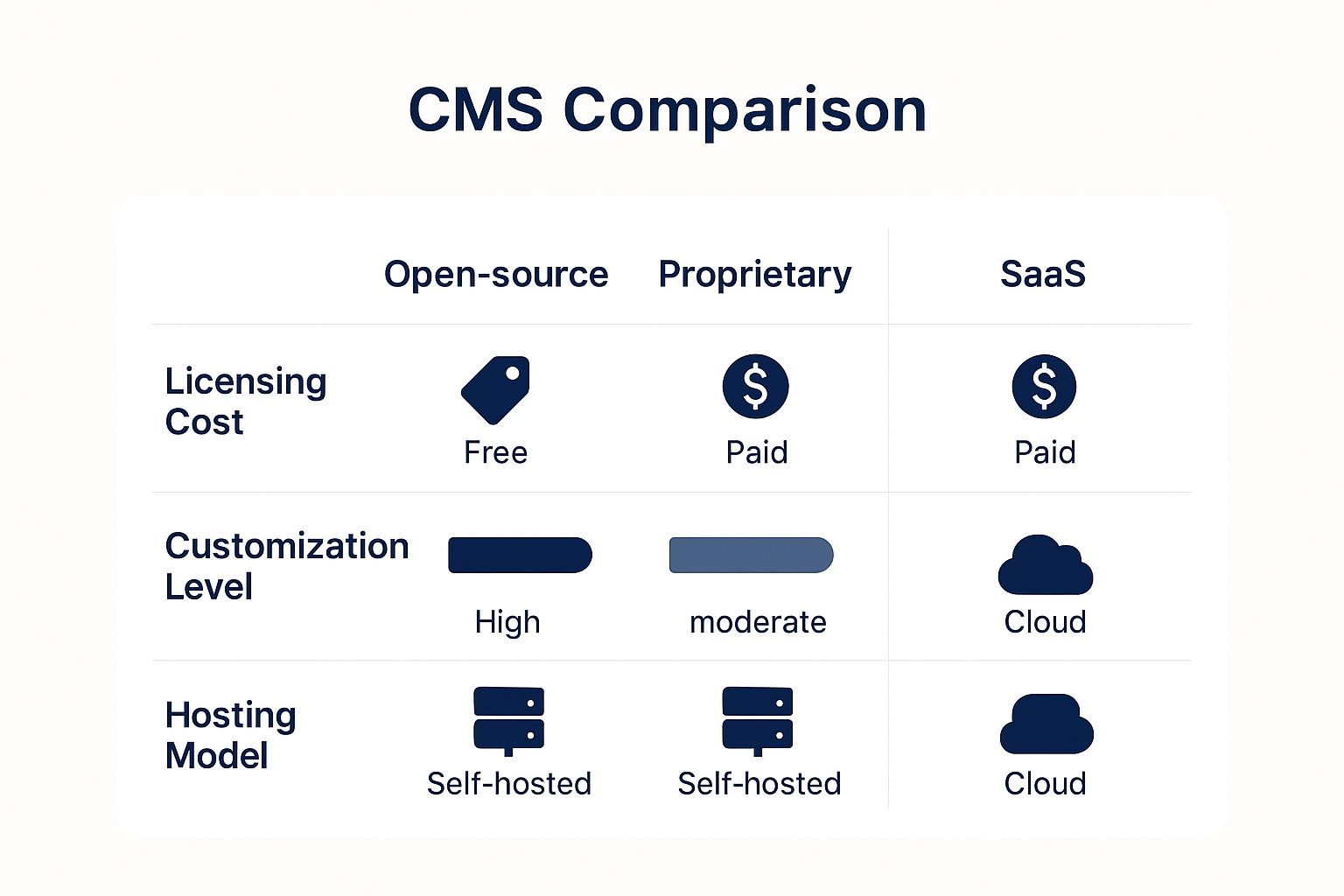
You can see a clear trade-off. More customisation often means self-hosting and higher development costs, which is a massive consideration when you're weighing up traditional versus headless.
The Headless Advantage: Flexibility for Agentic Commerce
A headless CMS works on a totally different principle. Its only job is to be the best content repository it can possibly be, handling everything from product data enrichment to unique descriptions. It then uses an API to deliver that content to any front-end you can dream up.
This API-first approach is the key to agentic search optimisation. As AI agents in ecommerce like ChatGPT, Perplexity, and Amazon's Rufus become the new front door for shoppers, your content has to be structured and easy for them to access. A headless CMS is built for this, serving up clean, AI-ready SEO content that can be pulled into any conversational interface.
This flexibility is absolutely critical for the future of agentic commerce. It lets your brand show up consistently and perfectly optimised wherever your customers are, whether that's a standard website or an AI-powered conversation.
Think about retailers in fashion, furniture, or electronics. A headless architecture unlocks powerful, automated content workflows. AI image recognition and tagging can enrich product data on the back-end, and that optimised data can be instantly fired out across all your digital touchpoints, from your mobile app to third-party marketplaces.
Traditional CMS vs Headless CMS for Retailers
To make the choice clearer, let's look at how these two architectures stack up for modern ecommerce. The differences in flexibility, scalability, and future-readiness are stark.
| Feature | Traditional CMS | Headless CMS |
|---|---|---|
| Architecture | Tightly coupled (front-end and back-end combined) | Decoupled (front-end and back-end are separate) |
| Flexibility | Limited to predefined templates and themes | Highly flexible; use any front-end technology |
| Multi-channel | Difficult; often requires plugins or custom workarounds | Native support; push content anywhere via API |
| Performance | Can be slower due to the monolithic structure | Faster, lighter front-ends deliver better performance |
| Developer Experience | Restrictive; developers work within the CMS framework | Freedom to use modern tools and frameworks |
| Future-Proofing | Can become outdated as new channels emerge | Adapts easily to new technologies like AI agents |
Ultimately, the choice depends on your long-term vision. A traditional CMS might feel easier today, but a headless architecture gives you the freedom to build for tomorrow.
This separation also creates a much more efficient workflow between your teams. Your content specialists can focus on fixing duplicated supplier content and writing high-quality descriptions in the CMS. Meanwhile, your developers are free to build fast, modern shopping experiences on the front-end without being held back. It's a core part of moving from manual SEO to AI SEO.
The ability to manage content through APIs is also becoming essential for working with modern retail platforms. You can learn more about how this works in our article on the Shopify Catalog API and AI agents. This approach future-proofs your content automation and makes sure your brand is ready for the agentic shopping revolution.
Powering AI SEO with a Strategic CMS
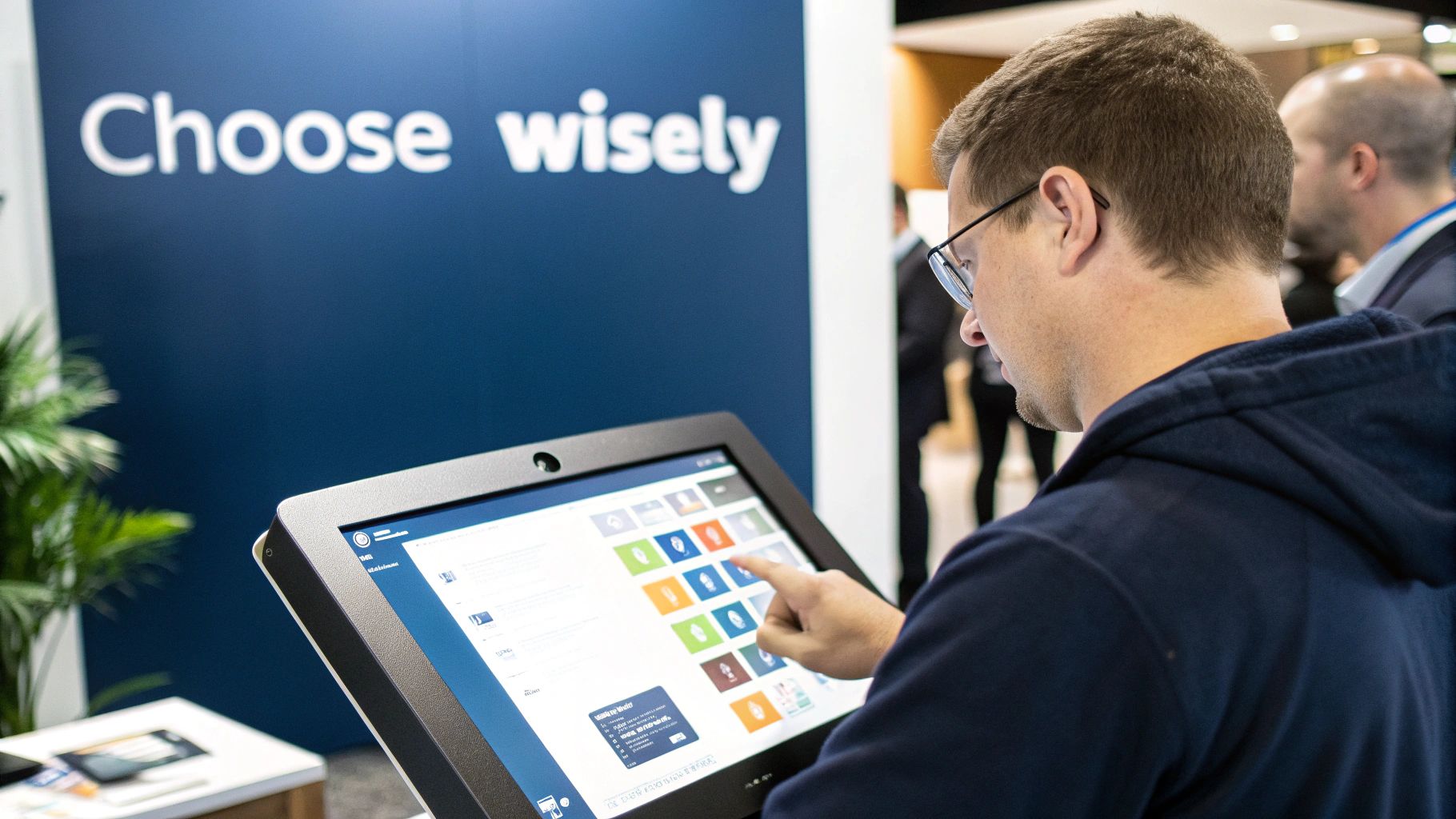
A modern content management system is much more than a digital filing cabinet. For forward-thinking Australian retailers, it�s the engine driving a next-generation AI SEO strategy. It moves your operations from tedious manual updates to automated, scalable optimisation where you can finally compete on the digital shelf.
A strategic CMS becomes the launchpad for your AI-powered retail transformation. It provides the infrastructure needed to connect different data sources, automate repetitive content jobs, and deploy smart workflows that boost visibility and sales. It�s the difference between hitting content bottlenecks and achieving genuine retail efficiency at scale.
From Supplier Feeds to Optimised Experiences
One of the biggest hurdles for any large retailer is wrestling with raw supplier data. These feeds are often thin, generic, and full of duplicated content that can absolutely tank your search rankings. But a powerful CMS equipped with AI can flip this problem into an opportunity.
Imagine turning thousands of basic, duplicated supplier feeds into unique, structured, and compelling product pages. This is the heart of modern product data enrichment.
- Automating Product Descriptions: AI agents built into the CMS can rewrite generic supplier descriptions, creating unique, on-brand copy that speaks to your customers and keeps search engines happy.
- Structured Data Generation: The system can automatically structure product details, specs, and features so they�re easily understood by AI shopping SEO agents like Google's AI Overviews and Amazon Rufus.
- SKU-Level SEO: By automating these processes, you can achieve granular, SKU-level SEO across your entire catalogue, a task that�s simply impossible to manage by hand.
This automated process ensures every product page is an asset, not a liability. It�s a foundational step in getting your business ready for the future of agentic search optimisation, where AI assistants do the shopping on behalf of consumers.
The crucial shift is from manually fixing problems to proactively building optimised content from the ground up. Your CMS becomes the assembly line for high-performance product pages, ready to capture traffic from both traditional search and emerging AI-driven platforms.
Activating AI Workflows for Retail
Beyond just text, visual content is a critical battleground for retailers in categories like fashion SEO optimisation and furniture SEO services. An advanced CMS with integrated AI image recognition and tagging creates a massive competitive advantage.
Instead of manually writing alt tags for thousands of images, the system can analyse a photo and automatically generate descriptive, keyword-rich metadata. A picture of a leather armchair is no longer just an image file; it's tagged with attributes like "brown leather," "mid-century modern," and "solid wood legs," boosting its visibility in image search and improving accessibility. You can find out more about the next evolution of search in our detailed guide to AI for SEO.
This is AI workflow automation for retail in action. It plugs directly into your digital shelf performance by making sure every element of your product page is optimised. This includes metadata, image tags, and internal linking structures, all managed and automated within a single system. This level of automation is driving huge growth. Globally, the content management system market was valued at around USD 47.4 billion and is expected to more than double to USD 117.5 billion by 2032. You can learn more about these global CMS market trends and their impact. For Australian retailers, adopting this technology isn't just an option, it's essential for future-proofing your business.
How to Choose the Right CMS for Your Business
Picking a content management system isn't just a technical task; it's a strategic decision that will shape the future of your retail operation. Forget simple feature lists for a moment. You're choosing a partner for growth, one that can handle your unique challenges today and get you ready for what�s coming next in retail search.
This choice is the very cornerstone of your digital strategy. It dictates your ability to achieve SEO at scale, your readiness for the future of agentic commerce, and whether your team is stuck doing manual tasks or freed up to work on high-impact projects. The wrong choice creates content bottlenecks. The right one fuels real retail efficiency and growth.
Scalability and Your SKU Count
The first make-or-break test for any potential CMS is its ability to scale. If you're a retailer managing tens of thousands of SKUs, a system that grinds to a halt under pressure is a complete non-starter. You need a platform built from the ground up to handle a massive product catalogue without sacrificing speed or performance.
Think about your growth plans over the next five years. Will this CMS support you if you double or triple your product lines, especially in complex categories like fashion or electronics? Answering this question is what separates genuine enterprise-grade solutions from the simpler platforms that quickly run out of steam.
Integration and AI Readiness
Your CMS doesn't exist in a bubble. It must connect seamlessly with your existing tech stack, from your PIM and ERP to your DAM system. A robust API isn't a nice-to-have; it's non-negotiable. It's what enables the automated content workflows so critical for optimising product feeds efficiently.
But it�s about more than just basic connections. You need to scrutinise the platform's readiness for an AI-powered retail transformation. A future-proof CMS should be built for human and AI collaboration, with built-in features or easy integrations for tools that handle:
- Product Data Enrichment: Taking thin supplier feeds and turning them into fully optimised product content.
- AI Image Recognition and Tagging: Automating the metadata for all your visual assets.
- Automating Product Descriptions: Fixing supplier content duplication across thousands of products at scale.
Your CMS should be the engine for ecommerce SEO automation, not a barrier to it. If a platform can't show you a clear path to integrating AI agents for retail efficiency into its workflows, it's already falling behind.
A Practical Vendor Checklist
When you're weighing up your options, a detailed comparison of Shopify and WooCommerce platforms can be a great starting point. But as you start talking to vendors, you need to push past the sales pitch and ask sharp questions that reveal what their platform can truly do for a modern retailer.
Here�s a checklist to guide those conversations:
- SKU-Level SEO: How does your platform handle SKU-level SEO across a catalogue of over 10,000 products? Can it truly automate metadata optimisation at scale?
- AI Workflows: Can you show us a real-world demo of how your CMS powers AI workflows for ecommerce? We want to see how it tackles product feed optimisation and unique description generation.
- Agentic Search: How is your platform preparing for agentic search optimisation? What features are in place to ensure our content is structured and ready for SEO for AI agents like ChatGPT and Rufus?
- Team Efficiency: How does your system eliminate retail content bottlenecks for large retail teams? Show us the specific workflow and approval tools designed for human-led AI content QA.
Choosing the right CMS comes down to aligning the technology with your long-term vision. It's a direct investment in your brand's ability to compete and win on the digital shelf, not just today, but in the future of retail.
Frequently Asked Questions
Got questions about content management systems? You're not alone. Here are some of the most common things we hear from retail leaders, with straightforward answers to help clear things up.
How Is a CMS Different From a PIM or DAM?
It helps to think of these systems as a specialist team working together. Each one has a distinct job to do.
The Content Management System (CMS) is your digital shopfront. It manages everything your customers see and interact with on your website, from the homepage banner to the blog posts.
Your Product Information Management (PIM) system is the single source of truth for all your product data. It�s the central library holding every SKU, attribute, and technical spec in a clean, organised way.
And the Digital Asset Management (DAM) system? That�s your media hub. It�s where you store, organise, and tag all your product images, videos, and brand creative.
A modern AI workflow automation strategy gets these three systems talking to each other. The DAM feeds images to the PIM, the PIM enriches the product data, and the CMS pulls it all together to create a compelling customer experience on the digital shelf.
What Is the First Step to Migrating to a New CMS?
Before you even start window shopping for new platforms, your first move should always be strategic planning. Too many retailers jump straight to demos without knowing what they actually need.
Start with a full content audit. Go through every page on your site and decide what�s worth keeping, what needs a rewrite, and what you can get rid of entirely.
Once you know what content you�re working with, define your business and technical requirements. But don�t just think about today, plan for the future. What will you need in two or three years? This is where you should be thinking about things like agentic search optimisation.
Finally, create a detailed migration plan. This isn't just a technical checklist; it needs to include clear safeguards to protect your hard-earned SEO rankings during the move.
Can a CMS Actually Fix Supplier Content Duplication?
Yes, absolutely. In fact, this is one of the biggest wins you'll get from a modern CMS, especially one that's plugged into AI.
A smart system can automatically flag duplicated content that's been pulled in from generic supplier feeds, the kind of copy that�s hurting your SEO because it�s identical to what dozens of other retailers are using.
But it doesn�t stop there. Once identified, it can trigger automated content workflows to rewrite thousands of product descriptions. This process turns bland, duplicated text into unique, on-brand copy that search engines love. This kind of product data enrichment at scale is how you turn a massive retail headache into a real competitive advantage.
Take control of your digital shelf and eliminate content bottlenecks with Optidan AI. Discover how our AI-powered platform can automate your retail content strategy and drive scalable SEO results. Start optimising today.
