


Why Content Is Now Infrastructure for Modern Retail
For the last decade, ecommerce teams have treated product content as an output.
Something generated late in the process, often sourced from suppliers, lightly edited, and pushed live once inventory arrives.
That model is breaking.
In 2026, discovery no longer starts on category pages alone. It starts inside AI agents, conversational search, social platforms, marketplaces, and recommendation engines that never see your homepage.
- This shift is forcing a rethink.
- Product content is no longer a by-product of commerce.
- It is the infrastructure that powers it.
Welcome to the transition from product feed management to agentic commerce.
The limits of traditional product feed management
Product feed management solved a real problem.
Retailers needed a way to distribute product data across Google Shopping, Meta, marketplaces, and affiliates.
But feeds were designed for machines, not intelligence.
They focus on:
- Titles
- Prices
- Availability
- Basic attributes
What they do not solve is meaning.
Feeds do not explain:
- Who a product is for
- How it should be used
- Why it exists within a brand ecosystem
- How it compares
- What problem it solves
As long as discovery was keyword-led and transactional, that gap was survivable.
Agentic discovery changes that completely.
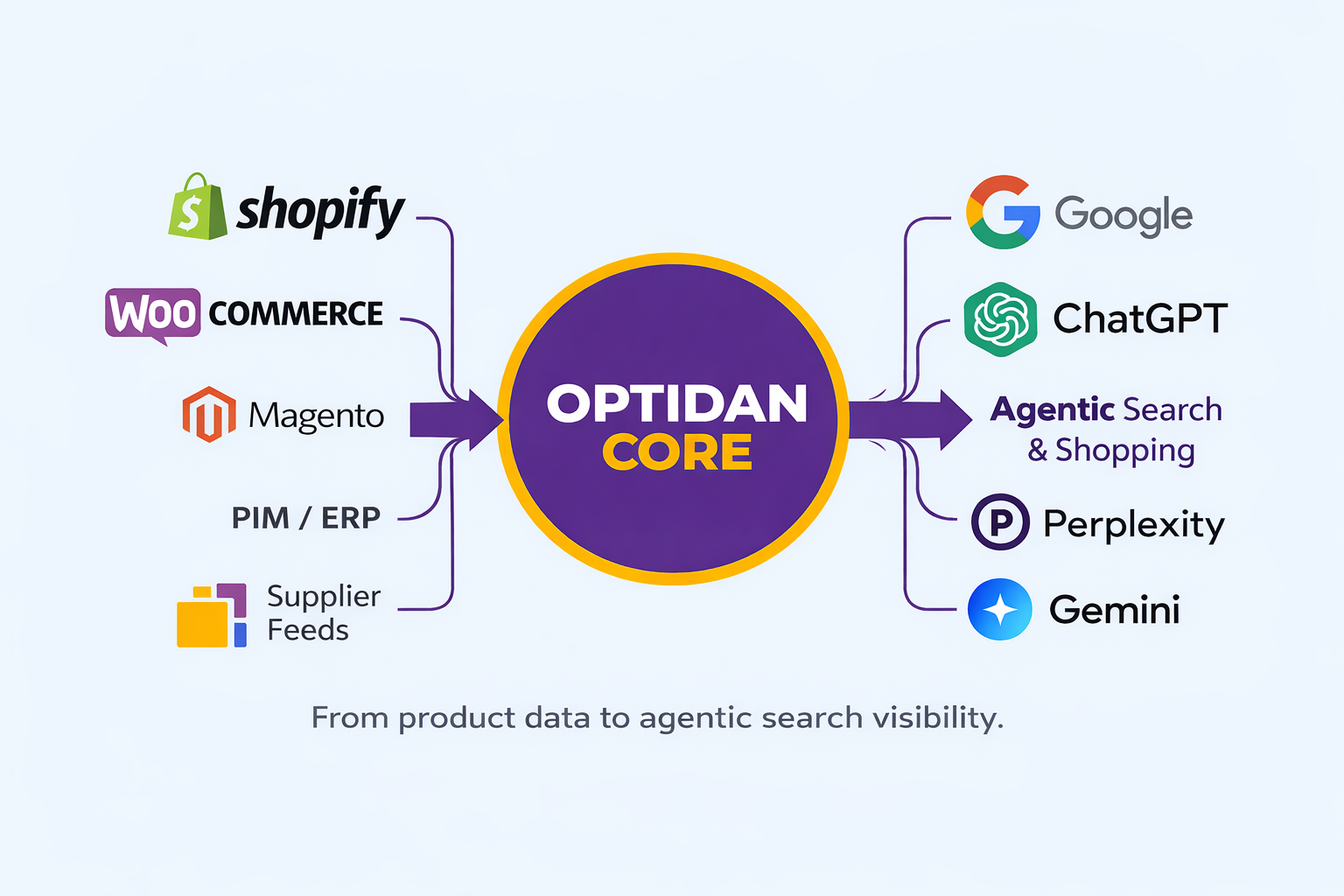
What agentic commerce changes
Agentic commerce introduces a new layer between retailers and shoppers.
AI agents now:
- Interpret intent
- Compare options
- Synthesize product information
- Recommend without showing traditional SERPs
These agents do not browse your site like a human.
They ingest structured and unstructured content, connect context, and make decisions on the shopper’s behalf.
If your content is:
- Thin
- Inconsistent
- Supplier-led
- Missing key attributes
You simply do not exist in the decision set.
This is not an SEO problem.
It is an infrastructure problem.
Content is now infrastructure
Modern retail content must do more than rank.
It must:
- Power product pages
- Inform category and brand pages
- Feed AI agents
- Support social and editorial outputs
- Scale operationally without manual effort
That requires a shift in mindset.
Content is no longer something teams “write.”
It is something teams build systems around.
When content becomes infrastructure, it:
- Starts earlier in the lifecycle
- Is created before inventory arrives
- Is enriched continuously
- Feeds every downstream channel
This is where most retailers struggle.

The hidden operational problem retailers face
Across hundreds of retailers analysed, the same issues repeat:
- Supplier data is incomplete or inconsistent
- Ingredients, warnings, usage notes, and specifications are missing
- Product descriptions are duplicated across competitors
- Brand and category pages are thin or generic
- Content creation becomes the bottleneck to launch speed
In one industry study analysing content from over 800 online retailers, more than 40 percent of product content showed material duplication or near-duplication across sites.
This creates three problems:
- Poor differentiation in search and AI discovery
- Slower time to market
- Rising operational cost as teams scale headcount to compensate
The solution is not more copywriters.
It is a better system.
Case study insight: Bottle Stop and Barrel & Batch
At Bottle Stop and Barrel & Batch, the challenge was scale.
- Tens of thousands of products.
- Thousands of categories and brand pages.
- Supplier-led content duplicated across the market.
The goal was not just to rewrite pages.
It was to rebuild the content foundation.
The outcome:
- Over 20,000 product pages transformed
- Thousands of category and brand pages rebuilt for intent
- Content delivered back into Shopify at speed
- Human QA layered over automation to maintain brand voice
Most importantly, content creation stopped being the blocker to growth.
- Launch velocity increased.
- Search coverage expanded.
- Internal teams reclaimed time.
That is productivity and efficiency driven by infrastructure, not effort.
Why brand and category pages matter more than ever
Agentic systems do not just evaluate products in isolation.
They evaluate:
- Brand credibility
- Category authority
- Consistency of messaging
- Internal linking and relationships
Retailers that treat brand pages as thin introductions miss a major opportunity.
Brand pages are becoming digital storefronts.
Category pages are becoming education layers.
Together, they create context that AI agents rely on to make confident recommendations.
This is why content systems must operate site-wide, not page by page.
From feeds to foundations
The future state looks different.
Instead of:
- Waiting for suppliers
- Manually cleaning spreadsheets
- Writing content after products go live
Leading retailers are:
- Ingesting data early
- Identifying gaps upfront
- Enriching attributes systematically
- Publishing content before inventory lands
- Indexing ahead of launch
This allows products to build discovery signals before they are even in stock.
That is a structural advantage.
Human-led, AI-powered
Automation alone is not the answer.
Unchecked automation creates:
- Hallucinations
- Brand drift
- Compliance risk
- Loss of trust
The winning model is human-led, AI-powered.
Systems handle scale.
Humans handle judgement.
This balance allows retailers to:
Move fast at enterprise scale!
- Stay accurate
- Protect brand voice
- Adapt as platforms change
It is also how organisations avoid job displacement and instead upskill teams into higher-value work.
Where this is heading
Agentic commerce is still early, but the direction is clear.
Retailers that win will:
- Treat content as infrastructure
- Build systems, not templates
- Design for AI and humans simultaneously
- Optimise for speed, scale, and consistency
Those that do not will find themselves invisible in the moments that matter most.
Final thought
The question in 2026 is no longer:
“How do we manage our product feeds?”
It is:
“How do we build a content foundation that powers every channel, every agent, and every customer interaction?”
Because in agentic commerce, content is not a layer on top of retail.
Content is the infrastructure underneath it.
Frequently Asked Questions
Agentic commerce refers to shopping experiences driven by AI agents that interpret intent, evaluate options, and make recommendations without traditional browsing.
SEO focuses on ranking pages. Agentic commerce focuses on being understood, trusted, and selected by AI systems before a page is ever shown.
Optidan is built for retailers with large or complex product catalogues who need scalable, structured content without adding operational overhead.
Yes, but only with infrastructure in place. Manual processes do not scale without significant cost and delay.
Yes. Any organisation with large content or product datasets will face similar discovery challenges as AI agents become the primary interface.
