

End-to-End Content Workflows
Product Feed Management for Enterprise Ecommerce
Turn supplier data into structured, optimised product feeds that power AI search visibility, digital shelf performance, and scalable content workflows across large enterprise ecommerce catalogues.
Built for retailers managing thousands of SKUs, multiple suppliers, and growing AI search complexity.
The Retail Product Data & Content Problem
Most enterprise retailers rely on fragmented supplier feeds, duplicated content,
and manual workflows that restrict visibility, performance, and AI search readiness.
The Retail Product Data & Content Problem
Most enterprise retailers rely on fragmented supplier feeds, duplicated content, and manual workflows that restrict visibility, performance, and AI search readiness.
Duplicate Supplier Content
Supplier feeds reused across retailers create duplicated product pages that struggle to rank, convert, or perform in AI-driven search environments.
Incomplete Product Data
Large catalogues often contain missing attributes, weak descriptions, or inconsistent data that limits visibility across search engines & on-site discovery tools.
PIM Systems not Built for Search
PIMs are essential for data management, but they are not designed to optimise product content for search engines, AI platforms, or digital shelf performance.
Manual Content Bottlenecks
Manual copywriting workflows do not scale to thousands of SKUs, creating delays, inconsistency, and mounting operational pressure on internal teams.
Generic AI Tools
Off-the-shelf AI tools generate content quickly, but without structure, governance, or brand control, they introduce risk at enterprise scale.
Centralised Product Data Intake
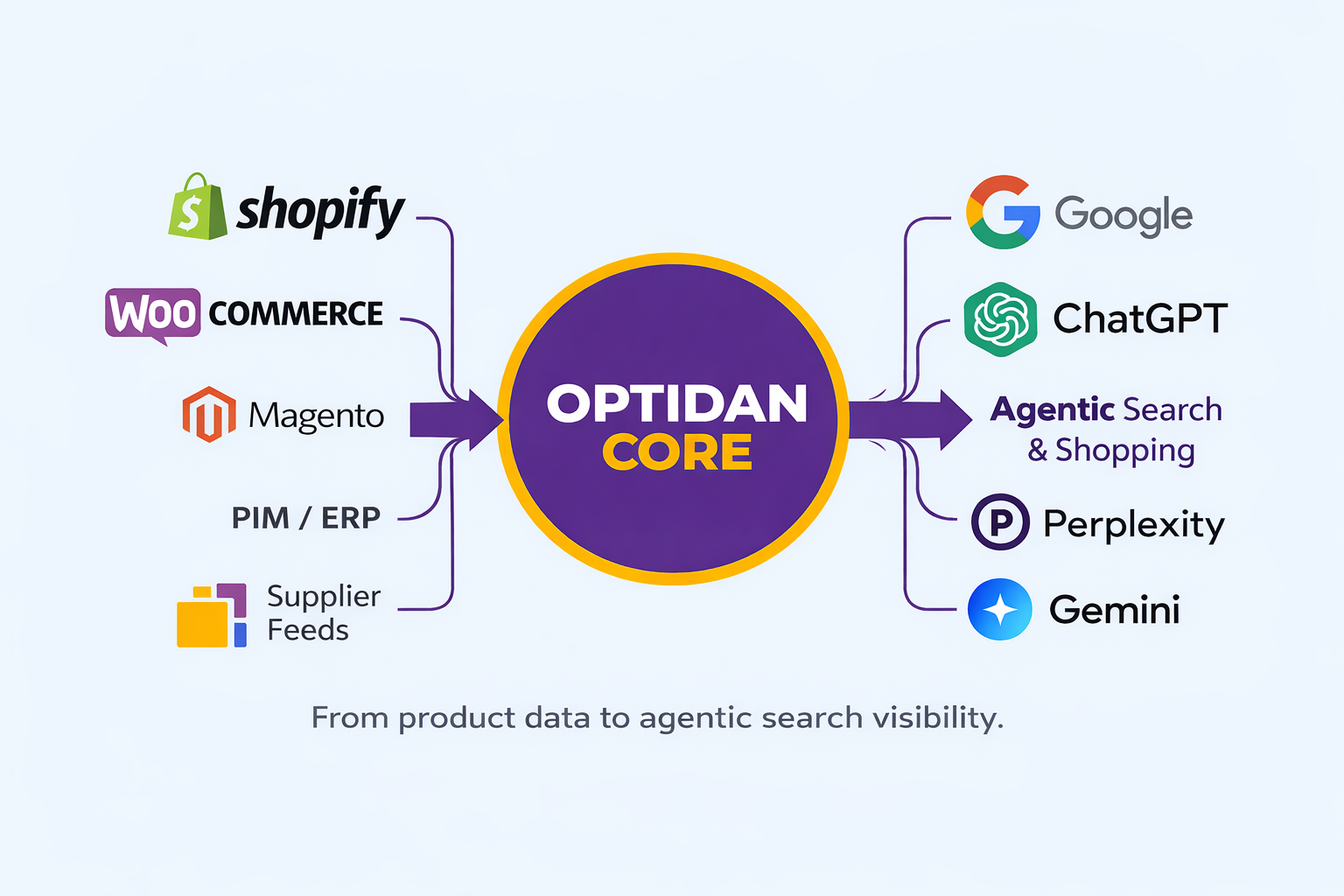
Optidan connects to supplier feeds, PIMs, and internal systems to create a single, structured source of truth for your product catalogue, reducing fragmentation and data inconsistency.
Search & AI-Ready Enrichment
Product attributes, taxonomy, metadata, and relationships are enriched to support modern search engines, AI-driven discovery and emerging agentic shopping platforms.
Unique, Brand-Led Content at Scale
Product, category, and brand content is generated and optimised to remove supplier duplication, preserve brand voice, and improve relevance across thousands of SKUs.
Continuous Optimisation & Deployment
Content is deployed across product pages, category structures, brand pages, and feeds, using workflows designed to scale efficiently as your catalogue grows.
How Product Feed Management Works
A structured approach to managing, enriching, and deploying product data so it performs across search engines, AI-driven discovery, and on-site experiences.
Product Feed Management Built for Agentic Search
What Product Feed Management Improves
Clear improvements across AI search visibility, organic performance, and retail operations at scale.
AI Search & Agentic Visibility
Structured product data optimised for discovery across AI platforms, search engines, & agentic shopping experiences.
Organic Search Performance
Improved indexation, relevance, and ranking across product, category, and brand pages.
On-Site Discovery & Conversion
Cleaner attributes and taxonomy improve internal search, filters, and shopper confidence.
Digital Shelf Consistency
One source of truth ensures consistent product information across channels and markets.
Operational Efficiency at Scale
Automated workflows reduce manual effort across thousands of SKUs without adding headcount.

10,000+ Pages Optimised in Less Than 1 Week
Built for Enterprise Retail Teams
Designed for scale, governance, and real-world retail constraints.
Product Feed Management supports teams managing large catalogues across multiple systems, markets, and channels, where accuracy, consistency, and speed directly impact visibility and performance.
It fits into existing operating models, helping ecommerce, SEO, digital, and merchandising teams improve results without increasing manual workload or headcount.
Key considerations:
- Works with Shopify, WooCommerce, Magento, PIMs, ERPs, and supplier feeds
- Complements existing SEO, merchandising, and ecommerce teams
- Supports AI search, agentic shopping, and traditional organic discovery
- Designed for enterprise scale and ongoing catalogue growth
Let’s talk. We’re confident we can help with our Content Supersuite.
Product Feed Management vs Product Feed Optimisation
Product feed management ensures product data is structured, accurate, and distributed across search engines, marketplaces, and AI-driven discovery systems.
Product feed optimisation focuses on improving the quality, depth, and performance of that data.
For large ecommerce catalogues, this distinction matters.
Managing a feed keeps operations running.
Optimising a feed improves visibility, discovery, and conversion.
At enterprise scale, optimisation requires more than manual fixes. It requires a content infrastructure that enriches supplier data, strengthens category context, removes duplication, and aligns structured attributes across thousands of SKUs.
This is where product feed management becomes performance infrastructure.
When data enrichment, catalogue management, and agentic commerce optimisation are embedded into the feed layer, retailers improve discoverability without increasing operational workload.
Frequently Asked Questions
Product feed optimisation is the process of improving product data such as titles, descriptions, attributes, taxonomy, and metadata so products perform better across search engines, AI platforms, and on-site discovery. It ensures product data is accurate, structured, and aligned to how shoppers and AI systems search.
Traditional SEO focuses on individual pages. Product feed optimisation works at catalogue scale, improving thousands of products at once. It connects product data, content, and structure so listings perform consistently across organic search, AI-driven discovery, and ecommerce platforms.
Yes. Optimised product feeds help AI platforms understand, retrieve, and recommend products accurately. Structured attributes, clean taxonomy, and consistent content improve visibility across AI search engines, agentic shopping tools, and emerging discovery platforms.
Yes. Product feed optimisation is designed for retailers managing thousands or hundreds of thousands of SKUs. It supports ongoing catalogue growth, frequent updates, and complex product hierarchies without adding manual workload to internal teams.
Product feed optimisation works with platforms including Shopify, WooCommerce, Magento, PIMs, ERPs, and supplier feeds. It complements existing ecommerce, SEO, merchandising, and digital workflows rather than replacing them.
Cleaner attributes, consistent content, and improved taxonomy enhance internal search, filters, and navigation. This helps shoppers find the right products faster, builds confidence, and improves conversion without changing your front-end design.
Because optimisation happens at scale, improvements to indexing, visibility, and discovery can appear quickly. Many retailers see meaningful catalogue-level improvements within days or weeks, depending on catalogue size and deployment approach.
Product feed optimisation works best as an ongoing capability, not a one-time task. As products, categories, suppliers, and search behaviour change, continuous optimisation ensures your catalogue stays accurate, competitive, and visible across channels.