


The disconnect between raw supplier data and an optimised product listing is more than just a technical headache, it's a direct threat to your revenue and market share. For Australian retail leaders, this gap creates a major content bottleneck, silently chipping away at your digital shelf performance with every customer search.
It's all about transforming those raw, inconsistent supplier feeds into customer-centric product content that actually drives search performance. This means using smarter, AI-powered content workflows to enrich data, eliminate duplication, and structure information for both human shoppers and the AI agents reshaping how people buy online. The shift from manual SEO to AI SEO is no longer optional, it’s a critical component of a scalable SEO solution.
The True Cost of Disconnected Supplier Data
Think of it this way: inconsistent, duplicated, or incomplete supplier feeds are actively hurting your search rankings, frustrating potential customers, and leaking revenue. This is a primary retail content bottleneck that requires a strategy for optimising product feeds efficiently.

Let’s take a real-world example from the competitive electronics space. A supplier sends you a feed for a new television but forgets to include the "HDMI 2.1" attribute. That single missing detail makes your product invisible to any gamer specifically searching for a compatible screen. It's a sale lost before you even had a chance to compete. This is a classic challenge for electronics SEO optimisation.
This isn't a small problem. We see it constantly in the Australian market.
The Real-World Impact on Your Digital Shelf
A recent eCommerce Benchmark Report by Pattern AU revealed a telling trend: while overall traffic to Australian eCommerce sites grew by 4% year-over-year, conversion rates actually fell by 1%. This drop is often tied directly back to outdated or inaccurate supplier information that tanks product visibility and digital shelf performance.
In fact, retailers still relying on manual updates see a 15% higher bounce rate on average than those with automated systems. The consequences show up in a few critical ways:
- Damaged Search Rankings: Generic descriptions straight from the supplier fail to match specific search intent, pushing your products right off the first page. This highlights the need for unique product descriptions SEO.
- Duplicate Content Issues: When you use the same supplier content as dozens of your competitors, you are signalling low value to search engines. This can get your listings suppressed, a clear sign you need a duplicate content SEO fix.
- Wasted Ad Spend: Promoting products with the wrong stock levels or features burns through your budget and, worse, erodes brand trust.
- Low Conversion Rates: Shoppers who can't find key attributes simply won't have the confidence to buy. That means more abandoned carts.
The table below breaks down how these data issues directly hit your most important KPIs.
Impact of Poor Supplier Feed Data on Retail KPIs
Here’s a summary of the direct consequences misaligned supplier data has on key ecommerce performance indicators.
| Data Problem | Impact on Search Performance | Impact on Customer Experience |
|---|---|---|
| Missing Attributes | Product is invisible in filtered or long-tail searches. Lower relevance scores. | Shoppers can't find specific features, leading to frustration and site abandonment. |
| Duplicate Descriptions | Penalised by search engines, leading to suppressed rankings and poor visibility. | Lack of unique information makes it hard for customers to differentiate products or trust the listing. |
| Inaccurate Stock Levels | Wasted ad spend on out-of-stock items. Negative signals to search engines. | Terrible user experience when an item is ordered but unavailable, leading to lost sales and trust. |
| Generic Supplier Titles | Fails to capture search intent, resulting in low click-through rates. | Vague titles confuse shoppers, making it difficult to confirm they’ve found the right product. |
As you can see, what starts as a "simple" data issue quickly snowballs into significant performance problems across the board.
Preparing for the Future of Agentic Commerce
Fixing your data isn't just about cleaning up for today's Google, it's a strategic move to get ready for agentic commerce. AI agents like Amazon's Rufus and Google's AI Overviews depend on highly structured, detailed data to answer user queries. If your product data is weak, you simply won't exist in this new search world. Agentic shopping and the future of work demand AI-compatible SEO content.
Fixing the data disconnect is the first step in moving from a reactive, manual SEO model to a proactive, AI-powered one. It’s about building a scalable SEO solution that ensures your entire catalogue is visible, compelling, and ready for the next generation of retail search.
Tackling these disconnects is a core part of a much broader strategy. For more context, it's worth exploring how a tailored digital transformation for data management governance can fundamentally improve data quality and how it's used across the business. This is the kind of shift that prepares your operation for the future, where human expertise guides AI-powered execution at scale.
Auditing Your Supplier Feeds for AI Search Readiness
Before you can fix the disconnect between your supplier data and what search engines need, you first have to diagnose how big the problem is. A thorough audit of your supplier feeds is the only real starting point for any retail leader looking to compete. This isn't about spot-checking a few SKUs, it's a systematic analysis to find the hidden weaknesses actively hurting your visibility and get your catalogue ready for the future of retail search.

Manually reviewing spreadsheets just isn't an option anymore, not when you are dealing with thousands of products. Systemic issues like supplier content duplication or missing attributes are nearly impossible to catch at scale without a better approach. This is where the principles of AI Search Engine Optimization (AI SEO) come in, using AI workflow automation for retail to analyse entire product catalogues with precision. It’s a framework that guides how you structure and enrich data for both today’s search engines and tomorrow's AI agents.
Identifying Critical Weaknesses at Scale
A proper audit goes way beyond simple error checking. It zeroes in on the specific data points that make or break your digital shelf performance, analysing the quality and uniqueness of the information each supplier provides. The goal is to hunt down those recurring problems that are dragging down your rankings and killing conversions.
The scale of this data problem in Australia is massive. Nearly 9.8 million households shopped online last year, and while 63% of Australian consumers expect accurate product details, only 42% of retailers are consistently updating their feeds. This mismatch is a direct cause of a 20% higher rate of cart abandonment for shoppers who find outdated info.
Your audit should prioritise flagging these common culprits:
- Recycled Supplier Descriptions: This is the big one. Your audit needs to pinpoint where the exact same product descriptions and specs are being used across competitor sites. It's a major red flag for search engines and a primary reason for duplicate content penalties.
- Missing Product Attributes: You need to identify the gaps in data that power your site’s faceted search, things like colour, material, or technical specs. For a fashion retailer, a missing 'material' field for hundreds of items is a direct conversion blocker.
- Generic Product Titles: Look for those supplier-centric titles that completely miss how real customers search. A title like "HG-245B-BLK" from a feed is useless for SEO, it needs to be "Men's Black Leather Biker Jacket" to even stand a chance.
Mapping Data for Agentic Search Optimisation
Beyond flagging errors, a future-focused audit maps your current data fields against the needs of agentic search optimisation. This just means structuring your product information so AI agents like Google’s AI Overviews and Amazon’s Rufus can easily understand and recommend your products.
An audit isn't about finding fault, it's about finding opportunity. Every identified gap in your supplier feed is a chance to enrich, differentiate, and ultimately outperform competitors on the digital shelf.
This foundational analysis is what lets you build a scalable strategy. Once you have a clear view of your data’s weaknesses, you can move from manual chaos to an automated, high-performance content workflow. For a deeper look into the operational side, our guide on supplier feed management provides a comprehensive framework. This systematic approach creates a clear roadmap for turning raw supplier data into a powerful asset that drives real search performance and prepares your business for the agentic commerce future.
Once you’ve audited your supplier feeds and pinpointed the data gaps, it’s time to turn that raw, messy information into fully optimised, customer-centric content. This is where AI-powered product data enrichment stops being a buzzword and becomes your most practical, scalable tool.
It’s the engine that powers the shift from old-school manual SEO to AI-driven performance, finally breaking the content bottlenecks that have been holding back your growth.

Forget about your team spending weeks writing unique descriptions or manually correcting supplier errors. AI agents can knock out these tasks in a matter of days. This frees up your experts to focus on high-level strategy and quality control, the very heart of effective human + AI collaboration in SEO. This isn't about replacing your team, it's about making them exponentially more effective and championing the future of work in retail.
Automating Unique Content at Scale
One of the most damaging issues for any retailer is supplier content duplication. Seriously. Using the same generic product information as your competitors is a fast track to getting penalised by search engines and ignored by shoppers.
An AI-powered content workflow tackles this head-on by automating product descriptions for your entire catalogue. It can generate unique, on-brand content for every single SKU you carry, enabling SEO at scale.
Modern AI systems do more than just spin existing text. They're trained on your specific brand voice and can weave in relevant keywords and product attributes to create compelling copy that resonates with both customers and AI agents like ChatGPT or Google's AI Overviews. This is crucial for creating AI-compatible SEO content and getting ready for the future of retail search.
By automating descriptions, you’re not just dodging penalties, you’re building a distinct, authoritative brand identity across thousands of pages.
AI-Driven Image and Metadata Optimisation
For visual-heavy categories like fashion, furniture, or beauty, product images are just as important as the text. The big problem? Supplier feeds often come with minimal or non-existent metadata, completely crippling your image SEO for ecommerce.
This is where AI image recognition and tagging becomes an absolute game-changer in your retail SEO automation toolkit.
This technology can analyse a product image and automatically generate descriptive alt tags, file names, and attribute tags. For example, it can:
- Identify a "blue linen armchair with wooden legs" and tag it with those exact attributes.
- Recognise a "V-neck, long-sleeve cotton blouse" in a fashion shot, enriching the data for faceted search.
- Tag specific features on electronics, like port types or screen finishes.
This automated process ensures every single image contributes to your SEO, boosting visibility in visual search engines and massively improving the on-site filtering experience for shoppers. It transforms static images into active, data-rich assets.
This level of detail is non-negotiable for furniture image tagging SEO and fashion product image SEO, where customer searches are incredibly specific. To dive deeper into refining your data strategy, check out our complete guide on product data enrichment. It’s a foundational step towards achieving genuine SKU-level SEO.
The Efficiency Gap AI Creates
When you bring AI into the mix for these repetitive, data-heavy tasks, you create a massive efficiency gap between you and your competitors who are still stuck doing things manually. The difference in speed, scale, and strategic focus is stark, allowing you to achieve an optimised at scale performance that was simply impossible before.
The table below paints a pretty clear picture of this contrast.
Manual SEO vs AI-Powered Feed Enrichment
A direct comparison illustrating the efficiency, scale, and quality differences between traditional content processes and modern AI workflows.
| Task | Manual SEO Team Approach | AI Workflow Automation Approach |
|---|---|---|
| Unique Descriptions | A small team writes descriptions for a few "hero" products, leaving the rest of the catalogue with duplicated supplier content. | Generates thousands of unique, on-brand descriptions simultaneously, eliminating duplication across the entire product catalogue. |
| Attribute Tagging | Junior team members manually add attributes from spreadsheets, a slow and error-prone process that creates data inconsistencies. | AI models automatically standardise attributes and use image recognition to tag visual details, ensuring consistent and rich data. |
| Speed to Market | New product launches are delayed by days or weeks, waiting for manual content creation and optimisation. | New products are enriched with unique descriptions and attributes, ready to go live within hours of receiving the supplier feed. |
| Strategic Focus | The team spends 80% of its time on repetitive, low-value data entry and clean-up tasks, creating a constant bottleneck. | The team dedicates 80% of its time to high-value strategy, performance analysis, and quality assurance, guiding the AI. |
Ultimately, an AI-powered workflow doesn't just make your team faster, it fundamentally changes their role. It lets them escape the grind of manual data entry and focus on the strategic initiatives that actually drive growth and improve your digital shelf performance.
Connecting Enriched Data to Search Performance
Optimised data is only valuable if it actually drives sales. After all the work of transforming raw supplier feeds into unique, attribute-rich content, the most critical step is connecting those efforts directly to tangible search metrics.
This is how you create a powerful feedback loop. It's what allows retail leaders to prove the ROI of their AI workflows and justify further investment in scalable SEO. The goal here is to move past assumptions and build a data-driven case showing exactly how better product data impacts the bottom line. You're building a closed-loop system where every optimisation is tracked, measured, and tied back to your overall digital shelf performance. This is how content stops being a cost centre and becomes a measurable revenue driver.
Establishing a SKU-Level Performance Baseline
Before you can measure improvement, you need a clear starting point. The first move is to integrate your newly optimised product feeds with your analytics platforms. We're not talking about looking at sitewide traffic here, this is about getting granular with SKU-level SEO. You need to track the performance of individual products or categories that have undergone enrichment.
Your baseline should capture key metrics before the new content goes live. This typically includes:
- Organic Rankings: Note the current positions for specific long-tail keywords relevant to each product. For a furniture retailer, this might be something like "oak mid-century modern coffee table."
- Click-Through Rate (CTR): Measure the percentage of users who actually click on your product listings in search results.
- On-Page Engagement: Track metrics like bounce rate and average time on page to see how users are interacting with the existing content.
- Conversion Rate: Record the percentage of visitors who end up making a purchase from that specific product page.
This detailed snapshot gives you the "before" picture, setting the stage perfectly to demonstrate the "after" impact of your AI content workflows.
Tracking the Impact on Search and Revenue
With a solid baseline established, you can start monitoring the direct results of your data enrichment. As search engines crawl and index the new, unique content, you should begin to see positive shifts in performance. The trick is to connect these SEO gains directly to commercial outcomes.
Look for specific improvements, like a jump in organic rankings for those long-tail keywords you weren't even tracking before. As your optimised titles and descriptions become more relevant, your CTR should also increase. This means more qualified traffic is reaching your product pages, the first real step towards higher sales.
The ability to say, "Our AI-driven enrichment of the electronics category led to a 15% increase in organic traffic and a 5% lift in conversions for those SKUs," is what turns a technical project into a strategic business win.
Demonstrating ROI to Stakeholders
Connecting data enrichment to performance is absolutely essential in the hyper-competitive Australian retail market. According to the IBISWorld Online Shopping Industry Analysis, industry revenue has grown at a compound annual rate of 3.5% over the past five years, now sitting at an estimated $64.9 billion.
This incredible growth makes the vulnerabilities of outdated supplier feeds even more glaring. Retailers failing to synchronise and enrich their product feeds often see a 30% lower CTR than competitors with optimised data.
By tracking performance at the SKU level, you build a compelling business case. You can clearly demonstrate how fixing the data disconnect directly contributes to revenue growth, justifying the investment. This closed-loop system proves that optimising product feeds isn't just an operational task, it's a core driver of profitability in modern retail.
Building Your Automated Optimisation Workflow
Fixing the disconnect between supplier data and search performance isn't a one-off project. It's a fundamental shift in how you operate. The real goal is to build a smart, repeatable, and automated optimisation workflow that constantly turns raw data into search-ready content. This is where you graduate from reactive, manual fixes to a proactive system driven by AI.
Forget about your team burning weeks correcting titles or writing descriptions from scratch. You can set AI agents in ecommerce to handle these heavy-lifting tasks. They can achieve in days what would take a human team months, freeing up your experts to focus on the high-level strategy and quality control that actually drives the business forward. This is the new reality of human + AI collaboration in SEO and the future of work in retail.
This infographic shows the straight line connecting enriched data to better SEO and, ultimately, more revenue.
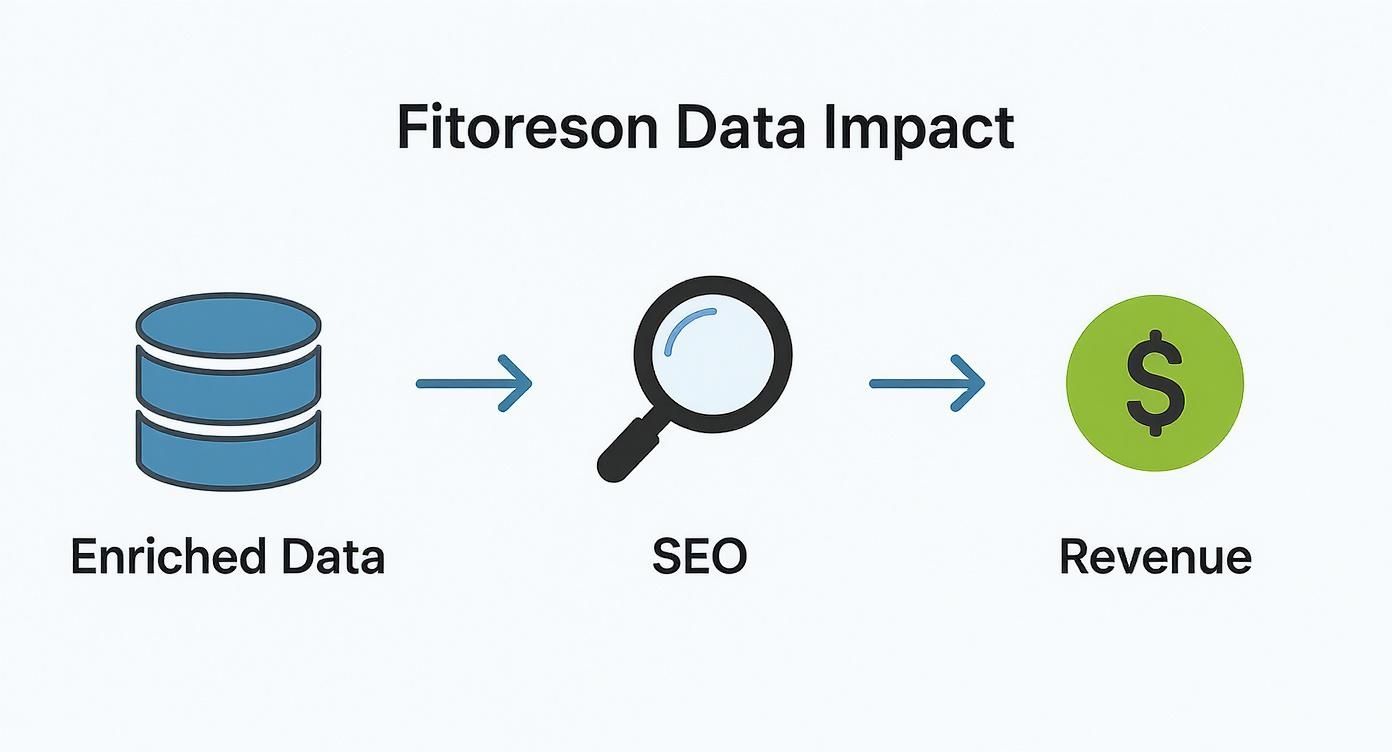
It’s clear that investing in AI-powered product data enrichment isn't just an operational chore, it's a direct route to better search visibility and commercial success.
From Static Feeds to Dynamic Intelligence
An automated workflow does more than just clean up data once. It creates an intelligent system that learns and adapts to the market. AI agents for retail efficiency can be set up to monitor search trends, competitor pricing, and emerging keywords, automatically flagging new opportunities for optimisation.
Picture this: an AI agent notices a sudden spike in searches for "eco-friendly linen furniture" in the Australian market. It can automatically:
- Scan your catalogue and identify all relevant products that are missing this attribute.
- Enrich those product listings with "eco-friendly" and "linen" tags.
- Suggest updates to product descriptions to properly highlight these features.
- Flag the updated SKUs for your marketing team to feature in their next campaign.
This transforms your product catalogue SEO from a static library into a dynamic asset that's constantly responding to what customers want. It's a core piece of any modern, scalable SEO solution and gets you ready for the future of agentic commerce.
Establishing Your Core Automation Rules
The first step in building this system is setting up the rules and logic that will guide the AI. This is where your team’s expertise is absolutely crucial. They define the "what" and the "why," and the AI executes the "how" at a scale and speed humans simply can't match. This isn’t about letting AI run wild, it’s about encoding your strategic decisions into an automated process.
Your automated workflow should be a direct reflection of your brand strategy. It’s the mechanism that ensures every product, from hero SKUs to the long-tail, is perfectly aligned with your standards and commercial goals, without manual intervention.
Here are a few key components you'll need in your rule-based system:
- Data Standardisation Logic: Automatically map inconsistent supplier terms (like 'navy', 'dark blue', or 'midnight') to a single, clean attribute ('Blue').
- Content Generation Templates: Define the brand voice, tone, and keyword priorities for AI-driven automating product descriptions.
- Image Optimisation Standards: Set rules for alt tag optimisation for retail, ensuring AI-generated tags for fashion product image SEO or furniture image tagging SEO are descriptive and actually useful.
These rules create a consistent, high-quality output that gets rid of supplier content duplication and ensures your entire catalogue is primed for agentic search optimisation.
The Future of Work: Human-Led AI Governance
Moving from manual SEO to an AI-driven approach fundamentally changes the role of your ecommerce team. They stop being content creators and become strategic directors of an AI-powered workforce. Their value is no longer measured by their ability to write 50 product descriptions a day, but by their skill in guiding and refining an AI that can write 50,000.
This human-led AI content QA process is the cornerstone of a successful automated workflow. Your team’s focus shifts to high-impact activities like performance analysis, strategic planning, and continuously improving the AI models. They become the essential "human-in-the-loop," guaranteeing quality, brand alignment, and strategic direction. To explore this operational shift further, learn more about the real driver of AI ROI for retailers.
By building an automated content workflow, you're not just optimising product feeds efficiently. You are creating a resilient, intelligent, and scalable system that positions your business to win in the increasingly complex world of AI-powered retail.
So, What's the Real Impact on My Business?
Switching to an AI-first approach for managing supplier feeds always brings up some great questions from retail leaders. Let’s get into the most common ones and give you some straight answers focused on what really matters: AI SEO, scale, and performance.
How Does Fixing Duplicated Supplier Content Actually Affect Our SEO?
Here’s the thing: when you and ten other retailers are all using the exact same generic product description from a supplier, search engines have no idea which page is the original or most important. It’s a huge source of confusion that ends up diluting the rankings for everyone, pushing your product pages further down the search results.
This is where AI agents for retail efficiency come in. By generating thousands of genuinely unique descriptions at scale, you’re sending a clear signal to Google that your pages offer distinct value. It’s a direct duplicate content SEO fix that not only solves a technical problem but also builds your brand’s voice and dramatically improves your shot at ranking for those competitive product keywords. Think of it as a crucial first step in improving your digital shelf performance.
Getting rid of supplier content duplication isn't just a data cleanup task. You're actively telling search engines that your product pages are original, authoritative sources of information. That’s a massive signal for higher rankings.
Honestly, this move is foundational to any ecommerce SEO automation strategy that’s built to win today. It makes sure your content is an asset, not a liability.
What on Earth Is Agentic Search Optimisation and Why Should I Care?
Agentic Search Optimisation (ASO) is all about structuring your product data so it can be easily picked up and used by AI agents like Google's AI Overviews and Amazon's Rufus. These AI assistants are built to find, compare, and recommend products based on natural, conversational questions from shoppers.
This means you need deeply structured, highly detailed product data that goes way beyond old-school keywords. For example, by using AI to enrich your supplier feeds with precise attributes, you make sure that when a customer asks an AI assistant to 'find a water-resistant running jacket under $200 with reflective details,' your products are actually in the running to be recommended. This is a non-negotiable part of preparing for the agentic commerce future.
If you ignore ASO, you're essentially choosing to be invisible in the future of retail search. It’s about making your catalogue compatible with how people are already starting to shop.
Can AI Really Handle the Nuance in Categories Like Fashion?
Absolutely. This is where modern AI, especially systems armed with advanced AI image recognition SEO, really shines. It’s a complete game-changer for retailers in specialised verticals because it can understand and tag category-specific details at an incredible scale.
Take a fashion retailer, for instance. An AI can look at a product image and instantly tag attributes like 'V-neck,' 'A-line skirt,' or 'puffed sleeves'. These are the granular details that are almost always missing from basic supplier feeds, yet they're exactly how customers search. This kind of automated fashion product image SEO ensures your products are found through the specific terms real people use.
It works across the board:
- For electronics, it can standardise technical specs like port types or screen refresh rates.
- For furniture, it can identify materials, styles, and dimensions right from an image.
- For beauty, it can flag key ingredients or benefits like 'vegan' or 'hydrating'.
This AI-powered data enrichment, always guided by human-led AI content QA to keep it on-brand, closes the data gap. It provides the rich, structured information you need for superior SKU-level SEO.
Ready to eliminate data disconnects and unlock scalable growth? Optidan AI transforms your raw supplier feeds into thousands of SEO-ready product pages in days, not months. Discover how our AI-powered content workflows can elevate your digital shelf performance by visiting https://optidan.com.
