


Supplier feed management is the process of taking messy, inconsistent product data from multiple suppliers and turning it into a unified, high-quality product catalogue. For Australian retailers, this means transforming chaotic spreadsheets into a powerful asset for driving sales and boosting SEO performance at scale. This is no longer a nice-to-have, it's essential for competing in a market increasingly shaped by AI and automation.
The Hidden Bottleneck Crippling Australian Retail
For many Australian retailers, the biggest barrier to growth isn't marketing spend or logistics. It's the hidden chaos of wrestling with raw supplier data.
Teams are sinking countless hours into manually fixing inconsistent spreadsheets, chasing down decent images, and rewriting the same duplicated supplier content over and over. This creates a huge bottleneck that slows everything down and tanks your SEO potential. This manual approach is no longer sustainable for any serious ecommerce manager.
This reactive, time-consuming cycle stops your team from focusing on what actually matters: strategic growth. It kicks off a domino effect of problems that hit your bottom line hard:
- Delayed Product Launches: New products get stuck in a queue, waiting for someone to manually clean and enrich the data. By the time they go live, you've missed crucial sales windows.
- Poor Digital Shelf Performance: Using the same generic, duplicated content as every other retailer is a fast track to search engine penalties. It kills your rankings and makes it impossible for customers to find you, impacting your entire retail search visibility.
- Inconsistent Customer Experience: When product information on your website is wrong or incomplete, it erodes trust and leads to higher return rates. It's as simple as that.
From Manual SEO to AI SEO
The strategic jump from manual data entry to automated, AI-powered supplier feed management is the only way forward for retail leaders. This isn't just about cleaning up a spreadsheet, it's about fundamentally changing how your retail team operates and reducing retail content bottlenecks.
You move from constantly putting out fires to proactively optimising your entire catalogue. This unlocks the ability to manage and enhance your products at a scale that was previously unimaginable. This is the very heart of shifting from old-school SEO tactics to a forward-thinking AI SEO strategy, a true next-gen SEO for retailers.
This transformation is the foundational step for preparing your ecommerce platform for the future of agentic search. AI agents like ChatGPT, Perplexity, and Amazon's Rufus rely on structured, unique, and comprehensive product data to make purchase recommendations. If your data is messy, you'll be invisible in this new era of agentic commerce.
The goal is to create automated content workflows that turn those messy supplier feeds into a genuine strategic asset. It’s about building a system that doesn’t just fix errors but actively enriches product data with unique descriptions, AI-generated image tags, and properly structured attributes.
This is how you achieve SKU-level SEO, optimising tens of thousands of pages in days, not weeks. The challenges of supplier product feeds for retailers are many, but with the right AI workflow automation for retail, they can be tackled efficiently.
Manual vs AI-Powered Supplier Feed Management
The difference between the old manual methods and a modern, AI-powered approach is stark. It's not just an upgrade, it's a complete overhaul of how you manage your digital shelf.
| Process | The Manual Bottleneck | The AI-Powered Solution |
|---|---|---|
| Data Ingestion | Manually downloading and uploading inconsistent files (CSVs, spreadsheets). | Automated ingestion from any source (API, FTP, XML) into a unified system. |
| Product Descriptions | Copying supplier text, leading to duplicate content and manual rewrites. | Generative AI creates unique, SEO-optimised descriptions at scale for every SKU, automating product descriptions efficiently. |
| Image Optimisation | Manually writing alt tags and tagging product attributes, often inconsistently. | AI image recognition automatically tags attributes (critical for fashion or furniture SEO) and generates descriptive alt text. |
| Time-to-Market | Days or weeks to get a new product range live, missing key sales periods. | Hours or minutes, enabling rapid response to market trends and promotions. |
| Scalability | Limited by team size; managing 10k+ SKUs is a significant resource drain. | Effortlessly manages millions of SKUs, ensuring consistency and quality across the catalogue with scalable SEO solutions. |
Ultimately, making this shift frees up your team to focus on strategy and growth, leaving the repetitive data work to intelligent automation. This isn't just about efficiency, it's about building a competitive edge for the future of work in retail.
Unifying Your Inconsistent Supplier Data Feeds
The first real test in managing supplier feeds is taming the sheer variety of data that lands on your desk. One supplier sends a messy CSV, another provides an XML file with cryptic column headers, and a third offers a direct API connection. For any ecommerce manager, this inconsistency is a massive operational headache.
Your goal here is to build a unified ingestion workflow that handles this chaos automatically. It starts by creating a standardised internal product schema, your single source of truth, and then intelligently mapping every incoming supplier field to it. For example, a supplier’s ‘desc’, ‘description’, or ‘product_details’ field must all be mapped to your internal ‘ProductDescription’ field, every single time.
This isn’t just about tidying up data. It’s about building a scalable foundation for retail content automation. A solid automated process will clean, validate, and normalise every piece of data on a massive scale, ensuring consistency before it ever hits your PIM or ecommerce platform. This is how you eliminate the manual errors that lead to poor customer experiences and lost sales.
Building a Resilient Ingestion Workflow
To truly unify messy supplier data and keep it accurate up-to-the-minute, you need to look at adopting real-time data integration best practices. This approach moves you beyond clunky batch uploads and helps you create a dynamic, responsive system that can keep up with market changes.
A truly resilient workflow should be able to:
- Handle Multiple Formats: Automatically parse data from any source, CSV, XML, JSON, or direct API calls, without needing someone to step in and fix it.
- Normalise Data Types: Convert all incoming data into standard formats. This means making sure all prices are numeric, dates follow a consistent structure, and measurements are standardised (e.g., converting 'centimetres' and 'cm' into a single, uniform unit).
- Validate Information: Implement rules to check for completeness and accuracy. The system should automatically flag or reject products with missing essential data like SKUs, prices, or primary images.
Getting this initial clean-up right is absolutely essential for preventing the classic "garbage in, garbage out" problem. It ensures that every step that follows, from product data enrichment to AI-powered SEO, is built on a reliable and accurate dataset.
Addressing Volatility in the Australian Market
The challenge of unifying data gets even tougher when you factor in market volatility, a common issue for many Australian industries. Fluctuating commodity prices and input costs can create huge data integrity problems if you're not managing them correctly.
This infographic shows the journey from manual data chaos to proactive, automated optimisation.
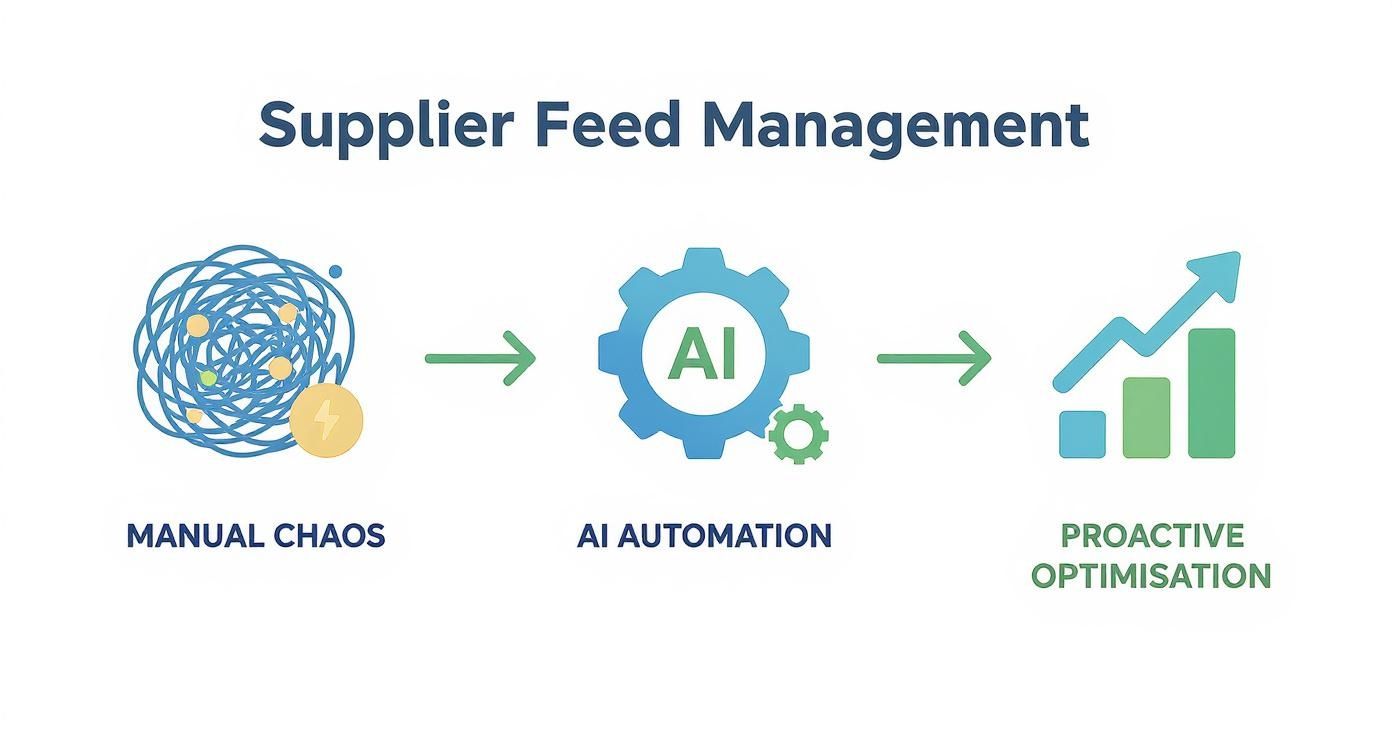
As you can see, AI-powered automation is what transforms inconsistent inputs into a strategic asset, giving retailers the agility they need to stay ahead.
Take the Australian prepared animal and bird feed manufacturing industry as a real-world example. It’s a market comprising 281 businesses that generated $6.1 billion in revenue, but it also saw a decline due to volatile commodity prices, especially for coarse grains. For these businesses, input cost volatility directly impacts product formulation, pricing, and supply, making accurate supplier feed management a critical operational function.
For any retailer, whether you're in fashion or agriculture, getting this foundational data unification step right is crucial. It’s the key to eliminating downstream errors, improving efficiency, and preparing your entire product catalogue for advanced optimisation and AI-powered retail transformation.
By standardising data at the point of ingestion, you can also start tackling one of the biggest problems in ecommerce: duplicated supplier content. Learn more about avoiding supplier product feed duplication in our detailed guide. This initial step sets the stage for creating the unique product descriptions and rich content needed to win on the digital shelf.
Automating Product Enrichment for Your Digital Shelf
Once you’ve wrangled all your raw supplier data into one place, the real work begins. Raw data is never ready for customers, and it certainly isn't optimised for search engines. This is where AI workflow automation comes in, transforming those basic, inconsistent feeds into rich, compelling product listings that actually perform on the digital shelf.
This is the engine that drives modern retail content automation.
It’s about more than just cleaning up messy data. It's a strategic process of enriching every single product with unique, valuable information that both shoppers and search algorithms love. This is the core of effective supplier feed management, it’s what separates a product listing that just exists from one that actively pulls in traffic and drives sales.

This diagram from Wikipedia shows how a central system, like a PIM, acts as the command centre for all your product information. It’s a foundational concept, but the real power kicks in when you use AI to automate the enrichment processes within that hub. That’s how you turn raw data into optimised, channel-ready content at a massive scale.
From Duplicates to Distinctive Descriptions
Using generic, supplier-provided product descriptions is one of the most damaging things a retailer can do. It creates a huge supplier content duplication problem, telling search engines that your product pages offer zero unique value compared to your competitors. The result? Poor rankings and next to no visibility. A proper duplicate content SEO fix is essential.
An AI-powered content workflow is the only scalable fix. Manually rewriting descriptions is impossible when you have thousands of SKUs. Instead, generative AI can create unique, SEO-friendly product descriptions for every single item in your catalogue. This isn't just about avoiding Google penalties, it's about building a distinct brand voice and giving shoppers a reason to buy from you.
This automated content workflow can:
- Generate Multiple Variants: Create different descriptions for your website, marketplaces like Amazon, and social commerce channels, all from a single source of truth.
- Incorporate SEO Keywords: Naturally weave in relevant keywords for things like fashion SEO optimisation or electronics SEO optimisation to boost search performance.
- Maintain Brand Voice: Follow your brand’s style guide to ensure every description, whether for a luxury handbag or a power tool, sounds like it came from your team.
By automating product descriptions, you solve a major retail content bottleneck and set the stage for much stronger digital shelf performance.
AI-Powered Image Recognition for Smarter SEO
For retailers in visual categories like fashion, furniture, or beauty, product images are just as important as the text. But they're often a massively underutilised SEO asset. This is where AI image recognition and tagging becomes a complete game-changer.
Instead of relying on whatever sparse metadata your supplier provided (if any), AI can literally "see" your product images and automatically extract valuable attributes. This technology is crucial for achieving deep, SKU-level SEO.
Imagine you're a fashion retailer. An AI agent can analyse an image of a dress and instantly generate tags like 'V-neck', 'long-sleeve', 'A-line silhouette', and 'floral print'. These attributes are then used to build highly descriptive alt tags and enrich the product data, making that dress discoverable through very specific, long-tail search queries. This is fashion product image SEO in action.
This AI image recognition SEO creates a far richer data profile for each product. This is vital not only for traditional search but also for the future of agentic commerce. AI shopping assistants like Rufus or Perplexity will depend on this kind of structured data to match products with conversational user queries.
Optimising Metadata at an Unprecedented Scale
The real magic of these AI workflows for eCommerce is their ability to operate at a scale that manual teams could only dream of. Metadata optimisation at scale is no longer just a goal, it's a reality. This means optimising every little element that contributes to your retail search visibility.
Key enrichment tasks that can be automated include:
- Attribute Extraction: Pulling critical data like material, colour, dimensions, and compatibility from messy, unstructured description text and turning it into clean, filterable attributes.
- Category Mapping: Accurately assigning products to the correct taxonomy on your site, which drastically improves navigation and the user experience.
- Alt Tag Generation: Creating descriptive, keyword-rich alt tags for every single product image to boost your image SEO for ecommerce.
This is what SEO at scale for retailers actually looks like. It’s the ability to apply deep, granular optimisations across tens of thousands of product pages in a matter of days, not months. For a deeper dive, check out our complete guide to product data enrichment, which details how to turn basic feeds into a powerful strategic asset.
This level of retail efficiency was once impossible, but with AI-powered retail transformation, it's quickly becoming the new standard for success.
Getting Your Product Data Ready for AI-Powered Search
Effective supplier feed management isn't just about data accuracy anymore. The real work is preparing your entire product catalogue for the immediate future of retail search, a future driven by AI. This is where enriched product data becomes your most valuable asset in the new game of agentic search optimisation.
When your product information is structured, unique, and comprehensive, you make your catalogue ‘AI-compatible’. This allows AI agents from Google, ChatGPT, and Amazon's Rufus to properly understand your products, interpret their features, and confidently recommend them over your competitors. The old game of keyword stuffing is over. It's now about building a rich, semantic data layer that gives real answers to complex, conversational customer questions.
Moving Beyond Keywords to Conversational Commerce
The jump from manual SEO to AI SEO is a fundamental strategy shift. Old-school tactics were all about matching specific keywords. The new approach, which is crucial for agentic shopping, is about providing the context and structured data needed to answer nuanced, conversational questions.
For instance, a customer might ask an AI assistant, "Find me a waterproof, lightweight hiking jacket for under $300 that's made from recycled materials and available in navy blue." An AI agent can't find that just by scanning for the keyword "hiking jacket." It needs clean, structured data points like:
- Activity Type: Hiking
- Key Features: Waterproof, Lightweight
- Price: < $300
- Material: Recycled Fabric
- Colour: Navy Blue
If you don't have these clean, filterable attributes pulled from your supplier feeds and enriched through retail SEO automation, your products are invisible to these sophisticated queries. This is exactly why you need to be preparing your product catalogue for agentic search and why automated content workflows give you a massive competitive edge.
Building an AI-Compatible Data Foundation
Making your product data AI-compatible means turning raw supplier information into a highly structured format that machines can easily read and understand. This process is the heart of product feed optimisation and is non-negotiable for any retailer serious about future-proofing their digital shelf performance.
The shift to agentic search isn't some distant future, it's happening right now. Retailers who invest in creating structured, unique, and query-ready product data today are building the foundation to dominate the AI-driven search results of tomorrow.
This isn't just a retail trend. Take the Australian animal feed market, which is projected to grow at a CAGR of 2.82% through to 2033. This growth is driven by precision nutrition, where feed is tailored to specific livestock needs using detailed data. It’s part of a wider move towards digitalisation and automation in supplier feed handling, leading to better inventory management. You can explore detailed market analysis from IMARC Group. Just as precision data is vital in agriculture, it's equally crucial for retail SEO.
The Strategic Value of Scalable SEO Solutions
The only way to achieve this level of data quality across thousands of SKUs is through AI workflow automation. Manually tagging every product with dozens of attributes just isn’t feasible. AI-powered systems can analyse product titles, descriptions, and even images to pull out and structure this vital information at scale.
This is the key difference in the AI SEO vs Traditional SEO debate. A traditional SEO team might optimise a few dozen high-priority pages. AI SEO services, on the other hand, deliver SKU-level optimisation across your entire catalogue, ensuring every single product is perfectly positioned for the next generation of search.
This is SEO at scale for retailers, turning a once-impossible task into a streamlined, automated workflow. By focusing on building a deep, semantic data layer, you prepare your business not just for today's search engines, but for the agentic commerce future.
Bringing a Human Touch to AI-Powered Content
AI automation is incredibly fast for managing supplier feeds, but letting it run completely unchecked is a recipe for disaster. To protect your brand's integrity, you absolutely need human oversight. This is where a ‘human-in-the-loop’ (HITL) quality assurance workflow comes in, blending AI’s raw efficiency with genuine human expertise.
This approach isn't about slowing things down, it's about making sure the collaboration between human and machine produces content that’s not just optimised for search, but also perfectly aligned with your brand’s unique voice. It’s a system designed to keep the immense benefits of automation while dodging the risks of factual errors or off-brand messaging.

Building a Smart QA Framework
An effective HITL process doesn't mean manually checking every single piece of AI-generated content. That would completely defeat the purpose of automation and just create another bottleneck. The key is to be smart and targeted in your reviews.
It all comes down to using the right retail efficiency tools and dashboards. These allow your managers to oversee automated content workflows from a high level, flagging exceptions based on rules you define beforehand. This small shift transforms your team from glorified proofreaders into high-value quality controllers.
A truly efficient ecommerce content quality assurance framework needs to include:
- Confidence Scoring: The AI should assign a confidence score to its own output. This way, your team only needs to review content that falls below a certain threshold, say 85% confidence.
- Rule-Based Flagging: Set up automatic flags for content that contains specific brand terms, complex technical specs, or sensitive language. These get a mandatory human review.
- Random Audits: Implement a system for randomly sampling a small percentage of all generated content. This keeps a constant check on quality across the board.
With this targeted approach, a small team can effectively manage the output for tens of thousands of SKUs without getting buried in busywork.
The future of work in retail isn't about replacing humans with AI, it's about amplifying human capabilities. A human-in-the-loop model allows your team to become strategic editors and brand guardians, leveraging AI as a powerful tool to execute at scale.
The Real Value of Human-Led AI Content QA
The main goal of human-led AI content QA is to refine, approve, and give feedback on what the AI creates. This establishes a powerful feedback loop that helps the AI models learn and improve over time, becoming much more aligned with your specific needs. To ensure the accuracy and completeness of product information within your feeds, consider engaging dedicated software quality assurance services to build robust validation frameworks.
That human touch is simply irreplaceable for a few critical tasks:
- Brand Voice Alignment: Does the AI-generated description for a high-end piece of furniture sound as sophisticated as one written by your best copywriter? A human editor has to make that final call.
- Factual Accuracy: For technical products, like in electronics SEO optimisation, a human must verify that specifications like dimensions, power ratings, and compatibility are 100% correct. No exceptions.
- Nuance and Context: An AI might completely miss the subtle cultural references or the emotional tone needed for a product in the beauty & cosmetics SEO space. Human oversight makes sure the content actually connects with your target audience.
This balanced system combines the scalability of AI with the irreplaceable nuance of human judgment, creating a workflow that is both efficient and devastatingly effective. It's the practical application of human + AI collaboration in SEO, ensuring your digital shelf performance is built on a solid foundation of quality and trust. This is how you confidently achieve SEO at scale.
Measuring the Real Impact on Your Business
At the end of the day, a top-tier supplier feed management system has to deliver real, measurable business outcomes. It’s time to move past vanity metrics like total traffic. The actual value is found in the small, granular improvements that directly pump up your bottom line, connecting your automated workflows to concrete wins in digital shelf performance and your overall visibility in retail search.
The goal is to track KPIs that tell the whole story of your investment. This means zeroing in on results that actually matter, like better search rankings for those super-specific, long-tail product keywords, higher click-through rates (CTR) from search engine results, and a clear lift in conversion rates right down to the SKU level. These are the direct payoffs from fixing supplier content duplication and enriching your product data at scale.
Another game-changing metric is how much faster you can get new products to market. By automating ingestion and enrichment, you can slash the time it takes to get a new range live from weeks down to just days, or even hours. That kind of operational agility is a massive competitive edge, letting you jump on market trends and promotional opportunities without missing a beat.
Key Performance Indicators for AI-Powered Workflows
To properly measure the success of your new system, you need to be tracking a mix of SEO, operational, and commercial metrics. These indicators give you a complete picture of how efficient supplier feed management is transforming your business from the ground up. You can find a more detailed breakdown by exploring the top metrics to track for ecommerce success.
Here are the core KPIs to keep your eyes on:
- Organic Ranking for Product Keywords: Are you climbing the ranks for thousands of long-tail product queries? This is the clearest sign that your unique product descriptions and rich data are hitting the mark.
- Click-Through Rate (CTR) Improvement: As your listings become more detailed and relevant, they’ll naturally attract more qualified clicks from search results.
- Conversion Rate by SKU: Measure how well individual product pages are turning traffic into sales. This shows the real-world impact of high-quality images, accurate attributes, and descriptions that sell.
- Time-to-Market Reduction: Put a number on the decrease in time and resources needed to launch new products. This showcases a direct improvement in retail efficiency.
A Lesson in Feed Efficiency from Australian Industry
The strategic importance of precise feed management isn’t just for digital retail shelves. It’s the backbone of success for Australia’s leading industries, where optimising a complex supply chain is non-negotiable for profitability and output.
Take Australia’s beef industry as a powerful real-world example. Despite a 10% lower cattle slaughter volume compared to a decade ago, the industry managed to produce a record 2.55 million tonnes of beef. This was largely achieved through huge improvements in feed management systems that increased average carcase weights by 11%.
This incredible efficiency gain came from better grainfed programs and optimised feeding periods, proving how a sophisticated approach to managing inputs can lead to record-breaking results. As you can discover in more detail from MLA's report, a precise system is the key to maintaining output. This principle is just as true for ecommerce, where your product data feed is the critical input that fuels your digital growth engine. Just like in agriculture, managing your feed with precision and automation is what unlocks scalable performance and lasting success.
Ready to transform your messy supplier feeds into a powerful driver of growth? With Optidan AI, you can create thousands of unique, SEO-ready product pages in a fraction of the time. Stop drowning in manual updates and start dominating the digital shelf. Discover how Optidan AI can automate your success.
