


The way your customers find products is changing forever.
We’re moving on from just typing keywords into a search bar. Now, it's about having actual conversations with AI agents like ChatGPT, Perplexity, and Amazon's Rufus. For Australian retail leaders and ecommerce managers, this isn’t some far-off concept; it’s happening right now.
This shift is called agentic search, and it means AI assistants are becoming personal shoppers. They find the best products based on complex, conversational needs, not just a few simple keywords. Suddenly, your standard product catalogue just doesn't cut it anymore. To really get a handle on this, it's worth understanding what agentic search is and how it works.
This new reality is being fuelled by a massive migration to digital channels. In Australia alone, the number of monthly online shoppers is on track to hit 23.14 million by 2029. This ecommerce boom highlights just how urgent it is for retailers to get their product catalogues ready for the AI tools that consumers are using every day.
The Big Shift: From Manual SEO to AI SEO
Traditional SEO was all about optimising for human eyeballs. We focused on keywords, created readable blog posts, and tweaked meta descriptions. But Agentic Search Optimisation, or AI SEO, demands a completely different game plan.
It’s about building a machine-readable foundation that serves AI agents first. This marks a critical move away from tedious, page-by-page tweaks and toward scalable, automated content workflows. The challenge is no longer just about ranking for a keyword; it's about becoming the most trusted, detailed, and authoritative data source for an AI's recommendation. You can dive deeper into how agentic AI is changing the way retailers compete online in our detailed guide.
The future of agentic commerce will happen gradually, then suddenly. The retailers who invest in proper product data enrichment now will be positioned to capture the first wave of AI agent-driven traffic. Your digital shelf performance depends on the actions you take today.
To give you a clearer picture, here's how the old world of SEO stacks up against the new reality of optimising for agentic search.
Traditional SEO vs Agentic Search Optimisation
The table below breaks down the fundamental differences between legacy SEO tactics and the data-first approach required for AI agents. It’s not just a small pivot; it’s a complete rethink of how we achieve visibility online.
| Attribute | Traditional SEO | Agentic Search Optimisation (AI SEO) |
|---|---|---|
| Primary Focus | Keywords and backlinks | Structured data and attributes |
| Target Audience | Human users browsing search engines | AI agents and language models |
| Content Goal | Create readable, engaging web pages | Provide accurate, machine-readable data |
| Key Tactics | On-page SEO, link building, meta tags | Product data enrichment, schema markup, feed quality |
| Success Metric | Keyword rankings and organic traffic | Inclusion in AI-generated answers |
| Workflow | Manual, page-by-page optimisation | Automated, scalable data workflows |
As you can see, the game has changed. What worked for a decade won't get you found in an AI-driven world. The focus has moved from convincing a human to click a link to providing an AI with enough structured, trustworthy information to recommend your product.
This guide explains why preparing your product data now is the only way to stay competitive. We'll walk through how to shift from outdated SEO practices to an AI-powered strategy, hitting the key areas that are absolutely critical for success:
- Product Data Enrichment: We're talking about transforming basic supplier feeds into rich, structured content that AI agents can actually process.
- Correcting Duplicated Supplier Content: It’s time to move beyond generic supplier descriptions and build a unique brand voice that AI will prioritise.
- Image Recognition & Tagging: This is about turning your product images into valuable data points for both visual and contextual searches.
- AI Workflow Automation: We’ll look at implementing scalable solutions to optimise thousands of SKUs efficiently and finally break through those retail content bottlenecks.
Building a Machine-Readable Product Catalogue
AI agents don't browse your website; they read your data. If you want to win in agentic search, your catalogue needs to become a definitive, machine-readable source of truth, all built on rich, structured data. This is where the real work begins.
The central task is product data enrichment. It's the process of turning basic supplier feeds, often just a title and a generic description, into highly detailed, organised product content that an AI can understand and trust. This calls for a fundamental shift from manual SEO toward an AI-powered optimisation mindset.
This evolution from keyword-based search to conversational, agent-driven interactions demands a complete rethink of your product data strategy.
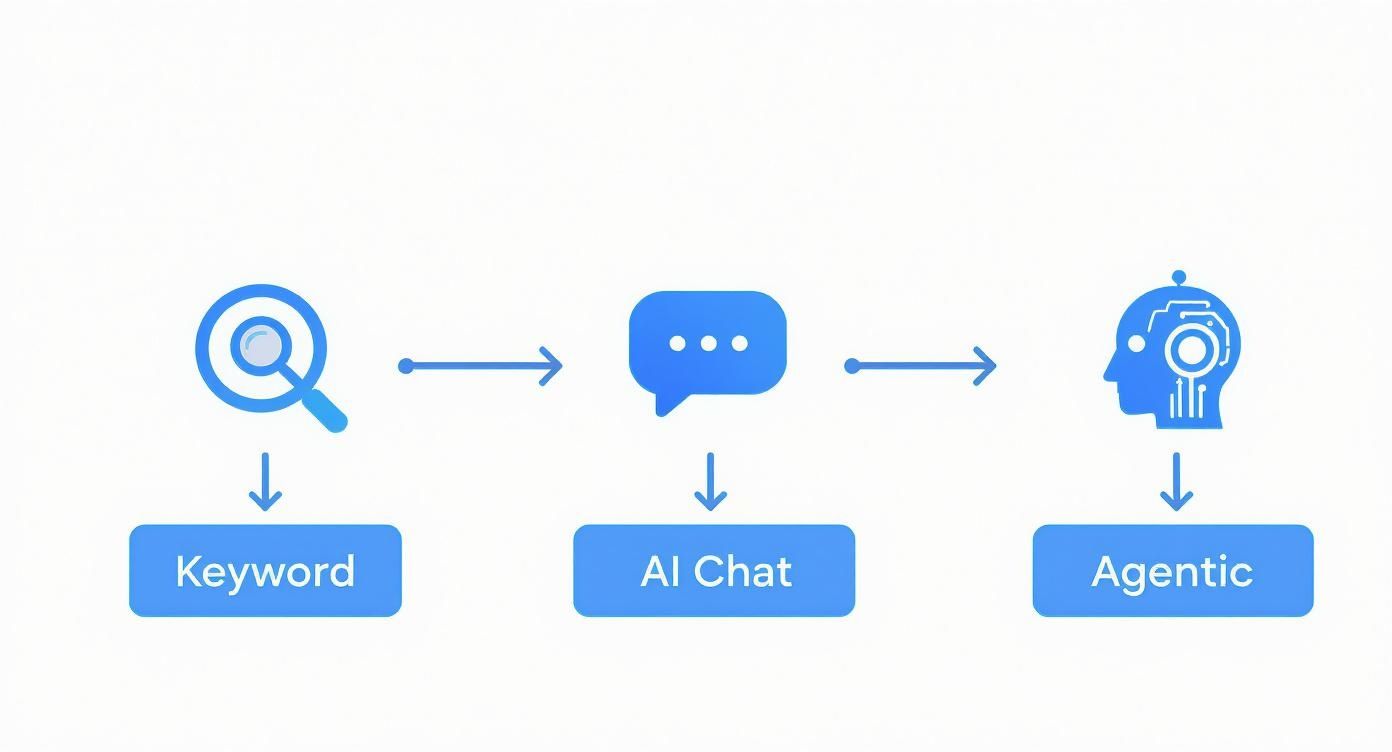
This visualisation really nails the journey from simple queries to complex, AI-led discovery, showing why deep product data is no longer a "nice-to-have". It's essential.
From Basic Feeds to Enriched Data
A standard supplier feed might list a sofa as "Grey 3-Seater Sofa". That’s nowhere near enough for an AI agent trying to answer a customer's real-world query, like, "Find me a durable, stain-resistant, three-seater sofa made from natural fibres that will fit in my 3-metre-wide living room."
Effective SKU-level SEO means going much deeper. An AI-compatible entry for that exact same sofa would need to include granular attributes:
- Material Composition: 70% Linen, 30% Cotton blend
- Durability Score: High-traffic suitable, Martindale rub count of 30,000
- Fabric Treatment: Scotchgard stain-resistant coating
- Dimensions (L x W x H): 220cm x 95cm x 85cm
- Frame Material: Sustainably sourced solid pine wood
- Assembly: No assembly required
This level of detail turns your product page into a direct answer. When an AI agent scans for options, your product speaks its language and addresses the user's complex needs, making it a prime candidate for recommendation.
Why Structured Data Is Non-Negotiable
Agentic search optimisation is less about persuasive copy and more about factual accuracy and structure. An AI agent doesn't get "convinced" by marketing fluff; it matches user intent with hard data points.
In the agentic commerce future, the retailer with the most comprehensive and accurate product data wins. AI agents will naturally favour sources they can trust, making data quality your new competitive advantage.
This is precisely why structured data is so critical. It organises information into a predictable format that machines can easily parse and compare. This isn't just a digital trend, either. It builds on the long history of catalogues as trusted sources for product discovery. In Australia, the power of a well-organised catalogue remains surprisingly strong, with millions still relying on them weekly for purchasing decisions. It’s a testament to how effective clear, structured product information truly is.
At the core of keeping everything organised is a robust Digital Asset Management workflow. It’s what ensures all your enriched data, from images to documents, is consistently managed and ready to go.
The Scale Challenge and AI Workflow Automation
Let's be realistic, manually enriching thousands of SKUs is a massive retail content bottleneck. This is where AI workflow automation becomes your best friend. Instead of hiring an army of copywriters, you can implement AI-powered content workflows that operate at an incredible scale.
For instance, an electronics SEO optimisation task might involve standardising specifications across 5,000 different products. An AI agent can scan supplier data, pull out key attributes like "screen resolution," "processor speed," and "battery life," and format them consistently in seconds.
This approach represents a major shift in how we think about retail efficiency tools. The goal is no longer just to write content but to structure data. Our guide on the future of product feeds and training AI agents digs deeper into making this transition work. By automating these processes, you can achieve optimised at scale performance, transforming a 10,000-page catalogue in days, not years.
Solving the Duplicate Content Problem at Scale
Relying on generic supplier descriptions is the fastest way to become invisible in the new era of search. Agentic search tools are built to find original, authoritative sources, which means that cookie-cutter, duplicated content is going to get penalised more severely than ever before. For many Australian retailers, this is a massive headache.
For years, just grabbing the supplier's content was a handy shortcut to get products online fast. But that common practice has created a digital shelf where thousands of retailers say the exact same thing about the exact same products. AI agents, designed to find the single best answer, will simply tune out all that noise.
This is a widespread issue in retail that needs to be tackled head-on. The goal is to carve out a unique brand voice and provide genuine value that makes your catalogue the go-to source for AI-powered shopping queries.
Moving Beyond "Copy and Paste" SEO
The old-school approach to dodging duplicate content penalties involved manually rewriting a few of your most important product descriptions. That method just doesn't fly when you're dealing with thousands of SKUs. The future of work in retail is about shifting away from manual, repetitive tasks and towards smarter, technology-driven workflows.
This is where a Human + AI Collaboration in SEO model becomes so critical. It’s not about replacing your team with machines; it's about giving them retail efficiency tools that can handle the heavy lifting. Instead of your team spending weeks rewriting descriptions, they can focus on brand strategy, quality control, and the bigger picture.
An AI agent doesn't care about ten different websites having the same description for a coffee machine. It will identify the original or most detailed source and disregard the rest. Your job is to become that source.
This shift requires a new mindset. The focus is no longer just on avoiding penalties but on actively building authority and becoming the definitive source of information for your product categories.
Creating Unique Narratives with AI Workflows
So, how do you create unique, on-brand product narratives for 10,000+ pages without hiring an army of writers? The answer lies in AI workflow automation for retail. This is a scalable process that blends the efficiency of AI with essential human oversight, allowing you to generate compelling descriptions in days, not months.
Here’s a glimpse of what this process looks like in practice:
- Data Ingestion and Analysis: First, an AI system pulls in your raw supplier feed data, identifying the core features, specifications, and technical details for every single SKU.
- Brand Voice Integration: The system is then trained on your specific brand guidelines, tone of voice, and key marketing messages. This is crucial for ensuring the generated content actually sounds like it came from your team.
- Unique Content Generation: With that foundation, the AI generates multiple unique description variants for each product. It can translate technical specs into customer benefits, highlight specific use cases, and craft narratives that connect with your target audience.
- Human-Led AI Content QA: Your internal experts then step in to review, tweak, and approve the AI-generated content. This human-in-the-loop step is non-negotiable; it ensures accuracy, protects your brand integrity, and adds that final human touch that pure automation can't replicate.
This system is a powerful example of Generative AI for retail teams in action, turning a huge retail content bottleneck into a streamlined, efficient workflow. If you're looking to put this into practice, our deep dive on content automation for retailers walks through these scalable SEO solutions in more detail.
This approach ensures your catalogue not only sidesteps supplier content duplication issues but also actively builds brand equity. For a fashion SEO optimisation strategy, this could mean turning a simple "black cotton t-shirt" into a compelling story about its sustainable sourcing, soft-touch feel, and versatile styling options. That kind of rich, unique content is precisely what AI agents are looking for.
Making Your Product Images Work Harder

For an AI agent, your product image isn't just a pretty picture, it's a goldmine of data. Far too many retailers overlook their visuals, but this is exactly where you can add powerful, searchable context that turns a simple photo into a machine-readable asset.
The whole idea is to stop thinking of images as just pixels and start treating them as structured data points. This goes way beyond just uploading high-quality photos. It’s about embedding them with the kind of descriptive metadata that AI agents can understand and process, creating a new layer of discoverability for your catalogue.
From Pixels to Product Attributes
Let’s be honest, traditional image SEO barely scratches the surface, usually stopping at a generic alt tag. For agentic search, you have to go much, much deeper. This is where AI image recognition comes in. It can scan your product photos and automatically tag them with granular attributes, transforming your visual library into a powerful discovery tool.
Think about an AI looking at a photo of a dining table. It doesn't just see a table. It can instantly identify attributes like:
- Material: Solid oak wood
- Finish: Matte, light varnish
- Style: Scandinavian, minimalist design
- Features: Extendable leaf, seats six to eight people
- Shape: Rectangular with rounded corners
This kind of product image tagging adds incredibly rich layers of searchable data. It means your products can now show up for highly specific, conversational queries like "find me a minimalist oak dining table with rounded corners," even if that exact phrase isn't written anywhere in your product description.
In the agentic commerce future, the visual context of your products will be just as important as the written text. An AI agent will 'see' the details in your images, and if that data isn't optimised, your products remain invisible to a whole new class of queries.
Automating Metadata Optimisation at Scale
Now, imagine manually writing descriptive file names and detailed alt tags for a catalogue of 10,000+ products. It’s a non-starter. This is another area where AI-powered content workflows are a game-changer for retailers, turning a massive manual bottleneck into an automated, scalable system for metadata optimisation at scale.
This is absolutely essential for visually-driven industries. For a fashion SEO optimisation strategy, an AI could tag images with "V-neck," "puffed sleeves," or "floral print." In the same way, furniture image tagging SEO could automatically identify "tapered legs," "upholstered headboard," or "mahogany finish."
The table below breaks down just how much more efficient and effective an AI-powered workflow is compared to the old manual grind.
Key Visual and Metadata Optimisation Actions
| Optimisation Area | Manual Approach (The Bottleneck) | AI-Powered Workflow (Scalable Solution) |
|---|---|---|
| Alt Tag Generation | Junior team member writes basic, inconsistent tags. | AI generates descriptive, keyword-rich tags based on image content. |
| File Name Creation | Defaults to generic names like IMG_8432.jpg. |
Renames files to descriptive names like oak-dining-table-scandi.jpg at scale. |
| Attribute Tagging | No process exists due to time constraints. | AI identifies dozens of visual attributes per image automatically. |
| Metadata Consistency | Varies widely by person and over time. | Enforces a consistent, structured format across the entire catalogue. |
This automated approach doesn't just save a ton of time; it builds a far richer, more consistent data layer for every single one of your visual assets. By making your images machine-readable, you massively improve their chances of being discovered through the context-based searches that are defining the future of agentic shopping.
To see how this fits into the bigger picture of your online store, check out our guide on product page optimisation with AI. It’s a key piece of the puzzle for boosting your overall digital shelf performance.
Automating Your Content Workflows for Peak Efficiency

Getting your catalogue ready for agentic search isn't a one-off project. It’s a complete operational shift. The old-school, manual approach to SEO is dead in the water when AI agents can chew through thousands of SKUs in a second. To even stay in the game, you have to move to scalable, AI-powered content workflows.
This final piece of the puzzle is about building a system, not just tweaking a few pages. It's about using retail content automation to manage and enrich your entire product catalogue at a speed that was previously unthinkable. The goal here is simple: stop playing catch-up and start taking proactive, strategic control of your digital shelf.
This is the very core of the future of work in retail, letting technology handle the grunt work so your team can focus on high-value strategy.
From Manual Grind to AI-Assisted Scale
The traditional way of enriching content, usually involving a mess of spreadsheets and manual copywriting, creates massive retail content bottlenecks. When you put AI SEO vs Traditional SEO, the difference is stark. One is about manual labour; the other is about systemic efficiency.
Automated workflows are built to shatter these bottlenecks. They empower a small team to do what would have once required an army of writers, optimising 10k+ pages in days, not years.
This isn't about replacing your team; it's about making them superhuman. The winning model is Human + AI Collaboration in SEO. AI does the heavy lifting, processing data and generating content, while your team provides the critical brand expertise, strategic direction, and final quality check.
This partnership ensures your brand voice stays authentic while you achieve the scale needed for agentic search optimisation.
The Anatomy of an Automated Content Workflow
An effective automated workflow isn't just a tool; it's a process that plugs directly into your operations. It’s a series of key stages that turn raw supplier data into a powerful, agent-ready asset.
A typical AI workflow automation for retail process looks something like this:
- Supplier Feed Ingestion: Automatically pulling in raw product data from all your different supplier feeds into one central place.
- Data Standardisation: Cleaning up messy and inconsistent data. Think converting all measurements to metric or making sure colour names are standardised.
- AI-Powered Enrichment: Using AI to generate unique product descriptions, pull out key attributes from text, and even tag images with relevant metadata.
- Human-in-the-Loop QA: Giving your team an interface to quickly review, edit, and approve the AI-generated content to make sure it’s on-brand.
- Multi-Channel Syndication: Pushing the newly enriched and optimised content out to all your sales channels, from your ecommerce site to various online marketplaces.
This creates a continuous loop of improvement, helping you maintain a high-quality, consistent product catalogue everywhere you sell. This is how you achieve SEO at scale for retailers.
The Commercial Imperative for Automation
The sheer growth of Australian ecommerce makes this level of efficiency a necessity. Recent data shows that online retail sales hit a staggering AUD 4,703.8 million in a single month. That figure is up 4.9% from the previous year, highlighting a relentless upward trend that makes digital readiness non-negotiable. For a closer look, you can dig into the latest Australian retail trade statistics.
This huge volume of transactions means that for AI agents to give accurate recommendations, your product catalogue must be flawlessly digitised, with real-time stock levels and deep metadata. Without automated content workflows, keeping up is simply impossible.
This is where AI agents for retail efficiency become a competitive weapon, not just a nice-to-have. The shift from manual SEO to AI SEO is the only way to compete on the ever-expanding digital shelf and prepare for the agentic commerce future.
Your Agentic Search Questions Answered
Making the leap to AI-driven search brings up some big questions for retail leaders. It’s natural to wonder about the implementation, the resources needed, and what this all really means on the ground. Let's cut through the noise and get straight to the answers.
How Quickly Do We Need to Act?
The infrastructure for agentic commerce isn't some far-off concept, it's being built as we speak. The major players are already shipping the tools that will define this new shopping era.
While it'll take time for every consumer to switch, the retailers who get their data foundations sorted today will be the first ones to capture AI-driven traffic. Think of it less like a hard deadline and more like a snowball rolling downhill. It starts small, but it picks up speed fast.
Acting early gives you a massive competitive advantage. AI agents are designed to favour rich, clean, structured data. If you wait, you risk your products becoming invisible to a whole new generation of AI-powered shoppers.
Is This Just for Large Enterprise Retailers?
Not at all. While huge retailers with massive catalogues absolutely need scalable SEO solutions, the principles of agentic search optimisation work for businesses of any size. In fact, smaller, more nimble retailers can often adapt much faster.
The real ticket to entry here is clean, structured data, not a nine-figure budget. The rise of AI agents in ecommerce is levelling the playing field. Data quality, not ad spend, is what will drive visibility from now on.
The question isn't whether your business is big enough for AI SEO, but whether your data is good enough. A small retailer with perfectly structured data can outperform a large competitor with a messy, inconsistent catalogue.
What Is the Role of My Human Team in an AI-Powered Workflow?
This is one of the most common, and important, questions about the future of work in retail. Bringing in AI workflow automation for retail doesn't replace your team; it makes them more strategic. The winning model is Human + AI collaboration in SEO, where the tech handles the repetitive, soul-crushing data tasks.
Your team’s role shifts to focus on what humans do best:
- Strategic Oversight: Defining the brand voice, setting the goals, and steering the AI's output.
- Quality Assurance: Acting as that crucial human-in-the-loop to review, tweak, and approve AI-generated content.
- Creative Direction: Now freed from the grind of manual data entry, they can focus on high-value work like campaign strategy and brand storytelling.
AI becomes a force multiplier for your team's expertise. It smashes through bottlenecks and lets them achieve more, faster than ever before.
Where Should We Start This Process?
It all starts with your data. Simple as that. Before you even think about new retail efficiency tools, you need to run a full audit of your product catalogue.
Get in there and find the gaps. Are your supplier feeds a mess of inconsistencies? Is supplier content duplication running rampant across your site? Do your images have any useful metadata, or are they just IMG_4056.jpg?
Once you have a clear picture of your data's health, you can prioritise. For most retailers, the biggest win right out of the gate is tackling duplicate content. It delivers an immediate SEO boost while setting you up for richer data enrichment down the line. Moving from manual SEO to AI SEO is a journey, and a proper data audit is your roadmap.
For more detailed answers, you can dive into our comprehensive agentic AI SEO and content optimisation FAQs.
Doing this foundational work is what prepares you for the agentic commerce future. It ensures that when AI agents start doing the shopping, your products are the first ones they find.
Ready to move from manual SEO to an AI-powered workflow that delivers results at scale? Optidan AI is the retail content automation platform designed to prepare your product catalogue for the future of search. Discover how we help leading retailers create thousands of optimised pages in days, not months.
