

The future of product feeds is no longer about static data files. It is about training sophisticated AI agents to become authentic, knowledgeable brand ambassadors. Think of it as turning your product catalogue into an intelligent, autonomous sales force, ready for the next wave of agentic commerce.
The Tipping Point for Australian Retail Has Arrived
Australian ecommerce has hit a critical junction. The old ways of managing product information, relying on basic, often duplicated supplier content, are fast becoming obsolete. The digital shelf is no longer a passive display. It is an interactive, conversational space where AI-driven search is the new normal, impacting your overall digital shelf performance.
For retail leaders and ecommerce managers, this signals a massive shift from manual SEO to AI SEO.
The challenge is clear: how do you make your products stand out when generative AI tools like ChatGPT, Perplexity, and Amazon's Rufus are the new gatekeepers? The answer is to transform your product feed from a simple list of SKUs into a rich, structured knowledge base. This is the heart of agentic search optimisation, preparing your content so AI shopping agents can understand, interpret, and recommend it.
From Static Catalogues to Digital Sales Agents
Imagine your traditional product feed as a printed catalogue. It shows what you sell, but it cannot answer questions or adapt to a customer's specific needs.
Now, picture upgrading that catalogue into a team of highly trained digital sales agents. These agents do not just list features, they articulate benefits, understand nuance, and tell your brand’s story authentically. That is the future of agentic commerce. By using AI workflow automation for retail, you can train these agents at scale.
This AI-powered retail transformation solves some of the most stubborn problems in ecommerce:
- Correcting Duplicated Supplier Content: AI can rewrite thousands of generic descriptions from supplier feeds, giving your brand a unique voice and helping you avoid SEO penalties for supplier content duplication.
- Product Data Enrichment: It turns basic supplier data into compelling, optimised content loaded with detailed attributes, specifications, and benefits, crucial for ecommerce content optimisation.
- Optimised at Scale: AI-powered content workflows can enhance 10,000+ product pages in days, a job that would take manual teams months to complete, delivering true SEO at scale.
The Booming Australian Ecommerce Market
This shift is especially crucial given the explosive growth of online retail in Australia. The sector has seen online spending skyrocket from AU$28.5 billion in 2019 to a record AU$69 billion in 2024, a staggering 142% increase.
With nearly 17% of all retail spending now happening online, AI-driven optimisation is no longer a luxury. It is a necessity for survival and growth. You can dive deeper into these online shopping innovations to grasp the true scale of the opportunity.
Moving From Manual SEO to Agentic AI
The leap from traditional SEO to an AI-first strategy is not just an update, it is a complete change in how retailers need to compete online. For years, ecommerce SEO was a grind. It was a manual, often tedious game of keyword density, backlinks, and technical fixes designed to please search engine crawlers. Success was all about ranking for a few specific terms.
That old playbook is now obsolete, marking the transition from manual SEO to AI SEO.
We are now in the era of agentic search optimisation. This is not about tweaking pages for crawlers anymore. It is about feeding intelligent AI agents like ChatGPT, Perplexity, and Amazon's Rufus the exact information they need. These systems do not just scan for keywords, they try to understand products with almost human-like comprehension to answer complex, conversational questions. This is the future of retail search.
This shift means the very foundation of your product content has to be rebuilt. AI agents need more than a keyword-stuffed title. They demand deep, structured data to do their job properly.
From Keywords to Context
In the past, a retailer might optimise a product page for "black leather boots." The strategy was simple, get that phrase into the title, meta description, and page copy. It worked, but it was a shallow approach that never really helped the customer.
Agentic SEO demands a much richer story. An AI shopping agent needs to know the boot's heel height, shaft circumference, leather type, and sole material. It needs to know if the style is "Chelsea" or "combat" and if it is a good fit for someone with wide feet.
This is the core of product data enrichment. It is about turning thin supplier feeds into comprehensive, attribute-heavy product profiles. This is the context AI agents need to confidently and authentically sell your brand.
The New Standard of SEO: Agentic commerce requires a fundamental shift from optimising pages for keywords to optimising entire product catalogues for contextual understanding. The goal is to give an AI agent all the information a top human salesperson would have at their fingertips.
The Problem of Duplicated Supplier Content
One of the biggest things holding retailers back is the heavy reliance on supplier content duplication. So many simply copy and paste manufacturer descriptions across their entire catalogue. This does not just create a boring customer experience, it actively harms your search visibility because search engines penalise duplicate content. A duplicate content SEO fix is essential.
AI agents are built to find the single best answer, so they will always favour unique, authoritative sources. When your product pages look exactly like dozens of your competitors', you lose any chance to establish your brand as the expert. This is where SKU-level SEO becomes absolutely critical, ensuring every single product has its own unique, data-rich story.
Building an AI-Compatible Digital Shelf
To get ready for this future, retailers need to focus on building an AI-compatible foundation. This comes down to a few key actions:
- Eliminating Duplication: Use retail content automation to rewrite thousands of supplier descriptions, creating unique product descriptions and SEO-friendly content at scale.
- Deep Data Enrichment: Go way beyond the basic specs. Use AI image recognition and tagging to pull out attributes from product photos, like neckline styles on a dress for fashion SEO or wood finishes for furniture image tagging SEO.
- Structuring for Machines: Organise your product data with clear, consistent attributes that AI agents can easily read and compare for multi-channel product optimisation.
By taking these steps, you are not just tweaking your current SEO. You are future-proofing your business for the next wave of retail. To get a deeper understanding of this competitive shift, you can explore our detailed guide on how agentic AI is changing the way retailers compete online. Making this strategic pivot now is essential to improving your digital shelf performance in an AI-driven world.
How to Train Your AI Sales Agents
Think of your AI agents as new members of your digital sales team. You would not throw a fresh hire onto the sales floor without any training, right? The same goes for AI. An untrained AI is just a glorified data processor, but a well-trained one becomes a genuine extension of your brand, ready for the new age of agentic commerce.
The "training" is not about writing code. It is all about the data. Specifically, it is about turning those basic, often copied-and-pasted supplier feeds into a rich, structured, and unique knowledge base. This is the heart of product data enrichment at scale, giving the AI everything it needs to sell with intelligence and authenticity.
This is the bridge between old-school manual SEO and modern AI SEO services. You are building a foundation that both search engines and the new AI shopping agents can actually understand and trust.
From Supplier Feed to Brand Asset
The whole journey kicks off by fixing the biggest headache for most retailers: generic supplier content. When you rely on manufacturer descriptions, you are just adding to a sea of sameness online, which can lead to duplicate content SEO issues and a seriously bland customer experience.
This is exactly what AI-powered content workflows are built to solve. By giving an AI your unique brand voice and tone guidelines, it can start automating product descriptions across tens of thousands of products. This is not just about spinning words, it is about crafting genuinely useful, on-brand stories that sell benefits, not just list features.
This human-led AI content QA workflow ensures that while the heavy lifting is automated, the final output is always strategically aligned with your brand. It combines the speed of machines with the nuance of human expertise, ensuring every product tells the right story.
This approach is the only way to achieve optimised at scale workflows that can breathe new life into an entire product catalogue in just a matter of days.
The infographic below really drives home the difference between a basic feed and an AI-ready, enriched one.
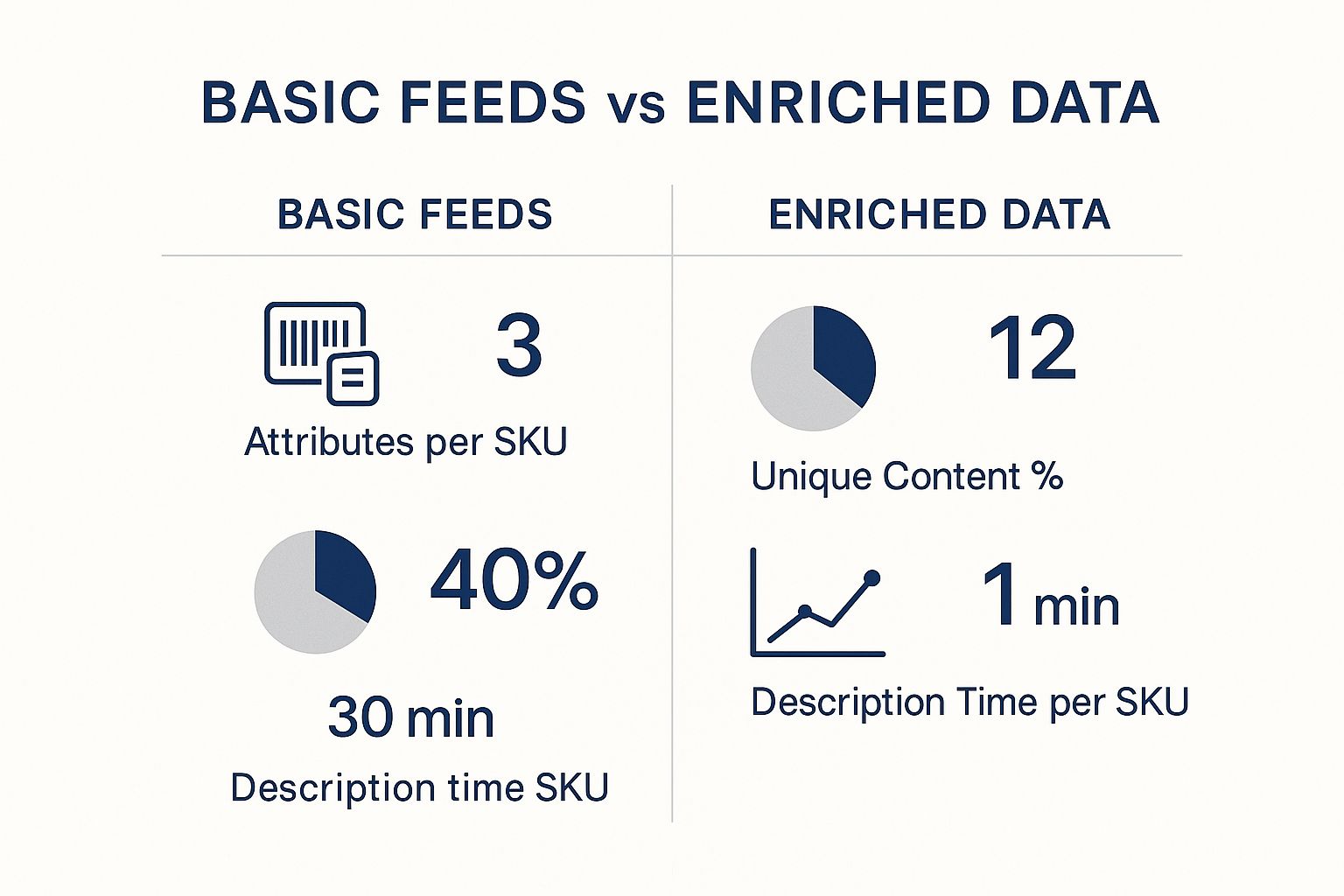
As you can see, enriching your feed massively boosts the depth and quality of your content while slashing the manual effort required. It is a complete game-changer for retail efficiency.
Training with Visual Intelligence and Nuance
A great salesperson does not just read a spec sheet. They look at the product. They will notice the texture of a fabric, the specific finish on a piece of furniture, or the layout of ports on a new laptop. Now, AI agents can be trained to do the same thing using AI image recognition and tagging.
This tech scans your product photos and pulls out dozens of valuable details often left out of supplier feeds. For a fashion store, it might identify "puff sleeves" or a "V-neckline." For a furniture retailer, it could tag "mid-century modern" design cues or a "walnut finish."
This visual data gives AI agents the critical context they need to answer super-specific customer questions. It is a massive step towards building a solid foundation for AI-compatible SEO content and improving your overall digital shelf performance.
These AI workflows are a core part of a modern retail efficiency toolset, freeing up your team to focus on strategy instead of tedious data entry. You can see how this works in the real world by learning how agentic AI shopping integrates with the Shopify Catalog API, which shows exactly how structured data directly empowers these AI agents.
The Human and AI Collaboration Model
The future of retail is not about AI replacing people. It is about human + AI collaboration in SEO. Your team's role shifts from writing endless descriptions to providing strategic oversight. They become the trainers, the strategists, and the final quality check.
This new workflow looks something like this:
- Set the Strategy: Your team defines the brand voice, target customers, and key selling points.
- AI-Powered Execution: The AI takes over, generating optimised descriptions, metadata, and image tags at scale.
- Human-Led QA: Your experts review and tweak the AI's output to guarantee it is on-brand, accurate, and authentic.
This model does not just clear retail content bottlenecks, it elevates your team to a higher strategic level. A key part of this is Mastering Search Intent Optimization to truly understand what customers are looking for, a skill perfectly suited for human oversight. This synergy between human insight and machine efficiency is what will power the next generation of retail SEO.
Achieving SEO at Scale with Content Automation
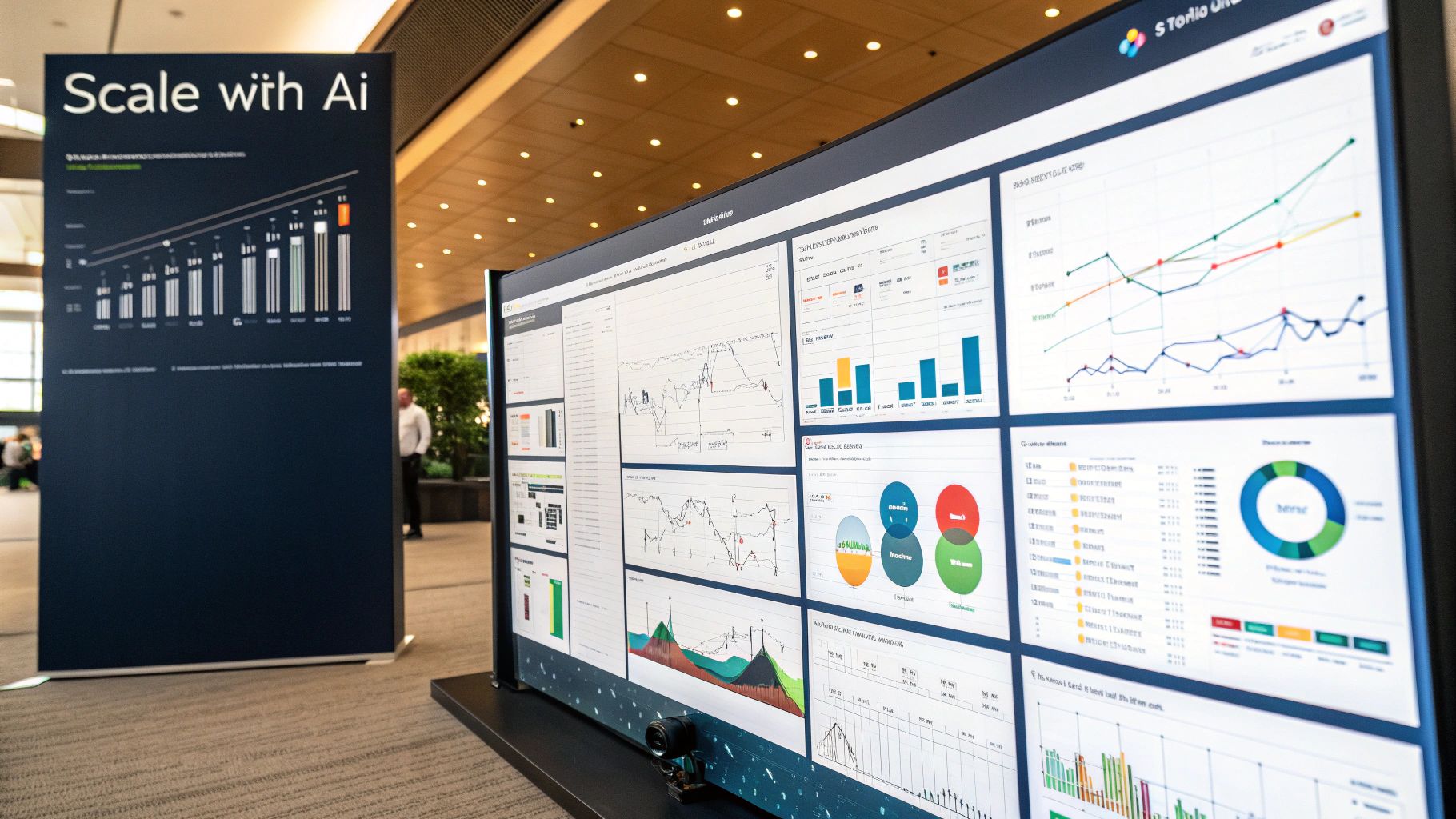
For any retail leader or ecommerce manager, the biggest hurdle to effective product catalogue SEO has always been scale. Let's be honest, manually optimising thousands, or even tens of thousands, of product pages is an impossible job. It creates massive content bottlenecks, leaving teams bogged down in repetitive busywork while real opportunities on the digital shelf slip away.
This is where AI-powered content workflows completely change the game.
These automated systems are built to execute scalable SEO solutions with incredible speed, turning what would be a months-long project into a matter of days. By shifting from manual SEO to AI-driven SEO, retailers can finally break through the barriers that have held back their digital performance for years. The goal is to deploy 10,000+ optimised pages quickly and efficiently, a task that was once pure fantasy.
And it is not just about speed. It is about strategic execution across every single part of a product page, from writing unique metadata to optimising every last image.
Breaking Through Content Bottlenecks
Traditional content creation is painfully linear and slow. An ecommerce team might spend weeks just refreshing a single category. Meanwhile, automated content workflows run in parallel, processing an entire catalogue all at once. This approach hits common retail pain points head-on.
- Supplier Content Duplication: AI can rewrite thousands of generic supplier descriptions, creating unique content that sidesteps SEO penalties and carves out a distinct brand voice.
- Metadata Optimisation at Scale: It can generate unique, keyword-rich meta titles and descriptions for every SKU, improving click-through rates from search results.
- Alt Tag Optimisation for Retail: AI image recognition can analyse product photos and automatically write descriptive alt tags, a critical but often ignored part of image SEO for ecommerce.
These retail efficiency tools are designed for the real-world complexity of modern catalogues, especially in sectors like fashion and furniture where visual details are everything, addressing key needs in fashion SEO optimisation and furniture SEO services.
The real advantage of AI workflow automation for retail is its ability to handle immense volume without ever sacrificing quality. It gives teams the power to achieve a level of consistency and depth in their SEO that is impossible to do by hand, leading directly to better rankings and more conversions.
The Power of Human and AI Collaboration
Bringing in automation does not mean sidelining your team. Quite the opposite. It creates a powerful model of human + AI collaboration in SEO. The AI does the heavy lifting, the repetitive, soul-crushing tasks that lead to burnout and kill momentum.
This frees up your human experts to focus on what they do best: strategy, creative direction, and quality control.
Your team’s role shifts. They become the conductors of the AI orchestra, setting the brand guidelines, refining the outputs, and making sure every piece of content aligns with the bigger business goals. This synergy is central to the future of work in retail, where efficiency tools amplify human talent instead of replacing it.
This partnership ensures that even at massive scale, your brand's messaging stays authentic and relevant to a diverse Australian market. The local online shopper profile is broad, with major spending across all generations. In 2023, Millennials spent US$14.8 billion online, followed by Gen X (US$11.7 billion), Baby Boomers (US$8.3 billion), and Gen Z (US$7.1 billion). AI can help tailor content for these different groups, but it is human oversight that keeps the core brand message consistent. You can explore more about the Australian ecommerce market and its demographics to understand this audience better.
This collaboration transforms retail teams and AI efficiency, setting a new benchmark for productivity. It is this blend of machine speed and human insight that delivers true SEO at scale for retailers.
Preparing for the Future of Agentic Commerce
Looking beyond the immediate wins of automation, the rise of AI is fundamentally reshaping the future of work in retail here in Australia. For retailers, this is not just about making old processes faster, it is a strategic shift. Roles are already moving away from repetitive tasks like manual data entry and toward high-value, strategic oversight.
This shift is clearing the path for the next massive leap in ecommerce: agentic commerce. This is not some far-off sci-fi concept. It is the very near future where your customers will delegate complex shopping tasks to their personal AI agents.
Just imagine a shopper asking their device, "Find me a sustainably made, waterproof jacket under $300, in a forest green colour, with good reviews for hiking in Tasmania." The agent's job is to instantly sift through millions of products, understand every nuance of that request, and present the perfect options. This is exactly where your investment in high-quality product data and agentic search optimisation starts to pay off.
Making Your Products Discoverable to AI Shoppers
For an AI shopping agent to find and recommend your products, it needs a lot more than just a brand name and a price. It needs deep, structured, and contextual data. The product feed optimisation you are doing today is, quite literally, the training manual for these future AI agents.
Every attribute you add, every unique product description you write, and every piece of sloppy supplier content you fix helps an AI understand your products with absolute clarity. Without this foundational work, your products will be completely invisible in the new era of AI shopping SEO.
Agentic commerce is the next frontier of retail, where AI assistants will act as personal shoppers for consumers. Brands with the most structured, detailed, and authentic product data will be the ones these agents trust and recommend, creating a powerful new competitive advantage.
This is a critical concept for retail leaders to wrap their heads around. The future is not just about getting a human to your website, it is about convincing an AI that your product is the best possible answer to a human's need. Exploring some successful AI agent implementations can offer practical insights into how to prepare for this shift.
The Long-Term Competitive Advantage
Retailers who adopt AI-powered transformation early are building a significant moat around their businesses. While competitors are still stuck wrestling with manual content bottlenecks and messy supplier feeds, forward-thinking brands are creating intelligent, scalable product catalogues ready for whatever comes next.
This readiness is vital, especially in a market that is set to explode. The Australian eCommerce landscape is forecasted to grow from 17.08 million online shoppers in 2024 to a massive 23.14 million by 2029, a 35% surge. Training AI agents to understand and communicate your brand’s value will be essential to capturing this expanding audience.
Ultimately, this is not just an operational upgrade, it is a complete strategic repositioning. By embracing AI agents for retail efficiency, you are not just improving your digital shelf performance for today. You are securing your brand's place in the future of agentic commerce. To get a deeper dive into how this will reshape the online world, explore our detailed guide on the agentic commerce future. This kind of foresight is what will separate the market leaders from the laggards in the years ahead.
Got Questions About AI in Retail? We've Got Answers.
As retail leaders and ecommerce managers start exploring AI-driven strategies, the same questions tend to pop up. Here are some straight, practical answers to the most common queries we hear about AI-powered product feeds and the shift to agentic commerce.
What Is the First Step to Prepare for Agentic SEO?
Before you do anything else, you need to audit your existing product data. It is the most critical first step. You simply cannot train a reliable AI agent with incomplete, inconsistent, or inaccurate information. Think of it as the foundation of your entire AI SEO strategy.
Start by pulling all your supplier feeds and internal product info into one single source of truth. The goal here is to hunt down the gaps, inconsistencies, and any product pages still running on duplicated supplier content.
This initial cleanup and centralisation is not just busywork, it is the bedrock for every AI-powered content workflow you will build. Before you can dream of automating product descriptions or using AI image recognition and tagging, you need clean, structured, and complete data to work from. It is the essential prep for agentic search optimisation.
How Do We Ensure Brand Voice Remains Authentic with AI?
This is a big one, but the answer is simpler than you think: you maintain authenticity with a strong, human-led quality assurance process. It is a common misconception that AI erases your brand’s voice. In reality, it is designed to scale it. The key is giving the AI a strict set of rules to follow.
You do this by creating detailed brand style guides, comprehensive tone-of-voice documents, and a library of approved brand messaging. This material is then used to fine-tune the AI models, effectively teaching the AI the nuances of your brand, from the specific words you use to the emotional tone you want to hit.
The best model is always human + AI collaboration in SEO. The AI handles the heavy lifting, generating the first draft at scale, but your team reviews, refines, and gives the final sign-off. This workflow guarantees every description is perfectly on-brand while still getting the speed and efficiency benefits of AI.
This collaborative approach frees your creative team from grinding through repetitive tasks. Instead, they can focus on strategic oversight, making sure the soul of your brand stays intact across your entire digital shelf.
Will AI Automation Replace Our Content Teams?
No, but it will absolutely transform their roles for the better. The future of work in retail is not about replacing talented people, it is about augmenting them with powerful tools. AI workflow automation for retail is built to kill off the most tedious, mind-numbing parts of content management.
Your team’s focus will shift from manual grunt work, like writing thousands of unique meta descriptions or alt tags, to more strategic, high-value activities. They will become AI workflow managers, content strategists, and quality assurance specialists.
Their new responsibilities will look more like this:
- Training the AI: Feeding the models the right brand guidelines and providing feedback to sharpen performance.
- Setting Strategic Direction: Defining content goals and tweaking the AI's output to hit business targets.
- Ensuring Quality and Authenticity: Acting as the final gatekeepers for the brand voice and customer experience.
It is about equipping your team with AI efficiency tools, not replacing them. In this new model, human creativity and strategic insight are more valuable than ever.
How Is SEO for AI Agents Different from Traditional SEO?
The difference is massive. Traditional SEO was often a game of keywords and backlinks, optimising content for search crawlers that scanned for text signals. SEO for AI agents, or agentic SEO, demands a much deeper, more contextual approach.
AI agents need to understand your products like a human sales expert would. This means your product data has to be highly structured with clear, granular attributes like colour, material, dimensions, and compatibility. It also requires rich, benefit-focused descriptions and a clear map of the relationships between different products.
For example, instead of just optimising for "women's hiking boots," AI-compatible SEO content needs to be structured to answer a complex, conversational query like, "What are the best waterproof leather hiking boots for wide feet, suitable for multi-day treks in the Blue Mountains?"
Answering that question properly requires deep product data enrichment and SKU-level SEO. This pivot from keyword-stuffing to contextual, structured data is the fundamental difference between legacy SEO and being ready for the future of retail search. It is about building a comprehensive knowledge base that makes your products the most logical and authoritative answer for any AI-powered shopping assistant.
Ready to stop wrestling with manual content bottlenecks and prepare your brand for the future of agentic commerce? Optidan AI uses advanced AI workflows to transform your product feeds, creating thousands of unique, SEO-ready product pages at scale. See how we can enhance your digital shelf performance and drive real results.
