


Getting your product catalogue ready for agentic search is a completely different ball game. It’s a fundamental shift away from old-school SEO. We’re now talking about creating AI-compatible SEO content. This means structuring your product data with rich, machine-readable attributes so AI agents like ChatGPT and Amazon Rufus can find, compare, and recommend your products autonomously. This is the new frontier of AI SEO and the core of future-proofing your digital shelf performance.
The End of Traditional SEO for Retailers
The way Australian customers find products is changing for good. The days of optimising a category page with a few keywords are over, replaced by an urgent need for Agentic Search Optimisation. AI agents are making traditional SEO tactics obsolete, forcing a hard pivot from manual SEO to AI SEO. For retail leaders and ecommerce managers, this isn't a future trend, it's a current reality.
This isn't some far-off concept; it's happening right now. The heart of this new approach is your product catalogue. It's no longer just a backend list of inventory, it's the foundational data layer for every AI-driven sale. For retailers who get this right, it’s a massive opportunity to own the future of Agentic Commerce and lock down a prime position on the digital shelf. This AI-powered retail transformation demands a strategic rethink of content workflows and retail efficiency tools.
A New Battlefield for Visibility
In this new world, visibility is won or lost at the SKU level. An AI agent doesn't care about your beautifully designed landing page. It goes straight to your product data, interrogating it for specific, structured information to answer a person's conversational question. This is the essence of SEO for AI agents.
Here are the key shifts retail leaders need to wrap their heads around:
- From Keywords to Attributes: Success isn't about ranking for "women's black dress" anymore. It's about having structured data for attributes like sleeve length, neckline style, fabric composition, and occasion suitability that an AI agent can actually understand and use.
- From Pages to Products: The focus is shifting from webpage rankings to how machine-readable your individual products are. Product Catalogue SEO is your new secret weapon for improving digital shelf performance.
- From Manual Tweaks to Automation at Scale: You can't manually optimise thousands of SKUs. It's just not possible. AI-powered content workflows and retail content automation are the only way to get the speed and scale you need to compete, turning a content bottleneck into a strategic advantage.
The Urgency for Australian Retailers
The Aussie retail market's reliance on digital is picking up speed. With online sales influencing a significant portion of total retail revenue, a catalogue that's invisible to AI agents is a serious liability. Retailers need scalable SEO solutions that can handle the volume of modern ecommerce.
This shift means that retailers still clinging to outdated SEO practices will quickly become invisible. If your product data isn't structured for AI consumption, you essentially don't exist in the new world of agentic shopping. This is the core challenge of moving from traditional SEO to next-gen SEO for retailers.
As old SEO strategies lose their punch, it’s critical to understand what a robust search solution looks like. For example, looking into the benefits of implementing enterprise search with Sitecore Search can offer some solid insights into building the kind of infrastructure you'll need. The future of retail search belongs to those who get their data ready today.
Turning Supplier Feeds into Strategic Assets
Your product catalogue is the very foundation on which AI-driven discovery is built. Making the jump from old-school SEO to what's required for agentic search starts with one critical step: turning those raw, messy supplier feeds from a liability into your most powerful asset through product data enrichment. This is where so many retailers get stuck, bogged down by generic, duplicated descriptions that damage SEO and digital shelf performance.
To an AI agent, a basic supplier feed is practically invisible. It’s missing the rich attributes, the context, and the unique language that Agentic Search Optimisation thrives on. To get noticed, you need a systematic process for optimising product feeds efficiently. This is all about transforming thin supplier data into a detailed, structured resource that machines can easily understand and, more importantly, trust.
The infographic below highlights the shift in how product discovery now works. We're moving away from simple keyword searches towards complex data analysis led by AI agents.
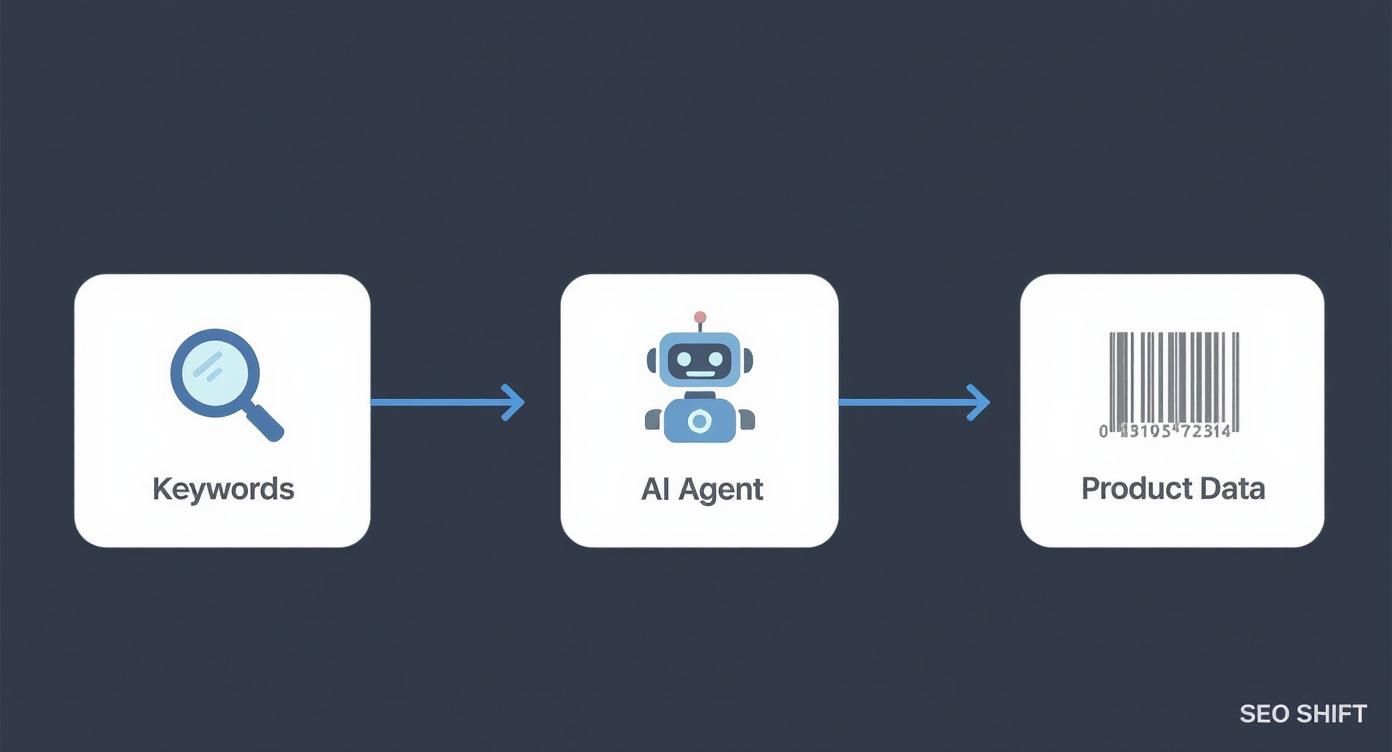
What this really shows is that AI agents for retail efficiency are the new gatekeepers. They don’t care about the keywords you've stuffed onto a page; they rely entirely on the quality and depth of your product data.
Solving Supplier Content Duplication at Scale
The biggest hurdle for most ecommerce managers is Supplier Content Duplication. It’s a huge problem. Using the exact same product description as dozens, sometimes hundreds, of other retailers is a fast track to poor search performance and a brand voice that gets completely lost in the noise. This is where a duplicate content SEO fix becomes a top priority.
Of course, manually rewriting thousands of SKUs just isn’t feasible. This is why automated content workflows are no longer a "nice-to-have", they're essential for achieving SEO at Scale.
An AI-powered approach to supplier feed enrichment completely changes the game. It looks something like this:
- Ingesting Raw Feeds: First, you systematically pull in all the basic data from your suppliers, think model numbers, dimensions, and materials.
- Attribute Extraction: Then, AI gets to work identifying and structuring key product features that are often buried deep inside unstructured blocks of text.
- Unique Content Generation: Finally, generative AI creates distinct, on-brand product descriptions, titles, and metadata for every single one of your SKUs, automating product descriptions at an unprecedented scale.
This workflow takes what used to be a manual, months-long nightmare and turns it into a task completed in days. It lets you sidestep SEO penalties while carving out a unique presence on the digital shelf. For a deeper dive, check out our guide on transforming your supplier feed management.
Before we move on, let's look at a clear comparison of what this transformation actually means for your data.
Traditional vs. Agentic-Ready Product Data
| Data Attribute | Traditional Catalogue Approach | Agentic-Ready Catalogue Approach |
|---|---|---|
| Product Title | Basic, keyword-focused (e.g., "Black T-Shirt") | Descriptive, context-rich (e.g., "Men's Classic Crewneck T-Shirt in Jet Black, 100% Organic Cotton") |
| Description | Copied from supplier, feature-based | Unique, benefit-driven, answers likely user questions |
| Attributes | Limited, often missing (e.g., colour, size) | Exhaustive & structured (e.g., material, fit, sleeve length, care instructions, origin) |
| Categorisation | Broad, inconsistent categories | Granular, multi-level taxonomy aligned with search intent |
| Uniqueness | High duplication across the web | 100% unique content for every SKU |
| Machine Readability | Poor, unstructured text | High, uses schema and structured fields for easy parsing by AI |
As you can see, the agentic-ready approach isn’t just about adding more words; it’s about adding structured, meaningful information that helps an AI make a confident recommendation.
Investing in a Future-Ready Catalogue
Australian retailers are definitely waking up to this shift. The country's catalogue management system market is projected to grow significantly, a clear signal that businesses are investing heavily in sophisticated digital catalogues built for machine readability and agentic search.
Ultimately, preparing your product catalogue for agentic search isn't just a technical task. It’s a strategic imperative that directly impacts your future visibility, efficiency, and competitiveness in the new landscape of Agentic Commerce.
By finally fixing that duplicated supplier content and enriching your product data at scale, you’re not just optimising for today’s search engines. You’re building the solid data foundation required to win in an AI-driven retail world. This is the very core of modern Retail SEO Automation.
Preparing Your Visuals for AI-Powered Search
If you're in a visually-driven industry like fashion, furniture, or electronics, you already know that how a product looks is just as important as what it does. But in the new world of agentic search, that visual information can't just be locked away inside a JPEG file. AI agents need to understand the aesthetics of your products with the same clarity they understand technical specs.
This is where AI Image Recognition SEO becomes a non-negotiable part of your catalogue strategy. It's the process of teaching AI what your products look like by embedding rich, descriptive data into every single image.

Trying to manually tag thousands of SKUs is an impossible task, it's a classic retail content bottleneck. Instead, retail content automation tools can analyse your entire image library and perform Product Image Tagging at a scale and speed that human teams just can't match. This isn't just about saving time; it's about transforming your visual assets into structured, searchable data points that AI can actually use to improve digital shelf performance.
From Basic Alt Tags to Rich Visual Descriptors
For years, we've optimised alt tags for accessibility and basic keyword SEO. That's no longer enough. Agentic search demands much more granular, descriptive data about visual characteristics for effective alt tag optimisation for retail.
Think about the difference:
- Old Approach:
alt="walnut sideboard" - Agentic-Ready Approach:
alt="Art Deco walnut sideboard with brass handles and tapered legs"
That level of detail is absolutely crucial. When a user asks an AI agent to find "a sideboard that matches my mid-century modern living room," the agent needs specific visual cues like "tapered legs" or "brass handles" to make an accurate recommendation. Without this structured data, your visually perfect product remains completely invisible.
By enriching your visual assets, you are essentially creating a new, powerful layer of searchable attributes. This structured visual data empowers AI agents to fulfil highly nuanced customer queries, directly improving your digital shelf performance in searches where aesthetics are paramount.
Optimising Visual Data Across Verticals
This principle applies right across the board in visually focused retail. For a fashion retailer, automated tagging can identify and label key attributes directly from an image, turning a simple photo into a data-rich asset. If you want to dive deeper into how this works on the page itself, it's worth reading up on AI-driven product page optimisation.
Here are a few real-world examples:
- Fashion SEO Optimisation: AI can tag images with attributes like ‘V-neck linen blouse’, ‘puffed sleeves’, or ‘floral A-line skirt’.
- Furniture Image Tagging SEO: It can pick out styles such as ‘Scandinavian oak coffee table’ or ‘industrial metal bookshelf’.
- Electronics SEO Optimisation: AI can even recognise visual features like a ‘bezel-less display’ or a ‘brushed aluminium finish’.
This automated metadata optimisation at scale ensures every single product image is actively contributing to its own discovery. It’s a core component of future-proofing your catalogue, making your products not just visible, but truly understandable to the AI agents shaping the future of retail search.
Structuring Product Data for Machine Readability
Here’s a hard truth: AI agents don’t care about your website’s beautiful design or clever marketing copy. They don't browse, they parse. To them, your site is just a source of data to be ingested and analysed. If you want to show up in agentic search, you need to stop thinking about surface-level SEO and get serious about deep, structural readiness. This is the difference between AI SEO and traditional SEO.
This all begins with a relentless focus on schema markup. Think of schema as a universal language that speaks directly to search engines and AI agents. By wrapping your product information in Product, Offer, and Organization schema, you’re creating an explicit, machine-readable data layer that leaves nothing to chance. This is the bedrock of Generative AI SEO and the only way AI shopping SEO assistants will ever find your products.

Getting this right is absolutely essential for competing in Australia's massive eCommerce market. With millions of Aussies shopping online every month and that number projected to grow, a clean, well-prepared catalogue isn't just a nice-to-have, it's your key to capturing a piece of that growth and ensuring strong digital shelf performance.
The Shift to SKU-Level SEO
In this new era of agentic commerce, optimising your category pages just isn't enough anymore. The real battle for visibility is now fought and won at the individual product level. This is where SKU-Level SEO becomes critical for retail leaders.
Every single variant, from a t-shirt in six different colours to a sofa in three fabric options, needs its own complete and accurate structured data.
Imagine an AI agent helping a customer find a "size 12 navy blue cotton V-neck t-shirt." It’s going to query data for each of those specific attributes. If your product variants aren't individually and explicitly defined with schema, they are completely invisible to that AI. They simply won't even make it into the consideration set. This granular approach is the only way to make sure every single item in your inventory is discoverable.
Mastering Multi-Channel Product Optimisation
A pristine, centralised catalogue is the engine that drives effective Multi-Channel Product Optimisation. Once your product data is perfectly structured and enriched through supplier feed enrichment, you can syndicate it to marketplaces like Amazon, The Iconic, or Catch without the data falling apart along the way.
That consistency is non-negotiable. Why? Because AI agents will absolutely compare offers across different platforms.
Any discrepancies in pricing, stock levels, or product attributes between your website and a marketplace listing can create distrust for an AI agent. This causes it to favour a competitor with cleaner, more consistent data. Your goal has to be a single, unified source of truth.
To pull this off, retailers need robust retail content automation systems that can:
- Validate schema before pushing feeds out to various channels.
- Customise data to meet the unique formatting rules of each marketplace.
- Maintain real-time synchronisation of inventory and pricing across every single platform.
This meticulous data management ensures your products show up accurately, everywhere they’re listed. To see how this all fits together, our guide on how structured data drives visibility across every retail channel offers a much deeper dive.
Ultimately, structuring your product data for machines is the single most important technical step you can take. It turns your inventory from a simple list of products into a powerful, AI-compatible asset ready for the future of search.
Building Your AI-Powered Content Workflow
Manually optimising thousands of SKUs for agentic search is a non-starter. The sheer scale of modern retail makes traditional, human-only content teams a massive bottleneck. This is where the Future of Work in Retail really starts to take shape, moving from mind-numbing repetition to sharp, strategic oversight with the help of AI agents in ecommerce.
The new model is all about Human + AI Collaboration in SEO. By putting smart AI Workflows for Ecommerce in place, retailers can finally achieve genuine SEO at Scale. AI agents do the heavy lifting, enriching product data, writing unique descriptions, and sorting out metadata, which frees up your team for the high-value strategic work they were hired to do. This is the core of an efficient AI workflow automation for retail strategy.
Suddenly, the content bottlenecks holding back growth disappear. Instead of taking months to refresh a category, you can get tens of thousands of pages optimised in a matter of days.
Shifting From Manual Labour to Strategic Oversight
The goal here isn't to replace your expert teams; it's to supercharge them. An AI-powered content workflow elevates your content specialists from production line workers to strategic editors and quality assurance leads. Their deep industry knowledge and brand intuition become more valuable than ever.
In practice, this human-led AI content QA process looks something like this:
- AI Takes the First Pass: The system pulls in raw supplier feeds and generates thousands of unique, attribute-rich product descriptions and titles. It works from a set of predefined rules and your specific brand tone of voice.
- Humans Refine and Approve: Your team then steps in to review the AI-generated content. They’re not writing from scratch; they’re fine-tuning for nuance, checking brand alignment, and making strategic keyword adjustments before approving content in batches.
- The System Learns: All that feedback from the human QA process is fed back into the AI models. This refines the system, making future outputs even better and driving efficiency gains over time.
This operational shift is the absolute core of making AI work. For a much deeper look into how this plays out, our guide on the real driver of AI ROI for retailers breaks down exactly how these workflows create real, measurable results.
This collaborative model is the natural evolution of Retail Teams and AI Efficiency. It frees up your most important asset, your people, to tackle complex problem-solving, competitor analysis, and big-picture strategy instead of drowning in repetitive content creation.
Integrating Prompt Engineering for Better Outputs
To truly get the best out of your AI tools, your team needs to get good at talking to them. This is where prompt engineering moves from a niche skill to a core competency for any modern retail team. A well-crafted prompt is the difference between generic, unhelpful copy and content that's unique, contextually spot-on, and perfectly aligned with your brand.
For anyone looking to really get their head around AI interaction and how to communicate effectively with these new agentic systems, a practical guide to prompt engineering is a great place to start building that foundational knowledge. Mastering this skill is non-negotiable for building a truly efficient, future-proof operation.
Common Questions We Get About Agentic Search
As retail leaders start to wrap their heads around this shift to agentic commerce, a lot of practical questions pop up. It makes sense. This isn't just a small tweak to your SEO strategy; it's a fundamental change in how you need to think about product data, content, and your day-to-day workflows.
Let's dive into some of the most common queries we hear from ecommerce managers getting their catalogues ready for an AI-driven world. The running theme here is moving from optimising for human eyeballs to structuring data for AI agents. It’s a complete overhaul of your digital shelf.
What Exactly Is Agentic Search? How Is It Different?
Agentic search is what happens when AI agents, think tools like Amazon Rufus or even ChatGPT, do the shopping for the user. They proactively find, compare, and present products based on conversational requests. This is a world away from traditional SEO, where the goal has always been to rank a webpage for a specific keyword.
Agentic Search Optimisation, then, is all about structuring your product data so these AI agents can easily grab it, understand it, and recommend it. This means getting granular. We're talking highly detailed, attribute-rich product feeds and schema markup right down at the SKU-level, not just optimising your category pages. An AI doesn't "browse" a website; it queries your data directly.
How Do We Fix Duplicated Supplier Content Across Thousands of Products?
Trying to fix Supplier Content Duplication at scale with a manual team is a losing battle. You simply can't keep up. The only realistic solution is to use AI-Powered Content Workflows.
The process starts by ingesting all your raw supplier feeds. From there, generative AI gets to work, creating unique product descriptions SEO from the core attributes like materials, key features, and dimensions.
This kind of automated content workflow for Product Data Enrichment can rewrite thousands of descriptions in the time it would take a human team to do a handful. It solves the duplicate content problem for your SEO and, just as importantly, massively improves the quality and uniqueness of your product pages.
The reality is, moving from manual SEO to AI-driven SEO is no longer optional. Retailers still relying on outdated, duplicated supplier content will find their products are simply invisible to AI agents. These agents are programmed to prioritise unique, trustworthy, and richly detailed information.
What’s the First Practical Step We Should Take?
Before you can build anything, you need to know what you're working with. The most critical first step is a thorough audit of your current product data.
Your audit should dig into the quality, completeness, and structure of your product information, starting with your main supplier feeds. Look for the obvious gaps, missing attributes, messy formatting, and the sheer volume of duplicate content. This analysis gives you a clear baseline and helps you figure out where to focus your Product Feed Optimisation efforts first.
- Is your data actually structured with schema?
- How many of your products are missing crucial attributes like material or dimensions?
- What percentage of your product descriptions are just copy-pasted from suppliers?
Answering these questions lays the foundation for any successful Agentic SEO project. For a deeper dive into these topics, feel free to explore our comprehensive Agentic AI SEO FAQs for more detailed insights.
Ready to transform your product catalogue and get ahead in the future of retail search? Optidan AI provides the AI-powered content workflows you need to achieve SEO at scale, turning messy supplier feeds into strategic assets. Book a demo today and see how we can optimise 10,000+ pages in just a few days.
