


While many retailers are still focused on flashy, customer-facing AI, the real money is being made behind the scenes. The biggest driver of AI ROI isn't chatbots or virtual try-ons, it’s AI workflow automation for retail. This is where you transform slow, manual jobs like product data enrichment and creating content into slick, scalable systems that deliver next-gen SEO for retailers.
Making this shift from manual SEO to AI SEO is how you start winning on the digital shelf and seriously improve profitability.
The Real Engine of Retail AI ROI is Workflow Automation
For years, retail content and SEO teams have been buried under a mountain of manual work. It's a painful cycle that kills growth. Think about the hours spent painstakingly writing unique product descriptions or correcting duplicated supplier content from feeds. It's a massive, unsustainable workload, especially when you have thousands of SKUs, leading to significant retail content bottlenecks.
This old-school approach makes achieving SEO at scale an expensive, slow-moving nightmare.
AI-powered retail content automation completely flips this on its head. By setting up automated content workflows, you can break free from those limits. Imagine optimising over 10,000 product pages in a matter of days, not months. This isn't just about moving faster, it's about gaining a genuine strategic edge in your digital shelf performance.
The big change is moving your team from tedious grunt work to high-impact strategy. Instead of manually fixing product feeds, they can focus on analysing the market, planning campaigns, and getting ready for the new world of agentic commerce.
This operational uplift is exactly why we're seeing huge investment in the space. The AI retail market in Australia and New Zealand hit $310.9 million in a recent year, and that figure is expected to skyrocket to $1.99 billion by 2030. This isn't just hype, it shows real confidence in AI’s power to overhaul retail from the ground up.
From Manual Bottlenecks to Automated Success
To get this right, you need to understand effective marketing workflow automation and how it solves real-world retail problems. It allows you to tackle critical pain points with scalable SEO solutions that actually work.
Take a look at the difference AI automation makes to everyday retail tasks.
Manual vs AI-Powered Retail Workflows
| Retail Task | Traditional Manual Workflow | AI-Automated Workflow Impact |
|---|---|---|
| Product Data Enrichment | Manually copying and pasting supplier data into a CMS. Hours spent rewriting basic specs. | Raw supplier feeds are automatically transformed into structured, optimised, customer-ready content in minutes through efficient product feed optimisation. |
| Fixing Duplicated Content | A content writer manually rewrites a handful of top-selling product descriptions one by one to fix supplier content duplication. | Unique, SEO-friendly descriptions are generated for every single SKU, eliminating duplication penalties and boosting organic visibility across the board. |
| Image Tagging & Alt Text | An intern or junior team member spends weeks adding basic alt tags to thousands of product images. | AI image recognition instantly creates descriptive alt tags and metadata, which is crucial for fashion SEO optimisation and furniture SEO services. |
| Category Page Content | SEO manager writes generic intro text for a few key categories, leaving others thin or empty. | Compelling, keyword-rich content is created for every category and brand page, building topical authority and improving digital shelf performance. |
This table isn't just about saving time, it's about unlocking performance that was impossible before. By automating these workflows, you're not just improving efficiency, you're building a more resilient, competitive, and profitable business.
Here are a few key areas where AI workflows are making the biggest impact:
- Product Data Enrichment: Automatically turning raw, messy supplier feeds into clean, structured, and customer-friendly content.
- Correcting Duplicated Content: Wiping out SEO penalties by generating unique product descriptions for every item, finally moving past generic supplier copy.
- Image Recognition and Tagging: Creating descriptive alt tags and metadata for thousands of images, a task that was once a huge manual bottleneck, especially for fashion and furniture retailers.
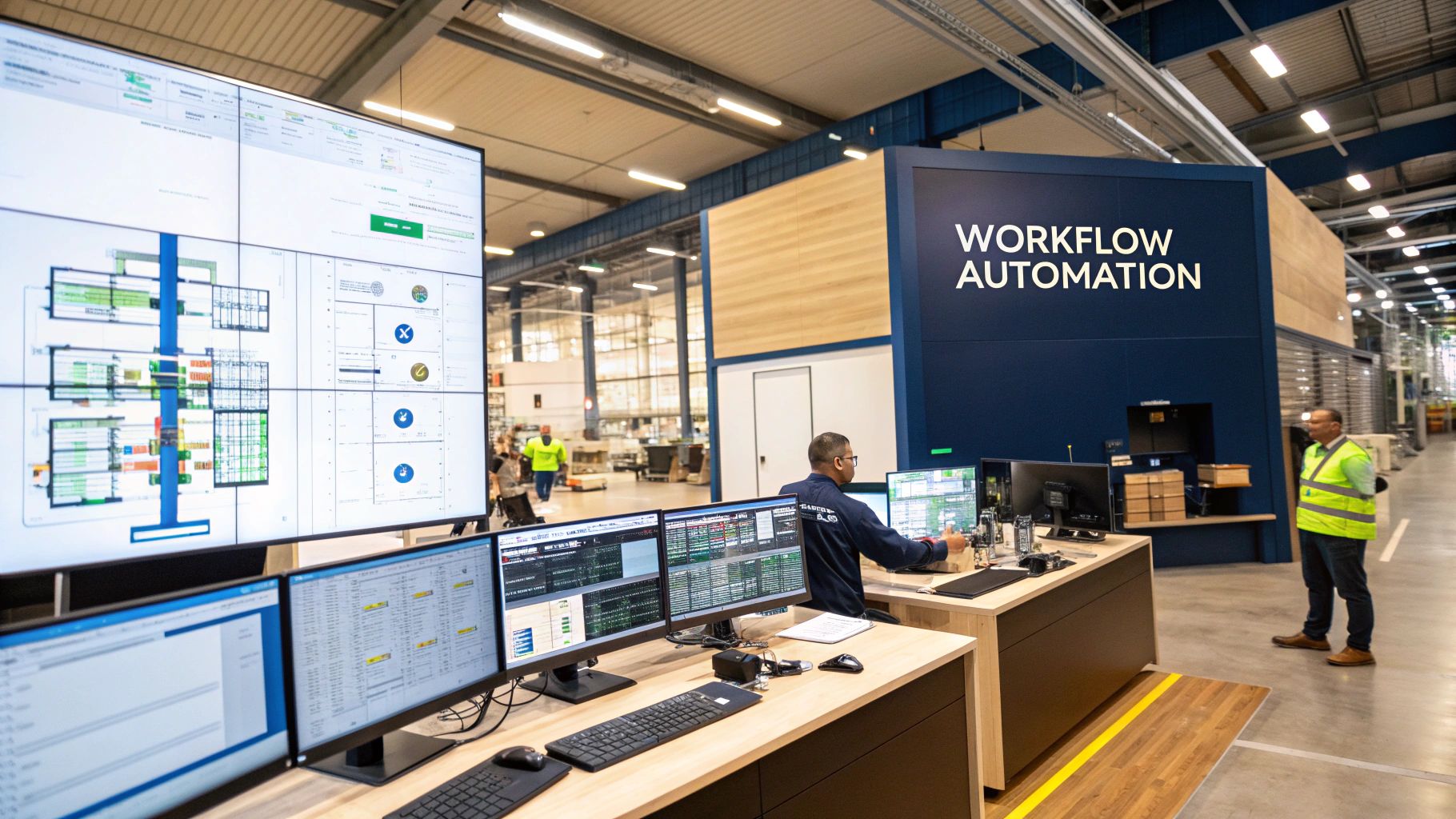
When you embrace these kinds of retail efficiency tools, you’re not just patching up old processes. You're building a solid foundation for the future of work in retail. Our guide on winning the digital shelf dives deeper into what it takes to compete in this new landscape.
Turn Raw Supplier Feeds into Customer-Ready Content at Scale

One of the biggest hurdles for any Australian retailer is the soul-crushing task of turning raw, inconsistent supplier data into optimised, unique content for the digital shelf. This manual process is a notorious bottleneck, slowing down time-to-market and draining your team’s resources.
An AI-powered workflow for product data enrichment breaks this cycle. It ingests messy supplier feeds, automatically standardises formats, corrects errors, and enriches basic data with compelling attributes that genuinely matter to customers.
This automation directly attacks the pervasive problem of duplicated supplier content, which severely harms SEO rankings. Instead of generic copy-paste descriptions that Google penalises, AI generates unique, brand-aligned content for every single product.
Optimised at Scale: The Real Advantage
The true power of this approach is achieving optimised at scale. An AI-driven system can process, enrich, and create unique content for tens of thousands of SKUs in days. This is a task that would take a human team months to complete, if they could even get to it.
This speed dramatically accelerates your product launches and ensures every item in your catalogue contributes positively to your SEO performance.
This isn't just about clearing a backlog, it's about establishing a scalable, repeatable process. This AI workflow automation ensures that as your product catalogue grows, your content quality and SEO performance grow with it, without exponentially increasing your team's workload.
This level of retail content automation provides a significant competitive edge. It allows you to:
- Eliminate SEO penalties by fixing supplier content duplication across your entire catalogue.
- Boost SKU-level SEO with unique, keyword-rich descriptions and metadata.
- Improve digital shelf performance through higher-quality, more consistent product information.
- Free up your team to focus on strategy instead of tedious data entry.
By implementing AI agents for retail efficiency, you turn a major operational weakness into a powerful asset. This prepares your business not just for today's search algorithms but also for the agentic commerce future. For more on this, you can explore our insights on training AI agents to represent your brand authentically. This transition is fundamental to building a more agile and profitable retail operation.
Preparing Your Catalogue for Agentic Search and AI Shopping
The future of retail search is conversational. It's being driven by AI assistants like ChatGPT and Amazon's Rufus, which are starting to make purchase decisions for consumers. To succeed here, you need a fundamental shift in your workflow. It’s not just about keywords anymore, it's about feeding AI agents the structured, detailed, and context-rich product data they need to understand and trust your listings. This is the core of agentic search optimisation.
This means rethinking how you prepare your entire catalogue. The real goal is to create AI-compatible SEO content that directly answers the complex questions an AI shopping agent might ask. Mastering LLM SEO and AI search ranking isn't some far-off trend, it's what you need to do right now to maintain visibility.
Building a Workflow for Agentic Commerce
A practical workflow for this new reality has to be built around scalable content creation and enrichment. First up, you need unique, high-quality product descriptions for every single SKU. Move away from that generic supplier content, as it just confuses AI agents and makes you look like everyone else. This step is about establishing a foundation of trust and authority.
Next, you have to tackle metadata optimisation at scale. This means crafting descriptive titles, meta descriptions, and structured data that give AI agents clear, unambiguous signals about your product's features, benefits, and specifications.
The Australian retail sector is moving fast on this. A recent Salesforce report found that 77% of Australian retailers believe AI agents will be essential for a competitive edge within a year. On top of that, 74% are planning to boost their AI spending, which shows a clear commitment to embedding these new AI workflows for ecommerce.
That data really underscores the urgency. Retailers need to adapt their internal processes now, not later.
The Critical Role of Visual Data
Finally, any modern workflow has to address visual search, a massive component of agentic shopping. For retailers in visually-driven categories like fashion, furniture, or electronics, this is a non-negotiable part of the strategy.
An effective workflow uses AI image recognition to automatically generate highly descriptive alt tags and metadata for thousands of product images. This process can tag key attributes like:
- For Fashion: "women's high-waisted linen trousers in beige"
- For Furniture: "solid oak dining table with a mid-century modern design"
- For Electronics: "ultra-slim 55-inch OLED television with ambient backlighting"
This level of detail makes your products discoverable to AI agents that process visual and textual information at the same time. By implementing these kinds of automated content workflows, you’re future-proofing your business. To get a better handle on this shift, check out our detailed guide on agentic AI for retail, which outlines the next steps for ecommerce leaders.
How Human and AI Collaboration Delivers Quality Assurance

Bringing AI workflow automation into retail isn’t about replacing people. It's about elevating their roles. A human-led AI approach is the only way to guarantee quality, letting the technology handle the grunt work while your team provides the critical, strategic oversight.
AI agents can generate thousands of unique product descriptions and fix messy supplier content at a speed that’s simply not humanly possible. But your team understands the nuances of your brand voice and strategic positioning in a way that AI alone never will.
This partnership is what the future of work in retail really looks like. This human + AI collaboration in SEO transforms your content creators into editors, strategists, and quality auditors.
Redefining Roles for Greater Impact
This human and AI collaboration creates a seriously powerful retail content engine. The workflow is straightforward but effective: AI generates the initial content at scale, and your team refines and approves it, making sure every single piece is on-brand and hits the mark.
This frees up your best creative minds from the repetitive, low-value tasks that bog them down. Instead of just writing basic descriptions, they can focus on high-impact work like campaign development, market analysis, and shaping the future of your brand in this new agentic commerce world.
The shift from manual SEO to AI-driven workflows is already happening. A recent study found that while 82% of Australian and New Zealand retailers have deployed AI agents, only 9% fully trust them to run without human oversight. This gap highlights the critical balance between AI efficiency and human-led quality control. You can explore more of these retail AI adoption findings to get a sense of where things stand.
With this model, your content isn’t just optimised for performance, it's perfectly aligned with your brand’s identity. For anyone leading a team through this change, knowing how to review writing effectively is becoming an even more vital skill.
Putting AI Workflows into Action in Your Retail Business
Alright, let's move from theory to practice. Bringing AI-powered workflows into your business isn't about flipping a switch, it's a structured process that starts by finding your biggest headaches.
The first step is to pinpoint the most significant bottlenecks in your content pipeline. Is it the painfully slow process of enriching product data? Or maybe the inconsistent content you get from suppliers? For many, it's just the sheer volume of manual SEO tasks that eats up all your team's time.
Getting this initial diagnosis right is everything. It makes sure your first foray into content automation delivers immediate, measurable value. When you solve a real, pressing problem first, you build momentum and get the internal buy-in you need for a bigger transformation.
From Pilot to Full-Scale Rollout
The key here is to start small. Don't try to overhaul everything at once. A phased rollout, beginning with a focused pilot project, lets you prove the ROI and fine-tune your approach without massive risk.
For example, you could focus on automating product descriptions for just one high-priority category. This kind of controlled test case is perfect for showing the effectiveness of AI SEO vs traditional SEO on a manageable scale.
Once you’ve validated the workflow and seen the uplift in digital shelf performance, you can confidently scale the solution across your entire product catalogue. Big challenges, like integrating with your PIM or ecommerce platform, become much easier to tackle when you've already got a successful model to follow.
"A common mistake is trying to boil the ocean. A focused pilot project, like transforming a single product category's content, builds the business case for you. Success in one area makes the argument for full-scale AI workflow automation undeniable."
This simple, three-step process is the best way to get started.
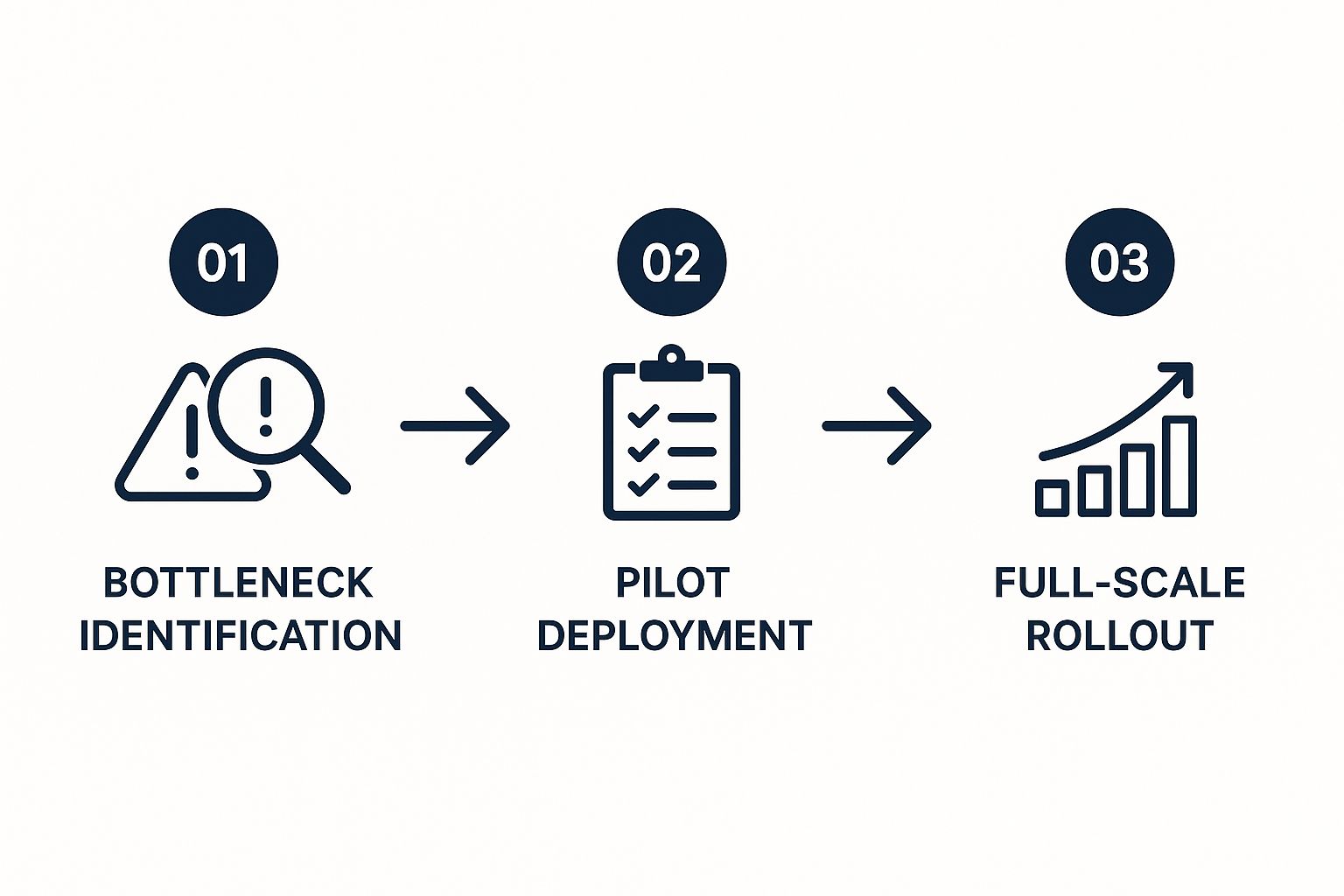
This visual roadmap simplifies the transition, showing a clear path from identifying problems to achieving a complete rollout. It reinforces the idea that scalable SEO solutions begin with targeted, strategic action. Australian retailers are already jumping on board. Recent data shows 70% of small retail businesses are already using AI tools, with another 13% planning to adopt them within two years. To learn more, read about the latest retail AI adoption trends.
Ultimately, a successful rollout comes down to choosing the right retail efficiency tools and preparing your team for a new way of working, human + AI collaboration. The goal is to make this transition an achievable, high-return initiative. For a real-world example, you might be interested in how our AI transformed content workflows from months to minutes.
Common Questions About AI Retail Workflows
When it comes to AI workflow automation, retail leaders usually have a few key questions. Getting these answers sorted early helps set clear expectations and paves a much smoother path forward.
How Much Does AI Workflow Automation Cost?
The investment really depends on the scale and complexity of your retail operations. Many of the top-tier efficiency tools are SaaS-based, so you’ll find flexible pricing tiers that can grow with you.
A smart way to start is with a small pilot project. Pick one high-impact area that’s causing a lot of headaches, like automating product description writing for a single category. This approach can deliver a tangible ROI fast, giving you a strong business case to expand the investment across your entire product catalogue.
Will AI-Generated Content Hurt My Brand?
Not if you do it right. The key is to implement a human-led AI workflow, not just let the machines run wild. Modern generative AI platforms built for retail can be trained on your brand’s specific style guide and voice.
The best approach is to let AI do the heavy lifting, drafting the initial content at scale. Your team then comes in for the final review, checking for quality, tone, and making sure everything is perfectly on-brand. It’s the perfect blend of machine efficiency and human strategic oversight.
Where Should I Start for the Biggest Impact?
For most retailers, the single most effective starting point is automating product data enrichment and unique description writing.
This area is a direct hit on some of ecommerce’s most stubborn bottlenecks. It immediately solves the supplier content duplication issue that kills your SEO, boosts your SKU-level search performance, and frees up your team’s time for more strategic work. The results are clear, measurable, and build the momentum you need for wider AI adoption.
Ready to see how AI can transform your retail content workflows from months into minutes? Optidan AI builds scalable SEO solutions that drive real results. Discover more at Optidan.
