


Winning the new race for AI ROI means Australian retailers need to fundamentally shift from old-school SEO to an agentic commerce strategy.
It’s no longer about optimising for web browsers. It’s about optimising for AI agents like ChatGPT and Amazon's Rufus by turning generic supplier feeds into highly structured, unique product data, and doing it at scale. Success hinges on embracing AI-powered content workflows and retail content automation to dominate the digital shelf before your competitors even know what hit them.
The New Reality of Retail Agentic Commerce
Australian retail is at a tipping point. The way customers discover and buy products is being completely rewired by AI agents like ChatGPT, Perplexity, and Amazon's new shopping assistant, Rufus. This is the future of work in retail.
This shift has created a brand new battlefield: the ‘digital shelf’. Here, your old SEO tactics and manual content strategies just won’t cut it. This isn't some far-off future prediction, this is the reality for 2025 and beyond.
We're now in the era of agentic commerce, where AI assistants do the heavy lifting for consumers, finding them the best products based on their needs. To even show up, your product information has to be perfectly structured for machine consumption. A proactive AI SEO strategy isn't a "nice-to-have" anymore. It's essential for seeing any real return on investment and building a competitive advantage that lasts.
You can get a deeper dive into the fundamentals of this shift in our guide to agentic commerce.
Why Legacy SEO Falls Short
Traditional SEO was all about pleasing search engine crawlers with keywords and backlinks. Simple enough. But Agentic SEO is a completely different game. It’s about feeding conversational AI agents rich, structured data that directly answers complex, human-like questions.
The difference is crucial. An AI agent doesn’t just scan for a keyword. It tries to understand the context, the attributes, and the relationships between different products to find the perfect match.
This demands a move from manual SEO to AI SEO. Relying on duplicated supplier content, a common shortcut for far too many retailers, is now a direct path to becoming invisible. Those generic descriptions lack the unique detail and structure AI agents need to confidently recommend your products. The result? Poor digital shelf performance and a significant retail content bottleneck.
To get a clearer picture of this shift, it helps to see the two approaches side-by-side.
Transitioning from Traditional SEO to AI-Ready Agentic SEO
The table below breaks down the key differences between the old way of doing things and the new requirements for being ready for agentic commerce.
| Attribute | Traditional SEO Approach | Agentic SEO (AI-Ready) Approach |
|---|---|---|
| Primary Target | Search engine crawlers (e.g., Googlebot) | AI agents and LLMs (e.g., ChatGPT, Perplexity) |
| Content Focus | Keywords, backlinks, on-page elements | Structured data, unique attributes, context |
| Data Source | Often relies on duplicated supplier feeds | Unique, retailer-owned, enriched product data |
| Key Metric | Keyword rankings, organic traffic | AI agent visibility, query answer rate, conversions |
| Workflow | Manual content creation, slow updates | Automated, AI-powered content enrichment at scale |
| Goal | Rank a URL on a search results page | Have a product recommended directly in an AI response |
This isn't just a minor tweak to your existing strategy, it's a complete rethink of how product information is created, managed, and served, marking the next-gen SEO for retailers.
Embracing AI for Scalable Optimisation
The sheer scale of this challenge is massive, especially if you’re managing thousands of SKUs. This is where AI-powered content workflows become a genuine game-changer. The focus needs to be on a few key areas:
- Product Data Enrichment: Systematically turning basic supplier feeds into detailed, unique, and SEO-optimised product listings that actually sell.
- Correcting Duplicated Supplier Content: Automating the rewrite of those generic descriptions to establish a unique brand voice and avoid search penalties.
- Optimised at Scale: Putting systems in place that can enrich tens of thousands of product pages in days, not months. This is SEO at scale.
- AI Image Recognition & Tagging: Automatically tagging images with rich metadata, which is absolutely critical for visual-heavy sectors like fashion and furniture.
This infographic breaks down the core process, from getting your data foundations right to achieving market leadership.
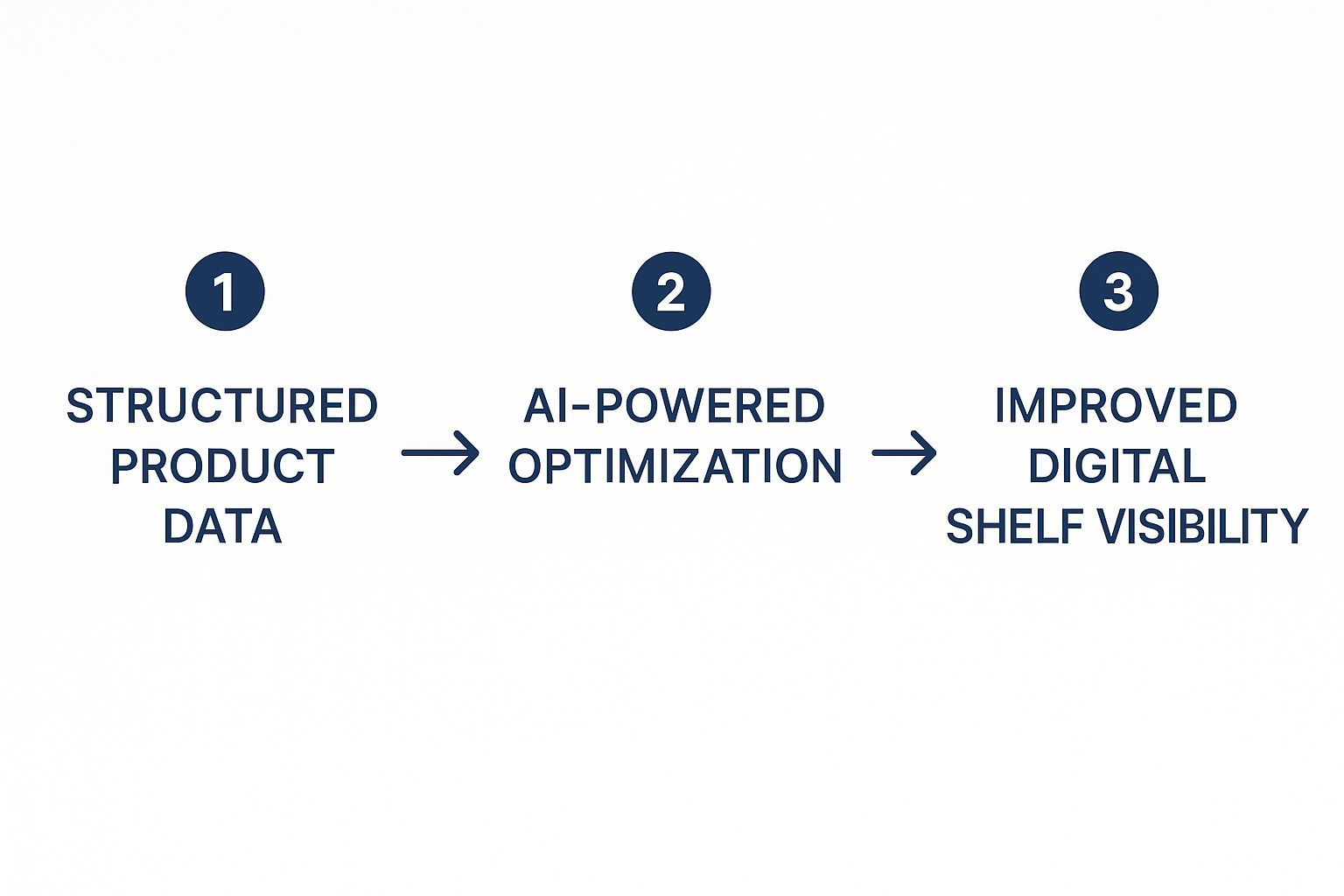
The flow is clear: high-quality structured data is the fuel. AI-powered optimisation is the engine that drives visibility and sales on the digital shelf.
And the adoption of these retail efficiency tools is picking up pace fast. In fact, 70% of small retail businesses in Australia are already using AI tools in some capacity. Another 13% plan to jump on board within the next two years, showing just how quickly retail content automation is becoming standard practice.
As retailers get to grips with this new reality, many are also focusing on the customer experience side, like boosting customer satisfaction with Richly AI to create interactions that build real loyalty.
For years, the standard supplier feed has been the backbone of Australian retail, a quick and dirty way to get products online. But what was once a shortcut is now a serious liability. In the new era of agentic commerce, those generic feeds are the number one cause of duplicate content, an issue that will make you invisible to AI-driven search.
The fix? Stop treating supplier feeds as a finished product. Think of them as raw materials. Your biggest competitive advantage is transforming that basic data into a rich, unique, and strategic asset for your business.
This process, known as product data enrichment, is how you win the digital shelf. It’s a systematic approach to turning thin supplier content into unique, optimised descriptions, specifications, and metadata for every single SKU in your catalogue.

From Content Bottleneck to SEO Engine
Let's be honest, enriching product data has traditionally been a massive operational headache. The old manual approach, hiring writers to craft unique content for thousands of products, is slow, expensive, and completely unscalable. It's just not feasible when you're dealing with seasonal product rotations or launching new catalogues.
This is where AI-powered content workflows completely change the game. By automating the process, you can ingest, clean, structure, and enrich entire product feeds with incredible speed. A task that once took months can now be done in days, turning a huge content bottleneck into a powerful engine for SEO at scale.
This isn't just about moving faster, it's about gaining a strategic edge. While your competitors are stuck with the same duplicated supplier content, AI workflows let you deploy thousands of uniquely optimised product pages, each one tailored to attract both human shoppers and AI shopping agents.
This shift is happening fast. The Australian retail AI market is set to explode, growing from $310.9 million in 2024 to an estimated $1.99 billion by 2030. That growth is being driven by agentic AI systems that can make autonomous decisions, underscoring just how urgent the need for clean, machine-readable product data really is. You can read more about what's behind this growth in this analysis on AI in Australian retail.
SKU-Level Optimisation in Action
The real magic happens at the individual product level. When you are automating product descriptions and metadata, you can achieve a granular, SKU-level SEO that was simply unimaginable a few years ago.
Let's look at a couple of real-world scenarios:
- Fashion Retail: An AI workflow can take a generic supplier description for a dress ("Blue cotton dress, sizes 8-16") and spin it into a compelling, SEO-rich story. It can pull attributes from images and data to include phrases like "perfect for summer weddings," "breathable organic cotton fabric," and "flattering A-line silhouette," all while generating unique alt tags for every single image. This is a core part of fashion SEO optimisation.
- Consumer Electronics: For a new television, the AI can pull technical specs from the feed and translate them into benefit-driven copy. It can automatically generate content highlighting features like "crystal-clear 4K resolution for an immersive movie night," "ultra-slim design that complements modern living spaces," and "smart TV capabilities with all your favourite streaming apps pre-installed." This showcases effective electronics SEO optimisation.
This is precisely the level of detail that AI agents like Google's AI Overviews and Perplexity need to confidently recommend your products over a competitor's.
By correcting duplicated supplier content and creating unique, valuable information for every product, you're building a powerful defensive moat around your business. Your product catalogue becomes a collection of high-performing assets, each optimised to capture long-tail search traffic and drive conversions, securing your position in the future of retail.
Winning the Visual Search with AI Image Optimisation
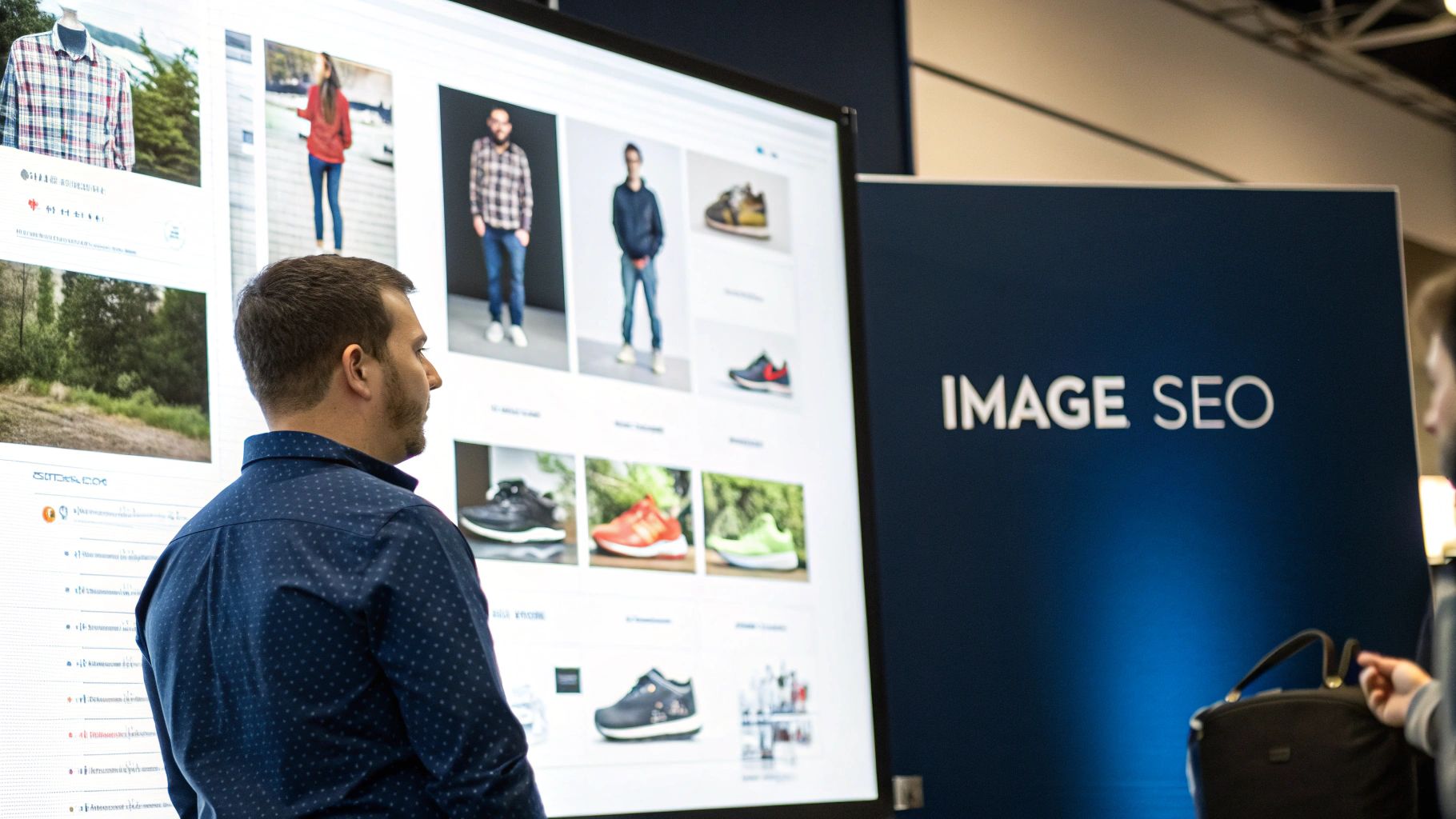
If you're in a visually-driven industry like fashion, furniture, or beauty, your product images aren't just supporting content, they're the main event. In this new world of agentic commerce, AI search agents don't just read your words, they ‘see’ and analyse your images with incredible detail. This opens up a huge opportunity for retailers ready to move beyond basic SEO.
Winning this visual race means using AI image recognition to get ahead. The old way of manually tagging images with a few basic keywords just doesn't cut it anymore. Agentic search demands a much deeper level of metadata, and AI is the only scalable way to create it.
This is where automated image tagging and enrichment, or product image tagging, become absolutely critical. These AI-powered workflows can scan your entire product catalogue, identifying and tagging dozens of attributes for every single image.
Unlocking Granular Detail with AI Image Tagging
Picture an AI system looking at a photo of a sofa. Instead of just slapping a "grey couch" tag on it, the AI identifies specific, high-intent attributes that a human might miss or simply not have time to document.
This AI-driven process can generate tags related to:
- Style: "Mid-Century Modern," "Scandinavian," "Industrial Loft"
- Material: "Linen Blend Upholstery," "Solid Oak Legs," "Velvet Fabric"
- Colour: "Charcoal Grey," "Slate," "Dove Grey"
- Features: "Tapered Legs," "Button-Tufted Cushions," "Removable Covers"
This rich, structured data gives AI agents like Rufus and Perplexity the exact information they need to match your products to highly specific queries, like, "Find me a three-seater charcoal grey sofa with solid oak legs and a mid-century modern style." While your competitors remain invisible, your products show up.
Optimising Image Metadata at Scale
Beyond tagging, AI is essential for optimising all the technical elements of image SEO for ecommerce across thousands of SKUs. This means automatically generating descriptive, keyword-rich alt tags and file names through metadata optimisation at scale.
A manual approach to alt tag optimisation for retail is a resource-draining bottleneck. An AI-powered workflow, on the other hand, can create unique and descriptive alt text for every product image in minutes. A generic tag like "dress.jpg" becomes "womens-blue-floral-print-a-line-summer-dress.jpg," which is far more valuable to search algorithms.
This isn't just a background technical task, it's a core part of preparing your catalogue for the future of retail search. Properly optimised image metadata directly impacts your discoverability in both traditional image search and the emerging agentic shopping landscape.
This automated approach ensures every single image asset is working as hard as possible to boost your digital shelf performance. For any retailer serious about dominating their niche, this is a non-negotiable strategy. To really maximise your impact, a comprehensive guide on how to do image SEO can provide a strong foundation for winning the visual search.
The Advantage in Specific Retail Verticals
The benefits of AI image recognition are especially powerful in certain categories where visual details are the main driver of purchasing decisions.
Take fashion SEO optimisation, for example. AI can identify patterns ("paisley," "gingham"), necklines ("V-neck," "boat neck"), and sleeve types ("cap sleeve," "puffed sleeve"). In furniture SEO services, it can distinguish between wood types ("walnut," "teak") and design details ("dovetail joints," "brass hardware"). This level of detail makes your products far more discoverable to customers with very specific tastes.
By turning your product images into a source of rich, structured data, you build a formidable competitive advantage. You're not just showing customers what your products look like, you're telling AI agents exactly what they are, ensuring you win the visual search every time.
Building Your Human and AI Collaboration Workflow
Let's get one thing straight: bringing AI into your retail operation isn't about replacing your team. It’s about making them ridiculously powerful. The future of high-performing retail teams lies in a human + AI collaboration model. This is where you get incredible efficiency without losing the brand voice you’ve spent years building.
Think of AI agents as the ultimate heavy lifters. They're built to handle the tedious, repetitive work of processing data and churning out first-draft content. This frees up your experienced ecommerce managers and marketers to do what they do best: focus on high-value strategy, creative direction, and quality control. This is the future of work in retail.
This hybrid approach finally breaks the retail content bottlenecks that have held retailers back for years. Your team stops being a group of manual workers drowning in spreadsheets and becomes a team of strategic operators who guide the AI workflows for ecommerce.

Defining Roles in an AI-Powered Team
To make this work, you need to draw clear lines in the sand. What does the AI handle, and where does your human team step in? It's not about rigid rules, but about playing to the strengths of both.
AI agents are masters of speed and scale. Their sweet spot includes tasks like:
- Initial Data Ingestion: Sifting through thousands of rows from a supplier's product feed in seconds, not hours.
- First-Draft Content Generation: Creating unique product descriptions, titles, and meta details from structured data and your brand guidelines.
- Image Recognition and Tagging: Automatically spotting attributes in product photos, like a 'v-neck' on a shirt or 'oak finish' on a table, to build rich metadata.
- Spotting Duplication: Flagging every instance where a supplier's generic copy appears across your catalogue so you can fix it.
Your human team, on the other hand, provides the critical layers of strategy and nuance that AI simply can't replicate. Their role evolves to focus on:
- Strategic Direction: Setting the brand voice, tone, and specific messaging angles for different product lines.
- Prompt Engineering: Writing the detailed instructions that steer the AI toward producing on-brand, effective content.
- Quality Assurance (QA): Reviewing and polishing the AI-generated output to check for accuracy, brand alignment, and that subtle human touch.
- Performance Analysis: Digging into the data to see which AI-driven content is actually moving the needle on the digital shelf and tweaking the strategy accordingly.
This collaborative setup gives you all the benefits of automation without sacrificing the personality that actually connects with customers. The QA step is crucial, and the principles in our guide on how to review writing are perfectly suited for refining AI-generated content.
To make this crystal clear, here’s a breakdown of how the responsibilities split in a modern retail content workflow.
AI Workflow Roles and Responsibilities
This table shows which tasks are best left to AI automation and where human oversight is essential for strategy and quality.
| Task Area | AI Agent Responsibility (Automation) | Human Team Responsibility (Strategy & QA) |
|---|---|---|
| Data Processing | Ingests and standardises thousands of SKUs from supplier feeds in minutes. | Defines data standards and identifies critical attributes needed for enrichment. |
| Content Creation | Generates first-draft product titles, descriptions, and meta tags at scale. | Crafts prompts, defines tone of voice, and refines AI output for brand personality. |
| SEO & Keywords | Identifies keyword opportunities and integrates them into generated content. | Sets the overall SEO strategy, targets customer intent, and analyses performance. |
| Image Analysis | Scans product images to automatically tag visual attributes (colour, style, etc.). | Verifies tag accuracy and defines the taxonomy for visual search and filtering. |
| Quality Control | Flags missing data, inconsistencies, or duplicated supplier content. | Conducts final review for factual accuracy, brand alignment, and emotional connection. |
This clear division of labour ensures you get the best of both worlds: the speed of machines and the strategic insight of your experienced team.
Structuring Your Automated Content Workflow
A well-designed workflow puts these roles into action, creating a seamless production line that turns raw supplier data into a fully optimised, live product page. This is how you achieve SEO at scale, making it possible to enrich over 10,000 pages in just a few days.
Here’s what a typical workflow looks like in practice:
- AI Ingestion and Cleaning: An AI agent pulls in the raw supplier feed, standardises the data formats, and flags any missing critical information for review.
- AI Enrichment and Generation: The system then uses AI image recognition to tag visual attributes. Based on that data and your pre-defined brand rules, it generates the first draft of the product title, description, and meta tags.
- Human QA and Refinement: Your ecommerce managers or content specialists jump in to review batches of the AI-generated content. They aren't rewriting from scratch, they’re making small, high-impact edits to inject brand personality and double-check factual accuracy.
- Final Approval and Publishing: Once the content gets the green light, it's pushed live to your ecommerce platform, often through an automated integration.
This Human-in-the-Loop (HITL) model is the most effective way for retail teams to use generative AI. It combines the raw horsepower of automation with the irreplaceable strategic insight of your people, creating a system that’s both incredibly fast and incredibly smart.
Solving Data Challenges to Unlock AI ROI
The promise of a big AI return is exciting for retail leaders, but it’s often held back by one massive hurdle: fragmented and messy data. The best AI tools in the world are useless if the data they’re fed is inconsistent, siloed, and incomplete. Let's tackle the data challenges stopping so many Australian retailers from moving beyond small pilots to achieve a genuine AI ROI.
The Data Foundation Problem
A lot of retailers are working with data spread across countless disconnected systems. You’ve probably got supplier feeds in one format, inventory data in another, and marketing content living in its own silo. This chaos creates a data environment that completely hamstrings any AI initiative.
An AI agent needs clean, structured, and unified data to do its job. When it hits conflicting information or poorly formatted supplier feeds, its ability to generate accurate, optimised content grinds to a halt. It’s like asking a master chef to cook a gourmet meal with randomly labelled ingredients from a disorganised pantry, it just won’t work.
This isn't a niche problem. Despite all the buzz around AI, Australian retailers are struggling with the fundamentals. A recent report highlighted this gap, finding that while 45% of retailers use AI regularly, a tiny 11% feel prepared to scale these tools across their entire business. The disconnect is almost always due to fragmented data stopping AI from delivering anything useful. You can see more on these retail data hurdles on ecommercenews.com.au.
Centralising for Clarity and Control
The first real step toward building a solid AI foundation is data centralisation. This means creating a single source of truth for all your product information. Instead of your systems pulling from dozens of different spreadsheets and supplier portals, you need one unified hub where all data is cleaned, standardised, and enriched.
This process involves a few key steps:
- Ingesting diverse feeds: Pulling in data from all your suppliers, no matter their original format.
- Standardising attributes: Making sure terms like "colour" or "size" are consistent for every single SKU.
- Validating information: Checking for errors, duplicates, and missing details before the data enters your core system.
By centralising your data, you create an organised, reliable asset. This doesn't just get you ready for AI-powered content workflows, it also boosts internal efficiency, cutting down the time your team spends chasing down the right product information.
From Raw Data to Enriched Assets
Once your data is centralised, the next phase is enrichment. This is where you turn basic supplier information into the detailed, structured content that AI SEO and agentic commerce demand. Having a centralised data hub is what makes this process scalable.
Instead of manually updating individual products one by one, AI workflows can tap into your clean data source and handle enrichment tasks at an incredible scale. This is the heart of product data enrichment, moving from tedious manual SEO to powerful AI SEO.
A clean, centralised data repository is the launchpad for scalable SEO solutions. It enables automated content workflows to enrich tens of thousands of product pages, solving the duplicate supplier content problem and preparing your digital shelf for AI agents.
This strategic approach ensures your AI investments are built on solid ground. You can dig deeper into this in our guide to leveraging data analytics for superior digital shelf performance.
Preparing Your Infrastructure for Agentic Commerce
Ultimately, fixing your data challenges is about future-proofing your business. Agentic commerce isn’t some far-off concept, it’s the next evolution of retail search, and it runs on high-quality, structured data. AI shopping agents like Rufus or Perplexity rely on detailed product attributes to make their recommendations.
If your product data is thin, generic, or inconsistent, these agents will simply skip right over your catalogue in favour of a competitor who has done the foundational work. The retailers investing in cleaning and centralising their data right now are the ones who will own the digital shelf tomorrow.
By tackling these data hurdles head-on, you make sure your AI projects don't get stuck in pilot mode forever. You build a resilient data infrastructure that not only supports today's AI tools but is also ready for the next wave of retail transformation, turning your data from a liability into your most powerful competitive advantage.
Your Questions on AI SEO for Retail Answered
Stepping into the world of AI-driven retail always brings up a lot of questions. This new frontier, focused on preparing for agentic commerce and getting a real return on AI, definitely requires a different way of thinking. Here, we tackle some of the most common queries we hear from Australian retail leaders and ecommerce managers to give you the clarity you need.
What Is the Real Difference Between Traditional SEO and AI SEO for Retailers?
The biggest difference is who, or what, you’re optimising for.
Traditional SEO is all about targeting search engine crawlers like Googlebot. You focus on keywords, on-page elements, and backlinks to get a URL to rank. The goal is simple: win a spot on the search results page.
AI SEO, on the other hand, is about optimising for AI agents like ChatGPT, Perplexity, and Amazon's Rufus. This means creating highly structured, incredibly detailed, and unique product data that can directly answer complex, conversational questions. Instead of just trying to rank a page, the goal is to have your product recommended as the definitive answer within an AI's response. It’s a fundamental shift from feeding the crawler to feeding the AI.
The new race for AI ROI demands a move from broad keyword strategies to granular, SKU-level optimisation. It's less about getting clicks and more about becoming the AI's trusted source for product recommendations, which is the cornerstone of agentic search optimisation.
How Do We Get Started with Product Data Enrichment Without a Huge Team?
The idea of enriching your entire product catalogue can feel pretty daunting, I get it. But the key is to start small and prove the concept works. You don’t need a massive team to start seeing results from product feed optimisation.
The most effective way forward is to pick a single, high-value product category and make it a pilot project.
- Select a Pilot Category: Choose one with high margins or significant search volume where any improvement will make a noticeable impact.
- Use AI-Powered Tools: A retail content automation platform can do the initial heavy lifting, taking your supplier feeds and generating unique, optimised first drafts for descriptions and attributes in a fraction of the time.
- Establish Human-Led QA: This is where your team comes in. Their role isn't to write from scratch but to refine the AI's output, making sure it’s factually correct and perfectly matches your brand voice.
This approach turns a huge, intimidating task into a manageable and measurable project. Once you can show the uplift in rankings and conversions from this small-scale test, you’ll have a solid business case to roll the process out across your entire catalogue.
How Can We Measure the ROI of Automating Our Product Content?
Measuring the return on your investment from AI-powered content workflows is actually quite straightforward once you start tracking the right things. The goal is to connect the dots between better content quality and real business outcomes.
First, benchmark your performance before you make any changes. Then, track these key metrics:
- Organic Search Rankings: Keep an eye on improvements for long-tail product queries. This is a strong sign that your detailed, enriched content is hitting the mark.
- Time-to-Market for New Products: How much faster can you get new SKUs live on your site with fully optimised content? Measure the reduction in time.
- On-Page Engagement: Look for lower bounce rates and increased time on page for your product detail pages (PDPs).
- Conversion Rates & Revenue: This is the ultimate proof. You should see a tangible increase in conversion rates and the organic revenue that comes from these optimised pages.
Tracking these data points will paint a clear picture of the financial impact of moving from manual processes to scalable SEO solutions. For a deeper dive into this, check out our guide to Artificial Intelligence SEO.
Is Agentic Commerce Just a Trend or Is It Here to Stay?
Agentic commerce isn't just a fleeting trend, it's the natural next step in how people will shop online.
As consumers get more comfortable using AI assistants in their daily lives, they’ll start delegating their shopping tasks to them. They'll expect AI to find the best products, compare features, and even make purchases for them.
Retailers who treat this as a temporary fad will get left behind. The ones who start preparing now, by investing in structured product data, fixing supplier content duplication, and using AI agents for retail efficiency, will build a massive and lasting competitive advantage. This is the future of the digital shelf, plain and simple.
Ready to win the race for AI ROI and dominate the digital shelf? Optidan AI provides the AI-powered content workflows you need to transform your product feeds, eliminate content bottlenecks, and prepare your business for the future of agentic commerce.
Discover how Optidan AI can scale your SEO at https://optidan.com
