

Artificial intelligence SEO isn't just a buzzword; it's the practice of using AI to automate and scale up search engine optimisation, ditching slow manual processes for smart, data-driven workflows. For Australian retail leaders and ecommerce managers, this is a game-changer. It offers a much faster, more efficient way to optimise huge product catalogues, fix the endless problem of duplicate supplier content, and get ready for the future of search, including agentic search.
The Inevitable Shift to AI-Powered SEO
Let's be honest. The old way of doing things, manual keyword research and optimising one page at a time, is a massive bottleneck for any growth-focused Australian retailer. Trying to manage thousands of SKUs, rewrite duplicated supplier descriptions, and keep up with constant search engine changes has become an impossible task. This is exactly where artificial intelligence SEO steps in, becoming a necessity rather than a nice-to-have. This is the core of the transition from manual SEO to AI SEO.
This shift is all about moving from a reactive, time-sucking model to a proactive, automated one. Think of it as the difference between having a small team manually tweak a handful of pages each week versus an AI-powered system that can enrich and optimise over 10,000 product pages in just a few days. The goal isn't just to rank anymore; it's about building a solid foundation for digital shelf performance that lasts and prepares you for what's coming next in the future of retail search.
From Manual Effort to Scalable Efficiency
Traditional SEO teams often find themselves trapped in a loop of tedious, repetitive work. Manually writing product descriptions, fixing content copied from suppliers, or optimising metadata SKU by SKU simply doesn't work for modern ecommerce, especially in competitive industries like fashion, furniture, or electronics. This creates significant retail content bottlenecks.
AI SEO offers a clear path forward. Here in Australia, AI and machine learning have become powerful forces in SEO, completely changing how retailers approach their digital marketing. AI-driven tools can analyse massive amounts of data with incredible speed and accuracy, revealing deep insights into what customers want and what competitors are doing. This is absolutely critical, as search engines like Google are powered by their own sophisticated AI, which is constantly reshaping the SEO game in the Australian market. This is where AI workflow automation for retail becomes a competitive advantage.
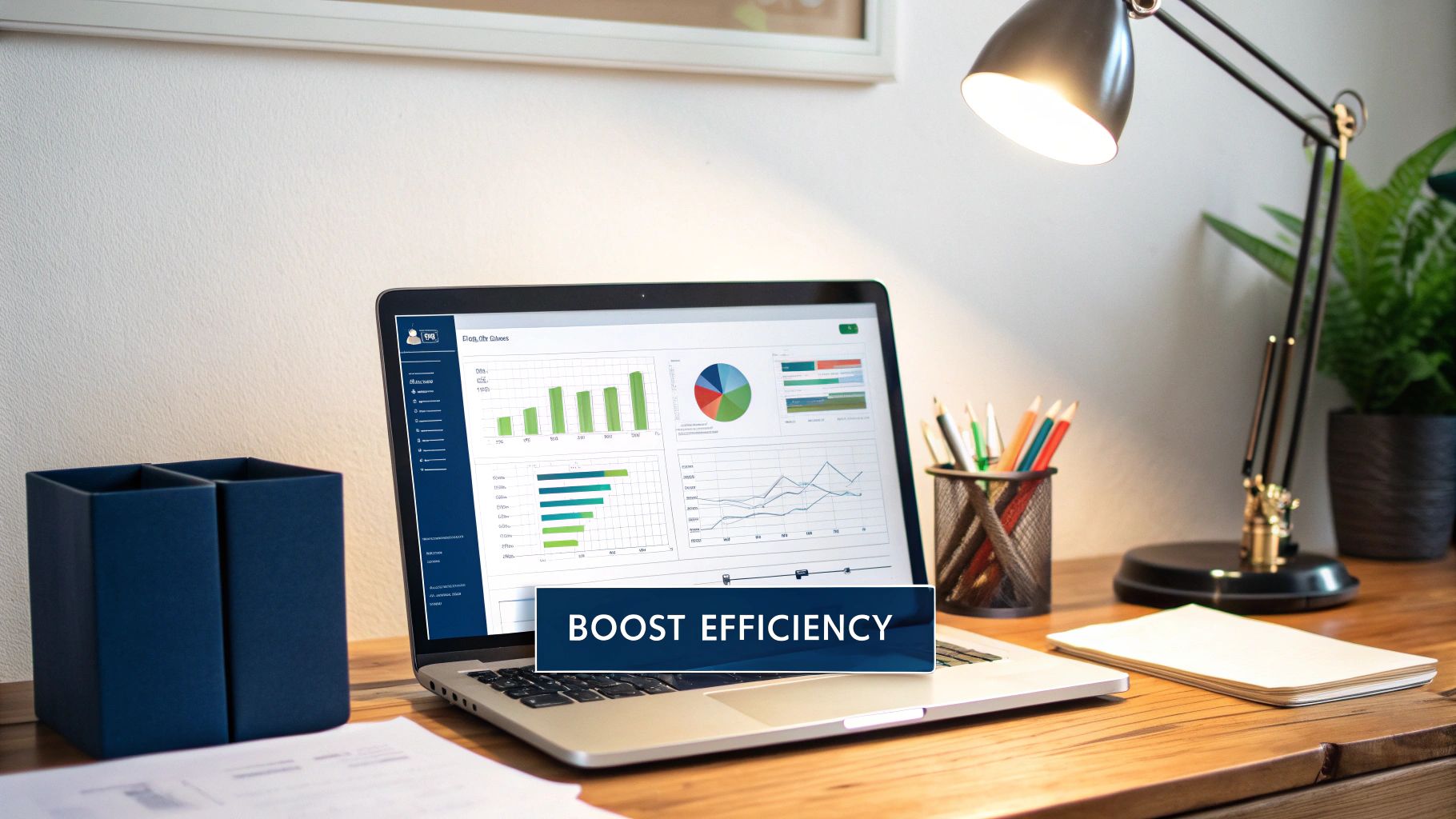
The infographic below highlights some of the key performance boosts businesses are seeing after adopting AI in their SEO strategies.
As you can see, the data makes a strong case: adopting AI is directly linked to major gains in traffic, ranking speed, and overall efficiency.
To put this into perspective, let's compare the old and new ways of working.
Traditional SEO vs AI SEO: A Retailer's Comparison
This table breaks down the core differences, highlighting how AI transforms slow, manual tasks into scalable, automated workflows that are essential for large-scale ecommerce. This is the essence of AI SEO vs traditional SEO teams.
| SEO Task | Traditional SEO (Manual Approach) | Artificial Intelligence SEO (Automated Approach) |
|---|---|---|
| Product Descriptions | Manually written one-by-one; slow and inconsistent. | Generated and optimised at scale for thousands of SKUs. |
| Keyword Research | Time-consuming analysis of a limited set of terms. | Continuous analysis of vast datasets to find trends. |
| Duplicate Content | A never-ending manual cleanup of supplier feeds. | Automatically identifies and rewrites duplicate content sitewide. |
| On-Page Optimisation | Page-by-page updates for titles, meta tags, and headers. | Systematically applied across the entire catalogue in minutes. |
| Scalability | Limited by team size and hours in the day. | Nearly limitless; can process tens of thousands of pages quickly. |
The contrast is clear. While the manual approach might work for a small boutique with a handful of products, it hits a wall very quickly. For any serious retailer, automation and scalable SEO solutions are the only way to compete effectively.
Preparing for the Future of Retail Search
But this change isn't just about making things more efficient. We're on the cusp of a new era called agentic commerce, where AI agents like ChatGPT, Perplexity, and Amazon's Rufus will do the shopping for consumers. This demands a whole new level of optimisation known as agentic search optimisation.
You can explore a variety of AI e-commerce SEO use cases to see concrete examples of how this is already playing out. To win in this new environment, your product data has to be perfectly structured, completely unique, and packed with rich attributes. Why? Because AI agents need to understand and trust your data to recommend your products. This is the future of agentic commerce.
Getting this right now is your ticket to being visible in the next generation of retail.
Automating Product Data Enrichment at Scale
For plenty of Aussie retailers, the biggest SEO headache isn't a lack of trying, it�s the sheer volume of messy, inconsistent, and often duplicated product data. Supplier feeds are a necessary evil, but they're rarely optimised for search engines or designed to create a unique brand feel. This is where artificial intelligence SEO makes its most immediate and powerful mark.
AI workflow automation is built to fix this exact problem. It takes raw, generic information from suppliers and transforms it into structured, optimised, and unique product content that both search engines and customers actually like. This process, known as product data enrichment, is the bedrock of any scalable SEO strategy. It shifts retailers from a state of constantly playing catch-up with content clean-up to having a proactive system for content creation. This is retail content automation in action.
Instead of a team manually fixing thousands of SKUs one by one, AI agents can churn through entire product catalogues in just a matter of days. This means standardising product attributes, writing compelling descriptions, and making sure every single product page is an asset, not a liability.
From Supplier Feeds to Optimised Content
Getting from a basic supplier feed to a product page that actually performs involves a few crucial steps that AI can automate with pinpoint accuracy. This isn't just about filling in the blanks; it's a strategic process of adding real value at every turn.
An automated content workflow systematically clears the common content bottlenecks that hold retailers back, ensuring consistency and quality right across the board. This includes getting through tasks that are simply impossible for human teams to manage at scale.
Key stages in AI-powered product data enrichment include:
- Standardising Attributes: The AI gets to work analysing inconsistent supplier data (think 'Blue', 'blu', and 'Navy Blue') and unifies it into a single, structured format. This is a game-changer for creating effective filters on your site and improving the internal search experience.
- Generating Unique Descriptions: AI agents create original, on-brand product descriptions for thousands of SKUs. This single-handedly solves the supplier content duplication problem that can seriously torpedo your search rankings, a critical fix for duplicate content SEO.
- Enriching with SEO Keywords: The system identifies and weaves relevant keywords naturally into titles, descriptions, and metadata, boosting your SKU-level SEO right from the get-go.
This systematic enrichment ensures every product page is not only unique but also deeply structured. This is the exact type of AI-compatible SEO content that next-generation AI shopping agents like ChatGPT, Perplexity, and Amazon's Rufus are built to understand and prioritise.
Achieving SEO at Scale
The real magic of using AI is the ability to achieve SEO at scale. A small in-house team might spend weeks just optimising a single product category. An AI-powered system, on the other hand, can process tens of thousands of pages, making sure every single product is actively contributing to your site's authority and visibility.
This isn't about replacing people, but supercharging them. AI handles the mind-numbing volume of data processing, freeing up retail teams to focus on strategy, creative direction, and making sure the final output is spot on. For businesses in fast-moving industries like fashion SEO optimisation or electronics SEO optimisation, this kind of speed is a massive competitive advantage.
By automating the foundational work of product feed optimisation, retailers can build a robust SEO presence that drives much better performance on the digital shelf. The result? Better rankings, more organic traffic, and ultimately, more sales. You can explore how to automate your SEO with Optidan to see how these automated content workflows can completely transform your retail operations and get your catalogue ready for the future of search.
Optimising Image Metadata with AI Recognition
In retail sectors like fashion, furniture, and electronics, your product images aren't just pictures, they're powerful SEO assets. The problem is, for most retailers, image optimisation is a massive task that gets pushed to the bottom of the list. It's a huge missed opportunity, especially as more customers use visual search to find and buy products.
This is where artificial intelligence SEO steps in. With advanced AI image recognition, AI can do what a human team can't: analyse thousands of product images in minutes. It automatically identifies key attributes like styles, materials, and colours, and then uses that information to generate descriptive, keyword-rich metadata.
This isn't just a small tweak. This automated process tackles a bottleneck that's simply impossible for human teams to clear across huge product catalogues. The result is a massive lift in image SEO for ecommerce, getting your products seen in valuable visual search results on platforms like Google Images. This is a critical retail efficiency tool.
From Simple Images to Structured Data Assets
An AI-driven content workflow does a lot more than just write alt tags. It turns your entire image library from a folder of static files into a goldmine of structured data. This has major implications not just for your SEO today, but for the entire future of work in retail.
Here�s how it works:
- AI Image Recognition: The system looks at each image and understands what it sees. For a piece of clothing, it might recognise a "blue linen V-neck short-sleeve shirt," capturing details that a generic filename would miss. This is crucial for fashion product image SEO.
- Automated Alt Tag Optimisation: Based on that recognition, the AI creates highly descriptive alt tags. This is great for accessibility, but it also gives search engines the precise context they need to understand what your image is about.
- Dynamic Metadata Generation: The AI also generates detailed titles and descriptions for your images, weaving in relevant keywords like furniture image tagging SEO or fashion product image SEO.
This level of detail is exactly what search engines crave. It gives them the granular data needed to confidently rank your products in both traditional text searches and visual ones, directly boosting your digital shelf performance.
By turning images into machine-readable data, you are actively preparing your catalogue for the next wave of agentic commerce. Future AI agents like Rufus and Perplexity will rely heavily on visual and structured data to make purchasing recommendations.
The Impact on Retail Efficiency and Visibility
There�s a reason AI adoption for SEO tasks is growing so quickly across Australia. Around 65% of businesses in Australia already believe AI improves their SEO efforts, from content creation to automating tedious work. What's more, 84% of content marketers and SEO specialists say AI and automation have a significant impact on their strategies. You can see more data on this trend and how it's affecting Australian businesses' AI adoption at taylorscherseo.com.
For retailers, this translates into a real competitive edge. Automating image metadata frees up your team from a mind-numbing, manual job, letting them focus on bigger-picture strategy instead.
This human + AI collaboration in SEO is key to building an efficient, modern retail operation. It breaks through content bottlenecks and makes sure every single product image is pulling its weight to drive traffic and sales. By putting AI workflows for ecommerce in place, retailers can reach a level of optimisation that just wasn't possible before, securing better visibility today while laying the groundwork for the agentic search of tomorrow.
Preparing Your Business for Agentic Commerce
The way customers find products is changing, and fast. We�re moving away from a world of keywords typed into a search bar and into an era of conversations with AI assistants. This is agentic commerce, where AI shopping agents act like personal shoppers, finding and recommending products for their users.
To even show up in this new world, retailers need to rethink SEO from the ground up. The new game is called agentic search optimisation. It�s no longer about simply targeting search queries. Instead, the focus is on creating deeply structured, attribute-rich product data that an AI can understand, process, and most importantly, trust. It's the only way your products will make the shortlist when an AI like ChatGPT, Perplexity, or Amazon's Rufus is asked for a recommendation.
This isn't some far-off future concept; it's already happening. Consumer behaviour in Australia shows that around one-third of Australians use voice search daily, a clear signal of the shift towards conversational interactions. What�s more, roughly 8% of local searches are phrased as questions, which is exactly the kind of natural language query AI is built to answer.
What AI-Compatible SEO Content Looks Like
Getting your store ready for agentic commerce means structuring your product data so an AI sees it as a complete and reliable source of truth. Vague marketing fluff and generic supplier descriptions just won't cut it anymore. Your content has to be explicit, detailed, and machine-readable.
AI-compatible content is built on a few key pillars:
- Granular Product Attributes: Think way beyond just colour and size. You need details like material, style, country of origin, electronic compatibility, and exact dimensions. This is how an AI agent matches your products to highly specific user requests.
- Structured Data and Schema: Using schema markup is like adding labels to your data. It tells search engines and AI agents exactly what each piece of information means, from the price and stock levels to customer ratings.
- Unique, Factual Descriptions: Your content has to be original and fact-based. AI agents are designed to cross-reference information from multiple sources. If they find duplicated or inaccurate content, they'll lose trust and simply ignore your products. This addresses supplier content duplication head-on.
- Contextual Relevance: Your content needs to answer the questions a customer hasn't even asked yet. For a sofa, this means including details on fabric care, delivery dimensions, and warranty information right on the page.
The core idea behind agentic search optimisation is to make your product information so clear, detailed, and trustworthy that an AI agent has zero hesitation in recommending it. Think of it as preparing the perfect briefing document for a very literal-minded personal shopper.
Human and AI Collaboration for Future Readiness
Overhauling an entire catalogue with thousands of products is a massive undertaking. This is where human + AI collaboration in SEO becomes a necessity, not just a nice-to-have. AI agents are the workforce, capable of processing and structuring huge amounts of data at a scale no human team could ever match. They can handle the heavy lifting of product data enrichment and metadata optimisation.
But AI can't do it alone. Human oversight is absolutely critical. Your retail teams provide the strategic direction, brand voice, and quality control needed to ensure the AI's output is accurate and actually sounds like you. This marks a big shift in the future of work in retail, where your team becomes the director of AI-powered workflows instead of the one doing all the manual, repetitive tasks. As you prepare for this new reality, it's also crucial to consider the evolving landscape of data privacy in 2025 to make sure your AI SEO strategies are both compliant and ethical.
By embracing this collaborative model, you effectively future-proof your SEO. You�ll not only perform better in today�s search engines but also build the structured, trustworthy catalogue you need to be visible in the agentic commerce of tomorrow. To see these systems in action, check out our guide on AI shopping agents for Shopify and start getting your business ready for this exciting next chapter.
Driving Digital Shelf Performance and Efficiency

At the end of the day, artificial intelligence SEO isn't just a technical exercise; it's a direct line to commercial success for Australian retailers. It's about moving beyond theory to deliver measurable improvements in search rankings, boost visibility on the digital shelf, and drive higher conversion rates. This is where marketing activity finally connects with tangible business outcomes.
The whole game is about efficiency and automation. By automating product descriptions and optimising product feeds at scale, retailers can finally break through the content bottlenecks that have always slowed down growth. This shift frees up your talented teams, letting them step away from tedious manual work and focus on high-value strategic thinking that actually moves the needle.
AI SEO isn't just another marketing function. It�s a core part of operational excellence in modern retail, and it directly impacts your bottom line.
Connecting AI Workflows to Commercial Outcomes
The path from an AI-driven workflow to more revenue is surprisingly clear. When you deploy AI agents for retail efficiency, you're not just making content faster; you're building a stronger, more resilient online presence. Every single optimised product page becomes an asset that works 24/7 to attract and convert customers.
This isn't just random optimisation. It's a system that directly influences your digital shelf performance:
- Improved Rankings: By finally solving the supplier content duplication problem and enriching pages with the right keywords, your products naturally climb higher in search results.
- Enhanced Visibility: Unique, attribute-rich content means your products show up for a much wider range of specific, long-tail search queries, capturing buyers who know exactly what they want.
- Higher Conversions: Detailed and compelling descriptions answer customer questions upfront, building trust and smoothing the path to purchase.
This systematic approach makes sure your SEO efforts are a cohesive strategy, not just a series of disconnected tasks. The result is a stronger, more visible brand that consistently outperforms competitors still stuck doing things the old way. For more on this, check out our detailed guide on optimising your digital shelf for performance.
Building a More Efficient Retail Operation
One of the biggest wins from retail content automation is knocking down internal roadblocks. In far too many businesses, the content creation process is slow and fragmented, stopping marketing and merchandising teams from launching products or campaigns when they need to. An automated content workflow completely changes that dynamic.
AI SEO transforms content creation from a bottleneck into a strategic advantage. It gives retailers the speed and agility to win in a fast-paced market, turning a major operational weakness into a source of competitive strength.
Instead of waiting weeks for a handful of product descriptions, you can have thousands of optimised pages ready to go in days. That speed allows your business to be far more responsive to market trends, stock changes, and promotional opportunities.
The Future of Work: Human and AI Collaboration
Bringing AI into the mix doesn't mean sidelining your team, it means empowering them. The future of work in retail is a partnership where humans set the strategy and AI provides the scale. This synergy is the heart of any true AI-powered retail transformation.
Your team�s role shifts from manual execution to strategic direction. They become the conductors of a powerful AI orchestra, guiding the system to produce on-brand, high-quality content while they focus on accuracy, creativity, and the big picture. This human + AI collaboration in SEO is where the magic happens, blending machine efficiency with human ingenuity to create an unbeatable retail content engine.
Implementing a Human-Led AI SEO Strategy
Bringing artificial intelligence SEO into your business isn't about flipping a switch and showing your team the door. Not at all. The smartest, most effective way to do this is through collaboration, where AI tackles the sheer volume of work and your human experts provide the critical strategic direction. This Human + AI collaboration in SEO is the secret to creating high-quality, on-brand content that actually performs.
Think of it as a workshop. The AI agents are your tireless apprentices, handling the repetitive, heavy lifting of product data enrichment and metadata optimisation at scale with incredible speed and precision. Meanwhile, your human team acts as the master craftsperson, the director, guiding the whole process, checking for quality, and adding those final touches that align with your unique brand voice. This model is the true future of work in retail, where technology amplifies human skill instead of replacing it.
An automated workflow built on this idea makes sure every piece of content, from product descriptions to alt tags, hits a high standard. It's a system designed to clear those frustrating retail content bottlenecks while you keep complete control.
Building an Effective Human-Led Workflow
Putting this strategy into practice means setting clear roles for both your AI systems and your human experts. The aim is to create a seamless process where technology empowers your team to work smarter, not just harder. Their focus naturally shifts from tedious manual tasks to quality assurance and creative oversight.
This collaborative approach is absolutely essential for protecting your brand's integrity. While AI is fantastic at churning out factually correct, optimised text, it doesn't have that gut feeling for a brand's personality. Human-led quality assurance is that final, vital step. It ensures every product page isn't just technically sound but also genuinely connects with your customers. A big part of this involves using the right solutions, and for a practical look at what's available, you can explore some of the best AI Content Creation Tools for SEO.
The table below gives you a clear picture of how these responsibilities break down in a modern retail SEO workflow.
Roles in a Human-Led AI SEO Workflow
Here�s a practical look at how AI and human experts work together, playing to their respective strengths to get the job done efficiently and effectively.
| Task | AI Agent Responsibility (The 'Doer') | Human Expert Responsibility (The 'Director') |
|---|---|---|
| Data Processing | Analyses and structures raw supplier feeds for 10,000+ SKUs. | Sets the rules for data standardisation and attribute mapping. |
| Content Creation | Generates unique, keyword-rich product descriptions at scale. | Defines the brand voice, tone, and style guidelines for the AI. |
| Image Tagging | Uses image recognition to create descriptive alt tags for all products. | Reviews tags for accuracy and strategic keyword alignment. |
| Quality Control | Flags potential inconsistencies or errors in the data for review. | Performs the final quality assurance, editing, and approval. |
This division of labour ensures you get the scale and speed of automation without ever losing the strategic and creative touch that makes your brand unique.
The Skills Needed for the Future of Retail SEO
This new way of working calls for a shift in skills for retail teams. Technical SEO knowledge is still important, of course. But the most valuable abilities will now revolve around strategy, data analysis, and creative oversight. Professionals who can effectively manage and direct AI workflows for ecommerce are the ones who will be in highest demand.
This transition empowers your team to become strategic leaders. Instead of being bogged down by repetitive tasks, they can focus on what truly matters: driving growth and ensuring the AI's output aligns perfectly with business goals.
Ultimately, a human-led AI SEO strategy gives you the best of both worlds. It delivers the speed and scale you need to compete in modern ecommerce while preserving the creativity and strategic insight that only your human experts can provide. Getting started can be as simple as exploring the various top AI tools for enhancing your Shopify store's SEO, which can offer a practical first step in building these new capabilities.
Your Questions About Artificial Intelligence SEO
As retail leaders and ecommerce managers start digging into AI-powered optimisation, a few practical questions always come up. Here are the most common ones we hear, with straight answers to help you figure out your next move.
How Much Does an AI SEO Solution Cost?
The cost of artificial intelligence SEO varies, but it�s best to think of it as an investment in efficiency and scale, not just another line item on your software bill. Pricing is usually tied to the size of your product catalogue and how complex your needs are.
But the real story is in the return. You have to weigh the cost against the huge savings in labour and the potential revenue lift from better digital shelf performance. Automating tasks like product description writing and image tagging for 10,000+ SKUs frees up hundreds of team hours. That's a powerful ROI.
Will This Work with My Current Ecommerce Platform?
Yes, absolutely. Modern AI SEO solutions are built to plug straight into major ecommerce platforms like Shopify, BigCommerce, and Magento. They generally work by pulling in your existing product feed, enriching it with optimised content, and then pushing that enhanced data right back into your system through APIs or updated files.
This smooth integration means you can get powerful retail content automation up and running without having to rip out and replace your current tech stack. It makes the switch from manual to AI-driven SEO a much more manageable project.
Does AI SEO Replace My Existing SEO Team?
No, it makes them better. The whole point of AI SEO is to automate the repetitive, soul-crushing tasks that bog your team down, not to get rid of their strategic smarts. This is a classic example of human + AI collaboration in SEO.
AI is built for scale, it can process thousands of pages in days, a job that�s just impossible for a human team. Your people then step in to provide the crucial oversight, brand alignment, and strategic direction. Their focus shifts from grinding out manual work to quality control and high-level growth strategy. It completely transforms their role and makes your whole retail operation more efficient.
By letting the machines handle the groundwork, you free up your experts to focus on the stuff that actually drives the business forward, like competitive analysis, campaign strategy, and creative initiatives.
Ready to see how Optidan's AI SEO services can transform your retail operations and get your business ready for the future of agentic commerce? Visit https://optidan.com to see how our platform delivers scalable SEO solutions that drive real results.
Article created using Outrank
