

AI in e-commerce is not a far-off concept anymore; for competitive Australian retailers, it is the core engine driving their operations. It is what allows brands to automate content workflows, finally achieve SEO at scale, and give customers the kind of personalised experiences that keep them coming back. Making this shift from slow, manual processes to smart, AI-driven systems is now essential for any retail leader or e-commerce manager overseeing a large product catalogue.
The New Digital Shelf: AI's Role in Modern E-commerce
The move to an AI-powered digital shelf is a fundamental change in how Australian retailers do business. It is no longer enough to just have an online store. The goal now is to build an intelligent, automated retail machine that can scale with you. This is the only way to break free from the industry’s oldest bottlenecks, like painfully slow content creation and the SEO-killing plague of duplicated supplier content.
For retail leaders and e-commerce managers, the real prize here is optimised at scale. Think about it: what if you could turn thousands of messy, raw supplier product feeds into unique, SEO-ready pages in a matter of days, not months? That speed has a direct impact on your digital shelf performance, pushing up both visibility and conversion rates. This is the essence of moving from manual SEO to AI SEO.
From Manual Bottlenecks to Automated Efficiency
Traditional retail content workflows are notoriously slow and consume a huge amount of resources. They are the reason it takes forever to get new products live and selling. AI workflow automation for retail smashes through these barriers, creating a whole new model for getting things done.
Where does it make the biggest difference?
- Product Data Enrichment: AI agents can take basic supplier data and methodically build it into compelling, structured product content that search engines love. This is the core of product feed optimisation.
- Correcting Duplicated Supplier Content: Instead of just copying and pasting, AI can rewrite thousands of generic manufacturer descriptions. This creates unique content that sidesteps SEO penalties and helps you build a brand voice that actually sounds like you, fixing a critical duplicate content SEO issue.
- AI SEO Readiness: This whole approach gets your product catalogue ready for the next wave of retail search, including agentic search optimisation for platforms like ChatGPT and Rufus, positioning you for the future of retail search.
This process flow shows you exactly how AI gets put to work in e-commerce, from the initial data pull right through to the final deployment.
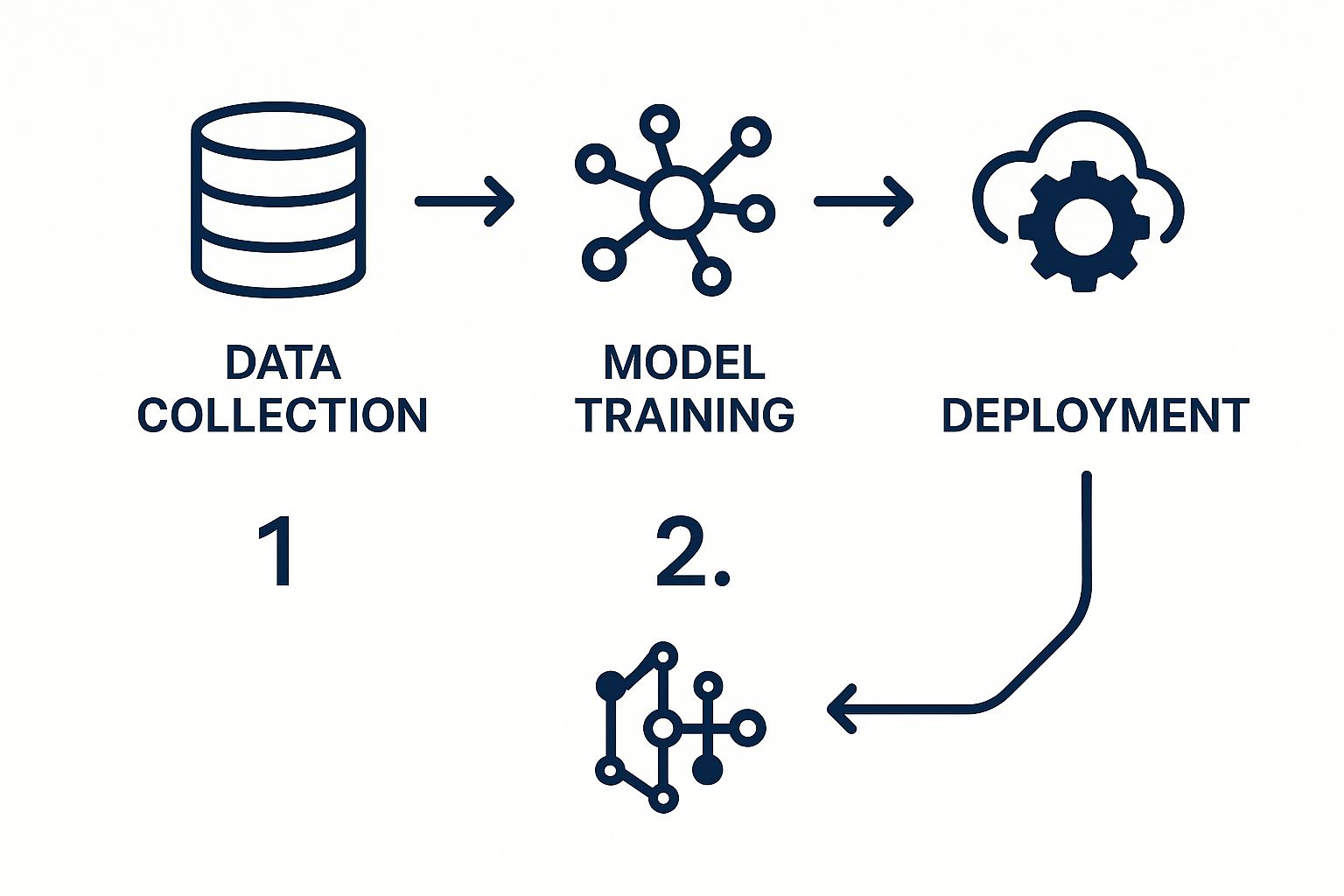
As the infographic makes clear, this is a structured, repeatable process. It's how AI systems are built to deliver consistent results for retail operations, time and time again.
Let's compare the old way with the new. The difference is not just about speed, it is a complete change in capability, a true leap from traditional SEO teams to next-gen SEO for retailers.
From Manual Efforts to AI-Powered Automation
| E-commerce Task | Traditional Manual Approach | AI-Powered Automated Approach |
|---|---|---|
| New Product Onboarding | Days or weeks per product. Manual data entry, copy-pasting descriptions. | Minutes per hundred products. Automated data ingestion and supplier feed enrichment. |
| Content Creation | Slow, inconsistent, and often outsourced. Difficult to maintain brand voice. | Rapid, consistent, and on-brand content generated at scale via automated content workflows. |
| SEO Optimisation | Keyword research for a few key pages. Often misses long-tail opportunities. | Comprehensive retail SEO automation across every single product, category, and brand page. |
| Personalisation | Basic rules-based suggestions (e.g., "customers also bought…"). | Hyper-personalised recommendations based on real-time user behaviour. |
| Data Analysis | Manual reports pulled from analytics tools, often weeks out of date. | Real-time insights and predictive analytics to inform strategy instantly. |
The takeaway is clear: manual methods simply cannot compete with the precision, speed, and scale that AI agents for retail efficiency bring to the table.
Across Australia's e-commerce scene, AI is quickly becoming the main driver of innovation. It is moving from a back-end tool for operational tasks to a front-and-centre part of the shopping experience itself, with things like AI styling tools and personalised content becoming the norm. To see how top brands are already doing this, you can learn more about optimising your digital shelf for performance.
The real magic of AI in e-commerce is its ability to handle immense scale and complexity with total precision. It frees up your team to focus on strategy and growth, leaving the repetitive, high-volume content work to automated systems.
Ultimately, this is not just about saving time. It is about building a more agile, competitive, and customer-focused business that is ready for the future of agentic commerce. As AI continues to reshape the digital shelf, it is a good idea to explore the evolving landscape of text marketing, mobile wallets, and AI to find new ways to connect with your customers.
Mastering Product Data Enrichment with AI
For any Aussie retailer, raw, inconsistent supplier feeds are a massive headache. They are the direct cause of messy product pages, frustrated customers, and a weak presence on the digital shelf. This is where product data enrichment comes in, systematically turning chaotic data into structured, SEO-optimised product content at a scale that was previously unimaginable.

This is not just about cleaning up a spreadsheet. It is a strategic move that turns a constant content bottleneck into a genuine competitive advantage. The entire focus is on optimising product feeds efficiently, giving retailers the power to enrich entire product catalogues in days, not months.
From Duplication Penalties to a Unique Brand Voice
One of the most common and damaging issues for large retailers is supplier content duplication. Copying and pasting the same generic descriptions provided by manufacturers across hundreds of websites is a huge red flag for search engines. It signals your content is not unique, and that often leads to ranking penalties. A duplicate content SEO fix is essential.
This is where AI-driven content workflows make an immediate, measurable impact. Instead of slow, manual rewrites, AI agents in e-commerce can take a standard supplier feed and generate thousands of unique product descriptions for SEO. This automated approach gives every single SKU its own distinct voice, directly fixing the duplicate content problem and strengthening your brand identity at the same time.
By correcting duplicated supplier content, you are not just dodging a penalty. You are actively building a stronger, more authoritative presence that both customers and search engines will reward.
This is absolutely critical in Australia's booming online market. By 2024, an estimated 17.08 million Australians were shopping online every month, a massive opportunity for brands that get their digital house in order. The fact that 19% of Australian retailers now see AI as a major growth lever shows a clear shift towards adopting these advanced tools. You can dig deeper into these trends in Australian e-commerce statistics.
Unlocking Rich Data with Image Recognition
Beyond just text, AI image recognition and tagging is a total game-changer, especially for visually driven retailers. Think about sectors like fashion, furniture, or electronics where the visual details are everything. AI can analyse a product image and automatically output descriptive, SEO-rich metadata.
This creates a much deeper, more discoverable layer of information that was almost impossible to manage manually. For example:
- Fashion SEO Optimisation: AI can spot and tag attributes like "V-neck," "floral print," "linen fabric," or "midi length," opening up countless long-tail keyword opportunities for fashion product image SEO.
- Furniture SEO Services: It can generate tags like "mid-century modern," "solid oak construction," or "velvet upholstery" automatically, making your products far easier to find through furniture image tagging SEO.
- Electronics SEO Optimisation: AI can even recognise specific ports, screen types, or design features, capturing the granular details that serious buyers search for.
This process ensures that every single image contributes directly to your SKU-level SEO and alt tag optimisation for retail, making your products visible to customers who are using highly specific, purchase-intent search terms.
Building a Foundation for Agentic Search
All of this deep, structured data is the foundation for the future of retail search and the rise of agentic search. AI shopping agents like Amazon's Rufus or those built into Perplexity and ChatGPT need well-structured, detailed, and accurate product information to give users good answers. A manually managed product feed simply cannot provide the depth of data these new search models demand.
By using AI for product data enrichment now, you are future-proofing your business. You are building a catalogue that is not only optimised for today's search engines but is also ready for the conversational, agent-driven commerce of tomorrow. Our detailed guide offers more insights into the powerful applications of AI for SEO. This kind of strategic preparation is what separates market leaders from the laggards.
The Shift to AI SEO for Agentic Search
The whole game of online search is changing right under our feet. The old SEO playbook, built on keywords and backlinks, is giving way to a smarter, more conversational way of finding things online called agentic search. This new reality is powered by AI shopping assistants like ChatGPT, Perplexity, and Amazon's Rufus, which act like personal shoppers for consumers. For anyone managing an e-commerce store, this is a massive shift from old-school SEO to AI SEO, a strategy built to get your products in front of these new AI gatekeepers.
This is not just another trend; it is a complete rewiring of how people discover products. AI agents do not just scan for keywords. They understand context, compare features, and pull together information to give direct answers. If your product data is thin, unstructured, or just plain generic, these AI agents will simply look past it. Your catalogue becomes invisible in this new world of agentic commerce future.
AI SEO vs Traditional SEO Workflows
Looking at the old way versus the new way really highlights the change. A traditional SEO team might spend weeks digging through keyword research for just a handful of best-selling products. It is a slow, manual process that is impossible to apply across an entire product catalogue.
AI SEO completely flips that model. It is all about scalable SEO solutions that get every single product ready for questions from both humans and AI agents.
The core difference is scale and structure. Traditional SEO optimises pages one by one for human searchers. AI SEO optimises the entire product catalogue systemically, creating highly structured data that AI agents can easily understand and recommend. This is the key strategic difference between AI SEO vs traditional SEO.
This is where AI-powered content generation becomes non-negotiable. It gives retailers the power to create unique product descriptions, detailed metadata, and optimised alt tags for tens of thousands of items at once. The aim is to produce AI-compatible SEO content that directly answers the complex, conversational questions people are now asking their digital assistants. To get a better handle on this, you can explore our in-depth article on understanding AI SEO and how it is shaping search strategies.
Preparing Your Content for AI Shopping Agents
To win in the era of agentic search, your content has to be machine-readable and incredibly informative. AI agents depend on structured data and natural language to do their job. The richer and more organised your product information is, the more likely an AI will be to pull up your product as a top recommendation.
Key elements of agentic search optimisation include:
- Granular Product Attributes: Go way beyond the basic specs. This means tagging everything from the material and dimensions to style attributes and what it is compatible with. For fashion SEO optimisation, this could be "organic cotton" or "ruched detailing."
- Unique, Descriptive Content: Generic, copy-pasted supplier content is the enemy of generative AI SEO. AI-generated descriptions can create unique stories for each SKU, highlighting real benefits and uses.
- Comprehensive Metadata: This includes well-written titles, meta descriptions, and image alt tags that describe the product in natural language. This is especially vital for image SEO for e-commerce.
The tech that allows AI to understand and create this human-like text is Natural Language Processing (NLP). To get your head around the core AI technology driving the next wave of search, you can learn more by reading this guide on What Is Natural Language Processing? A Complete Guide. This whole process turns your product catalogue from a simple list into a structured knowledge base, ready for any question a shopper can throw at it.
The Strategic Imperative for Retail Leaders
Ignoring this shift to agentic search is a huge risk. As more and more shoppers start using AI assistants to find what they need, brands that do not adapt will watch their visibility and traffic dry up. The future of retail search is already here, and it demands a deliberate move towards AI workflows for e-commerce.
This is not just another SEO tactic; it is a core part of a bigger AI-powered retail transformation. By embracing AI SEO, you are not just optimising for today's search engines. You are building a solid foundation for the intelligent, automated, and agent-driven world of commerce that is right around the corner. The retailers who make a move now will lock in a serious advantage.
Automating Retail Content Workflows for Peak Efficiency
For Australian retail leaders, the single biggest roadblock to scaling a large e-commerce operation is usually the content bottleneck. When you are dealing with thousands of SKUs, the old manual way of creating and optimising product pages just does not work anymore. This is where AI workflow automation comes in, turning a slow, expensive process into an engine for growth.
The problem is simple: managing huge product catalogues demands a totally new approach. AI agents for retail efficiency are designed to solve this exact problem by automating the repetitive but critical tasks that consume countless hours. This move from manual to automated content workflows is the key to achieving genuine SEO at scale.
This kind of automation lets retailers move at a speed that was once unimaginable. Instead of spending months updating a product line or launching a new category, AI can process and optimise 10,000+ pages in a matter of days. That speed has a direct impact on revenue and how quickly you can react to the market. This is not about replacing your team; it is about amplifying their impact with powerful retail efficiency tools.
From Human Effort to Human and AI Collaboration
The most effective model for the future of work in retail is all about human + AI collaboration in SEO. In this setup, the AI does the heavy lifting, the high-volume, repetitive work where human error and burnout are common. This frees up your expert teams to focus on strategy, creative direction, and making sure everything is perfect.
Think about the typical content creation process:
- AI-Powered Content Generation: An AI agent for retail takes raw supplier feeds and automatically generates unique, SEO-friendly product descriptions, titles, and metadata, all based on your brand guidelines.
- Automated Feed Optimisation: The system then tweaks this content for different channels, tailoring product feeds for Google Shopping, social commerce platforms, and marketplaces. This is core to multi-channel product optimisation.
- Human-Led Quality Assurance: Your team reviews what the AI has created, giving the final approval and making strategic adjustments. They become editors and strategists, not data entry clerks, ensuring effective e-commerce content quality assurance.
This collaborative model is already delivering massive results for brands that are thinking ahead. To see this in the real world, check out our case study on how Optidan AI transformed content workflows from months to minutes. It is a perfect example of the efficiency gains that are possible right now for retail teams and AI efficiency.
The goal of retail content automation is not to remove human expertise. It is to focus that expertise where it really matters. AI handles the scale, while your team provides the strategic oversight and brand soul.
This kind of operational efficiency is non-negotiable in a market as dynamic as Australia’s. The total e-commerce volume for Australia in 2024 is estimated at US$89.4 billion, with the retail sector accounting for US$46.2 billion of that. AI is a major driver of this growth, which is set to continue at a compound annual rate of 6% through 2027.
Tailoring AI Workflows Across Retail Verticals
The great thing about AI-powered content workflows is how adaptable they are. The same core automation principles can be applied with specific tweaks for different retail sectors, solving their unique challenges.
For example, in fashion SEO optimisation, AI image recognition can automatically tag attributes like "linen blend," "puff sleeves," or "A-line silhouette," creating incredibly rich, searchable data. For electronics SEO optimisation, it can pull out and list technical specs like "USB-C charging" or "OLED display", details that are crucial for getting a sale. This also applies to sectors like pharmacy e-commerce SEO and beauty & cosmetics SEO.
The table below shows how these automated workflows deliver specific benefits across key retail categories, directly improving digital shelf performance.
Key AI Applications Across Retail Verticals
This table breaks down how different e-commerce sectors can apply AI to solve specific problems and what the direct business impact looks like.
| Retail Vertical | AI Application Example | Primary Business Benefit |
|---|---|---|
| Fashion & Apparel | AI generates unique descriptions and tags visual attributes (e.g., fabric, neckline, pattern) from images. | Enhanced product discoverability for long-tail searches and a massive reduction in content creation time. |
| Furniture & Homewares | Automated creation of rich content detailing materials, dimensions, style (e.g., "mid-century modern"), and assembly. | Improved furniture image tagging SEO and higher conversion rates from well-informed customers. |
| Beauty & Cosmetics | AI generates benefit-led descriptions, optimises ingredient lists for SEO, and suggests complementary products. | Stronger SKU-level SEO for specific concerns (e.g., "anti-ageing serum with hyaluronic acid"). |
| Electronics | Automatically extracts and structures complex technical specifications from supplier data into clear, comparable formats. | Reduced bounce rates by providing customers with the detailed information needed for high-consideration purchases. |
This systematic approach makes sure that every single product, no matter the category, gets the same high level of optimisation. It is the practical application of retail content automation in action, turning a huge operational headache into a powerful strategic advantage for any brand serious about winning online.
Your Strategic Roadmap to AI Adoption
Knowing what AI can do for your e-commerce business is one thing. Actually making it happen requires a clear, practical plan. For retail leaders, this means building a roadmap that starts small, proves its value quickly, and then scales intelligently across the business. The goal is not a one-off tech project; it is about making a fundamental shift towards an AI-powered retail operation.

This whole journey starts by ditching the idea that you need a massive, disruptive overhaul from day one. That is a recipe for failure. Instead, the most successful strategies focus on finding and fixing the most painful operational headaches first. This approach builds momentum, shows a tangible return, and gets the internal buy-in you need for the bigger changes down the track.
Identify Your First High-Impact Project
So, where do you begin? Look for a persistent content bottleneck that is already costing you revenue and efficiency. For most large-scale retailers, the lowest-hanging fruit is the problem of supplier content duplication. Manually rewriting thousands of generic product descriptions is a slow, expensive grind that rarely gets done right.
This makes it the perfect pilot project for an AI workflow. By zeroing in on a single product category plagued with duplicated, poor-quality content, you can quickly show the power of retail content automation. The process is straightforward, and the results are easy to measure.
- Select a Test Category: Pick a product line with terrible descriptions, high return rates from misinformation, or poor visibility in search.
- Deploy an AI Workflow: Use an AI agent for retail efficiency to ingest the supplier feed and automatically generate unique, SEO-optimised product titles and descriptions.
- Measure the Impact: Keep a close eye on key metrics like organic traffic to those product pages, keyword ranking improvements, and any changes in conversion rates over a set period.
A successful pilot here becomes a powerful internal case study. It proves AI can deliver measurable improvements to your digital shelf performance without needing a massive upfront investment.
Adopting AI is not about a sudden, dramatic change. It is about a series of smart, targeted automations that solve real business problems, starting with the ones that hurt the most.
Structuring Teams for Human and AI Collaboration
Getting AI adoption right is just as much about your people as it is about the technology. The future of work in retail is all about human and AI collaboration, where AI handles the heavy lifting and your team provides the strategic direction and quality control. This means rethinking how your teams are structured and what skills you value.
Your content and SEO teams will naturally shift from being manual writers to strategic editors and AI workflow managers. Their focus moves from churning out individual product descriptions to refining the prompts and brand guidelines that steer the AI. This human-led AI content QA process is what guarantees quality and brand consistency, while the AI delivers the speed and scale.
This collaborative model is also crucial for getting ready for the future of agentic commerce. As agentic shopping becomes the norm, your team's role will be to ensure your product data is perfectly structured and optimised for these new platforms, a task perfectly suited for a human and AI partnership.
Scaling from Pilot to Full Integration
Once your initial project has proven its worth, your roadmap should lay out a phased rollout across the entire business. This scaling process is all about taking the lessons learned from the pilot and applying them to bigger and more complex challenges.
Your scaling strategy should focus on creating a unified, AI-powered content workflow that connects different parts of your operation, from product information management (PIM) to multi-channel marketing. This creates a single source of truth for all your product content, ensuring everything is consistent and high-quality, no matter where your products show up. Getting these scalable AI workflows in place early does not just fix today's problems; it builds a massive, lasting competitive advantage.
Why the Future of Retail Is Agentic and Automated
The shift from manual processes to AI-driven operations is not a far-off concept anymore, it is the new standard for growth. For Australian retail leaders, bringing artificial intelligence into e-commerce is about fundamentally retooling for an era where automation and agentic search define the entire competitive landscape. This is what a genuine AI-powered retail transformation actually looks like.
The benefits are clear and compelling. AI SEO lets you optimise at a scale that was previously impossible, turning thousands of messy, inconsistent supplier feeds into unique, structured product content in a matter of days. This does not just fix crippling issues like supplier content duplication; it builds a powerful foundation for better performance on the digital shelf and, ultimately, higher conversion rates.
The Urgency of Adopting AI Workflows
The rise of agentic commerce is only speeding things up. More and more, consumers are turning to AI assistants to discover, compare, and buy products. Retailers still stuck with outdated, manual content workflows are quickly becoming invisible in this new ecosystem. The future of work in retail will be defined by successful human + AI collaboration, where technology handles the sheer scale and your team provides the strategic direction.
The question is no longer if you should adopt AI, but how quickly you can integrate automated workflows to secure your position. Proactive investment is the only way to prepare for a future where AI agents are central to the consumer journey.
Your Next Step into an Automated Future
To thrive, Australian retailers need to move decisively. Investing in AI workflows for e-commerce is not just about efficiency; it is a strategic imperative for survival and growth. By automating content creation and optimising your product data for both humans and AI, you position your business to win in the next generation of online retail.
This is the moment to move away from manual bottlenecks and toward scalable, intelligent operations. To see how these systems work in the real world, check out our detailed guide on AI shopping agents for Shopify and see how agentic technology is already reshaping the market. The retailers who act now will be the leaders of tomorrow.
Frequently Asked Questions
Stepping into AI-powered e-commerce always brings up a few questions. Here are some of the most common ones we hear from retail leaders trying to figure out their next move.
What’s the Difference Between Traditional and AI SEO?
Traditional SEO has always been about getting keywords right to show up when a human searches on Google. AI SEO takes that a big step further. It is about preparing your content not just for people, but for the new wave of AI shopping agents like ChatGPT or Amazon's Rufus.
This means your product data needs to be highly structured, using natural language that can answer complex, conversational questions. For retailers, this is where AI SEO services come in, automating the creation of unique, detailed product information for every single item. It is a shift away from just matching keywords to creating a deep, contextual relevance that SEO for AI agents needs to find you.
The real difference is who you are talking to. Traditional SEO speaks to human searchers. AI SEO speaks to both humans and AI agents, and that requires a much richer, more structured data foundation.
How Does AI Fix Duplicated Supplier Content?
Supplier content duplication is one of the biggest silent killers for SEO. Search engines penalise sites with unoriginal content, and most retailers are running on generic descriptions straight from the manufacturer. It is a massive problem.
AI tackles this head-on by rewriting and enriching thousands of those generic descriptions automatically. Using generative AI for retail teams, a retailer can take a standard supplier feed and turn it into unique, brand-aligned product descriptions for every SKU. AI can even use image recognition and tagging to pull out more descriptive details, making your content stand out even more. This whole process turns a generic product feed from a liability into a genuine SEO asset, wiping out duplication penalties and boosting your search rankings.
Where Should Our Retail Business Start with AI?
The best place to start is with a high-impact area that is held back by a major content bottleneck. For most retailers, product data enrichment is the perfect first move because the returns are so clear and easy to measure.
Pick one product category where your supplier descriptions are especially poor, inconsistent, or duplicated.
- Run an AI Workflow: Use an AI tool to automatically generate unique product titles, descriptions, and metadata for everything in that category. This showcases the power of automating product descriptions.
- Measure the Impact: Keep a close eye on organic traffic, keyword rankings, and conversion rates over a set period. See what changes.
- Build Your Case: This focused pilot gives you a solid proof of concept and demonstrates real ROI. That makes it much easier to get buy-in for broader AI adoption across the business.
Ready to finally break through your content bottlenecks and get your catalogue ready for the future of agentic commerce? Optidan AI delivers scalable SEO solutions that turn your product feeds into unique, high-performing content.
