

AI Product Description Generator for Retail SEO

image 234 1 | Agentic AI | Optidan

Meet the Author

Ellipse 4251 1 | Agentic AI | Optidan
JP Tucker is the co-founder of Optidan and a second-time founder in the ecommerce space. Before building Optidan, JP scaled Hello Drinks, Australia’s first liquor marketplace with Afterpay, into a seven-figure business. He brings 20+ years of retail and FMCG experience, with roles at global brands including Dell, Beiersdorf (Nivea & Elastoplast), GlaxoSmithKline (Panadol, Sensodyne, Macleans, Lucozade), and Perrigo (Nicotinell, Herron and more). JP’s passion is helping retailers unlock performance through content, strategy, and innovation.

Share this article

To truly write faster, you need to stop thinking about your typing speed. Instead, think about building a smarter, automated content engine. For retail leaders, this is a massive shift. It means ditching slow, manual processes for AI-powered workflows that can pump out thousands of optimised product pages in days, not months. This isn’t just about being more efficient, it’s a strategic must-have in today’s market, preparing you for the future of agentic commerce.

Why Content Speed Is Your New Retail Superpower

In ecommerce, speed is a weapon. The pressure on retail leaders and ecommerce managers to create high-quality, unique, and optimised content for thousands of SKUs, often with lean resources, is huge. Traditional content creation methods are just too slow for the modern digital shelf, creating massive bottlenecks that hold up product launches and kill revenue. This manual grind often leads to a critical SEO mistake: relying on duplicated supplier content. Sure, copying and pasting descriptions from supplier feeds gets products live fast. But over time, it guts your site’s authority and search rankings. Search engines penalise duplicate content, making it much harder for your products to achieve the digital shelf performance they deserve.

From Manual Bottlenecks to AI-Powered Workflows

The real secret to writing faster at scale isn’t about working harder, it’s about changing your entire process. This means moving from old-school manual SEO to a system built on AI and automation.

By putting automated content workflows in place, you can turn raw, messy supplier data into a powerful asset. It all comes down to a few key steps:

  • Product Data Enrichment: Taking those basic, inconsistent supplier feeds and transforming them into structured, optimised, and AI-ready product content.
  • AI-Powered Optimisation: Using generative AI to create thousands of unique product descriptions, metadata, and alt tags that actually sound like your brand and follow a solid AI SEO strategy.Industrial Property: Warehouses and production facilities leased for industrial activities.
  • Correcting Duplication at Scale: Systematically finding and replacing all that duplicated supplier content with unique, compelling copy that improves how you show up on the digital shelf.

Let’s compare the old way with the new.

Manual vs AI-Powered Content Workflows

The difference is stark. Manual workflows are a constant bottleneck, whereas AI-powered systems create a continuous flow of high-performing content.

The future of retail search is increasingly driven by AI agents and agentic commerce. Preparing for this shift means having AI-compatible SEO content that is structured, detailed, and easily understood by algorithms like Google’s Search Generative Experience, ChatGPT, and Amazon’s Rufus.

Ultimately, learning how to write faster is less about individual skill and more about your operational framework. By adopting AI SEO services and scalable SEO solutions, you can eliminate retail content bottlenecks, enhance search visibility, and secure a real competitive edge.

To see exactly how this works in practice, check out our deep dive on AI for SEO. This strategic shift is what will ensure your brand is ready for the next generation of retail.

Build Your Foundation with Product Data Enrichment

Frame 2147224916 1
You can’t build a high-speed content engine on a shaky foundation. For retail leaders, that shaky foundation is almost always messy, inconsistent product data pulled directly from supplier feeds.
These raw feeds are the number one cause of slow, poor-quality content creation. They’re a major bottleneck that stops you from getting products to market quickly.
The most critical step in learning how to write faster at scale is mastering product data enrichment. This is the process of turning those raw supplier feeds into structured, optimised, and AI-ready data. It’s about creating a single source of truth that powers your entire ecommerce content optimisation strategy.
This foundational work is what makes true retail SEO automation possible. It sets the stage to generate thousands of unique, optimised product descriptions in days, not months.

This foundational work is what makes true retail SEO automation possible. It sets the stage to generate thousands of unique, optimised product descriptions in days, not months.

Standardise and Structure Your Data

First things first, you have to tame the chaos. Supplier feeds are notoriously messy, arriving with inconsistent formatting, missing attributes, and confusing terminology. Standardising this information is absolutely essential for any scalable SEO solution.
This means you need a clear, consistent structure for all your product attributes. It ensures a “colour” field is always labelled the same way, and product dimensions are always in the same unit of measure. This clean, structured data is the fuel that runs AI agents for retail efficiency and automated content workflows.
A few key standardisation tasks include:
  • Normalising Attributes:: Making sure terms like “navy,” “dark blue,” and “midnight” are all grouped under a single, consistent colour attribute.
  • Correcting Inaccuracies: Fixing incorrect weights, dimensions, or material details that came from the original feed.
  • Filling Gaps:: Finding and adding missing information that’s crucial for both SKU-level SEO and the customer experience.

Enrich with AI-Powered Insights

Once your data is clean and structured, it’s time for enrichment. This is where you add valuable layers of context that basic supplier feeds always lack, which directly improves your performance on the digital shelf. For anyone in visually-driven sectors like fashion SEO optimisation or furniture SEO services, this is a genuine game-changer.

AI image recognition, for example, can analyse your product photos to automatically generate descriptive tags. This tech can spot styles, patterns, materials, and features visible in an image but missing from the supplier’s text. Think of it tagging a dress with “V-neck,” “floral print,” and “A-line silhouette” without any human input.

By automating the tagging of visual attributes, you create a rich dataset that generative AI can use to write far more detailed and compelling product descriptions. This is how you solve the duplicate content SEO fix and build a unique brand voice at the SKU level.
This detailed, enriched data becomes the blueprint for your AI SEO efforts. It allows you to move away from generic, duplicated content and toward unique, highly relevant descriptions optimised for the future of agentic search and AI shopping. This is the core of moving from manual SEO to AI SEO, enabling true retail content automation.
A few key standardisation tasks include:

Architecting Your AI-Powered Writing Workflow

Once you’ve got clean, enriched product data sorted, it’s time to build a genuinely powerful, automated content workflow for your retail business. This isn’t about just buying a single tool off the shelf. Think of it as building an integrated system that connects your data directly to generative AI models. The whole point is to move away from creating content one piece at a time and instead build a scalable engine that can pump out optimised content for your entire catalogue.

A huge part of this is designing customised prompts that bake your brand’s unique voice and essential SEO keywords right into the AI’s instructions. This is the non-negotiable step to make sure the output never sounds generic and always aligns with your marketing strategy. To really get things moving, especially at scale, you’ll want to tap into powerful AI content generators that can properly interpret these detailed prompts.

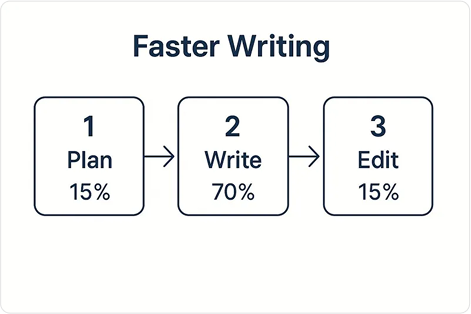
This is what an ideal, high-speed writing process looks like when you map out the time. The focus shifts heavily towards planning, which makes the execution phase incredibly efficient.
Architecting Your AI-Powered Writing Workflow

Once you’ve got clean, enriched product data sorted, it’s time to build a genuinely powerful, automated content workflow for your retail business. This isn’t about just buying a single tool off the shelf. Think of it as building an integrated system that connects your data directly to generative AI models. The whole point is to move away from creating content one piece at a time and instead build a scalable engine that can pump out optimised content for your entire catalogue.

A huge part of this is designing customised prompts that bake your brand’s unique voice and essential SEO keywords right into the AI’s instructions. This is the non-negotiable step to make sure the output never sounds generic and always aligns with your marketing strategy. To really get things moving, especially at scale, you’ll want to tap into powerful AI content generators that can properly interpret these detailed prompts.

This is what an ideal, high-speed writing process looks like when you map out the time. The focus shifts heavily towards planning, which makes the execution phase incredibly efficient.

image 1989 1 | Agentic AI | Optidan
The key takeaway here? That upfront time spent on planning and setup dramatically cuts down the actual writing time, leaving a much more focused window for final polishing.

Automating Content Creation at Scale

An effective AI workflow is one that automates the creation of unique product descriptions, detailed metadata, and optimised image alt tags for thousands of SKUs all at once. This is what SEO at scale for retailers really means. Instead of your content team slogging away for weeks writing copy by hand, the system generates drafts from your enriched product data in minutes
The process usually breaks down like this:
  • Engineering Your Prompts: Building a library of smart, sophisticated prompts for different product types, think fashion, furniture, or electronics SEO optimisation.
  • Generating in Bulk: Firing up the automated workflow to produce drafts for thousands of products, turning raw data into content that’s ready for customers to see.
This isn’t just a small shift, it’s the future of work in retail. AI agents in ecommerce handle the repetitive, high-volume tasks, which frees up your team to focus on strategy and oversight. We’ve seen how structured processes can boost author output by 25-40%, and this is the same principle applied to ecommerce. We saw a similar need for speed in the publishing world, where the pressure is on to release books rapidly after major events. It’s all about having an efficient system in place.

The Human-in-the-Loop QA Process

Automation gives you speed, but it’s human expertise that guarantees quality. A critical piece of any successful AI-powered workflow is the human-in-the-loop (HITL) quality assurance process. It’s the perfect model for human + AI collaboration in SEO.
AI handles 80% of the heavy lifting, drafting thousands of descriptions and metadata fields. Your team then steps in for that final 20%, providing the strategic review, fact-checking the important details, and injecting the content with your brand’s unique personality.
This human-led AI content QA process ensures everything is accurate and on-brand without creating the bottlenecks that come with traditional writing. It’s a workflow that can transform your content creation from a months-long project into a matter of minutes (https://optidan.com/how-optidan-ai-transformed-content-workflows-from-months-to-minutes), delivering a level of retail efficiency that just wasn’t possible before. That balance is exactly what you need to achieve both the speed and the quality required to dominate the digital shelf.

Optimising Your Tools for Maximum Throughput

Frame 21472249161 1
While AI-powered workflows can deliver incredible scale, your team’s fundamental efficiency is still the engine driving the whole process. To really write faster, you need to look at every part of your technical and physical setup, hunting down any hidden speed bumps that are slowing you down.
It all starts with your digital infrastructure. For modern retail teams, reliable, high-speed internet is completely non-negotiable. You’re constantly accessing cloud-based AI tools, collaborating on content reviews, and pulling from massive product databases. In that world, latency isn’t just an annoyance, it’s a direct hit to your productivity.

For Australian retailers, recent infrastructure upgrades have made a real difference. By the start of 2025, median fixed internet download speeds hit 77.90 Mbps, which is a 43.2% jump from the previous year. According to the latest Digital 2025 Australia report, this improved connectivity is what makes real-time collaboration and instant digital asset access possible for high-velocity retail.

Setting Up for High-Velocity Content Creation

Beyond your internet connection, the physical workspace is a critical factor that’s often overlooked. You can have the best retail efficiency tools on the market, but their potential is capped by the ergonomics and foundational skills of the people using them.
A well-configured workstation has a direct impact on how quickly and accurately your team can interact with AI-generated content. An uncomfortable setup just leads to fatigue, distraction, and errors, completely undermining the speed you gained from automation in the first place.
Here’s what your team’s setup should prioritise:
  • Ergonomic Keyboards and Mice: These are designed to reduce physical strain, allowing for longer stretches of focused work without discomfort.
  • Dual-Monitor Setups: A second screen is essential for efficient, human-led AI content QA. It lets an editor view the enriched product data on one screen while refining the AI-generated description on the other, killing the constant need to switch tabs..
  • A Distraction-Free Environment: Encourage habits that minimise interruptions, like blocking distracting websites during focused work sessions.
Your team’s ability to efficiently review, edit, and refine AI output is the final, critical step in any automated content workflow. Optimising their tools and environment ensures this human touchpoint doesn’t become the new bottleneck.

The Enduring Importance of Typing Skills

Even in a world increasingly driven by AI, strong typing skills remain a core competency. The whole human + AI collaboration model depends on your team’s ability to quickly engineer prompts, make precise edits, and add strategic nuances to AI drafts. Every single moment saved by not having to hunt for keys is a moment that can be reinvested into higher-value strategic tasks.

This combination of a streamlined technical environment, ergonomic tools, and solid foundational skills is what creates a truly high-velocity content team. It ensures that every part of your process, from accessing enriched supplier feeds to giving the final nod on thousands of unique product descriptions, is perfectly tuned. For more practical advice on this, check out our guide on  product description optimisation using AI tips and tools.This complete approach is how you turn the promise of retail content automation into a real competitive advantage.

Future-Proofing Your Team's Writing Skills

While technology gives you scale, it’s the human element in your retail content workflow that guarantees quality and strategic direction.
Proficient typing isn’t an outdated skill in the age of AI, it’s now a critical part of efficient human + AI collaboration in SEO. The faster your team can interact with AI-generated drafts, the faster your products get to market.

Think about it: better words-per-minute (WPM) means faster refinement of AI content, quicker prompt engineering, and more efficient creation of strategic copy. This fundamental skill ensures the human-in-the-loop quality check, a vital step for fixing supplier content duplication, doesn’t become the new bottleneck in your automated content workflows. It’s all about empowering retail teams and AI efficiency to keep pace with the machines they manage.

Bridging the Gap Between Human Skill and AI Speed

For any retail team, the ability to quickly edit and enhance AI output is what keeps your brand voice consistent and your product pages optimised for the digital shelf. The average typing speed sits around 40 WPM globally, but in professional settings across Australia, proficient typists often hit 75-80 WPM.
Research shows that boosting typing speed by just 10-20 WPM can slash writing and editing time by a massive 20-30%. When you multiply that efficiency gain across thousands of SKUs, the impact is huge. A faster typist can:
  • Refine More Content: Quickly correct AI drafts, add brand-specific nuance, and ensure product descriptions are compelling and accurate
  • Engineer Better Prompts: Iterate on instructions for generative AI models more rapidly, leading to better initial outputs.
  • Optimise Metadata Faster: Manually adjust titles, meta descriptions, and image alt tags with greater speed and precision.
In the agentic commerce future, speed and precision are paramount. Your team’s ability to quickly guide and correct AI agents will directly impact your brand’s performance in a world of AI shopping and agentic search optimisation.

Practical Steps for Skill Enhancement

Investing in your team’s foundational skills creates a more resilient and efficient content engine. When you combine strong keyboard abilities with advanced AI SEO tools, your team unlocks a whole new level of retail efficiency and gets ready for the future of work.
For a deeper dive into improving your overall writing speed and quality, explore these proven strategies to write faster and better..  Ultimately, this focus on the human element is a key part of creating high-quality content that ranks and converts.

Frequently Asked Questions

Frame 21472249162 1
As retail leaders and ecommerce managers start digging into AI-powered content, a few common questions always come up. We get it. Shifting to a new workflow raises concerns, from keeping your brand voice intact to getting ready for an agentic search future. Here are the answers we give most often.

How Can We Maintain Our Brand Voice with AI?

This is probably the biggest, and most valid, concern we hear. The trick is to stop thinking about generic, off-the-shelf AI tools and start building a bespoke automated content workflow. It’s all about engineering detailed prompts that teach the AI your specific tone, style, and even the terminology your customers expect.
You get there by feeding the AI examples of your best content and giving it crystal-clear guidelines. This trains the model to replicate your brand’s unique personality. The final, crucial step is a human-led QA process, where your team makes those small but vital tweaks to ensure every piece of content is perfectly on-brand before it ever goes live.

Will AI Content Hurt Our SEO Rankings?

Not if you do it right. In fact, it should do the opposite. Search engines care about high-quality, relevant, and unique content. The real danger isn’t the AI itself, it’s the low-quality, generic, or duplicated content that comes from lazy implementation, a massive problem with unrefined supplier content duplication.
 A smart AI SEO strategy is all about creating unique, value-driven product descriptions at scale. By enriching your product data and using sophisticated AI models, you can produce content that’s often far better than hastily written manual copy. This doesn’t just improve your digital shelf performance, it also prepares your entire catalogue for SEO for AI agents like ChatGPT and Google’s SGE.
 The goal of AI isn’t to replace your team, but to amplify its efforts. It automates the heavy lifting of drafting thousands of pages. This frees up your experts to focus on strategic optimisation and quality assurance, which is exactly where the future of work in retail is headed.

What Is Agentic Search and How Do We Prepare?

Agentic search is the next big shift in how people find things online. Instead of users doing the searching, AI agents will conduct complex searches and even make purchasing decisions for them. To get ready, your product content has to be structured, detailed, and incredibly easy for these AI agents to understand.

This means getting serious about robust product data enrichment, SKU-level SEO, and creating AI-compatible SEO content that clearly lays out features, benefits, and specifications. If you want to go deeper on this, check out our Agentic AI SEO content optimisation FAQs. For a broader look at speeding up content creation in general, this comprehensive guide on how to write faster is a great resource.

Ready to eliminate content bottlenecks and scale your SEO efforts? Optidan AI transforms your product feeds into thousands of optimised pages in days, not months. Discover how our AI-powered content workflows can boost your retail efficiency and digital shelf performance at https://optidan.com.

Sign up now for a free store audit?

Sign now now for a free audit that will help you!


    Leave a Reply

    Your email address will not be published. Required fields are marked *

    Optidan AI is a Sydney-based leader in ecommerce content & SEO automation. We help online retailers streamline product feed optimisation, site-wide brand voice, metadata, blog & FAQ strategies, and internal linking — all powered by Agentic AI. Trusted by over 100 brands, Optidan delivers scalable, performance-led SEO and always-on content strategies that improve rankings, conversions, and visibility across major markets.