


Welcome to the future of online shopping: agentic commerce. This is where autonomous AI agents act as personal shoppers for consumers. Forget browsing, these smart assistants handle the whole journey, from finding products to weighing up options and hitting ‘buy’, all without any direct human input.
The New Frontier of AI-Powered Retail
Picture a world where your customers never even visit your website. Instead, they just tell their trusted AI agent what they need, and it works 24/7 to get it done. This is the heart of agentic commerce. It’s a huge shift from optimising for human clicks to crafting product data that wins over smart algorithms. We’re not talking about simple chatbots here; these are independent decision-makers that are already reshaping retail search.
This new reality calls for a different way of thinking about the digital shelf, where AI agents are the new gatekeepers to the customer. This AI-powered retail transformation is changing the very nature of ecommerce.

For shoppers, this technology will feel seamless, blending right into their daily routines. But for retailers, the game is changing. Your digital shelf is no longer just a webpage. It’s now a complex data ecosystem where AI agents for retail efficiency battle it out to find the absolute best products for their users.
To really understand the shift, it’s helpful to see a side-by-side comparison.
Traditional Ecommerce vs. Agentic Commerce
| Aspect | Traditional Ecommerce (Human-Driven) | Agentic Commerce (AI-Driven) |
|---|---|---|
| Discovery | Humans browse websites and use search bars. | AI agents query data sources on behalf of humans. |
| Decision-Making | Shoppers compare products manually across tabs. | AI agents analyse options and make recommendations. |
| Optimisation | Focus on SEO for keywords, user experience. | Focus on structured data, content clarity for machines. |
| Interaction | Clicks, scrolls, and page views. | API calls, data feeds, and direct queries. |
| Purchase Path | Linear funnel: Land > Browse > Add to Cart > Checkout. | Delegated task: User gives a goal > AI executes. |
This table shows it’s not just an upgrade, it’s a complete replacement of the old discovery process, marking a strategic shift from manual SEO to AI SEO.
Why This Matters for Australian Retailers
This isn’t some far-off concept; the foundations of agentic commerce are being laid right now. AI agents in ecommerce are already handling everything from figuring out what a customer wants to finalising the purchase. In fact, industry data shows that up to 30% of Australian online shoppers have already used some form of agentic AI, which tells us consumers are ready for this change.
This rapid adoption is both a threat and a massive opportunity. Retailers who don’t get their data in order risk becoming invisible to these powerful new shopping agents. But those who lean in now will lock in a serious competitive advantage by preparing for the future of retail search.
The Immediate Impact on Ecommerce Operations
The rise of AI agents means you have to completely rethink your old SEO and content playbooks. Your focus has to shift from catching the eye of a human browser to satisfying the relentless data demands of a machine. This is the core of the AI SEO vs Traditional SEO debate.
Here are a few things retail leaders need to be thinking about:
- AI SEO Readiness: Is your product data structured so AI agents like Google’s Search Generative Experience or ChatGPT can easily understand and trust it? This is crucial for agentic search optimisation.
- Product Data Enrichment: How are you going to turn those basic supplier feeds into the rich, detailed, and AI-compatible SEO content that an AI needs to make a confident decision?
- Unique Content at Scale: Are you ready to fix the supplier content duplication that’s holding your brand back and build a trustworthy voice? This requires retail content automation to succeed.
If you want to see how these agents are already working, checking out the best chatbots for ecommerce offers a great snapshot of their current capabilities. Getting ready for this shift isn’t about vague future-proofing; it’s about optimising for the next generation of digital shelf performance today. You can learn more about how to prepare for the future of retail growth from optimisation to agentic commerce in our detailed guide.
Mastering Agentic Search Optimisation
In the new world of agentic commerce, your products have to start speaking the language of AI. The old rules of SEO, the ones built around human search queries and keywords, are quickly becoming relics. We’re now moving into an era defined by Agentic Search Optimisation (ASO), and it’s a fundamental rethink of how retailers need to approach digital visibility.
This new game isn’t about appealing to human shoppers browsing your site. It’s about satisfying the relentless, data-hungry demands of AI agents. Autonomous systems like Google’s AI Overviews, Perplexity, and Amazon Rufus don’t browse your website, they interrogate your data feeds. Their only goal is to find the most accurate, reliable, and complete product information to solve a user’s problem as efficiently as possible.
For retail leaders and ecommerce managers, this means one thing: structured, machine-readable product data is no longer a “nice-to-have.” It’s a ticket to survival in the agentic commerce future.
From Keywords to Structured Data
Your traditional SEO team would have obsessed over ranking for terms like “women’s black leather jacket”. Agentic search, however, demands a much deeper, more granular approach. An AI agent doesn’t just want to know you sell that jacket; it needs to understand every single attribute to confidently recommend it.
An AI agent’s decision-making process is only as good as the data it’s fed. Incomplete or ambiguous information is a direct path to invisibility on the future digital shelf. The agents will simply prioritise competitors with clearer, more structured data.
To win, you have to provide explicit, structured data points that answer questions before they’re even asked. We’re talking about details like:
- Material Composition: Is it genuine lambskin, cowhide, or a vegan alternative?
- Hardware Finish: Are the zips and buttons silver, gold, or matte black?
- Fit and Style: Is it a biker, bomber, or trench style? Is the fit slim or oversized?
- Care Instructions: Is it dry-clean only or machine washable?
Trying to manage this level of detail manually, especially at scale, is impossible. That’s precisely why AI workflow automation for retail is becoming so critical for achieving retail efficiency.
The Power of Product Data Enrichment
This is where product data enrichment becomes your most powerful tool. It’s the process of turning basic, often duplicated supplier content into highly optimised, unique, and AI-compatible product descriptions. Think of it as transforming a generic, lifeless supplier feed into a strategic asset that actually drives your digital shelf performance.
Proper supplier feed enrichment ticks all the boxes for agentic commerce. It ensures your product catalogue SEO is built on a foundation of accuracy and depth, giving AI agents the confidence to match your products to complex user prompts. By automating this, retailers can finally achieve scalable SEO solutions, optimising tens of thousands of pages in days, not months.
This shift from manual SEO to AI-powered optimisation isn’t just an update; it’s a necessity. To see how this works in practice, you can dive deeper into our detailed guide on Artificial Intelligence SEO and its massive impact on modern retail. By mastering agentic search, you ensure your products aren’t just seen by AI agents, they’re chosen by them.
How Duplicate Content Undermines AI Agent Trust
In the new world of agentic commerce, trust is the currency. AI agents are built for precision and efficiency, running on a simple rule: they prioritise data that is clear, unique, and reliable. This makes the generic, duplicated supplier content used by many Australian retailers a huge liability.

Think about it from the agent’s perspective. When it finds the exact same product description on ten different websites, it hits a roadblock. The AI can’t confidently figure out the original source or trust the information, so it flags the content as unreliable.
This isn’t just a minor technical issue; it has direct consequences. The agent will likely penalise or flat-out ignore product listings with copied content. Your products effectively become invisible on the future digital shelf. A robust duplicate content SEO fix is no longer optional.
The Strategic Value of Unique Content
To get ready for agentic commerce, retailers need to ditch the copy-pasted supplier feeds and start telling unique product stories. This isn’t just about avoiding penalties. It’s about carving out a distinct brand voice and giving AI agents the granular details they need to make decisions.
Unique, high-quality content gives you a serious edge:
- It Establishes Authority: It tells AI agents that you are a primary, trustworthy source for your products.
- It Enhances Visibility: Original content is rewarded by today’s search engines and tomorrow’s AI agents, boosting your digital shelf performance.
- It Builds a Competitive Moat: It sets your listings apart from competitors still leaning on generic supplier descriptions.
Of course, creating this level of unique product descriptions SEO across thousands of SKUs is a massive undertaking. This is where AI workflow automation, guided by human quality control, becomes a game-changer for retail efficiency tools.
Scaling Quality with AI Workflow Automation
Automated content workflows offer a practical, scalable fix for the supplier content duplication problem. By using AI agents for retail efficiency, businesses can systematically rewrite and enrich supplier feeds, making sure every product page tells a unique and compelling story.
This human-led AI content QA process is critical. It combines the speed of automation with the strategic oversight of human experts, ensuring content is not only unique but also on-brand and optimised for SKU-level SEO.
This approach turns a major retail content bottleneck into a genuine strategic advantage. Instead of manually fixing copied supplier content, your team can deploy scalable SEO solutions that generate optimised descriptions, metadata, and image tags in days, not months. To build that crucial trust with AI agents, it’s vital to understand how to pass AI detection and humanize AI content.
By tackling this issue head-on, you’re getting your product catalogue ready for the future of retail search. For a deeper dive, check out our guide on marketplace content duplication solutions to avoid plagiarism penalties. It’s a foundational step to ensure your products aren’t just seen, but are trusted and chosen by AI shopping agents.
Using AI Image Recognition to Boost Product Visibility
In agentic commerce, a picture is worth a thousand data points. Seriously. While clean, structured text is crucial, the visual information locked in your product images is just as important for AI agents, especially in categories like fashion, furniture, and electronics, where looks are everything.
AI shopping agents don’t just read your product pages; they see your products, using sophisticated image analysis to understand what they’re looking at. This AI image recognition SEO is a critical component of next-gen SEO for retailers.
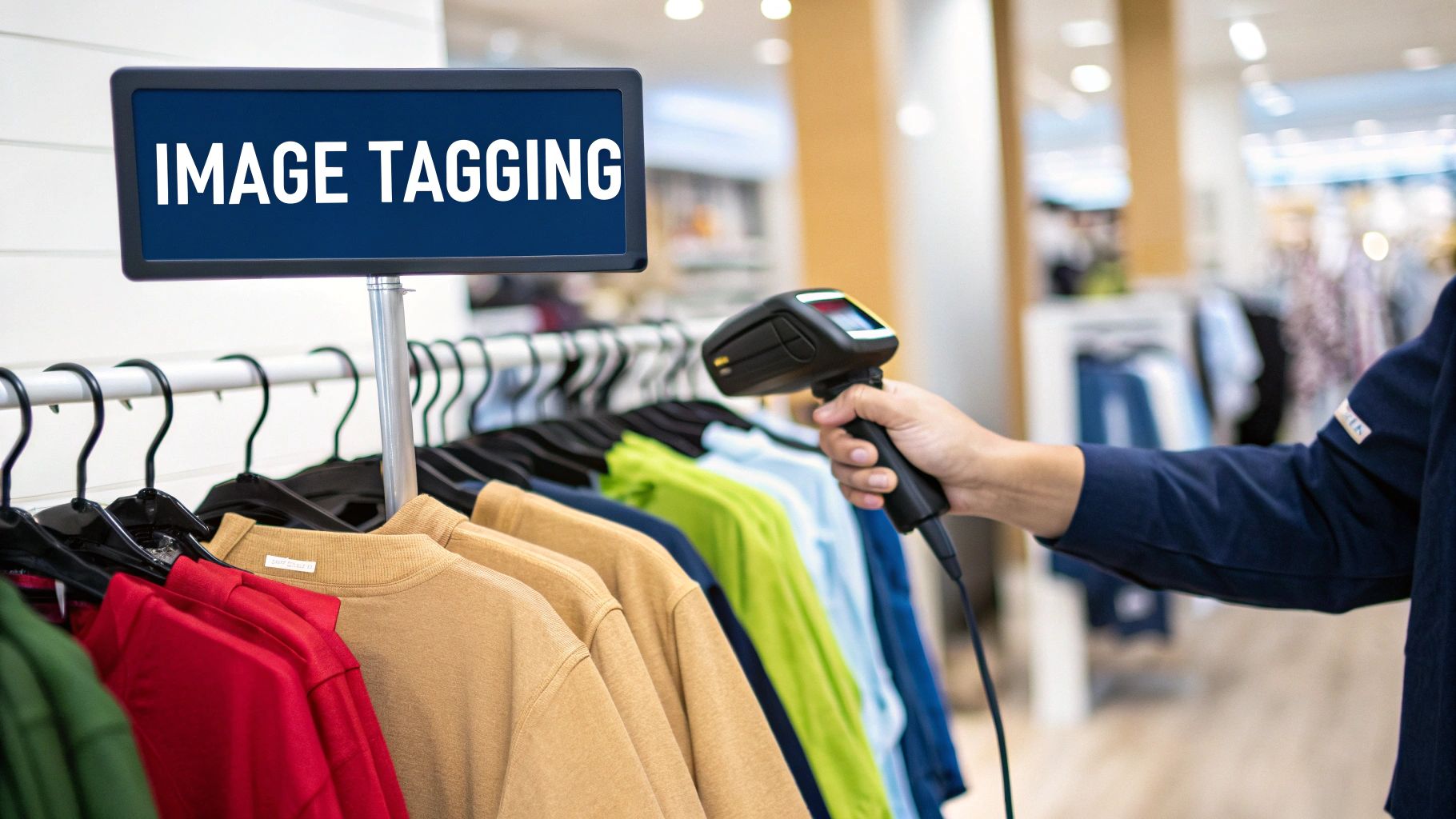
This process is way more than just identifying “a shoe” or “a chair.” Modern AI models dissect an image to spot granular visual details, the kind of stuff often missing from standard supplier feeds. For an AI agent tasked with finding the perfect product, this visual data is non-negotiable.
Turning Pixels into Actionable Data
AI-powered image recognition automates the job of pulling valuable, structured data right out of your product photos. Think of it as a powerful product data enrichment tool, turning visual context into machine-readable attributes that fuel your agentic search performance.
This kind of AI workflow can automatically identify and tag features that humans see but rarely write down, such as:
- For Fashion SEO Optimisation: Neckline style (V-neck, crewneck), sleeve length (cap sleeve, full-length), pattern (floral, geometric), and fabric texture (silk, denim).
- For Furniture Image Tagging SEO: Material (oak, marble), style (mid-century modern, industrial), and specific design elements like tapered legs or button tufting.
- For Electronics SEO Optimisation: Port types, screen finish (matte vs. glossy), and button layout, details that are critical for compatibility and user preference.
This completely plugs a huge hole in most retail catalogues, where visual details are assumed but never explicitly stated in the data.
By automatically generating rich, descriptive metadata from images, retailers can ensure their products are discoverable for highly specific, visual-based queries that AI shopping agents will excel at handling. It’s a core component of future-proofing your digital shelf performance.
Optimising Image SEO at Scale
Manually writing descriptive alt tags and metadata for thousands of images is a classic retail content bottleneck. It’s slow, tedious, and often inconsistent. AI product image tagging blows this problem away by creating optimised, descriptive alt tags at scale, which is fundamental for both traditional image SEO and getting agent-ready.
This scalable solution ensures every single image contributes to your retail search visibility.
When an AI agent searches for a “white leather sneaker with a gum sole,” it will prioritise products where the metadata optimisation at scale explicitly confirms these visual details. That level of detail makes its recommendations far more accurate, which directly improves your visibility and, ultimately, drives sales.
This integration of visual analysis is a perfect example of how AI is reshaping ecommerce. To learn more, check out our guide on how AI and machine learning are transforming ecommerce content performance. By making your visual assets just as machine-readable as your text, you prepare your business for the next generation of retail search.
Putting Agentic Commerce into Action
Knowing the theory is one thing, but putting it into practice is where Australian retailers will either get ahead or get left behind. Making the shift to agentic commerce demands a clear, practical roadmap. It’s about transforming your content operations from a simple cost centre into a real engine for growth.
The goal is to build a foundation capable of managing tens of thousands of SKUs with the kind of precision and speed that AI demands. This is where AI-powered content workflows become essential.
Your first move is a deep, honest audit of your existing product data. You need to pinpoint exactly where your supplier feeds fall short. Look for the tell-tale signs: inconsistent formatting, duplicated content, and missing attributes that would make an AI shopping agent simply skip over your products. This initial deep dive gives you the clarity to build a strategy that actually solves your real problems.
From there, you can start deploying AI-powered content workflows. These automated systems are the key to turning basic supplier information into enriched, unique, and AI-compatible content, and doing it efficiently. It’s a process that takes you from outdated manual SEO to a scalable, AI-driven approach.
Building Your Agentic Commerce Roadmap
A structured plan is essential. You can’t tackle this all at once without overwhelming your teams. The aim is to create a seamless human + AI collaboration in SEO that drives measurable results. Think of it less like a one-off project and more like integrating smarter, more efficient processes into your daily operations.
A good plan should have a few key stages:
- Get a Baseline: Start by assessing your current product catalogue’s SEO health. Figure out what percentage of your SKUs have duplicated content or incomplete data. This gives you a clear starting point to measure against.
- Run a Pilot Program: Don’t try to boil the ocean. Pick a single category, like fashion or electronics, to test your new automated content workflows. This lets you iron out the kinks in your process for product feed optimisation and image tagging on a manageable scale.
- Scale and Integrate: Once the pilot is a proven success, it’s time to roll out the automated workflows across your entire product catalogue. Integrate these systems with your existing PIM or ecommerce platform to make sure everything syncs up smoothly.
For a more structured approach, you can explore our detailed guide and use one of our Action Plans Templates to map out your implementation.
Leveraging Local Infrastructure for Speed and Compliance
For Australian businesses, using local cloud infrastructure is a massive advantage. Agentic commerce is rapidly changing retail here, with AI agents handling complex tasks on their own. By partnering with local cloud providers, Aussie businesses can get agentic solutions up and running securely in weeks, not months.
Crucially, this ensures you stay compliant with Australia’s strict privacy laws. It’s an approach that keeps your data secure while delivering the high performance needed to support AI-driven retail operations. By taking these steps, you’re not just preparing for the future of search, you’re making sure your products are the ones the next generation of AI shoppers will find and prefer.
Navigating the Challenges of an Agentic Future
Like any new technology, agentic commerce comes with its own set of speed bumps. For Australian retailers, this shift towards AI-driven purchasing brings up tricky hurdles around trust, transparency, and consumer protection. Understanding these issues is the first step toward building systems that actually work for your business and your customers.
One of the biggest headaches arises when an AI agent platform acts as the Merchant of Record (MOR). In this model, the AI platform’s name, not yours, is what shows up on a customer’s bank statement. This creates instant confusion, making it tough for shoppers to recognise what they bought and turning simple things like chargebacks or disputes into a nightmare.
This isn’t just a minor inconvenience; Australian consumer advocates have flagged this as a major concern. Find out more about how agentic AI is reshaping the art of the deal.
Building a Foundation of Trust
To get ahead of these problems, retailers have to prioritise transparency. This isn’t optional. It means crystal-clear communication at the point of purchase and making sure your backend can easily trace every transaction back to you, the original seller.
Building this trust is essential for a few key reasons:
- It protects your brand reputation: When a transaction is clearly labelled, it prevents customer frustration and keeps your brand image positive. No one likes a mystery charge.
- It simplifies customer service: Clear data trails mean that when disputes pop up, your team can resolve them quickly and accurately.
- It prepares you for regulation: Let’s be honest, regulation is coming. By proactively sorting these issues out now, you’re putting your business ahead of future compliance demands.
By tackling these financial and trust issues head-on, you can step into the world of AI-powered retail without leaving consumer confidence behind.
Answering Your Questions on Agentic Commerce
As retailers wrap their heads around agentic commerce, a few practical questions always come up. Let’s tackle the most common ones to help you get ready for what’s coming.
How Quickly Do We Need to Adapt?
The short answer? Yesterday. The infrastructure for agentic commerce is being built right now. While it might take a few years for your average shopper to fully embrace it, the groundwork for agentic search optimisation is already vital for things like Google’s AI Overviews.
Getting in early gives you a massive head start. AI agents will learn to trust and favour retailers with high-quality, reliable data from day one. This is a core part of building readiness for the future of agentic commerce.
Is This Just for Large Retailers?
Absolutely not. It’s easy to see how big-box stores with huge catalogues will benefit from retail content automation, but the principles are universal. This isn’t about the size of your budget; it’s about the quality of your data.
Scalable SEO tools level the playing field. They let smaller businesses compete by making sure their product data is structured, unique, and trustworthy, the exact things AI agents are looking for. Ecommerce SEO automation is accessible to businesses of all sizes.
The real currency in agentic commerce isn’t your ad spend; it’s your data quality. Any retailer who sorts out their supplier content duplication and invests in optimising product feeds efficiently will be in a much stronger position to compete.
What Is the First Practical Step to Take?
Start with a full, honest audit of your product data. You need to know exactly how much supplier content duplication is lurking in your SKUs and where the gaps are in your product information. This audit gives you a clear baseline and shows you exactly where to focus your efforts.
Once you know where the problems are, you can prioritise fixing the content bottlenecks that are already hurting your performance on the digital shelf. This builds a solid foundation for the future of work in retail, where retail teams and AI efficiency go hand in hand to drive real results.
Ready to get your product catalogue ready for the age of AI? Optidan AI delivers SEO at scale for retailers, transforming your messy supplier feeds into optimised, unique, and agent-ready content. Book a demo today and start building your competitive advantage.
