


Content marketing for ecommerce is no longer just about blogging. For Australian retail leaders managing thousands of SKUs, it's the engine that powers your digital shelf performance, turning basic product data into high-performing assets that drive sales and build loyalty.
The New Reality of Ecommerce Content Marketing
For Australian retail leaders, the old content playbook is officially broken. Slow, manual content creation is a major bottleneck. It leaves your brand exposed to penalties from correcting duplicated supplier content and makes it impossible to establish a unique voice at scale.
The shift from manual SEO to AI SEO isn't a future trend, it's a current operational necessity for survival and growth in a competitive market. This transition is driven by a need for speed, scale, and precision. Retailers are now managing tens of thousands of product pages, and every one requires unique, compelling, and optimised content. This is where AI SEO and retail content automation come into play, turning a monumental manual task into a scalable, strategic advantage.
Why Traditional Content Falls Short
The challenge isn't just creating more content, but better content, faster. Sticking to traditional methods almost always leads to the same problems, creating significant retail content bottlenecks:
- Supplier Content Duplication: Using generic supplier descriptions is a direct path to poor search rankings, as you're repeating what dozens of other sites are saying, triggering duplication penalties.
- Inconsistent Brand Voice: Manually maintaining a consistent tone and style across a massive product catalogue is nearly impossible.
- Slow Time-to-Market: Delays in getting new products live with quality content mean you're leaving money on the table.
- Poor Digital Shelf Performance: Under-optimised pages don't rank, don't attract clicks, and don't convert shoppers.
The chart below shows how different content types engage audiences, reinforcing why a varied, optimised strategy is so important for improving visibility.
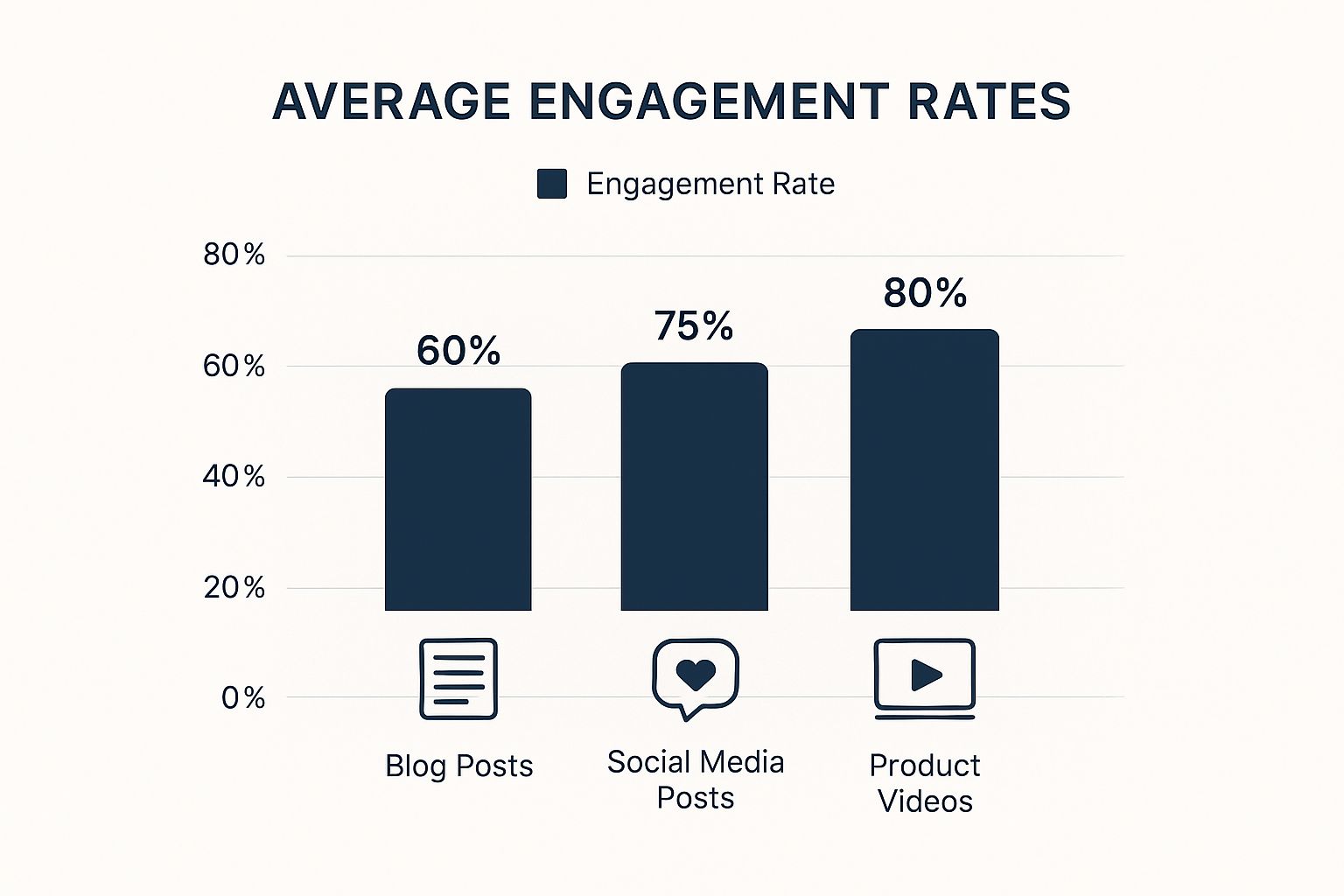
As you can see, while every type of content has its place, visually-driven formats like video often grab the most attention, a critical insight for any ecommerce brand leveraging AI workflow automation for retail.
Embracing a Scalable Future
The way forward is to weave AI-powered retail transformation into your core operations. This is not a nice-to-have, it's foundational. In fact, 74% of Australian ecommerce businesses now have a documented content marketing plan, showing just how seriously the market is taking this.
This strategic shift signals a deeper understanding of content's role in the entire customer journey. To better understand what works in this new environment, it�s worth exploring these essential content marketing best practices for e-commerce success.
Building Your Foundation with Product Data Enrichment
Think of your product data as the architectural blueprint for your entire ecommerce operation. If that blueprint is flimsy, incomplete, or a direct copy from a supplier, the whole structure will be unstable.
Solid content marketing for ecommerce doesn't start with a clever blog post. It begins with the foundational task of product data enrichment.

This is the process of transforming basic, duplicated supplier feeds into unique, structured, and highly optimised assets. It�s the critical first step in moving from manual SEO chaos to a scalable, automated system that drives your digital shelf performance. Without this, you are simply building your marketing on sand.
From Supplier Duplication to Unique Brand Assets
One of the biggest, and most avoidable, penalties in retail SEO comes from supplier content duplication. When dozens of retailers use the exact same product description from a supplier, search engines see it all as low-value, repetitive content. This directly harms your rankings and brand authority.
Fixing this isn't just about dodging penalties, it's about seizing a massive opportunity. An automated content workflow can systematically rewrite and enhance this data, creating thousands of unique product descriptions that reflect your brand. This is how you achieve true SKU-level SEO and stand out in a crowded market.
Product data isn�t just a technical requirement, it�s your primary marketing asset. Product feed optimisation is the most direct path to scalable SEO solutions, enhanced customer experience, and readiness for the future of agentic commerce.
This transformation is the real engine behind AI SEO. It goes beyond just slotting in keywords. It's about fundamentally restructuring your product information to make it far more valuable to both customers and search algorithms, preparing you for the future of work in retail.
Fuelling a Modern Retail Operation
High-quality, enriched data is the fuel for every other marketing activity. It's not an isolated task, it is the central hub that powers multiple functions, delivering efficiency and automation across your business.
- Powering Advanced Search: Enriched attributes like material, style, colour, and dimensions are essential for creating effective faceted navigation. This lets customers filter and find exactly what they need, fast.
- Enabling SEO at Scale: A clean, structured product feed is the prerequisite for automating product descriptions. Without it, AI-powered content workflows simply can't function effectively.
- Preparing for Agentic Search: Future AI agents in ecommerce, like Google's AI Overviews and Amazon Rufus, will rely on structured, factual data to make recommendations. Agentic search optimisation starts with a pristine product catalogue.
- Informing AI Image Recognition: Rich product data provides the context needed for AI image recognition SEO. Tagging an image of a couch becomes far more powerful when the system knows its material, brand, and style, all pulled from your enriched product feed.
Creating an Efficient Optimisation Workflow
The goal here is optimising product feeds efficiently. This means setting up a repeatable, scalable process that turns raw supplier data into a genuine strategic advantage. Modern retail content automation tools can take messy supplier feeds, standardise the information, pinpoint gaps, and apply AI-powered enhancements.
For categories like fashion SEO optimisation or furniture SEO services, this process is non-negotiable. Attributes like fabric type, fit, wood finish, or assembly requirements are critical purchasing factors. By structuring this data, you not only improve your SEO but also drastically improve the customer experience, which leads to higher conversions and fewer returns. This is the essence of building a robust foundation for next-gen SEO for retailers.
Achieving SEO at Scale with AI Content Automation

For most large retailers, the single biggest content bottleneck is scale. Manually creating unique, SEO-optimised content for a catalogue of 10,000+ SKUs is not just slow and expensive, for most in-house teams it is a logistical nightmare. This is where AI workflow automation for retail steps in, shifting your focus from small tweaks to massive gains in digital shelf performance.
This is about more than just using AI to write a few product descriptions. True AI SEO means building and deploying automated content workflows that can generate thousands of unique pages, from product descriptions to category pages and buying guides, in a matter of days. It tackles the core retail challenge of speed, turning a months-long project into a quick, repeatable process. This is the real difference when you compare AI SEO vs traditional SEO teams, as manual efforts simply cannot keep up.
The local opportunity is huge. The Australian ecommerce market is set to hit $42.2 billion in 2025, and it�s not slowing down. With over 17 million Australians shopping online every month, the retailers who win are the ones who can optimise their entire product catalogue, not just a handful of bestsellers.
From Manual Bottlenecks to Automated Efficiency
Traditional content creation is a slow, linear process that depends entirely on people. An AI-driven approach, however, is a system built for SEO at scale. It takes the enriched product data we discussed earlier and uses it to fuel a content generation engine.
The goal of retail content automation is not to replace your team, but to amplify their impact. AI handles the repetitive, high-volume tasks, freeing up your strategists to focus on brand guardianship, campaign innovation, and quality assurance. This embodies the principle of human + AI collaboration in SEO.
This shift enables something that was previously impossible: metadata optimisation at scale. Imagine updating meta titles and descriptions for your entire electronics or fashion category overnight to jump on a new search trend. That kind of agility is out of reach with a manual approach but becomes standard practice with AI-powered content workflows.
The Human and AI Collaboration Model
There's a common myth that AI automation means sacrificing quality or brand voice. When done right, the opposite is true. The best systems are built on human + AI collaboration in SEO, where the technology executes within a strategic framework set by your experts.
This collaborative process usually looks like this:
- Strategic Direction: Your team sets the brand voice, tone, key selling points, and SEO goals.
- AI Generation: The AI system takes this framework and your enriched product data to generate thousands of content variations.
- Human-Led AI Content QA: Your team reviews and refines batches of the AI-generated content, ensuring it meets brand standards before it goes live.
This model ensures every piece of content is on-brand, accurate, and optimised. It strikes the perfect balance between the speed of retail content automation and the essential nuance of human oversight. For a deep dive into putting this into practice, check out this practical guide to using AI for content creation.
By embracing these scalable SEO solutions, you can finally solve the persistent problem of supplier content duplication and create a unique, authoritative voice across your entire product catalogue. Making this strategic move from manual SEO to AI-driven systems not only clears content bottlenecks but also prepares your business for the future of retail search, where content quality at scale is non-negotiable. Learn more about how you can use AI for your SEO strategy in our dedicated article.
Optimising Visual Search with AI Image Recognition
For Australian retailers in visually-driven sectors like fashion, furniture, or electronics, customers truly buy with their eyes. Your product images are not just supporting assets, they are the primary point of connection. This makes image SEO for ecommerce a mission-critical part of your entire content marketing for ecommerce strategy.
The problem? Manually optimising tens of thousands of images with descriptive file names, alt tags, and metadata is a classic retail content bottleneck. It�s slow, expensive, and often inconsistent.
This is where AI image recognition SEO gives you a massive competitive advantage. Advanced AI models can analyse every pixel of your product photos, automatically identifying and tagging crucial attributes like colour, material, style, shape, and even intricate patterns.
This automated process turns a static image into a rich, structured data point, ready to be discovered by both traditional search engines and emerging visual search tools. It�s a foundational step in improving your digital shelf performance at a speed and scale that manual efforts could never hope to match.
Turning Images into Searchable Data Points
An effective AI-powered workflow for alt tag optimisation for retail does more than just fill in a blank field. It systematically creates descriptive, keyword-rich metadata that directly fuels your SEO.
Imagine you're a furniture retailer. An AI system can look at an image of a sofa and instantly generate tags like:
- Product Type: 3-seater sofa
- Style: Mid-century modern
- Material: Navy blue velvet upholstery
- Features: Tapered wooden legs, button-tufted back
This structured data is then used to automatically generate highly specific alt text ("Navy blue velvet 3-seater mid-century modern sofa with wooden legs") and optimised file names. When you apply this optimised at scale approach across thousands of products, every single image becomes a powerful discovery tool, especially for long-tail searches. This level of detail is a key part of our wider approach to product page optimisation with AI to boost your online store's overall performance.
The Impact Across Different Retail Verticals
The application of AI image recognition and tagging is not a one-size-fits-all solution. It is a versatile tool that delivers unique benefits tailored to the challenges of specific retail categories by addressing distinct customer search behaviours.
By automating image metadata, you are not just optimising for current search algorithms. You are building a visually indexed product catalogue that is fully prepared for the future of agentic commerce and AI-driven shopping assistants.
The strategic importance of this technology becomes clear when we look at its impact on different sectors. What matters in fashion is very different from what drives a sale in electronics, yet AI can adapt to both.
This table shows how AI image optimisation can be applied across different retail categories to solve specific problems and drive better SEO outcomes.
Impact of AI Image Optimisation Across Retail Categories
| Retail Category | Key AI Application | Primary SEO Benefit |
|---|---|---|
| Fashion & Apparel | Identifying specific attributes like neckline (V-neck, crew), sleeve length (cap, long), fabric (cotton, silk), and pattern (floral, striped). | Enhanced discoverability for highly specific "style finder" queries and improved performance in visual search platforms like Google Lens. This is a core part of fashion product image SEO. |
| Furniture & Homewares | Tagging materials (oak, marble), finish (matte, gloss), style (industrial, coastal), and features (flat-pack, solid wood). | Captures high-intent customers searching for products that fit a precise interior design aesthetic, boosting rankings for long-tail keywords. Key for furniture image tagging SEO. |
| Electronics | Recognising port types (USB-C, HDMI), screen size, colour, and specific model identifiers directly from the product image. | Improves accuracy in product listings and helps users visually confirm they are buying the correct model or accessory, reducing returns. Essential for electronics SEO optimisation. |
By implementing AI-powered content workflows for image optimisation, Australian retailers can solve a major operational headache while simultaneously future-proofing their visual assets. This automated approach ensures every image contributes directly to better search visibility, a more informative customer experience, and ultimately, stronger sales.
Preparing Your Business for Agentic Commerce
The ground beneath retail is shifting once again. For years, the focus of content marketing for ecommerce has been grabbing human attention with slick visuals and persuasive copy. But we are now entering the era of agentic commerce.
This is where AI agents for retail efficiency, like Google�s AI Overviews, ChatGPT, and Amazon Rufus, become the new gatekeepers. They will be the ones researching, comparing products, and even making purchasing decisions for users.
This requires a fundamental pivot. We're moving from optimising for human eyeballs to optimising for machine comprehension. The future of retail search belongs to retailers who can serve up structured, factual, and easy-to-digest content that these AI agents can trust. Your content must be computationally sound.
Building AI-Compatible SEO Content
So, what does content that�s ready for agentic search optimisation actually look like? This is not about stuffing keywords into a page. It's about presenting clear, unambiguous information that an AI can process and use to answer a person�s query with total confidence.
AI-compatible SEO content is built on a few key pillars:
- Structured Data: Use schema markup to explicitly label your product info, like price, availability, materials, and dimensions. You're giving the AI a clean, organised datasheet.
- Factual Accuracy: Your product specs must be correct and consistent everywhere your brand appears online. There is no room for error.
- Clear Hierarchy: Your content needs logical headings and subheadings. This makes the information easy for both humans and machines to scan and understand.
- Attribute Density: You have to get specific. For fashion SEO optimisation, this means going beyond �blue dress�. Think �navy blue A-line midi dress with V-neckline made from 100% organic cotton�.
This level of detail is crucial. An AI shopping agent tasked with finding "a durable, waterproof hiking boot under $250 with excellent ankle support" will not be admiring your lifestyle photography. It will be querying structured data points to find the perfect match, making SKU-level detail more important than ever.
The Role of Data Enrichment and Automation
This new reality ties directly back to the foundational principles we have already covered. You cannot prepare for agentic commerce future without first mastering product data enrichment and scalable content automation. These are the building blocks.
Agentic SEO is not a separate discipline. It is the logical next step for any data-first ecommerce strategy. Your ability to compete in the future of retail is directly tied to the quality and structure of your product data today.
Think of it this way: your enriched product data feed is the ultimate source of truth for an AI agent. When it needs to compare your product to a competitor�s, it will look at this structured data. If your data is incomplete, incorrect, or generic, you will be invisible in this new search paradigm.
This is exactly why fixing supplier content duplication and creating unique, detailed descriptions through retail content automation is so critical. For a deeper dive on this, you can explore our comprehensive Agentic AI SEO Content Optimisation FAQs.
Your Strategic Pivot to Agentic Readiness
Getting ready for the future of work in retail means making a strategic shift that embraces human + AI collaboration in SEO. Your team�s role will change. Instead of manually writing every description, they will be overseeing sophisticated AI workflows for ecommerce, setting the rules, verifying the data, and ensuring the output aligns with your brand�s goals.
Understanding how to apply this technology is key. For more insights into how AI agents can reshape your strategy, take a look at this article on Agentic AI Use Cases.
The move toward agentic shopping and the future of work is not a 'maybe someday' concept, it's an immediate strategic priority. Retailers still clinging to outdated, manual SEO practices will soon be fighting for scraps of visibility. In contrast, those who invest in a scalable, data-driven content engine will be perfectly positioned to win as AI agents in ecommerce become the new front door to their digital stores.
Integrating Your Content Across Marketing Channels
Powerful ecommerce content should never live in a silo. Once you have enriched your product data and set up AI-powered content workflows, the next step is to use these assets as a powerful source of truth for multi-channel product optimisation. This is where your investment in quality, structured content really starts to pay off, delivering exponential returns.
Suddenly, your detailed product descriptions and tagged images are not just for your website anymore. They become the raw materials for engaging social media posts, targeted email marketing campaigns, and compelling digital ads. This approach guarantees your brand message is consistent, accurate, and impactful at every single customer touchpoint.
Creating a Cohesive Customer Journey
The goal here is to create a seamless experience for your audience, no matter where they find you.
Imagine this: a customer discovers a new piece of furniture in an Instagram story, clicks through to the product page for more detail, and later gets a follow-up email showcasing related items. For that journey to feel connected and natural, the content has to be perfectly aligned.
Retail content automation makes this sophisticated, multi-channel approach feasible at scale. It allows your team to efficiently repurpose core product information for different platforms, tailoring the tone and format while keeping the brand's integrity intact. You can find more tips on this in our guide to maintaining a consistent brand voice across multiple channels.
By treating your enriched product data as a central content hub, you eliminate inconsistencies and empower every marketing channel to perform better. A single source of truth ensures every ad, post, and email is built on the same accurate, optimised foundation.
Tailoring Content for Australian Audiences
Different platforms demand different approaches, especially when you're trying to engage specific Australian demographics. Your AI-powered content workflows can adapt content for various channels on the fly:
- Social Media: Generate short, punchy copy and highlight key visual attributes identified by AI image recognition for platforms like Instagram and Facebook.
- Email Marketing: Create personalised campaigns by pulling detailed product attributes into emails, showcasing items that match a customer's browsing history.
- Digital Advertising: Use structured data to fuel dynamic product ads, ensuring your most compelling features are always front and centre.
Social media advertising is a dominant force in Australia's digital marketing space. In 2024, Australian brands spent a massive $4.26 billion on social ads, a 12.1% increase from the previous year, which now makes up 29.3% of all digital ad spend.
This highlights the critical need for high-quality, repurposed content to fuel these campaigns effectively. You can discover more insights about Australia's social media landscape on Meltwater.com. By integrating your content strategy across channels, you reinforce your brand message, drive qualified traffic from every direction, and maximise the return on your initial content investment.
Got Questions About AI-Powered Content Marketing? We've Got Answers.
Moving away from the manual content grind and into AI-driven strategies is a big step. It�s only natural to have questions. Retail leaders often want to know what this really means for their day-to-day operations, how different it truly is from the old way of doing things, and most importantly, how to keep their brand's personality intact.
Here, we tackle the most common questions ecommerce managers ask when they're thinking about bringing AI into their content workflows.
How Can We Start with AI Content Automation if We Don't Have a Big Tech Team?
You don�t need a huge in-house tech team to get started. The smartest and fastest way forward is to partner with a specialist provider of AI SEO services or a platform built specifically for retail. These solutions offer AI-powered content workflows as a managed service, so they handle all the technical heavy lifting for you.
The process usually kicks off with an audit of your product data feeds. This quickly flags the biggest content headaches, like missing descriptions or rampant duplicated supplier content. A good partner will then suggest a pilot project, focusing on a single category for instance, to prove a clear return on investment before you even think about scaling it across your entire catalogue. This frees up your team to focus on strategy and quality control while still getting the benefits of powerful retail efficiency tools.
What�s the Real Difference Between AI SEO and Traditional SEO?
The difference boils down to three things: scale, speed, and a relentless focus on data.
Traditional SEO is often a manual, piece-by-piece effort. A team might spend a month carefully optimising a handful of high-priority pages. In massive contrast, AI SEO automates this process to optimise thousands, or even tens of thousands, of product and category pages all at once. It's a clear case of AI SEO vs Traditional SEO efficiency.
It plugs directly into your product data, using AI agents for retail efficiency to analyse every attribute and generate unique, optimised content based on rules you help define. While traditional SEO often feels like running separate campaigns, AI SEO is more like an "always-on" optimisation engine that continuously improves your site.
Want to go deeper on this? Check out our detailed guide on how artificial intelligence is shaping search strategies.
How Do We Stop AI-Generated Content from Sounding Like a Robot?
Making sure your brand voice doesn't get lost is absolutely crucial, and it's achieved through what we call human + AI collaboration in SEO. This is not about just hitting "generate" and hoping for the best. Far from it.
You work with strategists to define your brand�s specific tone, style guides, and even the niche terminology you use.
These guidelines are then built directly into the AI models and content templates. Think of them as guardrails. The AI creates content that has to stay within these predefined boundaries, which is how you get consistency at scale.
Then comes the final, non-negotiable step: human-led AI content QA. Before a single word goes live, your team (or your agency partner) reviews batches of the AI-generated content to make sure it hits the mark and feels perfectly aligned with your brand. This model gives you the incredible scale of AI combined with the essential nuance and oversight that only a human expert can provide.
Ready to eliminate content bottlenecks and prepare your catalogue for the future of retail search? Optidan AI builds scalable, AI-powered content workflows that deliver unique, optimised content for thousands of products in days, not months. Visit Optidan.com to learn how.
