


Ever wish you had a single, reliable number that tells you exactly how happy your customers are? That’s the Customer Satisfaction Index (CSI). It’s a standardised metric that measures how well your products and services meet, or even exceed, what your customers expect.
What the Customer Satisfaction Index Means for Your Business
For Australian retail leaders and ecommerce managers, the Customer Satisfaction Index is so much more than just another feedback score; think of it as a vital sign for your business's health. It’s almost like a financial forecast for customer loyalty. A strong CSI score is a great predictor of repeat business, positive word-of-mouth, and a healthier bottom line. It’s not just a definition, it’s a strategic tool for growth.
A high CSI tells you that your operations, from the clarity of your product pages right through to the efficiency of your delivery, are hitting the mark. It's a direct reflection of your ability to set and meet expectations, which is the bedrock of building trust and keeping customers in a fiercely competitive market.

Connecting CSI to Modern Retail Operations
Not too long ago, gathering the data needed for a meaningful CSI was a manual, painstaking task. Today, the future of work in retail is all about efficiency and automation, which is where AI SEO and automated content workflows come in. These systems are essential for optimising the thousands of different touchpoints that shape a customer's perception of your brand, moving you from manual SEO to AI SEO.
For example, your CSI is directly tied to the quality of your product information. By using AI-powered product data enrichment, you can turn generic supplier feeds into unique, optimised content at a massive scale. This process involves:
- Correcting Duplicated Supplier Content: This helps you avoid penalties from search engines and establish a unique brand voice that builds trust.
- Optimising at Scale: You can deploy AI workflows for ecommerce that update tens of thousands of product pages in just days, ensuring everything is accurate and consistent.
- Enhancing Visual Search: AI image recognition and tagging can be a game-changer for categories like fashion and furniture, helping customers find exactly what they’re looking for.
Ultimately, a strong CSI is the outcome of excellent digital shelf performance. When customers can easily find accurate, compelling, and helpful information, their satisfaction naturally increases. This sets them up for a positive post-purchase experience.
By embracing retail content automation, you're not just improving your search rankings; you're building the foundation for superior customer satisfaction. A deeper look into understanding your customer is the key to effective communication can further highlight how these strategies align with what consumers really want.
How To Calculate Your Customer Satisfaction Index Score
Measuring your Customer Satisfaction Index (CSI) isn’t about complex spreadsheets or costly consultants. It’s more like a regular health check for your business, one that turns honest customer feedback into a single, trackable figure. Over time, that score becomes a reliable barometer of your performance in Australia’s retail scene.
At its heart, the CSI relies on three core questions. Answered on a 1-10 scale, they capture different angles of the customer experience. Once collected, you simply transform those ratings into percentages, apply weights, and roll them up into your final index. Modern AI workflows for retail efficiency can even automate surveys, so your CSI moves from a quarterly snapshot to a real-time pulse.
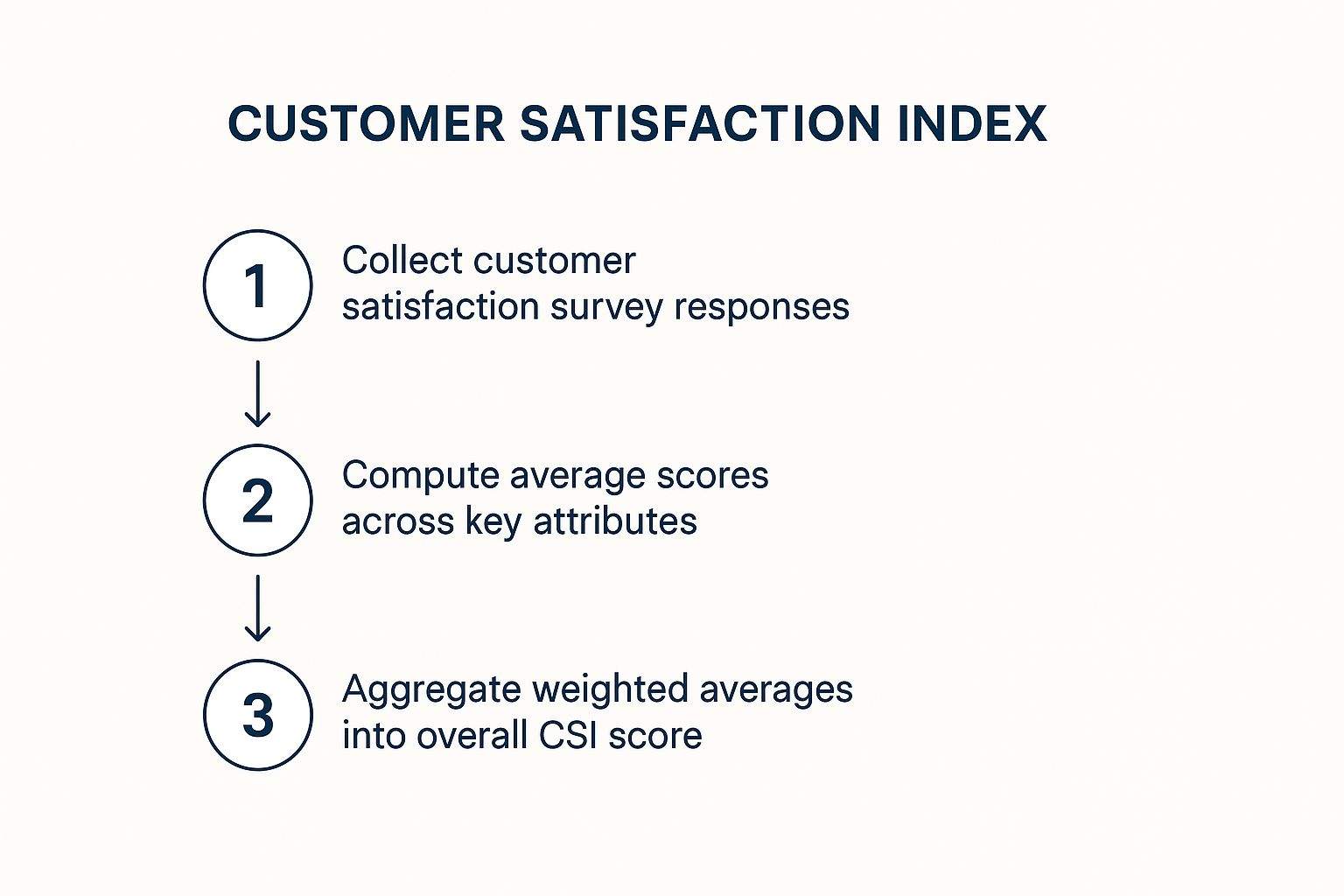
This chart distils the journey: from survey response to 0–100 scale, then to a single CSI that guides your strategic decisions.
Core Components Of The Customer Satisfaction Index Calculation
Before you crunch numbers, you need the right questions. Think of these components as the pillars holding up your CSI.
| Survey Question Component | What It Measures | Example Question (1-10 Scale) |
|---|---|---|
| Overall Satisfaction | Customer’s immediate sentiment | “How satisfied are you with our product/service overall?” |
| Expectation vs Reality | How actual performance matched initial expectations | “Did our product meet the expectations you had beforehand?” |
| Comparison to Ideal | Gap between current experience and a perfect scenario | “How close is our service to the ideal solution you imagined?” |
Each question brings its own insight. Together, they form a concise framework that retail leaders can use to benchmark progress and spot trouble early.
The Calculation Formula
Once responses are in, you follow three simple steps:
- Convert each 1-10 rating into a 0–100 score
- Apply weightings to reflect the priority of each question
- Average those weighted scores into your final CSI
A low score on the “Expectation vs Reality” component often highlights misaligned product descriptions or supplier data issues. This is a clear signal that product data enrichment is needed.
Weightings can be custom, but sticking to a standard approach helps you compare performance across time, and against your peers. Familiarity with customer satisfaction measurement methods ensures you adopt best practices from day one.
Automating surveys after every key interaction keeps your CSI fresh. For a broader view of performance metrics, see our guide on the top metrics to track for ecommerce success in 2024. Continuous data streams mean you spot shifts in sentiment early, and act fast.
Why CSI Is a Critical KPI for Australian Retailers
In the cut-throat Australian retail market, a high Customer Satisfaction Index (CSI) score is much more than a pat on the back. It’s a serious commercial advantage. This metric isn’t just about feelings; it’s a direct indicator of real business outcomes like customer loyalty, repeat purchases, and brand advocacy. For retail leaders and ecommerce managers, truly understanding what the customer satisfaction index means is the first step toward using it for growth.
Think of a satisfied customer as your best marketing asset. They’re far more likely to leave a positive review, which gives your digital shelf performance a direct boost and improves your search rankings. This is a massive factor for agentic search readiness, making sure AI agents for retail efficiency like Rufus or Perplexity will surface your products because they see positive user feedback. In a crowded market, nailing customer satisfaction is what genuinely separates your brand from competitors who are just recycling generic supplier content.

Driving Loyalty and Repeat Business
A consistently high CSI score tells you that your entire operation, from product data enrichment to the final delivery, is hitting the mark. When a customer’s actual experience lines up with the promise you made on your product page, you build trust. That trust is the bedrock of loyalty, driving repeat business and bringing down your long-term customer acquisition costs.
On the flip side, a poor experience can cause lasting damage. Many Australian retailers are still grappling with supplier content duplication, which just leads to customer confusion and costly returns. You can learn more about this common pitfall by exploring the unseen enemy of Australian online retailers.
A Benchmark for Performance in Australia
Across Australia, the CSI is a vital yardstick for measuring how consumers feel about the quality of products and services. The annual Roy Morgan Customer Satisfaction Awards, for instance, are built on surveys of over 60,000 Australian consumers. This data provides a solid benchmark for everyone from supermarkets to banks, helping businesses pinpoint their strengths and weaknesses.
These measurements are critical for shaping strategic decisions in Australia’s fiercely customer-focused market. You can find more insights on customer satisfaction trends in Australia from Statista.
In short, your CSI is a health check for your entire retail ecosystem. It shows whether your investments in AI SEO, automated content, and scalable SEO solutions are actually creating an experience that customers value enough to come back for. Tracking and actively improving your CSI isn't just a good idea, it's a core part of any sustainable growth strategy for modern Australian ecommerce.
Boosting Your CSI Score with AI and Product Data
Trying to lift your Customer Satisfaction Index (CSI) score at scale used to be a painful, manual job. For Australian retail leaders, there’s now a much smarter way forward: using AI to drive efficiency and improve the customer experience right from the source, your product data. It’s a strategic shift away from old-school manual SEO towards a more intelligent approach that transforms how you manage customer expectations.
Think about it. The absolute foundation of customer satisfaction in ecommerce is accurate product information. When a customer opens a box and finds the item inside is exactly what they saw online, the right colour, the right size, the right specs, you’ve nailed their core expectation. This is why product data enrichment is such a powerful lever for improving your CSI.
From Supplier Feeds to Satisfied Customers
So many retailers are still running on generic supplier feeds. The result? A mess of inconsistent, duplicated, and frankly boring product descriptions across thousands of different SKUs. This is a huge driver of customer frustration and returns, which directly torpedoes your CSI score. Fixing this problem of duplicated supplier content at scale is the first step to building a more trustworthy and reliable shopping experience.
An automated content workflow can completely change the game:
- Optimise at Scale: AI can rewrite and enrich tens of thousands of product pages in just days, making sure every single one is unique, accurate, and speaks in your brand's voice.
- Build Trust: Unique, detailed descriptions set crystal-clear expectations. This prevents that sinking feeling of post-purchase disappointment that kills customer satisfaction.
- Enhance Digital Shelf Performance: High-quality content doesn't just satisfy customers; it improves search rankings, making it easier for people to find what they need in the first place. This is a massive part of the modern customer satisfaction index meaning.
Leveraging AI for a Superior Experience
It’s not just about the words on the page. The visual experience is critical, especially for categories like fashion and furniture where details matter. AI-powered image recognition and tagging makes sure your visual information is just as accurate and searchable as your text. When a customer can filter for a "V-neck" top or an "oak finish" table and get spot-on results, their shopping journey feels seamless and satisfying. This is the level of detail modern online shoppers now expect.
A proactive approach means optimising not just for Google, but for the future of agentic commerce. Preparing your content for AI agents like ChatGPT, Perplexity, and Rufus ensures your products are accurately represented in the next wave of retail search.
This is where next-gen SEO for retailers comes in. Adopting a framework that embraces AI SEO services helps future-proof your retail business against these new search trends. By focusing on scalable SEO solutions, you’re not just chasing rankings; you’re building a content ecosystem designed to delight both human customers and AI agents.
While AI and product data are game-changers, a broader range of strategies to improve customer satisfaction scores can take your efforts even further. Ultimately, the move to an AI-powered retail transformation creates a direct line between operational efficiency and customer happiness. You can learn more about integrating these advanced methods in our detailed guide on implementing AI for SEO.
Understanding the Broader Economic Context of CSI
Your Customer Satisfaction Index (CSI) score doesn't exist in a vacuum. It’s easy to get tunnel vision, focusing only on internal operations, but for Australian retail leaders, the real customer satisfaction index meaning comes from seeing the bigger picture. The wider economy, things like consumer confidence, inflation, and cost-of-living pressures, powerfully shapes what your customers expect and how they perceive value.
A sudden dip in your CSI might have nothing to do with your latest retail transformation project or your automated content workflows. It could simply reflect a market-wide trend where anxious consumers are tightening their belts and thinking twice about every purchase. When economic storm clouds gather, the definition of "satisfaction" often shifts from flashy features to sheer value and reliability.
Connecting Internal Metrics to Market Realities
Grasping these dynamics lets you shift from being reactive to proactive. During periods of economic strain, your focus might need to pivot from promoting luxury goods to highlighting durability and cost-effectiveness. This is where having efficient retail content automation becomes a massive advantage. You can quickly roll out messaging that resonates with the current economic mood across thousands of products, ensuring your digital shelf is aligned with what customers need right now.
Understanding the macroeconomic climate transforms your CSI from a reactive report card into a predictive tool. It helps you anticipate shifts in customer priorities and adapt your strategies and retail efficiency tools before your competitors even know what’s happening.
This kind of thinking connects your internal KPIs to the larger Australian economic story, paving the way for smarter, more contextual decisions.
A Historical Look at Australian Consumer Confidence
You only need to look at historical data to see how tightly consumer confidence and satisfaction are linked to economic and social events in Australia. The ANZ-Roy Morgan Consumer Confidence Rating, which has been tracked since 1973, shows a clear pattern: how Australians feel about the economy directly impacts their satisfaction with goods and services.
Think back to the global financial crisis in 2008. Ratings swung wildly, mirroring the widespread uncertainty. The connection is strong because higher confidence usually leads to more spending and more positive reviews of services. You can learn more about these historical trends of Australian consumer confidence on Roy Morgan.
Navigating Major Events and Their Impact on CSI
Think of your CSI score as a ship’s compass in rough seas. When a storm hits, a global pandemic, a supply chain collapse, or a sudden market shift, that compass is the only thing that shows you where to steer. It tells you if you're holding steady or veering off course.
Major events can completely reshape customer expectations almost overnight. The COVID-19 pandemic was the ultimate stress test for every retailer’s ability to deliver consistent, reliable service when it mattered most.

Suddenly, health restrictions and supply chain nightmares created friction at every single touchpoint. At the same time, the massive shift to ecommerce meant digital agility wasn't just a goal; it was a survival mechanism.
- Labour Shortages pushed service levels and response times to their breaking point.
- Digital Adoption exploded as customers demanded online alternatives for everything.
- Operational Resilience quickly became the key competitive differentiator.
In a May 2022 report from the Customer Service Institute of Australia (CSIA), over 10,095 Australians weighed in on how these disruptions impacted their satisfaction with banking, insurance, and government services. Their feedback showed just how crucial it was for businesses to monitor CSI and adjust their strategies in real time.
“Continuous tracking of customer satisfaction through indices helps organisations understand evolving expectations and adapt service frameworks quickly.”
Adaptation Through AI Workflow Automation
It became clear that retailers with a solid digital foundation were far better equipped to keep satisfaction levels high. Those who could lean on efficient AI-driven workflows were able to manage real-time content updates across thousands of products without missing a beat.
You can see a similar dynamic in our analysis of Google’s March 2024 core update impact on online retail.
The winning strategies included:
- Automated content workflows to eliminate duplicated supplier content.
- Scalable product data enrichment to create clear, unique descriptions.
- AI-powered image recognition to ensure visual accuracy across the board.
Future-Proofing Your Customer Satisfaction Index
Building true resilience means investing in scalable retail content automation. By enriching your product data and stamping out supplier duplication at scale, you set crystal-clear expectations and dramatically reduce post-purchase disappointment.
Getting ready for the future also means embracing agentic search optimisation and preparing for AI agents. High-quality, AI-powered content is no longer just a "nice-to-have", it directly supports stronger digital shelf performance and reinforces customer trust.
In the end, it’s adaptability and resilience that separate the businesses that thrive from those that merely survive during major disruptions. Adopting efficient, AI-powered retail content workflows isn’t just about technology; it’s your pathway to future-proofing your CSI.
Commonly Asked Questions About CSI
When it comes to the Customer Satisfaction Index, Australian retail leaders tend to ask the same sorts of questions. Everyone wants to know what it really means for their business and how it fits into the bigger picture of ecommerce success.
Let's clear up some of the most common queries.
What's the Difference Between CSI and NPS?
Think of it like this: CSI measures satisfaction with a recent interaction, while NPS predicts long-term loyalty. CSI tells you how happy a customer is right now with a specific purchase or support call. NPS asks if they're willing to put their reputation on the line and recommend you to a friend.
Many of the sharpest ecommerce managers in Australia track both. Why? Because combining them gives you a complete picture of customer health. You get a snapshot of immediate satisfaction from CSI and a forecast of future growth from NPS.
- CSI captures in-the-moment happiness with a single transaction.
- NPS measures overall brand loyalty and advocacy.
- Using both helps you drive real improvements to your digital shelf performance.
When Should We Send a CSI Survey?
Timing is everything. For the most accurate feedback, trigger a CSI survey immediately after a key moment, like a purchase or a customer service interaction.
For a broader view of trends, sending them out quarterly works well without overwhelming your customers. Tools that offer automated content workflows or AI workflow automation for retail can make this data collection practically effortless.
“Consistent CSI tracking helps retailers stay ahead of satisfaction shifts and guide smarter decisions.”
How Does Product Data Affect Our CSI Score?
It has a huge impact. In fact, it's one of the most direct levers you can pull.
When your supplier content is incomplete, inaccurate, or duplicated, you create a gap between what a customer expects and what they actually receive. That mismatch is a direct path to disappointment, returns, and a plummeting CSI score.
On the other hand, proper product data enrichment ensures every description is accurate and every image is correct. This doesn't just lift your CSI score and boost conversions; it also improves processes like image recognition & tagging, paving the way for better digital shelf performance overall.
Ready to scale product content fast? Get started now with Optidan AI at https://optidan.com
