


Product data enrichment is the secret sauce behind today’s top-performing online stores. At its core, it's the process of taking raw, basic information from your suppliers and transforming it into complete, accurate, and genuinely compelling product listings. It’s about turning a messy, disorganised warehouse of data into a perfectly curated digital shelf where customers can easily find exactly what they need.
This isn’t just a simple clean-up job, it’s about creating a unique, structured, and optimised asset that drives high performance on the digital shelf.
Why Product Data Enrichment Is Your New Retail Superpower
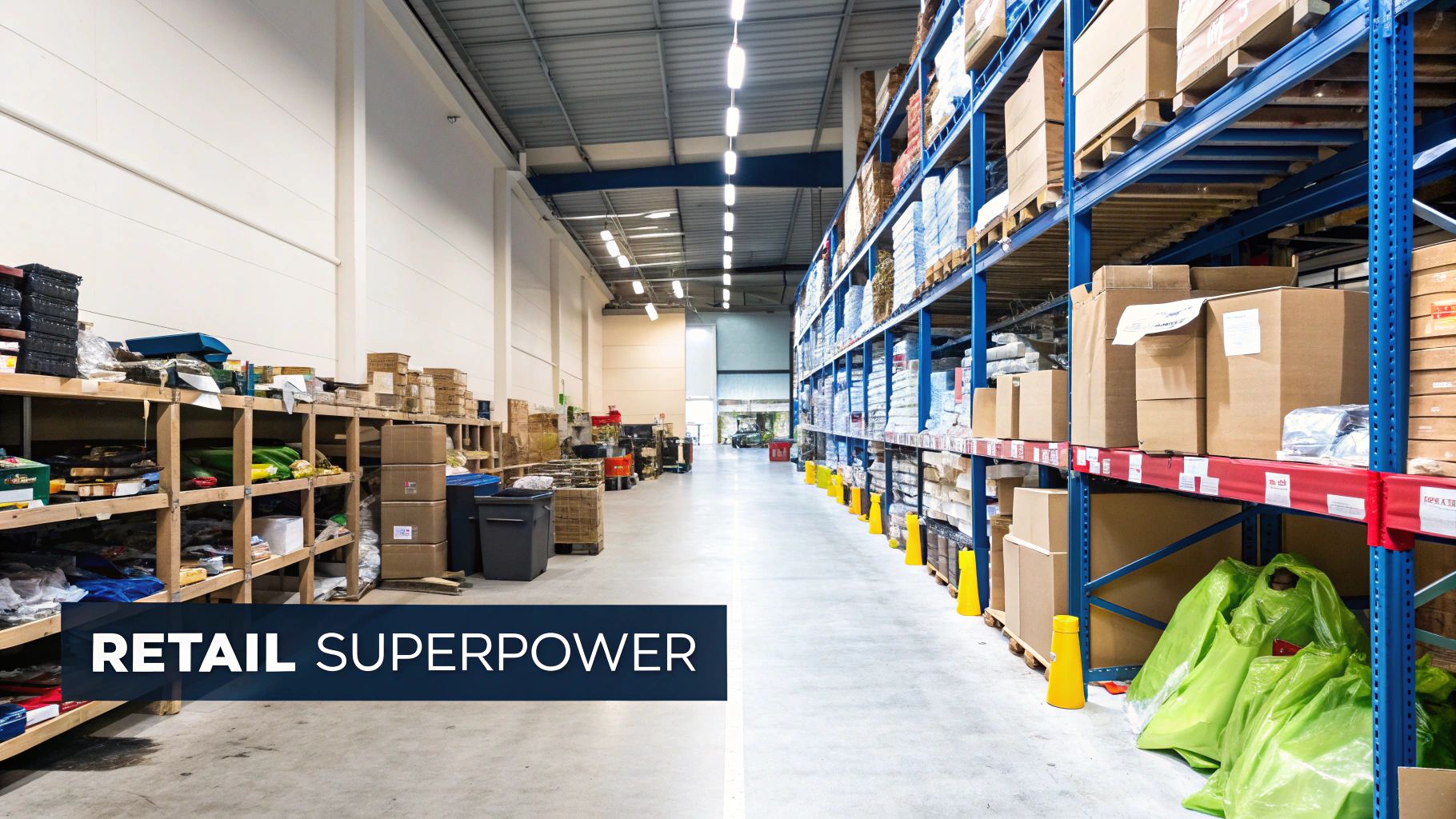
Let's be blunt: raw supplier feeds are holding your retail business back. That incomplete, generic, and duplicated product data isn't just sitting there, it's actively damaging your SEO rankings and creating a frustrating experience for your customers.
Product data enrichment isn't some minor technical task; it's a foundational business strategy for survival and growth. This is especially true as we move towards a future of AI-driven, agentic commerce. Think of it as the critical first step in shifting from outdated manual SEO to a smarter, more scalable AI SEO strategy. This is the core of retail efficiency tools that deliver next-gen SEO for retailers.
This process goes far beyond just filling in a few blank fields. It's a complete overhaul of your product catalogue that tackles several core challenges at once:
- Correcting Duplicated Supplier Content: It gets rid of the risk of search penalties by crafting unique product stories, moving you away from the generic descriptions every one of your competitors is using. This is a crucial duplicate content SEO fix.
- Optimised at Scale: It uses AI workflow automation for retail to process tens of thousands of SKUs in days, not months, breaking down the retail content bottlenecks that are stunting your growth.
- Preparing for the Future of Search: It structures your data in a way that AI shopping agents can actually understand, making sure your products stay visible in the agentic commerce future. This is about building AI-compatible SEO content.
From Chaos to a High-Performing Asset
The most immediate benefit of product data enrichment is its power to fuel compelling product descriptions that genuinely move the needle on sales. Enriched data gives you the granular details needed to tell stories that connect with your customers. If you're looking to sharpen this skill, learning how to write product descriptions that sell is a great place to start. This strategic approach is how you turn messy supplier feeds into a powerful engine for revenue and customer loyalty.
The table below breaks down just how stark the difference is between sticking with raw data and investing in enrichment.
The Impact of Data Quality on Retail Performance
| Retail Metric | Impact of Raw Supplier Feeds | Impact of Enriched Product Data |
|---|---|---|
| Search Engine Rankings | Penalised for duplicate content, leading to poor visibility and low organic traffic. | Improved rankings due to unique, keyword-rich content that search engines favour. |
| Customer Experience | High bounce rates and cart abandonment due to incomplete or confusing information. | Lower bounce rates and higher engagement as customers find clear, helpful details. |
| Conversion Rates | Low conversions because generic descriptions fail to build trust or answer questions. | Increased conversions driven by compelling narratives that build confidence and desire. |
| Return Rates | Higher returns as products don't match the vague or inaccurate descriptions provided. | Lower returns because accurate, detailed information sets clear customer expectations. |
| Brand Perception | Seen as just another reseller, lacking authority and trustworthiness. | Perceived as an expert and a trusted source, fostering brand loyalty and repeat business. |
As you can see, the path you choose has a direct impact on your bottom line.
The impact of this is huge, especially in Australia’s e-commerce market, valued at around USD 89.4 billion in 2024. With a staggering 80% of Australian households now shopping online, local retailers are turning to enrichment to make their sites easier to navigate and search.
In fact, research suggests that by dedicating just 20% of their efforts to data enrichment, Australian online retailers can see up to an 80% increase in profitability. It’s a massive return for a focused investment.
Ultimately, getting your product data right is the key to unlocking scalable SEO solutions and dominating your niche. To build that solid foundation, it’s essential to understand the principles behind modern search, which we cover in our guide on artificial intelligence SEO. This approach will position your business for success today and get you ready for the agentic shopping of tomorrow.
Turning Supplier Feeds Into High-Performing Assets
So, what does product data enrichment actually look like in practice? It’s the process of transforming a raw, messy supplier feed into a digital asset that actually performs. This is where we move beyond theory and into the automated content workflows that build a real competitive advantage.
The goal is to stop using the same basic, duplicated data as everyone else and start creating unique content that's optimised for every channel you sell on. It's about building a scalable system that makes every single product listing more discoverable, more compelling, and ultimately, more valuable.
The whole thing kicks off with data normalisation and classification. AI agents get to work on those incoming supplier feeds, correcting inconsistencies, standardising formats (like turning "inch" and "inches" into a uniform "in"), and slotting products into the right granular categories. This first step is crucial, it cleans the foundation before the real enrichment begins. From there, the system zeroes in on attribute extraction, which is where you really start to see improvements on the digital shelf.
This infographic breaks down the fundamental flow of turning raw data into a strategic asset.
As you can see, the journey from a basic supplier file to optimised product data is a structured, technology-driven process built for retail efficiency.
Using AI to Uncover Hidden Value
One of the most powerful parts of modern product data enrichment is AI image recognition and tagging. Let's be honest, suppliers rarely provide the rich, descriptive details that shoppers actually use to search. An AI-powered workflow changes that by analysing product photos to identify and tag visual attributes that would otherwise be completely lost.
This technology is a genuine game-changer across different retail sectors:
- For Fashion SEO Optimisation: AI can instantly spot and tag attributes like ‘V-neck’, ‘puff sleeve’, ‘linen blend’, or ‘floral print’ right from the images. This adds layers of searchable, long-tail keywords that capture exactly what your customers are looking for.
- For Furniture Image Tagging SEO: It can tell the difference between a ‘mahogany finish’ and a ‘walnut stain’, or tag styles like ‘mid-century modern’ or ‘industrial’. These are the details that matter when customers are making considered purchases.
- For Electronics SEO Optimisation: The AI can recognise ports, button layouts, and screen types, adding technical specs that might have been missing from the original supplier feed.
This automated image analysis adds a huge amount of unique, structured data to each product listing. Of course, transforming supplier feeds also demands careful attention to other areas, including strategic image optimization for web performance. This makes sure that not only is the data rich, but the user experience is fast and seamless.
Solving Supplier Content Duplication at Scale
Perhaps the biggest problem this AI-powered process solves is supplier content duplication. Using the same generic descriptions as dozens of other retailers is a fast track to search engine penalties and terrible organic visibility. An automated content workflow tackles this head-on by creating unique, SEO-friendly descriptions for every single item in your catalogue.
By generating distinct narratives for each product, retailers can protect their site from duplication penalties and significantly boost SKU-level SEO. Each product page becomes a unique asset capable of ranking for its own set of keywords, rather than competing with identical pages across the web.
This isn't just about dodging penalties; it's about building a unique brand voice and giving customers real value. An effective enrichment strategy is central to any modern eCommerce plan, and understanding the nuances of how product feed management is crucial for optimising and scaling your strategy is key.
By turning generic feeds into bespoke, high-quality assets, you create a powerful engine for organic growth and better conversion rates. It’s a systematic approach that prepares your catalogue for the future of retail search and secures your spot on the digital shelf.
Using AI for Product Data Enrichment at Scale

Let's be honest, manually optimising thousands of products is a dead-end strategy. The sheer volume of data makes it impossible for human teams to keep up, leading to content bottlenecks that slow growth and hurt your digital shelf performance.
This is where artificial intelligence stops being a buzzword and becomes a critical tool for retail efficiency. It’s what makes SEO at scale not just a goal, but an achievable reality.
AI-powered workflows are built for the complexity of modern retail. They automate the painstaking work of standardising data, pulling out key attributes, and creating content. This means you can enrich your entire product catalogue with a speed and consistency that manual efforts could never hope to match. It’s not just about moving faster, it's about being smarter.
Key AI Technologies Driving Retail Efficiency
The move towards AI SEO isn't some far-off concept; it's happening right now, driven by specific technologies that solve real-world retail problems. The difference between AI SEO vs Traditional SEO lies in this automation and strategic foresight.
Two of the most impactful are:
- AI Image Recognition and Tagging: This tech scans product photos to identify and tag visual details that supplier feeds almost always miss. For a fashion brand, it can automatically tag a dress with ‘puff sleeve’ or ‘A-line silhouette’. For a furniture store, it might identify a ‘walnut finish’ or ‘tapered legs’. This creates a goldmine of unique, searchable data that boosts SKU-level SEO and improves the customer’s filtering experience on your site.
- Generative AI for Content Creation: This is the powerhouse that finally solves the supplier content duplication problem. AI agents can be trained on your brand’s voice and SEO rules to write compelling, keyword-rich product descriptions, titles, and metadata in seconds. Every product page becomes a unique asset, optimised to rank on its own and avoid search engine penalties.
This shift isn't just a trend; it's a massive market force. The global data enrichment market is projected to explode from USD 6.95 billion in 2024 to USD 17.48 billion by 2035. This growth signals a huge demand for better, data-driven customer experiences, a movement Australian retailers are joining to get ahead.
The New Model of Human and AI Collaboration
Bringing AI agents for retail efficiency into your business isn't about replacing people. It’s about changing their roles for the better and empowering them to achieve more. Think of it as an evolution, moving your team away from repetitive tasks and towards strategic oversight. This is the future of work in retail.
By automating the heavy lifting of data processing and content creation, AI crushes the content bottlenecks that previously bogged down marketing and ecommerce teams. This frees up your talented staff to focus on higher-value activities like strategy, creative direction, and human-led AI content QA.
This human + AI collaboration is the new benchmark for high-performing retail teams. The AI handles the scale and speed, while your team provides the critical oversight, brand expertise, and quality checks to ensure the final result is perfect. It's a synergy that allows you to optimise a massive product catalogue with precision, giving you a serious competitive edge.
Making this transition is a crucial step for any forward-thinking retailer. To dig deeper into this, check out our article on how AI SEO software is reshaping online retail. Adopting this new model is key for any business looking to build scalable SEO and get ready for the next wave of agentic commerce.
Winning the Digital Shelf and Preparing for Agentic Search
A well-oiled product data enrichment strategy is what separates the winners from the rest. It’s the essential bridge between all the back-end work you do cleaning up supplier feeds and the front-end results that actually move the needle on your KPIs. Think of rich, detailed, and unique product data as the high-octane fuel for dominating today's digital shelf.
When your product listings are complete and genuinely helpful, every metric gets a lift. Your search rankings climb because unique content sidesteps those pesky duplicate content penalties. Click-through rates jump because shoppers are drawn to informative titles and useful attributes.
Most importantly, conversions grow. Why? Because you’re giving customers the confidence and clarity they need to hit "buy now."
But the game is changing. Fast. The next frontier isn’t just about making your website look good for human shoppers. It’s about getting your products ready for the agentic commerce future.
The Shift to Agentic Search Optimisation
The rulebook is being rewritten. AI shopping assistants like ChatGPT, Perplexity, and even Amazon's Rufus are quickly becoming the new front door for product discovery. These AI agents don't browse websites like we do. Instead, they digest highly structured, machine-readable data to understand, compare, and recommend products.
This is a fundamental shift from traditional SEO to what we call agentic search optimisation. If your product data is thin, generic, or just a mess of unstructured text, these AI shopping agents will simply ignore you. Your products will be invisible in this new wave of search, no matter how much you've invested in your old SEO playbook.
Enriching your product data is no longer a "nice-to-have" for improving current digital shelf performance. It's now a non-negotiable requirement for future survival. It’s the only way to ensure AI agents don't just find your brand, but actively recommend it.
To win here, you need to create AI-compatible content. This means moving beyond basic keywords and starting to think about the complex, conversational questions real people will ask these assistants. For example, a shopper might ask an AI to find "a waterproof hiking jacket under $300 with GORE-TEX, plenty of pockets, and a hood, that’s suitable for Tasmanian winters."
An AI agent can only pull your jacket into its recommendations if your product data explicitly and structurally contains every single one of those attributes:
- Use Case: Hiking, outdoor activities
- Price: Under $300
- Material: GORE-TEX
- Features: Multiple pockets, adjustable hood
- Climate Suitability: Cold weather, wet conditions
Without that level of granular detail, your product simply doesn't exist in the AI's world. This is exactly where AI-powered content workflows become a game-changer, allowing for the kind of metadata optimisation at scale needed to meet these complex new demands.
Building Your AI-Compatible Content Strategy
Getting ready for agentic shopping requires a real strategy for product feed optimisation. The mission is to build a rich, structured knowledge base for every single SKU in your catalogue. For retail leaders, enhancing your digital shelf performance involves a multi-faceted strategy that absolutely must now include a plan for AI agents.
This means focusing on a few key areas:
- Attribute Granularity: Go deeper than basic attributes like "colour" and "size." Use tools like AI image recognition to automatically tag specific details, think fabric weave, button style, or the type of connection ports on a piece of electronics.
- Functional and Benefit-Oriented Data: Structure your data around how a product is actually used and what problems it solves. Tagging a sofa with "pet-friendly fabric" or a laptop with "ideal for graphic design" directly answers the intent behind a shopper's query.
- Relational Data: Build connections between your products. You need to explicitly state that a particular phone case is compatible with a specific phone model, or that a camera lens fits a certain camera body. Don't make the AI (or the customer) guess.
- Standardisation and Normalisation: Make sure all your data is ruthlessly consistent. Use "cm" everywhere, not a chaotic mix of "cm," "centimetre," and "centimetres." This consistency is what allows AI agents to accurately parse your data and compare your products against competitors.
By concentrating on these areas, you transform your product catalogue from a simple list of items into a deep, interconnected database. This is the bedrock of agentic SEO. It's how you make sure that when an AI shopping agent is tasked with finding the perfect product, yours is the one it confidently serves up. This isn't just about future-proofing; it's about leading the charge in the future of retail search.
Product Data Enrichment in Action Across Australian Retail

Theory is one thing, but seeing product data enrichment work in the real world is where its power truly clicks. Let's look at how this plays out for Australian retailers in different sectors, turning abstract ideas like AI SEO into tangible results.
This is all about moving beyond the generic data your suppliers send you. The goal is to create rich, specific, and helpful content that both modern shoppers and AI search agents need to see. Get this right, and you'll build a serious competitive edge.
Fashion SEO Optimisation Unlocks Long-Tail Search
The Australian fashion scene is fierce. Winning here means capturing shoppers who know exactly what they want, searches that go way beyond a simple "women's dress." This is where AI image recognition and tagging becomes a retailer's best friend.
Imagine a simple white linen dress. The supplier feed might cover the basics, but an AI-powered workflow can analyse the product image and instantly pull out the details that matter to a real buyer. It automatically identifies and tags attributes like:
- Style: ‘Puff sleeve’, ‘midi length’, ‘A-line silhouette’
- Fabric: ‘Linen blend’, ‘lightweight material’
- Occasion: ‘Summer dress’, ‘beachwear’, ‘casual outing’
Suddenly, you've created a goldmine of unique, structured data that targets those super-specific, long-tail keywords. When a shopper searches for a "white linen puff sleeve midi dress," your product shows up because its data is a perfect match. This is SKU-level SEO in practice, transforming every single item into a magnet for high-intent traffic.
Furniture SEO Services Drive Qualified Traffic
When it comes to furniture, customers are making a considered purchase. They need details, lots of them, to feel confident clicking "buy." They aren't just looking for a "brown table"; they're searching for a piece that perfectly fits their room, their style, and their life.
For furniture brands, product feed optimisation is about layering in those crucial functional and aesthetic details. An AI workflow can take a basic sofa listing and enrich it with the specifics that close a sale:
- Dimensions: Exact length, depth, and height in centimetres.
- Materials: ‘Solid oak frame’, ‘performance velvet upholstery’, ‘down-filled cushions’.
- Style: ‘Mid-century modern’, ‘Scandinavian’, ‘coastal’.
- Features: ‘Removable covers’, ‘modular design’, ‘pet-friendly fabric’.
This level of detail doesn't just make for a better customer experience; it makes your catalogue ready for agentic search. An AI shopping assistant can confidently recommend your sofa to a user asking for "a durable, pet-friendly, three-seater sofa under 200cm" because your structured data gives it a direct, reliable answer.
By enriching product data with precise specifications and style attributes, furniture retailers can significantly reduce purchase friction and lower return rates, as customers know exactly what to expect. This builds trust and improves overall digital shelf performance.
Electronics SEO Optimisation Demands Precision
In the world of electronics, technical specs and compatibility are everything. If that data is missing or wrong, you've lost the sale before you even had a chance. The real headache is correcting and expanding on incomplete supplier content across thousands of different SKUs.
This is a perfect job for AI workflow automation for retail, which can standardise complex technical data at scale. Take a computer monitor, for example. A proper enrichment process would add critical information like:
- Compatibility Data: ‘Compatible with MacBook Pro via USB-C’, ‘VESA mount compatible’.
- Technical Specs: ‘144Hz refresh rate’, ‘1ms response time’, ‘99% sRGB colour gamut’.
- Use Cases: ‘Best for gaming’, ‘ideal for graphic design’, ‘excellent for office use’.
This isn't just nice to have; it's essential for both human shoppers comparing their options and AI agents tasked with finding a product that meets a strict set of criteria. It’s a clear-cut case of how shifting from manual work to AI SEO helps retailers deliver the precision needed to win in a highly competitive market.
To put it all together, here's how different retail categories can approach their enrichment strategy.
Enrichment Strategies by Retail Category
| Retail Category | Key Enrichment Attributes | Primary SEO Benefit |
|---|---|---|
| Fashion & Apparel | Style (e.g., 'boho', 'minimalist'), fit ('slim', 'relaxed'), occasion ('wedding guest'), material details ('organic cotton') | Captures long-tail searches and improves faceted navigation for better user experience. |
| Furniture & Homewares | Dimensions (L x W x H), materials ('solid timber', 'bouclé'), room suitability ('living room', 'outdoor'), assembly requirements | Attracts high-intent buyers searching for specific needs, reducing returns and cart abandonment. |
| Electronics | Compatibility ('iOS', 'Android'), connectivity ('Bluetooth 5.2', 'USB-C'), key specs ('refresh rate', 'battery life'), model numbers | Builds authority and trust by providing precise technical data that answers expert-level queries. |
| Beauty & Cosmetics | Skin type ('oily', 'sensitive'), ingredients ('hyaluronic acid', 'retinol'), benefits ('hydrating', 'anti-ageing'), finish ('matte', 'dewy') | Targets niche customer segments and helps shoppers find products that meet their personal needs. |
As you can see, the right attributes change with the category, but the goal is always the same: provide clear, structured, and helpful information that makes it easier for customers, and search agents, to find exactly what you're selling.
Building the Business Case for AI-Powered Enrichment
For any retail leader, the decision to bring in new tech always comes back to one thing: the return. Investing in AI-powered product data enrichment isn't just an operational tweak. It's a strategic move that delivers a clear, compelling ROI by directly lifting your digital shelf performance and future-proofing the business.
The shift from manual SEO to AI SEO is no longer a "nice to have," it's a must for survival and growth. Manual processes are slow. They create content bottlenecks, delay your speed to market, and make it impossible to achieve SEO at scale. Bringing in automated content workflows smashes through these barriers, letting you enrich tens of thousands of SKUs with unique, optimised content in days, not months.
This speed and scale give you a massive competitive edge. While your rivals are still wrestling with supplier content duplication and thin, uninspired product pages, your brand can be dominating search rankings with unique, detailed, and highly relevant listings for every single item you sell.
Securing Future Revenue Streams
The case for AI goes well beyond just doing things faster. It’s about making sure your brand is visible in the fast-approaching agentic commerce future. AI shopping assistants are already here, and they rely entirely on structured, detailed data to make their recommendations. Investing in AI-powered content workflows today is the only way to ensure your products are compatible with this new world of agentic search optimisation.
This isn't just a theory; market trends back it up. The big data analytics market in Australia, which sees product data enrichment as a core component, is growing rapidly. Local companies are already using enriched data to improve how they operate and create better customer experiences, proving it's a foundational part of modern retail strategy.
Adopting AI for retail content automation isn't just about saving money. It is a strategic investment in your brand's future relevance and profitability, positioning you to win customers in an increasingly AI-driven market.
From Strategy to Action
Building a solid business case means moving from an idea to a clear plan of attack. It starts by pinpointing your current headaches, from content bottlenecks to poor visibility at the SKU level, and then mapping them to the solutions AI offers.
If you're ready to make that leap, our guide on creating effective action plan templates can give you a structured framework to champion this crucial change in your organisation. Embracing AI agents for retail efficiency is the definitive step toward unlocking new levels of profitability and cementing your spot on the digital shelf of tomorrow.
Frequently Asked Questions
Jumping into AI-powered product data enrichment always brings up a few questions for retail leaders and ecommerce managers. Here are the answers to the most common queries we hear about making the switch and getting your business ready for what's next in search.
How Does Product Data Enrichment Fix Supplier Content Duplication?
Think of it as transforming generic, borrowed content into a unique asset that’s truly yours. Instead of just copying and pasting what your suppliers give you, our process uses generative AI to create entirely new, SEO-optimised product descriptions, titles, and metadata for every single item in your catalogue.
The AI also gets to work extracting unique attributes straight from your product images and tech specs, adding those rich, specific details that were never in the original feed. This ensures every product page has distinct, valuable content, which is exactly what you need to avoid Google penalties and let each product rank on its own for specific search terms.
What Is the Difference Between AI SEO and Traditional SEO?
The biggest difference comes down to scale and being ready for the future. Traditional SEO is a manual grind that just can’t keep up with large, constantly changing product catalogues. It’s slow and labour-intensive. AI SEO, on the other hand, automates these tasks to deliver maximum impact and efficiency through retail content automation.
AI agents can analyse feeds, spot data gaps, write unique copy, and handle metadata optimisation at scale. But more importantly, AI SEO prepares your content for agentic search optimisation. It focuses on building the highly structured data and conversational answers that AI assistants like ChatGPT and Amazon's Rufus need to find your products, a critical blind spot for traditional SEO.
Moving from traditional to AI SEO isn't just an upgrade; it’s a fundamental shift from manual effort to strategic automation. It’s about giving your retail team the AI tools they need to focus on oversight and strategy instead of getting bogged down in repetitive tasks. This human + AI collaboration is the future of work in retail.
How Do We Get Started with AI Workflow Automation?
The first step is always a full data audit. Take a good look at your current supplier feeds and pinpoint your biggest headaches, whether it's missing attributes, messy formatting, or the same product descriptions everywhere. This audit will show you exactly where AI workflow automation for retail will make the biggest and fastest impact.
From there, you’ll want to find a technology partner that lives and breathes AI-powered enrichment and scalable SEO solutions for retailers. We always recommend starting small with a pilot project. Pick one high-priority product category to focus on first.
This targeted approach lets your team:
- Prove the ROI with clear, measurable results.
- Develop and polish your own human-led quality assurance checks.
- Build a powerful, data-backed business case to get buy-in for scaling across your entire catalogue.
This strategy takes the risk out of the equation and clearly demonstrates the value of AI-powered retail transformation, setting you up for long-term success.
Ready to stop wrestling with manual SEO and prepare your business for the future of agentic commerce? Optidan AI was built to create thousands of unique, optimised product pages at scale, breaking through content bottlenecks and boosting your performance on the digital shelf. See how our AI-powered content workflows can reshape your retail strategy by visiting https://optidan.com.
