

Think about the last time you were in a physical store. Some products jump out at you, perfectly placed, with clear packaging and all the info you need. Others are hidden on the bottom shelf, dusty, with a price tag you can’t even read.
Your digital shelf works the same way. It’s the sum of every online touchpoint where a customer can find and buy your products, from your own website to marketplaces like Amazon or social media shops. Digital shelf performance is simply a measure of how well you’re showing up in those places. It directly impacts your brand’s visibility, customer trust, and, of course, sales.
Defining Digital Shelf Performance in Australian Retail

At its heart, digital shelf performance is about winning the critical moments in a customer’s online journey. It isn’t just about having a product listed online. It’s about making sure that listing is discoverable, desirable, and stands out from the competition on an incredibly crowded digital stage.
Think of it as the sum of all the parts that influence a purchase decision before a customer ever clicks “add to cart.” It’s a strategic game that involves mastering several key elements.
To help break this down, let’s look at the core components that make up a strong digital shelf presence. Each pillar contributes to the overall customer experience and has a direct impact on your bottom line.
Core Pillars of Digital Shelf Performance
| Pillar | Description | Business Impact |
|---|---|---|
| Product Availability | Ensuring products are consistently in stock and ready to purchase wherever customers are shopping. | Prevents lost sales, improves customer satisfaction, and builds loyalty. |
| Search Visibility | Optimising listings to rank highly in search results on retailer sites and search engines. | Increases organic traffic, drives discovery, and captures high-intent shoppers. |
| Content Quality | Providing rich, accurate product descriptions, high-quality images, and detailed specifications. | Builds trust, answers customer questions, reduces returns, and boosts conversions. |
| Ratings & Reviews | Actively managing and encouraging customer feedback to build social proof. | Drives trust and conversion, as shoppers rely heavily on peer experiences. |
| Price & Promotions | Maintaining competitive pricing and effectively communicating offers to attract buyers. | Attracts price-sensitive shoppers and creates urgency to purchase. |
Mastering these pillars isn’t just a “nice-to-have”, it’s essential for survival and growth in today’s competitive online market.
The Growing Complexity for Local Retailers
In recent years, the Australian market has seen a huge spike in the complexity of managing the digital shelf. Brands, especially in sectors like health and beauty, are now juggling three or four different retail media networks, each with its own set of rules and requirements.
This complexity makes a simple, unified strategy more important than ever. Local retailers are eager to launch their own retail media networks to offset the margin pressures from inflation and the shift to ecommerce. As of 2025, the focus is squarely on optimising the digital shelf to navigate these challenges and stay competitive.
This new reality puts immense pressure on retail teams. Manually correcting duplicated supplier content, enriching raw product feeds, and ensuring every single SKU is optimised is an impossible task at scale. It’s a classic retail content bottleneck that suffocates growth and eats away at profitability. To truly understand what digital shelf performance means, you have to master the key ecommerce performance metrics that drive success.
The shift from manual SEO to AI-powered retail transformation is no longer a future concept, it’s a present-day necessity. Automating product descriptions and implementing scalable SEO solutions are the only viable paths forward for retailers managing thousands of SKUs.
This is where AI workflow automation becomes a game-changer. By moving away from manual, repetitive tasks to AI-driven SEO, retailers can finally achieve optimisation at scale. It turns a massive headache into a powerful competitive advantage. The smart application of AI in ecommerce provides the tools needed to not just survive, but to thrive.
The Hidden Costs of Neglecting Your Digital Shelf

A poorly managed digital shelf does more than just look messy, it’s a silent drain on your bottom line. For Australian retailers, this isn’t some theoretical problem, it’s a tangible business risk. Every overlooked detail, from a blurry product image to a generic description, slowly chips away at your sales and brand equity.
These seemingly small issues add up across thousands of products, creating a massive financial drag. You might not see these costs on a spreadsheet, but they show up in falling traffic, lower conversion rates, and a widening gap between you and your customers.
The Real Price of Inconsistent Content
In ecommerce, inconsistency is a trust killer. When a shopper finds conflicting information about the same product across different channels, it plants a seed of doubt. This friction is often caused by a common shortcut: using raw, unedited supplier feeds across an entire product catalogue.
This one practice leads directly to several painful outcomes:
- Eroded Customer Trust: Shoppers who see conflicting specs or features get nervous. They hesitate to buy, worried they won’t get what they expect.
- Increased Return Rates: Inaccurate or vague product data is one of the biggest reasons for returns, which hits your profitability hard through reverse logistics and restocking fees.
- Damaged Brand Perception: A messy digital shelf signals a lack of care. It makes your brand look less reliable than competitors who present a polished, professional front.
Fixing this means moving away from generic data and embracing product data enrichment. It’s about turning basic supplier information into optimised, structured, and unique content that builds confidence and actually drives sales.
How Duplicated Content Cripples Your SEO
One of the worst hidden costs comes from using duplicated supplier content. When hundreds or thousands of your product pages use the same descriptions as dozens of other retailers, search engines get confused. They can’t figure out which page is the original or most important source.
This directly tanks your digital shelf performance. Search engines hit you with penalties that push your products down the rankings, making them practically invisible to potential buyers. Our research confirms this, and you can dive deeper into the hidden costs of duplicate content in our 2024 industry study. Simply put, without unique product descriptions, your SEO efforts are running on fumes.
Neglecting your digital shelf is like investing in a premium storefront but leaving the windows dirty and the displays in disarray. You might have great products, but customers will walk right past if the presentation fails to capture their attention and trust.
This is where traditional SEO workflows completely break down. Manually rewriting thousands of product descriptions is a gigantic task that creates huge retail content bottlenecks. For a catalogue of 10,000 SKUs, this could tie up a team for months, by which time your product line has already changed. This inefficiency makes achieving SEO at scale impossible.
The Inefficiency of Manual Workflows
The real problem here is relying on old-school, manual processes for jobs that demand speed and scale. Content teams get trapped in a never-ending cycle of tedious updates, leaving no time for high-value strategic work. This inefficiency is a massive hidden cost, wasting payroll on tasks that technology could handle in a fraction of the time.
This is where AI workflow automation comes in. It’s not about replacing your team, it’s about empowering them. By automating the heavy lifting of content generation and optimisation, AI agents can clear these bottlenecks, enabling optimised at scale operations that were once unthinkable. For any retailer serious about competing and achieving true retail efficiency, this shift isn’t just an option, it’s essential.
Moving From Manual SEO to AI-Powered Automation
Anyone managing a large retail catalogue knows the pain of traditional, manual SEO. The sheer volume of work needed to optimise thousands of SKUs, rewrite duplicated supplier content, and enrich product data creates a constant logjam. For retail leaders and ecommerce managers, this hands-on approach isn’t just unsustainable, it’s a direct barrier to improving digital shelf performance.
This is where the conversation has to shift from problems to solutions. Making the leap from manual drudgery to AI-powered automation isn’t just an upgrade, it’s a fundamental change in how retail SEO gets done. It’s the difference between slow, reactive fixes and proactive, scalable optimisation.
AI workflow automation is the direct answer to the inefficiencies that bog down retail teams. Instead of spending months painstakingly rewriting product descriptions, AI can generate thousands of unique, SEO-friendly versions in just a few days. This ability to optimise at scale is the single biggest advantage of next-gen SEO for retailers.
Overcoming Content Bottlenecks With AI
For most retailers, the biggest headache is the overwhelming task of content creation and management. Supplier feeds are a necessary evil, but they’re often generic and used by dozens of your competitors. This leads to massive supplier content duplication issues that directly harm your search rankings.
AI SEO cuts through this problem by turning raw data into a strategic asset.
- Product Data Enrichment: AI agents can systematically comb through supplier feeds, spot missing attributes, fix errors, and fill in the gaps with the kind of valuable details that both shoppers and search engines love.
- Automating Product Descriptions: Forget manual rewrites. AI can generate unique, on-brand descriptions for every single SKU, creating an effective duplicate content SEO fix at a scale no human team could ever match.
- Metadata Optimisation at Scale: AI can instantly generate optimised titles, meta descriptions, and other crucial metadata, making sure every product is perfectly primed for search visibility from the get-go.
This automated approach dissolves the content bottleneck, freeing up your team to focus on strategy and growth instead of getting stuck in endless, repetitive tasks. You can dig deeper into how AI SEO software is reshaping online retail and what it means for operational efficiency.
AI Image Recognition for Advanced Merchandising
In categories like fashion, furniture, and electronics, the product imagery is everything. But manually tagging thousands of images with descriptive alt text and attributes is another mammoth task that slows down product launches and tanks your image SEO for ecommerce.
This is where AI image recognition and tagging gives you a serious edge. AI models can analyse an image and automatically generate relevant tags, describing everything from colour and material to style and key features. For a fashion SEO optimisation strategy, this means automatically tagging a dress as “linen,” “A-line,” and “midi-length” without anyone lifting a finger.
This level of detail is becoming non-negotiable as we head into the future of retail search, where AI shopping agents will rely on structured data to find the perfect product for a user.
The move to AI SEO is less about replacing people and more about amplifying what they can do. It’s a classic case of human + AI collaboration in SEO, where the technology handles the scale and speed, allowing human experts to provide strategic oversight and creative direction.
This automated approach is vital in the increasingly complex Australian ecommerce market. Digital shelf management is becoming more sophisticated, with brands needing to navigate different guidelines from different retailers. As retailers move away from manual SEO, it’s also time to start rethinking listing optimization on Amazon, shifting the focus from just keywords to overall profitability. This demands constant audits and updates, making digital shelf optimisation a critical investment.
Ultimately, the shift from manual to AI-powered SEO is about building a more resilient, efficient, and competitive retail operation. It gives businesses the scalable SEO solutions they need to not only improve digital shelf performance today but also to get ready for the agentic commerce future.
Your Playbook for AI-Powered Retail SEO
Making the jump from a manual SEO setup to an AI-powered one takes more than just buying new software, it demands a real strategy. For retail leaders, this means rolling out a structured plan that overhauls how you work, piece by piece. The goal isn’t to replace your team’s expertise but to amplify it with AI agents built for speed, scale, and accuracy.
By breaking the process down into four distinct pillars, you get a clear roadmap to follow. Each step builds on the last, leading to a massive, lasting improvement in your digital shelf performance. This is your playbook for getting seriously efficient.
Pillar 1: Audit Your Current Performance
Before you can start optimising, you have to know where you stand. A deep audit of your digital shelf is the first, non-negotiable step. It’s about digging past the surface-level metrics to find the real gaps and opportunities hidden in your product catalogue.
Get answers to these questions during your audit:
- Content Quality: How many of our SKUs are just running on duplicated supplier content?
- Data Completeness: What percentage of our product listings are missing important details or specs?
- Search Visibility: Where do our most important products rank for high-intent keywords compared to our competitors?
- Image Optimisation: Are our product images properly tagged with descriptive alt text for visual search?
Trying to answer these questions manually across thousands of pages is a recipe for disaster. This is where AI workflow automation for retail comes in. It lets you run this analysis at scale, giving you a data-driven foundation for everything that comes next.
Pillar 2: Automate Your Product Data Enrichment
Once your audit is done, the next job is to fix the data itself. Raw supplier feeds are famously messy and incomplete, creating a huge bottleneck for any retail team. Product data enrichment is the process of cleaning, standardising, and improving this raw information to create top-quality, structured content.
An AI-powered workflow can handle this entire process automatically. AI agents can scan supplier feeds, spot missing information like materials or dimensions, and fill in the gaps with compelling details that make the customer experience better. This type of retail content automation turns a painfully slow manual job into a fast, scalable solution, ensuring every product page is built on rich, accurate data.
Pillar 3: Deploy AI for Unique Content Generation
The third pillar tackles one of the biggest SEO headaches for retailers: supplier content duplication. If you’re using the same product descriptions as all your competitors, your search rankings are going nowhere. But rewriting content for tens of thousands of SKUs by hand? It’s just not going to happen.
This is where generative AI delivers a massive breakthrough. By using AI agents, you can automate the creation of unique, SEO-friendly product descriptions for your entire catalogue. You can train these systems on your brand’s voice to keep things consistent while pumping out high-quality content that wipes out duplication penalties. This is how you achieve true SKU-level SEO and carve out a unique voice in a crowded market.
The infographic below shows just how much more efficient this shift is, highlighting the huge differences in output, accuracy, and conversion uplift.
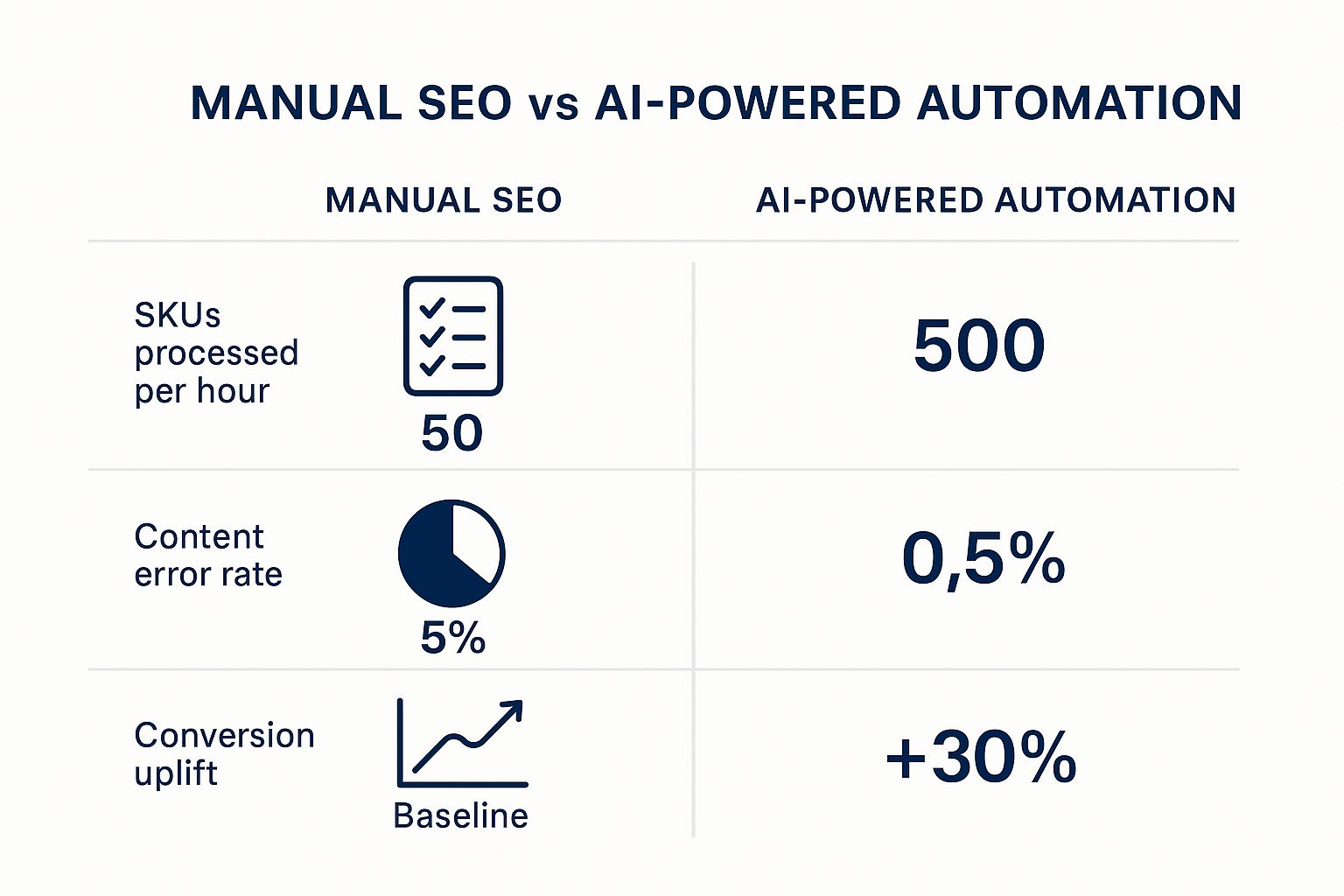
The numbers don’t lie. AI-powered workflows deliver a 10x increase in productivity while slashing errors, leading directly to a significant jump in sales.
To really see the difference in day-to-day operations, let’s compare how a traditional team and an AI-powered workflow would handle common retail SEO tasks.
Manual SEO vs AI SEO Workflow Comparison
| Task | Traditional SEO Team (Manual) | AI-Powered Workflow (Automated) |
|---|---|---|
| Product Description Writing | A copywriter manually writes ~10-20 descriptions per day. | An AI agent generates thousands of unique descriptions per hour. |
| Data Enrichment | A team member manually searches for missing specs online. | AI scans supplier data and auto-populates missing attributes. |
| Alt Tag Optimisation | Manually writing tags for images, often skipped due to time. | AI image recognition auto-generates descriptive tags for all images. |
| Keyword Research | Manually analysing competitors and trends for a few products. | AI analyses market data in real-time for the entire catalogue. |
It’s clear that sticking with manual processes leaves you at a massive disadvantage. AI automation doesn’t just speed things up; it allows for a level of depth and consistency that’s impossible to achieve by hand.
Pillar 4: Use AI for Visual Search Optimisation
Finally, in visual-heavy categories like fashion SEO optimisation or furniture, your images are everything. But without the right metadata, they’re invisible to search engines. The fourth pillar is all about using AI image recognition and tagging to optimise every single product image for visual search.
AI models can look at an image and automatically create descriptive alt tags and metadata. For instance, it can identify a piece of furniture as a “mid-century modern oak sideboard with brass handles,” giving search engines the rich detail needed to rank for super-specific searches. This alt tag optimisation for retail is essential for grabbing traffic from image-based search and getting ready for the agentic search future.
This four-pillar framework gives you a clear path from manual grunt work to AI-driven results. It frees up your retail teams to stop drowning in tedious tasks and start focusing on strategic growth, turning the digital shelf from a headache into a real competitive edge.
By working through these pillars one by one, retailers can build a powerful and scalable SEO machine. A structured approach like this is the key to unlocking AI’s full potential and dominating the digital shelf.
How to Prepare for Agentic Commerce and the Future of Search
The conversation around digital shelf performance is shifting under our feet. For years, we’ve been optimising our product content for two main audiences: the Google algorithm and human shoppers. But now, a powerful new player is entering the scene, AI shopping agents. This is the dawn of agentic commerce, and it’s set to fundamentally change how retail search works.
Tools like ChatGPT, Perplexity, and Amazon’s Rufus are fast becoming the new gatekeepers of product discovery. Instead of a customer searching for “noise-cancelling headphones,” they’ll soon ask their AI agent to find “the best noise-cancelling headphones for long flights under $400 with at least a 4.5-star rating.” That agent will then crawl the web, analyse product data, and present a curated list of options.
This evolution makes all the digital shelf optimisation work we’re doing today more critical than ever. The structured, enriched, and unique product data you build now is precisely what these AI agents need to understand and recommend your products. Being ‘AI-compatible’ isn’t some futuristic concept anymore, it’s a requirement for staying relevant, starting right now.
Building an AI-Ready Content Foundation
So, how do you get ready for this shift? It all comes down to doubling down on the core principles of excellent digital shelf management. The goal is to make your product information so clear, detailed, and structured that an AI can instantly recognise its value and suitability for a shopper’s query.
This is where traditional SEO teams hit a wall. Manually creating this level of granular, structured data across thousands of SKUs is just not feasible. The only practical way forward is through AI workflow automation for retail.
Here’s where to focus your efforts:
- Granular Product Data Enrichment: Go way beyond basic supplier feeds. You need to include detailed attributes like materials, dimensions, compatibility, and specific use cases. This is the language AI agents speak.
- SKU-Level SEO at Scale: Make sure every single product page has a unique, descriptive title, meta description, and comprehensive content. This clears up the ambiguity that can confuse AI crawlers.
- Structured Data Implementation: Use schema markup to explicitly label your data. This literally tells AI agents what each piece of information represents, from price to stock levels.
The future of work in retail will be defined by human + AI collaboration in SEO. Retail teams that embrace AI agents to handle the sheer scale of content optimisation will free themselves up to focus on high-level strategy, all while ensuring their digital shelf is perfectly primed for the agentic search era.
This proactive approach is essential for navigating the changing Australian retail environment. The latest Australian Retail Outlook forecasts a return to healthy conditions by mid-2025, driven by a deeper understanding of consumer behaviour and the critical role of the digital shelf. With online sales expected to drive all CPG growth, getting your product content right is the only way to capture this opportunity. You can find more insights into these market dynamics in the full 2025 outlook report.
From Optimisation to Agentic Readiness
Ultimately, retailers investing in AI SEO services and automated content workflows today aren’t just solving immediate problems like duplicate content. They are building a resilient foundation for the future of agentic commerce, an ecosystem where AI-powered retail transformation is the norm.
The work you do now to enrich supplier feeds, deploy AI image recognition for detailed tagging, and generate unique product descriptions at scale directly prepares you for this new reality. Your digital shelf becomes a clean, reliable data source for the next generation of shopping assistants.
If you want to dive deeper into this topic, you can learn more about how to prepare your business for the agentic commerce future in our detailed guide. This strategic shift positions your brand for sustained visibility and success, ensuring you not only survive but thrive in an AI-driven world.
Frequently Asked Questions
Got questions about putting AI to work on your digital shelf? You’re not alone. Here are some of the most common things retail leaders and ecommerce managers ask us about getting started with automation.
What’s the Real Difference Between Traditional SEO and AI SEO for Retail?
The short answer? Scale and speed.
Traditional SEO is a manual game. It relies on your team painstakingly researching keywords, writing content, and updating metadata one page at a time. That works fine if you have a handful of pages, but it creates massive retail content bottlenecks when you’re dealing with thousands of SKUs.
AI SEO, on the other hand, flips the script.
- Traditional SEO: Think project-based, slow, and resource-heavy. It’s a constant struggle to keep up with large, dynamic product catalogues.
- AI SEO: This is about automation at its smartest. AI agents handle the heavy lifting, like product data enrichment and generating thousands of unique product descriptions, almost instantly. What would take your team months to complete becomes a task finished in days.
It’s less about replacing humans and more about upgrading their roles. AI SEO lets your team shift from tedious execution to strategic oversight, which is the core of effective human + AI collaboration in SEO.
How Does AI Actually Fix Duplicate Content from Suppliers?
Supplier content duplication is one of the biggest silent killers of search rankings. It happens when you (and dozens of your competitors) use the same generic product descriptions straight from the manufacturer. Search engines see this as low-value, copied content and simply won’t rank those pages well.
AI provides a powerful duplicate content SEO fix by making every single one of your product descriptions unique. An AI workflow can take a basic supplier feed and automatically rewrite everything, ensuring each description is original, sounds like your brand, and is optimised for the right keywords. This is the foundation of ecommerce content quality assurance at scale.
By automating the creation of unique content, AI gets rid of the penalties that come with duplication. It tells search engines that every one of your product pages is a distinct, valuable asset, which directly boosts your digital shelf performance.
Can AI Really Understand the Nuances of Fashion or Furniture?
Absolutely. This is where modern AI has taken a huge leap forward. Today’s AI image recognition and tagging models have been trained on enormous datasets, allowing them to identify specific product attributes with incredible accuracy. This is a game-changer for detailed verticals like fashion, furniture, or electronics.
Take a sofa, for instance. An AI agent can look at a photo and instantly generate tags like:
- “velvet upholstery”
- “chesterfield style”
- “deep button-tufting”
- “solid wood legs”
This isn’t just basic tagging, it’s creating the rich, structured data you need for top-tier furniture image tagging SEO. More importantly, it gets your catalogue ready for the hyper-specific questions people will ask in the future of retail search. It’s how you become compatible with the new wave of AI shopping agents.
How Quickly Will I See Results from an AI SEO Rollout?
While it takes time for search engines to fully register major SEO improvements, the operational wins from AI are almost immediate. The speed at which you can fix foundational problems is what really separates AI SEO vs traditional SEO teams.
You’ll likely see results come in a few stages:
- Immediate (Days to Weeks): The content bottlenecks disappear. Your team can enrich product data, wipe out duplicate content, and fix metadata across your entire catalogue in a fraction of the time it used to take.
- Short-Term (1-3 Months): As search engines start crawling your newly optimised pages, you should see keyword rankings and organic visibility begin to climb for specific products.
- Long-Term (3-6+ Months): This is where the magic happens. The cumulative effect of scaled optimisation leads to significant jumps in organic traffic, better conversion rates, and a real, measurable lift in your overall digital shelf performance.
It’s this rapid execution of foundational SEO work that makes scalable SEO solutions so much more powerful than manual efforts.
Is This Technology Going to Replace My Ecommerce Team?
Not a chance. Think of generative AI for retail teams as an augmenter, not a replacement. AI is a tool designed to give your team back its most valuable resource: time. It handles the repetitive, large-scale tasks that currently bog them down.
By bringing in AI workflow automation for retail, you’re freeing up your people to focus on high-impact, strategic work. Instead of spending weeks rewriting thousands of product descriptions, they can analyse market trends, refine your brand’s voice, and cook up creative campaigns. This is the future of work in retail, where sharp human expertise guides powerful AI execution.
Ready to eliminate content bottlenecks and dominate the digital shelf? Optidan AI uses advanced AI to create thousands of optimised product pages at scale, improving your rankings and driving conversions. Discover how our retail content automation can transform your ecommerce strategy.
