

For Australian retailers, AI in ecommerce isn't just a buzzword anymore, it's the new engine room for growth. This isn't some far-off concept; it’s a practical tool that's here now, ready to automate content, enrich messy product data, and prepare you for the future of retail search.
The New Competitive Edge in Australian Ecommerce
The Australian ecommerce scene is exploding. Simply having a website is no longer enough to lead the pack. Over the last five years, the number of monthly online shoppers in Australia has jumped from 11.78 million to a staggering 17.08 million in 2024.
That’s a 45% spike. It means nearly 64% of the population now buys online regularly, making ecommerce the default way to shop for most Australians.
This incredible growth opens up huge opportunities, but it also creates massive headaches for ecommerce managers, especially when it comes to retail content bottlenecks and the overwhelming operational workload. Many retailers are drowning in the sheer volume of manual work required to keep their digital shelf performance competitive.
Why AI Is a Strategic Necessity, Not a 'Nice-to-Have'
For any retail leader, the conversation must move from if we should use AI to how we implement it for strategic advantage. The biggest reason is scale.
AI-powered content workflows are quickly becoming the difference between winning and losing. They offer a clear path to break through the old limitations holding back growth. This technology provides the retail efficiency tools needed to capture market share instead of being left behind in an increasingly automated world.
Here’s what that looks like in practice:
- Retail Content Automation: Imagine creating tens of thousands of unique, SEO-friendly product descriptions in days, not months. This directly solves the problem of using the same duplicated supplier content as every other retailer, helping you avoid penalties and build a unique voice.
- Agentic Search Readiness: You can structure your product data so AI agents like ChatGPT and Google’s AI Overviews can understand it. This is how you prepare your business for the coming era of agentic commerce, a core part of the future of retail search.
- A Sharper Digital Shelf: Improved visibility and higher rankings become achievable through SKU-level SEO, automated image recognition and tagging, and consistent multi-channel product optimisation.
The real challenge for Australian retailers has shifted. It’s no longer about just getting online; it's about optimising every single product listing at a speed that matches customer demand. AI makes this possible, turning tedious manual tasks into smart, automated content workflows.
Bringing AI into your operations is about building a more resilient and agile business. It frees up your team from mind-numbing manual work so they can focus on high-impact strategic projects. It is this exact human + AI collaboration in SEO that market leaders use to dominate, a shift we explore in our insights on how the giants are shaping ecommerce. The future of work in retail is already here, and it’s a partnership between people and machines.
Moving From Manual SEO to AI-Powered Performance
For any retailer operating at scale, the traditional approach to ecommerce SEO is fundamentally broken. For years, the process has been painfully manual, slow, and expensive. It relied on human teams to write product descriptions, tweak metadata, and fix technical problems one page at a time. This old model creates huge retail content bottlenecks, leaving thousands of product pages with thin or duplicated supplier content that actively tanks your search rankings.
Let's be blunt: this manual process is no longer sustainable. When your product catalogue has 10,000, 50,000, or even hundreds of thousands of SKUs, the old way of doing things cannot keep up. The result is a constant state of compromise where only a tiny fraction of your product range gets the attention it deserves, leaving a massive amount of revenue on the table.
AI in ecommerce flips this entire model on its head. It introduces AI-powered content workflows that turn SEO from a painstaking manual chore into a scalable, automated process. This is the heart of the shift from manual SEO to AI SEO, where technology handles the sheer scale, and your team provides the strategic direction.
Overcoming the Biggest Retail Content Bottlenecks
One of the most damaging issues for retailers is supplier content duplication. When multiple retailers use the exact same product descriptions provided by a supplier, search engines struggle to determine the most authoritative source. This confusion often leads to ranking penalties and diminished visibility.
Fixing this problem manually across a large catalogue is a monumental task that could take a skilled content team months, if not years. AI solves this in days. By ingesting raw supplier feeds, AI agents can generate thousands of unique, on-brand, and SEO-optimised product descriptions, correcting the duplicate content SEO fix at its source.
This is where the difference between AI SEO vs traditional SEO teams becomes crystal clear. An AI workflow can:
- Rewrite 10,000+ descriptions in the time a human team might finish a few dozen, achieving SEO at scale.
- Enrich product data by turning messy supplier feeds into structured, optimised content.
- Optimise metadata at scale, creating unique titles and descriptions for every single SKU.
- Perform image recognition and tagging for entire catalogues, generating descriptive alt text that’s crucial for fashion, furniture, and electronics SEO.
The infographic below shows how much better AI-driven approaches perform compared to older, rule-based systems across key ecommerce metrics.
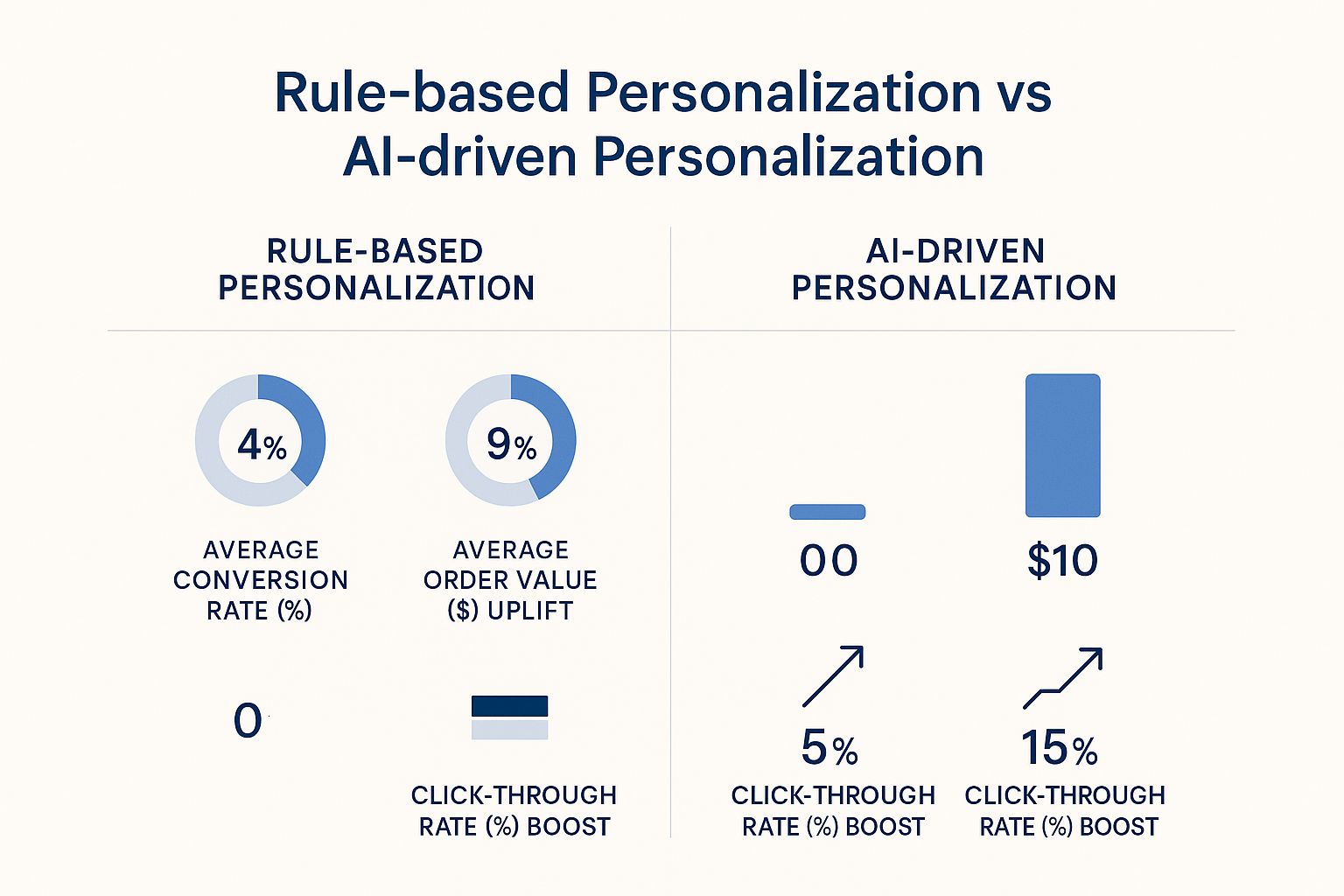
The data speaks for itself. AI's ability to analyse complex patterns leads to far more relevant customer experiences and, ultimately, much better commercial outcomes.
To illustrate this, here’s a side-by-side look at how these two approaches stack up for large retailers.
Traditional SEO vs AI SEO for Retailers
| Aspect | Traditional SEO Teams | AI SEO Workflows |
|---|---|---|
| Content Creation | Manual copywriting, slow turnaround. | Automated generation of thousands of unique descriptions in hours. |
| Data Enrichment | Manual tagging, often incomplete. | AI identifies and structures attributes from raw text automatically. |
| Scalability | Limited by team size and budget. | Scales to hundreds of thousands of SKUs without linear cost increases. |
| Error Correction | Reactive, manual fixes for issues like 404s. | Proactive detection and automated correction of technical issues. |
| Strategic Focus | Bogged down in execution and repetitive tasks. | Frees up teams to focus on strategy, analysis, and quality assurance. |
| Adaptability | Slow to react to algorithm changes. | Learns and adapts to new search patterns in near real-time. |
As you can see, it is a completely different way of operating. One is about managing limitations, the other is about creating opportunities.
Preparing for the Future of Agentic Search
The move to AI SEO is not just about doing today's tasks better, it is about preparing for the imminent future of retail search. The rise of agentic search platforms like ChatGPT, Perplexity, and Amazon's Rufus is changing how consumers find products. These AI agents do not just look for keywords, they hunt for structured, context-rich data to answer complex user questions.
Trying to manually prepare your entire product catalogue for this new era is practically impossible. Your product data must be perfectly structured and optimised to be "AI-compatible," allowing these agents to understand and recommend your products accurately.
This is where AI SEO services provide a critical advantage. By automating product data enrichment and creating structured, optimised content at scale, you make your entire catalogue ready for the next generation of AI shopping. It’s a strategic move that improves your digital shelf performance today while securing your visibility for tomorrow.
Ultimately, this new paradigm represents a fundamental change in how retail teams operate. Instead of getting bogged down in repetitive execution, your experts can focus on high-level strategy and quality assurance, guiding the AI to deliver results at a pace and scale that was previously unimaginable. To dig deeper into this shift, you can learn more about the foundations of Artificial Intelligence SEO and its impact on modern retail. This human + AI collaboration is the key to unlocking true retail efficiency and dominating your market.
Enriching Product Data for Modern Shoppers
At the heart of every successful ecommerce operation is high-quality product data. Yet for most retailers, this is a massive pain point. You are handed raw, inconsistent supplier feeds filled with generic descriptions, minimal details, and lacklustre images.
Turning that messy data into compelling, customer-focused, and SEO-friendly content is one of the biggest challenges in modern retail. This is where AI in ecommerce delivers one of its most powerful applications: product data enrichment.
AI-driven workflows are built to ingest that unstructured supplier information and systematically turn it into a high-performing asset. Instead of your team spending weeks manually cleaning spreadsheets and writing copy, AI can structure, organise, and enrich thousands of product pages in just a few days. It's the difference between merely listing your products and making them truly discoverable.
Fixing the Supplier Content Duplication Problem
One of the most damaging yet common issues hurting retailers is supplier content duplication. When you and your competitors all use the same generic descriptions from the manufacturer, search engines penalise your site. It’s a direct hit to your rankings, making it almost impossible to stand out.
AI-powered content workflows solve this problem at scale. They can generate thousands of unique product descriptions that are not only original but also perfectly aligned with your brand’s tone of voice. This immediately resolves duplication penalties and gives your product catalogue a distinct, authoritative voice.
This is not just about dodging penalties, it is about building a unique content asset that both search engines and customers value.
By automating the creation of unique descriptions, AI effectively eliminates one of the biggest barriers to achieving strong organic visibility. This shift from manual rewriting to automated content workflows is a game-changer for retail efficiency.
From Raw Data to Optimised Product Feeds
Effective product feed optimisation is non-negotiable for visibility on channels like Google Shopping, social media marketplaces, and affiliate networks. AI excels at this by taking raw supplier feeds and structuring them into perfectly formatted feeds. For more advanced product visualisation, businesses can even explore innovative methods like text-to-3D model conversion to create richer experiences.
Here’s how AI transforms a basic supplier feed:
- Structures Unstructured Data: It intelligently extracts key attributes like colour, material, size, and technical specs from messy blocks of text.
- Generates Compelling Copy: It creates benefit-led descriptions that speak directly to what a customer is looking for.
- Ensures Consistency: It applies uniform formatting and terminology across your entire catalogue, creating a professional and cohesive user experience.
This level of retail content automation ensures your products are presented flawlessly on every platform, a must-have for any serious multi-channel product optimisation strategy. If you're looking to scale, managing these feeds efficiently is key. Our guide on product feed management offers deeper insights into optimising your approach.
Enhancing Visual Search with AI Image Recognition
For retailers in visually driven sectors like fashion, furniture, and electronics, the right image is everything. AI image recognition technology analyses your product photos and automatically generates the rich metadata needed to boost your search visibility.
This is critical for SKU-level SEO, where every single product has a chance to rank. AI can:
- Generate Descriptive Alt Tags: It creates detailed alt text for every image, which improves accessibility and tells search engines exactly what the image shows. Think "blue linen armchair with tapered oak legs" instead of just "armchair."
- Automate Product Image Tagging: It applies relevant tags (e.g., "mid-century modern," "V-neck," "OLED screen") that power the faceted search on your site and make products easier to find. This is vital for fashion product image SEO.
- Optimise for Visual Search: By creating detailed image metadata, AI gets your catalogue ready for platforms like Google Lens, where people search with pictures, not words.
This automated approach to image SEO for ecommerce ensures every visual asset on your site is working overtime to attract qualified traffic. For a fashion retailer with thousands of items, this means every dress, shoe, and accessory is meticulously tagged for style, colour, and cut without any manual effort, unlocking massive SEO potential.
How to Prepare for the Future of Agentic Commerce
The way customers find products is changing for good. We are moving away from typing simple keywords into a search bar and towards sophisticated, conversational searches. This is the new frontier of agentic commerce, where AI agents, think supercharged versions of ChatGPT, Perplexity, or Amazon's Rufus, act as autonomous personal shoppers.
These AI assistants will find, compare, and even buy products for consumers, completely changing how your brand gets discovered. Preparing for this is not about jumping on another tech trend, it is a strategic move essential for survival. Retailers who do not adapt risk becoming invisible to a whole generation of AI-powered shoppers.
The key is to think beyond traditional SEO. It’s time to start structuring your product data so that AI agents can easily understand and trust it. An agent does not just look for a "blue dress." It is processing nuanced requests like, "Find me a sustainable, linen-blend, navy blue midi dress for a beach wedding in Queensland, under $250." To even show up in that search, your product data needs every single one of those attributes, presented in a clean, machine-readable format.
Shifting from Keywords to Structured Data
The old game of optimising for keywords is fast becoming obsolete. The future of retail search is about providing answers, not just matching search terms. Agentic search optimisation demands a fundamental shift in how you view your product catalogue, moving from keyword-stuffing to creating rich, interconnected data.
This means turning your raw supplier feeds into structured, AI-friendly content. It is about more than just writing unique product descriptions. It’s about meticulous SKU-level SEO, making sure every attribute, from material composition to sustainability certifications, is clearly defined and easy for an AI to digest.
Agentic commerce isn't a distant future, it's the next evolution of ecommerce. Retailers must now think like data architects, organising their product information so that AI agents can confidently recommend their products to consumers. This is the new baseline for digital shelf performance.
Practical Steps for Agentic Search Readiness
Getting your business ready for agentic commerce means adopting a focused, data-first approach. You're building a foundation that not only serves your current SEO needs but is also primed for future AI-driven discovery. The transition from manual, piecemeal optimisation to scalable AI SEO is at the heart of this.
Here are the core pillars for building an AI-compatible product catalogue:
- Comprehensive Product Data Enrichment: Go well beyond the basics. Your data should detail functional benefits, specific use cases, style attributes, and compatibility. For a piece of furniture, that means listing dimensions, assembly needs, materials, and care instructions, not just the name and price.
- Implement Structured Data Markup: Use schemas (like Schema.org) across your site to explicitly label product attributes. Think of it as giving AI agents a clear, structured roadmap to understand what your product is, what it does, and why it's a great choice.
- Automate Content Workflows: Manually enriching thousands of SKUs is an impossible task. You need to employ AI workflow automation for retail to process supplier feeds, generate structured data, and create unique descriptions at scale. This is a critical step we explore further in our guide on the future of retail growth from optimisation to agentic commerce.
AI is now seen as the critical catalyst for the next wave of ecommerce growth in Australia, with industry projections pointing to continued double-digit expansion. By 2028, it's expected that about a third of online retailers will rely on advanced AI agents, a massive jump from less than 1% today. While specific Australian adoption rates aren’t always broken out in global surveys, the message is clear: AI adoption is accelerating, and the gap between the early movers and those left behind is getting wider.
The Role of Human and AI Collaboration
Embracing the future of work in retail does not mean replacing your team with robots. It’s about creating a powerful human + AI collaboration. Your team’s strategic oversight and brand knowledge are irreplaceable. They guide the AI, set the brand voice, and perform the final quality checks.
This collaborative model frees up your experts from tedious, manual work and allows them to focus on high-value strategy. To truly prepare for what's next in modern retail, it pays to delve into concepts like the future of ecommerce in shoppable videos.
Let the AI handle the scale, while your team ensures the quality and alignment with your business goals. It’s a powerful engine for growth in the new era of agentic commerce.
Putting AI Workflows into Practice in Your Business
Jumping into AI does not mean you have to rip up your current operations and start from scratch. In fact, the smartest AI rollouts happen incrementally. They focus on fixing specific, high-impact problems without throwing your existing teams into chaos. The real goal here is to empower your people, not replace them, by giving them retail efficiency tools that do the heavy lifting while your experts steer the strategy.
This move towards AI in eCommerce is really about creating a powerful human + AI collaboration. Your team holds the brand knowledge, market intuition, and creative vision that an AI simply does not have. When you pair that human expertise with AI’s ability to work at incredible speed and scale, your entire organisation becomes far more effective.
It’s a partnership that lets you step away from mind-numbing manual tasks. Your team can finally focus on what really moves the needle, like sharpening the brand voice, monitoring competitors, and making sharp, strategic decisions.
A Phased Approach to Adopting AI
Getting started with AI can feel like a massive undertaking, which is why a practical, step-by-step approach is always the best bet. Do not try to automate everything at once. Instead, kick things off with a low-risk, high-reward pilot project. This lets your team get comfortable with new automated content workflows and gives you a chance to measure the impact in a controlled setting.
A perfect starting point for most retailers is tackling supplier content duplication in a single product category. It’s a common headache that directly hurts your SEO and is an ideal candidate for an AI-driven fix. By zeroing in on one area, you can build a clear process for human-led AI content QA, making sure every piece of content that goes live meets your brand’s standards.
Nailing this first project builds confidence and proves the value of the new approach. It makes it much easier to get the green light for a wider rollout across your entire product catalogue.
The core idea is to let AI handle the 90% of repetitive work, like churning out thousands of unique product descriptions. This frees up your team to spend their time on the final 10%, the crucial refinement, strategic oversight, and creative polish that guarantees brand integrity and keeps you relevant in the market.
Building Your Automated Content Workflow
A solid AI workflow is not just about plugging in a tool and hoping for the best. It is a structured process built for quality and efficiency. When you get the steps right, you can turn content production from a frustrating bottleneck into a smooth, scalable operation.
Here’s what a typical workflow looks like in action:
- Strategic Briefing: It all starts with your team. They define the goals, target audience, brand voice, and key SEO terms. This human-led direction is the essential first step that tells the AI exactly what to do.
- AI Content Generation: The AI takes the raw supplier data and the strategic brief and gets to work, producing thousands of optimised product descriptions, titles, and metadata tags at scale.
- Human-Led Quality Assurance: Now, your experts step in to review the AI-generated content. This is not about rewriting everything from scratch. It’s about making small tweaks, checking for brand consistency, and giving the final sign-off.
- Performance Measurement: Once the new content is live, you start tracking its performance. Keep an eye on metrics like search rankings, organic traffic, and conversion rates to see the real-world impact.
- Iterative Refinement: Based on what the data tells you, your team can then fine-tune the original strategic brief. This creates a feedback loop that continuously improves the quality and effectiveness of the AI's output over time.
This human + AI collaboration model gives you the best of both worlds. You get SEO at scale without ever sacrificing the quality and brand nuance that only your team can deliver. To see this in practice, check out the story of how Optidan AI transformed content workflows, cutting down processes that took months into just a few minutes. It is this perfect mix of machine efficiency and human expertise that unlocks what AI agents in eCommerce can really do.
Measuring the True Impact of Your AI Investment
To get the green light from executives and justify spending more, you need to show them the real, measurable value AI is bringing to your retail business. Adopting AI in ecommerce is not just a tech upgrade; it's a strategic investment. The trick is to stop talking about vague benefits and start focusing on the hard numbers that prove its impact on your bottom line.
Proving the return on your investment means tracking real improvements across key parts of your business. It is about connecting the dots. When you implement automated content workflows, can you see a genuine lift in revenue and efficiency? This data-first approach stops AI from looking like a cost centre and repositions it as a powerful engine for profitable growth.
Key Metrics to Prove Business Value
To build a case that nobody can argue with, you need to zero in on metrics that reflect your digital shelf performance and operational savings. These figures are the undeniable proof that an AI-powered retail transformation creates a serious competitive advantage.
Start by tracking these critical KPIs:
- SKU-Level SEO Performance: Monitor how organic search rankings change for individual products after their content has been enriched. One of the biggest wins of SEO at scale is watching products that were once invisible start climbing the search results.
- Organic Traffic Growth: Measure the jump in non-paid traffic to specific categories or even your entire site. Unique, high-quality content produced by AI is what fuels this growth.
- Conversion Rate Uplift: Track how much better your enriched product descriptions, improved image metadata, and greater discoverability are at turning visitors into buyers.
- Operational Cost Savings: Tally up the hours and money you're no longer spending on manual content creation, data entry, and fixing duplicate content issues. This shows the direct efficiency gains from retail content automation.
By tying AI adoption directly to these commercial outcomes, you build a powerful narrative. The conversation is no longer about the technology itself, but about its direct contribution to increasing revenue, cutting operational drag, and winning a bigger slice of the market.
Fuelling Growth in a Competitive Market
This focus on measurable impact is especially important in Australia’s booming retail sector. The total value of our ecommerce market hit a record US$89.4 billion in 2024, with retail ecommerce making up US$46.2 billion of that. With a forecast compound annual growth rate of 6%, the market is on track to hit US$107 billion by 2027. That’s a huge opportunity for efficient, forward-thinking retailers. You can dig deeper into these numbers with these detailed Australian ecommerce market insights.
Ultimately, measuring the impact of your AI SEO strategy reinforces the core message: this is not just another line item on the expense sheet. It is a fundamental investment in building a more profitable, scalable, and sustainable ecommerce business that’s ready for whatever comes next in retail.
Frequently Asked Questions About AI in Ecommerce
How Does AI SEO Differ from Traditional SEO for an Ecommerce Site?
The biggest difference is scale and speed. With traditional SEO, your team might spend weeks manually writing a few hundred product descriptions. AI can take a supplier feed and generate thousands of unique, optimised descriptions in just a few hours.
Beyond that, AI is brilliant at structuring data for the new wave of AI-driven search engines. It can spot complex patterns in data, handle image recognition for tagging, and manage tasks at a scale that's just not possible for a human team alone. It effectively shifts your team's focus from doing the grunt work to overseeing the strategy.
What Is the First Step to Implementing AI in Our Retail Content Workflow?
Start by finding your biggest bottleneck. A quick content audit usually points to the same culprit for most retailers: duplicated or thin content that comes straight from supplier feeds.
Once you’ve identified the problem area, run a small pilot project. Pick a single product category and use an AI tool for product data enrichment. This lets you build a controlled automated content workflow, set up a human-led quality check, and actually measure the impact on your SEO and sales before you commit to rolling it out across your entire catalogue.
The goal is not to replace your team, but to augment their capabilities. AI handles the repetitive, large-scale tasks, freeing up your experts to focus on higher-value work like brand voice, creative strategy, and competitive analysis.
Will AI Replace Our Existing Ecommerce and SEO Teams?
No, the future is all about human and AI collaboration. Think of AI as a powerful tool that supercharges your team's abilities, not something that makes them redundant.
AI agents and workflows are perfect for the heavy lifting, things like data enrichment and writing thousands of descriptions. This frees up your experts to focus on what they do best: strategy, creative direction, and analysing the competition. Your team becomes more efficient, achieving far more without the manual grind.
How Can We Ensure AI-Generated Content Matches Our Brand Voice?
This is where your team’s expertise is crucial. The process is always human-led. You start by feeding the AI system your brand guidelines, style examples, and strategic direction.
After the AI generates the content at scale, your team steps in to review, refine, and give the final approval. This hybrid model ensures you get the speed and scale of automation while maintaining perfect brand consistency and quality. Let the AI do the heavy lifting, while your experts provide the final creative and strategic polish.
Ready to eliminate content bottlenecks and prepare your retail business for the future of agentic search? Discover how Optidan AI can transform your product catalogue into a high-performing asset. Visit Optidan AI to get started.
