


Got a huge product catalogue but sales are flat? You’re not alone. The biggest disconnect for many Australian retailers is the gap between your product's 'digital DNA' (its metadata) and the real-world language your customers and new AI shopping agents use (customer intent). Closing this gap is the secret to getting seen and making sales in a retail world that's becoming more automated by the day.
The New Digital Shelf: Why Metadata and Customer Intent Are Crucial

In today's retail jungle, relying on generic supplier content is a fast track to becoming invisible. Search is changing. AI agents like Google’s AI Overviews and Amazon Rufus are now making direct buying recommendations, and they feed on data. If your product information isn't perfectly structured and deeply aligned with how real people search, you won't even be in the running for this new kind of agentic commerce future.
This is where your metadata and customer intent have to work together. It's not just a good idea, it's your most powerful asset. The move from old-school manual SEO to AI SEO isn't some far-off future, it's happening right now.
But here’s the problem for most retail leaders: scale. Manually correcting duplicated supplier content or enriching thousands of product feeds one by one is an impossibly huge job. It creates massive retail content bottlenecks that kill momentum.
The Shift from Traditional SEO to AI-Powered Intent Optimisation
This is where we see a major shift in strategy. Instead of getting bogged down in manual tasks, the smart move is toward AI-powered optimisation that can handle the heavy lifting. The old ways of doing things just don't cut it anymore when you're dealing with thousands of products and fast-moving AI.
Here's a look at how the game has changed:
| Focus Area | Traditional SEO Approach | AI-Powered Intent Approach |
|---|---|---|
| Content Source | Manually writing or copy-pasting supplier content. | AI workflow automation for retail transforming raw data into unique, rich descriptions. |
| Keyword Strategy | Targeting broad, high-volume keywords. | Focusing on long-tail queries and conversational phrases that match user intent. |
| Optimisation Speed | A few pages a week, taking months for the full catalogue. | Thousands of pages optimised in days, ensuring sitewide readiness for agentic search. |
| Data Structure | Basic title tags and meta descriptions. | Deeply structured data using schema, metafields, and rich attributes. |
| Goal | Rank on Google's blue links. | Achieve visibility across search engines, AI agents like ChatGPT and Rufus, and marketplaces. |
This isn't just about using new tools, it's a completely different way of thinking about how your products get discovered online. AI-powered product data enrichment offers a real solution, allowing for optimised at scale. Forget wrestling with messy supplier feeds. Retailers can now use automated content workflows to turn basic data into unique, compelling product pages in days, not months.
This process zeroes in on a few key areas:
- AI SEO Readiness: Getting your product catalogue ready to be understood and recommended by AI shopping agents (SEO for AI Agents).
- Supplier Content Uniqueness: Ditching generic, duplicated descriptions to build a distinct brand voice and sidestep SEO penalties.
- Scalable SEO Solutions: Using workflows that can efficiently handle 10,000+ pages, making your entire digital shelf competitive.
- Image Recognition & Tagging: Automatically creating rich metadata for images, a must-have for visual-heavy industries like fashion SEO optimisation and furniture.
To really make your metadata work for customer intent on this new digital shelf, you have to nail the fundamentals. A deep understanding of what is search intent is non-negotiable. It’s the foundation of any successful strategy for agentic search optimisation.
Moving to AI-driven automation is critical for boosting your digital shelf performance. Smart Australian companies are already pulling together first-party data from their websites and CRMs to build highly personalised customer journeys. The results? Higher conversion rates and a drop in customer acquisition costs by up to 20-30% in well-run campaigns.
When you embrace retail content automation, you’re not just putting out today’s fires. You're building a stronger, more resilient foundation for the future of work in retail. This AI-powered retail transformation is about efficiency and automation.
Translating Shopper Intent into Retail Success

To really win on the modern digital shelf, you have to get inside your customer's head long before they even see your product page. Every search they type is a clue. It tells you exactly what they want and, crucially, how close they are to pulling out their credit card.
This is where the magic happens: aligning your metadata and customer intent. It’s the difference between a shopper finding you or your competitor.
Customer intent isn't a single, straightforward thing. Think of it as a spectrum, which we can break down into four main types. By understanding these, you can tailor your product metadata to meet shoppers with the perfect message at the perfect moment. Getting this right is fundamental to improving your digital shelf performance and getting ready for the world of agentic commerce.
The Four Core Types of Customer Intent
Each type of intent needs a completely different approach. Map your content to these stages, and your products will show up at the exact moment a customer is looking for them.
- Informational Intent: The shopper is just exploring. They're looking for answers, guides, and general info, not necessarily a product just yet. A search like "best waterproof jackets for hiking in Tasmania" is a classic example. They need educational content.
- Navigational Intent: This person knows where they want to go. They’re searching for a specific brand or website, like "The North Face Australia official site." It’s a direct signal of brand awareness and can't be ignored.
- Commercial Investigation: This is the make-or-break middle ground. The shopper is actively comparing options. They're close to buying but haven't picked the winner yet. Think "Kathmandu vs North Face rain jacket reviews."
- Transactional Intent: Game time. The customer is ready to buy, and their search proves it. It's super specific and loaded with buying signals, like "buy North Face jacket size M Melbourne" or "men's black R.M. Williams boots sale."
For any retailer, the journey from informational to transactional intent is where the sale is won or lost. If you can match your product metadata to these signals, you capture customers right when they’re ready to buy, turning a simple search into a sale.
Matching Metadata to Each Stage of Intent
Now for the real work: translating this understanding into sharp, effective metadata. This isn’t about just stuffing in keywords. It's about structuring your product data to answer the specific question a customer is asking, whether they've typed it out or not. This is a core part of any serious AI SEO strategy.
Let's break down how you can tailor your metadata for each type of intent:
- For Informational Intent: Your product pages probably aren't the best fit here, but your category pages and buying guides are perfect. Optimise them with titles like "The Ultimate Guide to Choosing a Waterproof Jacket" and use descriptions that answer those common questions.
- For Commercial Investigation: This is where detailed product data enrichment really shines. Your title tags should feature comparison keywords like "vs," "review," or "best for." Your meta descriptions need to highlight key differences, specs, and unique selling points that push a shopper to make a choice. A great resource on this is Mastering Search Terms on Amazon, which explains how customer search queries translate directly into sales.
- For Transactional Intent: You need to be precise right down to the SKU-level SEO. Title tags should be specific:
[Brand] [Product Name] [Colour] [Size]. The meta description has to create urgency with calls to action like "Free Express Shipping in Australia" or "Buy Now, Pay Later with Afterpay."
By using AI-powered content workflows, you can apply this logic across thousands of products at scale. This allows you to fix duplicated supplier content and ensure every single product page is perfectly optimised for a specific stage in the customer journey. This kind of scalable SEO solution isn't just a nice-to-have anymore, it's essential for any retailer serious about competing in the future of retail search.
Mastering Metadata for AI and Shoppers

Once you’ve got a handle on what your customers are looking for, the next job is to bake that understanding directly into your product pages. It’s about getting granular with the metadata that fuels modern AI SEO. Think of it as creating a rich, structured language that both shoppers and AI agents can pick up on instantly.
This goes way beyond basic keyword stuffing. For ecommerce managers, it means a deep dive into your title tags, meta descriptions, and especially your structured data. These aren't just backend fields, they're the building blocks for visibility in an era of agentic commerce, where AI assistants make buying decisions based on the data you feed them.
Optimising Core On-Page Metadata
Your title tags and meta descriptions are essentially the digital equivalent of a shopfront window. In search results, they’re often the very first thing a potential customer sees. You absolutely have to make them count if you want to improve your digital shelf performance.
A winning formula blends clarity, keyword relevance, and a strong reason to click through. This is where automating product descriptions and metadata optimisation at scale really shines, giving you consistency and quality across thousands of different SKUs.
Here’s a practical way to approach each one:
- Title Tags: This is your heaviest hitter for on-page SEO. The formula needs to be direct and packed with information, especially when you’re targeting someone ready to buy.
- Formula:
[Primary Keyword] - [Product Name] | [Brand] - Example (Fashion SEO):
Women's Black Leather Ankle Boots - The Chelsea Boot | Merchant 1948 - Example (Electronics SEO):
4K OLED 65-Inch Smart TV - CX Series | LG Australia
- Formula:
- Meta Descriptions: This is your 160-character sales pitch. While it doesn't directly impact rankings, a sharp description is what gets you the click.
- Formula:
[Action-Oriented Hook] + [Key Benefit/Feature] + [Call to Action/Unique Selling Proposition]. - Example:
Step out in style with our handcrafted Chelsea Boots in genuine leather. Perfect for any occasion. Enjoy free shipping across Australia.
- Formula:
By using AI-powered content workflows to roll out these formulas, you can finally move away from slow, inconsistent manual updates and towards a systematic, scalable SEO solution.
Structured Data: The Language of AI Agents
While title tags talk to humans, structured data (or schema markup) speaks directly to machines. It's the single most important element in getting your catalogue ready for the future of retail search, where AI agents like Google’s AI Overviews and Amazon Rufus need crystal-clear data to make recommendations.
Structured data takes all your product information and organises it into a neat format that search engines and AI can process in a heartbeat. It’s the difference between telling an AI "this page is about a chair" and handing it a detailed spec sheet. This creates the AI-compatible SEO content needed to compete.
For agentic commerce readiness, providing detailed product schema is no longer optional. AI shopping SEO relies on this structured information to compare products, verify stock, and confirm pricing, directly influencing whether your product is selected.
Here are the key product schema properties you absolutely need to implement:
@type: Product: The foundation. This tells everything that the content on the page is a product.name: The official name of your product.image: High-quality URLs for your product images.description: A short, accurate description.sku: Your unique stock-keeping unit.brand: The product's brand name.offers: Absolutely vital for AI agents. This includes:price: The current price.priceCurrency: e.g., "AUD".availability: e.g., "InStock" or "OutOfStock".
aggregateRating: Customer review data, includingratingValueandreviewCount.
Making sure this level of detail is present through product feed optimisation is what ensures your products are fully compatible with the next generation of search.
The Power of AI Image Recognition and Tagging
For retailers in visual-heavy industries like fashion, furniture, or beauty, image SEO is a huge untapped opportunity. So many shopping journeys start with an image, and AI-powered visual search is getting smarter by the day. This is where AI Image Recognition SEO gives you a serious advantage.
Manually writing descriptive alt text for thousands of product images is a classic bottleneck for any retail content team. AI image recognition and tagging automates this whole process, generating rich, descriptive metadata for every single visual asset on your site.
This automated workflow looks at an image and generates tags for things like:
- Product Type: "Ankle boot," "sectional sofa," "serum bottle."
- Colour: "Oatmeal beige," "forest green," "midnight black."
- Material: "Genuine leather," "velvet upholstery," "oak wood."
- Style: "Minimalist," "bohemian," "mid-century modern."
This granular tagging fuels powerful alt tag optimisation for retail, improving accessibility and helping your products show up in the right visual searches. It’s a perfect example of how Human + AI collaboration in SEO can deliver optimisation at scale, turning a mind-numbing manual task into a real strategic edge.
Breaking Free from Duplicate Supplier Content
For a lot of Australian retailers, copying and pasting supplier descriptions across a product catalogue is just how things are done. It’s fast, simple, and feels efficient. But it's also the quickest way to become invisible on Google and blend into a sea of competitors selling the exact same stuff. The duplicate content SEO fix is a critical, often unseen, problem that quietly kills your SEO efforts.
This reliance on generic, duplicated content hurts your business in two big ways. First, search engines penalise duplicate content, pushing your pages down the rankings because you’re not adding any unique value. Second, it completely washes out your brand voice, making you sound like everyone else and giving shoppers zero reason to choose you over them.
The Problem with Manual Fixes
The obvious fix, manually rewriting thousands of product descriptions, is a non-starter for most businesses. For a retail leader with a catalogue of 10,000+ SKUs, this task creates a massive content bottleneck. It would take a whole team months, if not years, to get through it all, and by then, new products would have already piled up. The manual approach is slow, expensive, and just doesn’t scale for modern retail.
This is where the shift from manual SEO to AI SEO becomes essential. The goal isn't just to fix the problem but to eliminate the bottleneck entirely and achieve optimisation at scale, transforming entire product catalogues in days, not years.
Relying on supplier feeds creates a digital echo chamber where every retailer sounds the same. Breaking free requires a scalable workflow that builds a unique brand voice and earns search visibility, one product at a time.
AI Product Data Enrichment as the Solution
The modern answer to this challenge is AI-powered product data enrichment. This isn't about replacing human experts but giving them superpowers. Think of it as Human + AI collaboration in SEO, where technology does the heavy lifting while your team provides the strategic direction and final polish.
This process uses retail content automation to turn generic supplier feeds into thousands of unique, compelling, and keyword-rich product pages. An automated content workflow takes the raw, often messy, data from a supplier and systematically enriches it. The result is that every single product gets a distinct and valuable presence on your digital shelf.
A Scalable Automated Content Workflow
An effective AI workflow automation for retail follows a clear, repeatable process to fix duplicated supplier content and build a real competitive advantage. This systematic approach ensures every page is high-quality and consistent across your entire site.
- Data Ingestion and Analysis: The system starts by pulling in your raw supplier product feeds. AI models then get to work analysing the existing data, identifying key attributes like materials, features, dimensions, and intended use.
- AI-Powered Content Generation: Using this structured data as a foundation, generative AI creates unique product descriptions, titles, and meta descriptions. Crucially, the AI is trained on your specific brand voice, making sure all the content sounds like it came from you.
- Keyword and Intent Integration: The workflow seamlessly weaves in target keywords that are mapped to different stages of customer intent. For example, descriptions for fashion SEO optimisation might include terms related to style, occasion, and material. In contrast, electronics SEO optimisation would focus more on technical specs and compatibility.
- Image Recognition and Tagging: For visual-heavy categories like furniture or fashion, AI image recognition SEO automatically generates descriptive alt text and tags. It can identify attributes like colour, style, and material just by looking at the product images, adding another layer of rich metadata to the page.
- Human-Led AI Content QA: Finally, the generated content is reviewed by your team. This is a critical step. It ensures accuracy, brand alignment, and strategic refinement, creating the perfect balance of AI efficiency and human expertise.
This kind of automated content workflow doesn't just solve a one-off problem. It builds a dynamic, scalable system for managing your digital shelf performance for the long haul. By turning generic data into optimised assets, you eliminate duplication penalties, build a powerful brand voice, and make your entire product catalogue discoverable. It gets you found by both customers and the AI agents for retail efficiency driving the future of retail search.
For a deeper dive into this topic, you can explore our detailed guide on avoiding supplier product feed duplication. This is how you stop being just another retailer and become a destination.
Building Your AI-Powered Metadata Strategy
Alright, let's move from theory to action. An intent-driven metadata strategy doesn’t just materialise out of thin air. It’s built through a deliberate, scalable process that marries the best of human expertise with the raw power of AI. This is where Human + AI collaboration in SEO becomes a genuine force multiplier for your retail team.
The aim here is to build an automated content workflow where AI agents do the heavy lifting, from the initial data crunching right through to generating the content. This frees up your in-house experts to focus on what they do best: strategic oversight, quality control, and tweaking the final output until it perfectly captures your brand’s voice. It’s about creating a system that delivers optimisation at scale, not just patching up a few pages here and there.
Auditing and Mapping at Scale
The first cab off the rank is a full-blown audit of your existing product data. An AI-driven approach can rip through thousands of SKUs in minutes, spotting patterns, gaps, and opportunities that would take a human team weeks to find.
This audit should zero in on a few key areas:
- Existing Metadata Quality: A no-holds-barred look at the current state of your title tags, descriptions, and attributes.
- Supplier Content Duplication: Pinpointing exactly where generic, copy-pasted content is killing your digital shelf performance.
- Keyword-to-Intent Mapping: Analysing your current search performance to see which intent types you’re nailing and where you're completely missing the mark.
Getting this data-driven foundation right is non-negotiable for what comes next.
Designing Your Automated Content Workflow
Once you have a crystal-clear picture of your starting point, you can map out an automated content workflow to systematically enrich your entire product catalogue. This is the engine that transforms raw, uninspired supplier feeds into unique, optimised content that actually sells.
This flowchart gives you a high-level view of how it all works, turning generic data into something truly valuable.
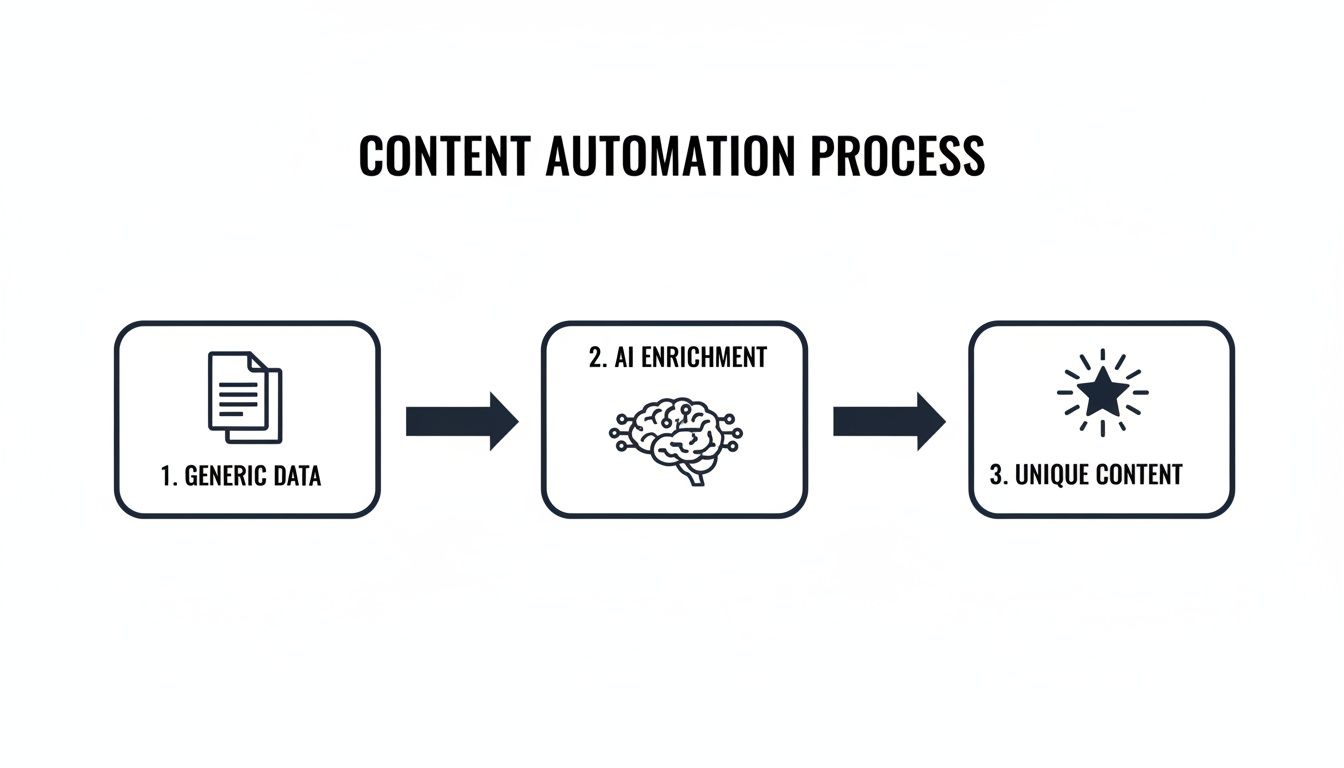
This workflow is how you turn a basic supplier spreadsheet into a strategic asset, moving from a list of specs to unique, customer-facing content ready for the digital shelf.
For Australian retailers, getting a handle on local search behaviour is everything. Search engines are the front door for discovering what customers actually want, and the metadata from their queries is a goldmine. In fact, as of 2025, 62.5% of Aussie internet users aged 16 and over hit up a search engine first when researching brands. The intent behind these searches is precise, and for local businesses, the payoff is huge: 28% of searches with local intent lead straight to a purchase or a visit to a physical store. You can dig into more of these local digital trends in the full report over on Meltwater.com.
A Practical Example: Furniture Retail
Let's make this real. Imagine a furniture retailer with 5,000 SKUs, getting absolutely hammered by the big-box competitors. Their product pages are drowning in duplicated supplier content, making them invisible for valuable, long-tail search terms.
By plugging in an AI-powered strategy, they can execute a complete catalogue overhaul. Here’s how it unfolds:
- AI Audit: The system instantly flags that most product titles are generic junk like "Oak Dining Table."
- Intent Mapping: Next, it maps out high-value commercial and informational keywords, like "solid oak extendable dining table for 8 people" or "best family-friendly dining tables Australia."
- Enrichment Workflow: The AI workflow gets to work, generating new, unique titles and descriptions for all 5,000 products. It pulls attributes from the feed (material, dimensions, seating capacity) and blends them with the intent-driven keywords.
- Image Tagging: At the same time, AI image recognition and tagging crafts descriptive alt text, like "Round oak wood dining table with four matching chairs in a modern dining room."
The result is a total transformation. In a matter of days, 5,000 generic product pages become highly specific, intent-focused assets. This is the real power of AI in SEO, moving beyond manual slog to achieve genuine retail efficiency and start dominating niche search categories.
Now that we've seen the process, let's put it into a clear action plan. The table below breaks down how to get from audit to optimisation, phase by phase.
Action Plan for AI-Powered Metadata Optimisation
| Phase | Key Actions | Core Tools / Technology |
|---|---|---|
| 1. Discovery & Audit | – Audit existing metadata for quality and duplication. – Analyse search performance to identify intent gaps. |
– SEO platforms (e.g., Ahrefs, SEMrush) – AI-powered content analysis tools |
| 2. Strategy & Mapping | – Define intent targets for each category/product. – Design the automated content workflow and AI prompts. |
– Spreadsheet software (Google Sheets) – Project management tools (Asana) |
| 3. Execution & Enrichment | – Run AI agents to generate unique titles, descriptions, and alt text. – Human experts review and refine AI output. |
– Generative AI platforms (like Optidan) – Product Information Management (PIM) system |
| 4. Deployment & Testing | – Push optimised metadata live via PIM or CMS. – A/B test different metadata versions on key product pages. |
– eCommerce platform (Shopify, BigCommerce) – A/B testing tools (Google Optimize) |
| 5. Measure & Iterate | – Monitor rankings, CTR, and conversion rates. – Use performance data to refine AI prompts and strategy. |
– Google Analytics, Google Search Console – Business intelligence (BI) dashboards |
This structured approach ensures you’re not just throwing AI at a problem, but building a sustainable system for ongoing success.
This kind of scalable operation is what modern SEO at scale for retailers is all about. To learn more about how it works, check out our guide on the benefits of scale with AI product feeds. Adopting this kind of strategy gets your business ready for the agentic commerce future, making sure you meet customers exactly where they are, with exactly what they’re looking for.
Measuring Success in the Age of Agentic Commerce
You can't improve what you don't measure. In the shift from old-school SEO to AI-driven search, tracking success means looking beyond vanity metrics like raw traffic. We need to focus on KPIs that directly prove your digital shelf is ready for agentic commerce.
Proving the return on your intent-driven metadata comes down to one thing: how well are you capturing valuable, high-intent audiences and turning their searches into sales? The automated content workflows we've talked about aren't just for efficiency, they’re the engine that gets you to this level of performance at scale.
Core KPIs for Intent-Driven Metadata
To see the real-world impact of your AI-powered product data, you need to concentrate on the metrics that actually move the needle. These KPIs give you a clear picture of your visibility, engagement, and, most importantly, your bottom line.
- Organic Ranking for Commercial Keywords: Are you climbing the ranks for high-intent, transactional search terms? Better positions here are a dead giveaway that your metadata is hitting the mark with what buyers want.
- Click-Through Rate (CTR) from SERPs: A rising CTR for your product and category pages is a great sign. It means your title tags and meta descriptions are doing their job, standing out and winning the click over your competitors.
- Conversion Rate from Organic Traffic: This is the ultimate test. Are the people finding you through search actually buying anything? An increase here shows that your on-page content is delivering on the promise your metadata made in the search results.
- SKU-Level Visibility: It’s not enough to have a few hero products ranking. You need to monitor how many of your individual product pages are indexed and showing up in search. A truly scalable SEO solution gets your whole catalogue seen.
Measuring success in the age of agentic search optimisation is about proving you can answer a customer's need better than anyone else. Strong performance across these KPIs shows that your structured, AI-compatible content is not just being found, but is being chosen by both humans and the AI shopping agents of tomorrow.
Preparing for the Future of Retail Search
These metrics are vital for winning today, but they also act as a barometer for how ready you are for the future. An AI-first approach to content, built on enriched product feeds and unique descriptions, is the single best way to prepare for a world where AI agents in ecommerce do the shopping.
This is a central theme in the new race for AI ROI, where dominating the digital shelf means outranking competitors in these new channels.
By optimising your metadata for customer intent now, you’re building a solid foundation. You're ensuring your products will be understood, recommended, and ultimately bought through the next generation of AI-driven shopping experiences. This strategic investment is what will separate the retailers who thrive from those who get left behind.
Ready to transform your product catalogue and dominate the digital shelf? Optidan AI uses advanced AI-powered content workflows to create thousands of unique, SEO-ready product pages at scale, ensuring you're prepared for the future of agentic commerce. Learn more at https://optidan.com.
