


Let's be honest, the old way of doing retail SEO is broken. If you're an Australian retailer managing thousands, or even tens of thousands, of products, manually optimising every single page is a losing battle. The real game-changer with AI product feeds is the ability to achieve unprecedented scale. You can finally move from slow, painful manual updates to automated, sitewide optimisation that takes days, not years.
Moving From Manual SEO To AI-Powered Scale
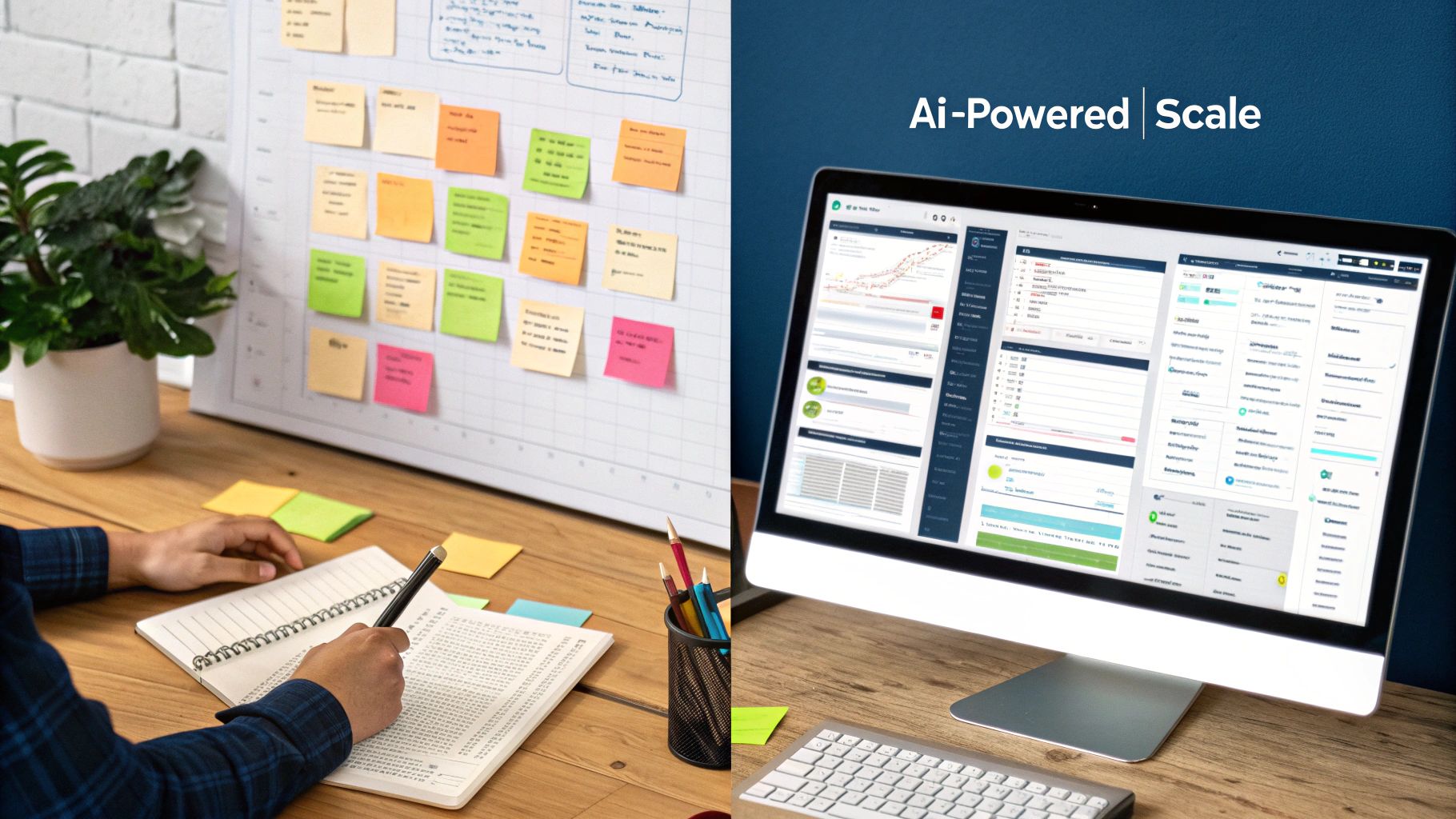
For too long, ecommerce managers have been stuck in a content bottleneck. Traditional SEO workflows just can't keep up with the demands of modern retail because they rely on human effort, which is slow and expensive. This manual approach doesn't just hold you back, it leaves your business wide open to critical SEO issues that directly hit your bottom line.
One of the most damaging problems is supplier content duplication. When dozens of retailers use the exact same product descriptions from suppliers, search engines get confused. They struggle to figure out which page is the original or most valuable, often leading to poor search rankings or even penalties. Suddenly, your products are invisible to the very customers trying to find them.
The Rise Of Retail Content Automation
This is where AI product feeds completely change the game. It’s a fundamental shift from clunky manual SEO to smart, scalable AI SEO. Instead of a small team spending months trying to rewrite thousands of product descriptions, an AI-powered workflow can get it done across your entire catalogue almost instantly.
AI isn’t just about doing things faster. It's about doing things that were previously impossible. For retailers, this means finally achieving SKU-level SEO perfection across a massive product range, a task that would be a logistical and financial nightmare using traditional methods.
This automation isn't just about replacing manual work, it's a strategic upgrade. It fixes duplicated content, enriches thin supplier data, and makes sure every single product page is uniquely optimised to capture search traffic. You can learn more about this leap forward in our guide on how AI SEO software is reshaping online retail.
Preparing For The Future Of Agentic Commerce
AI adoption in Australian retail is picking up serious speed. In fact, over 91% of retailers in Australia and New Zealand are now putting money into generative AI. This isn't just a trend, it's a clear signal that AI is essential for staying competitive.
This move towards AI is crucial for getting your business ready for the next evolution of search: agentic search optimisation. AI shopping agents like ChatGPT and Google's AI Overviews need highly structured, unique, and detailed product data to make recommendations. AI product feeds create exactly this kind of AI-friendly SEO content, ensuring your products show up in this new agentic world. To get ahead, businesses can use various AI-powered SEO tools to automate tasks and unlock greater scale, building a foundation for better digital shelf performance and long-term success.
What Are AI Product Feeds And How Do They Work?
Let's cut through the jargon. Think of your standard product feed as a simple spreadsheet. It’s a static list of your products, and it needs someone to manually keep it updated. It gets the job done, but it’s always a step behind and incredibly slow.
An AI Product Feed, on the other hand, is like a living, breathing database that actively improves itself. It's a proactive system built for the realities of modern retail. It doesn't just store data, it becomes an engine for growth and optimisation.
This is the fundamental difference between old-school SEO and what we call AI SEO. Instead of paying someone to manually tweak product pages one by one, AI-driven workflows automate these crucial tasks across your entire catalogue. This is how retailers can finally achieve comprehensive product catalogue SEO at a speed and scale that was simply impossible before.
Core Functions Of An AI Product Feed
At its core, an AI-powered system takes over the most tedious, time-consuming, and error-prone parts of managing a large product inventory. It turns raw, inconsistent supplier data into a genuine asset that drives sales and improves your digital shelf performance.
The main functions include:
- Automated Product Data Enrichment: The system pulls in basic supplier feeds and intelligently fills in the gaps. It adds missing attributes, fixes mistakes, and standardises all the information. For example, a weak entry like "red dress" is automatically transformed into "women's crimson A-line cocktail dress, size 12, silk-blend fabric," complete with structured data for material, style, and occasion.
- Unique Content Generation: To tackle the massive problem of supplier content duplication, the AI generates unique, on-brand product descriptions for every single SKU. This completely removes the SEO risk of using generic manufacturer text and builds a consistent brand voice across thousands of pages.
- Advanced Metadata Optimisation: The AI automatically creates SEO-friendly title tags, meta descriptions, and image alt tags. Using AI image recognition SEO, it can even look at a product photo from your fashion SEO optimisation efforts, identify visual details like "V-neck," "floral print," or "puffed sleeves," and tag them correctly without any human help.
From Manual Bottlenecks To Automated Workflows
The real magic happens when you apply these automated processes across tens of thousands of products in just a few days. This is the essence of SEO at scale for retailers. A job that would take a content team months, or even years, to do manually is knocked over in a fraction of the time, clearing huge retail content bottlenecks.
Imagine launching a new season's collection of 5,000 products. The old way? Your team would spend weeks manually writing descriptions and optimising each page. With AI workflow automation for retail, you can have every one of those 5,000 pages fully optimised and ready to rank before the first customer even lays eyes on them.
This creates an almost unfair competitive advantage. While your competitors are stuck in the mud with manual updates, your business is already capturing market share with perfectly optimised product listings. It’s especially vital for retailers in visual sectors like fashion, furniture, or electronics, where detailed attributes and image tags directly lead to discovery and sales. You can dive deeper into managing this process in our guide on product feed management for ecommerce.
Ultimately, an AI Product Feed isn't just a tool, it's a complete shift in your content model. It moves your operations from being reactive and manual to proactive and automated. It ensures every single product listing is engineered for maximum visibility, engagement, and conversion from the moment it goes live. This is the future of retail performance.
Solving Pervasive Retail Challenges With AI SEO
For Australian retailers, the daily grind feels like a constant battle against the same old growth-killing problems. Inconsistent supplier data and the ever-present threat of search penalties for duplicate content clog up workflows and hit the bottom line. Hard.
Many retailers are stuck managing messy supplier feeds that land with thin details and generic, copy-pasted descriptions. This creates an even bigger headache: supplier content duplication. When you use the same manufacturer’s text as dozens of your competitors, you’re telling Google you have nothing unique to offer, and your search visibility suffers for it.
These problems lead to expensive, inefficient content workflows where your team spends more time fixing basic data than thinking about strategy. AI Product Feeds offer a direct, powerful way to break this cycle, moving retailers from manual firefighting to automated, scalable growth.
Transforming Raw Data Into A Strategic Asset
At its core, AI SEO is about turning a liability, your raw product feed, into your single greatest marketing asset. It all starts with sophisticated product data enrichment. An AI system takes whatever your supplier sends, no matter how basic, and intelligently builds it out.
This isn’t just about stuffing in a few extra keywords. Imagine a supplier feed lists a product simply as ‘blue shirt’. An AI-powered workflow transforms that into a highly structured, detail-rich entry that’s genuinely useful:
- Product Name: Men's Navy Blue Cotton Crew-Neck T-Shirt
- Material: 100% Organic Cotton
- Fit: Regular Fit
- Sleeve Style: Short Sleeve
- Occasion: Casual Wear, Summer Apparel
This level of detail is fundamental for today’s search algorithms, but it’s even more critical for the emerging world of agentic search optimisation. AI shopping agents like Rufus and Perplexity depend on this kind of granular, structured data to find, compare, and recommend products. Without it, your products are invisible in the new agentic commerce future. For a deeper dive, learn more about how to align supplier feeds with search performance.
Eliminating Duplication And Building A Unique Voice
Once the data is rich and structured, the next job is to solve the duplicate content SEO fix at scale. AI algorithms get to work rewriting every single generic supplier description, creating unique, on-brand content for each SKU. This is about more than just avoiding penalties, it’s about carving out a distinct voice that actually connects with your customers.
By automating the creation of unique product descriptions, retailers can finally do what was once impossible: achieve complete content originality across a catalogue of 10,000+ products in days, not years. This single capability dramatically improves digital shelf performance and builds an SEO foundation that lasts.
This infographic shows the simple but powerful flow of how raw data gets turned into an optimised asset.
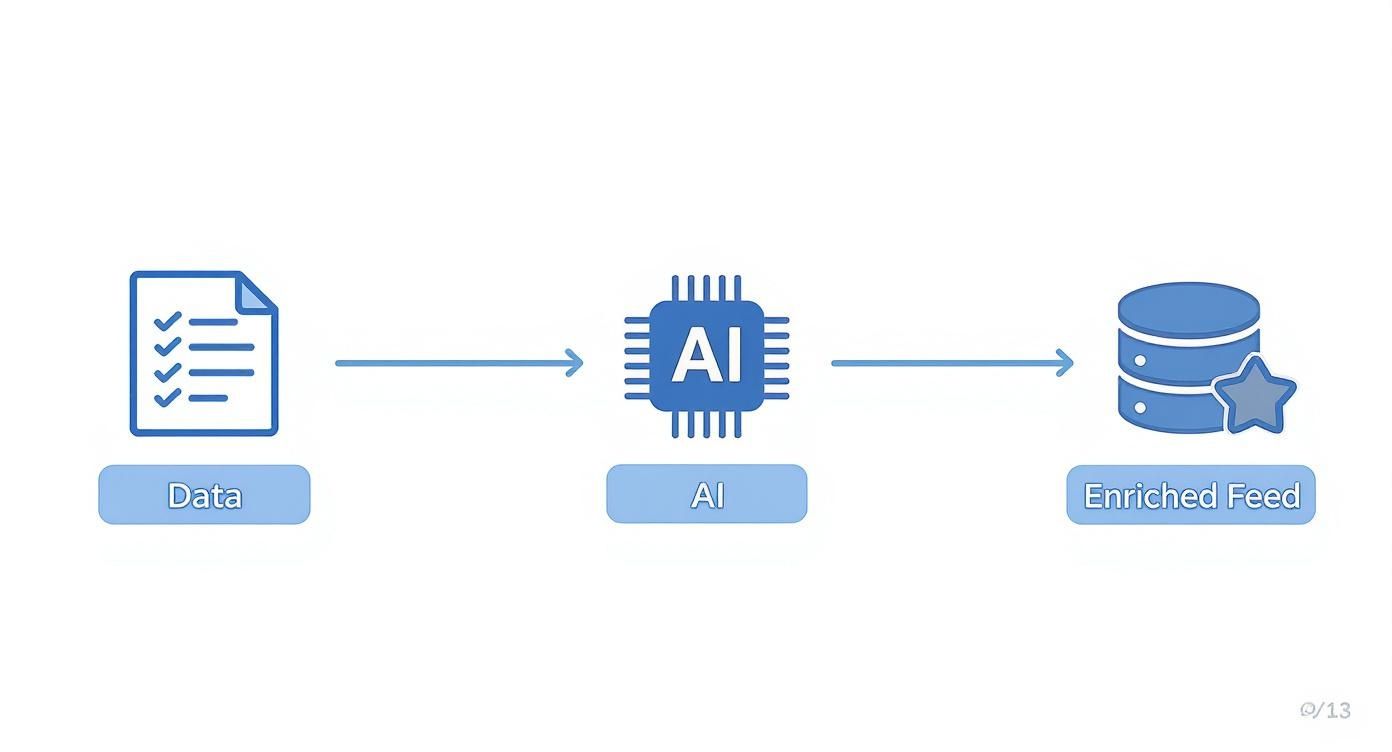
It’s a clear picture of how AI workflows turn basic inputs into high-performance outputs, ready for any sales channel.
Automating Visual Merchandising With Image Recognition
The value doesn't stop with text. For visual-heavy industries like fashion SEO optimisation or furniture SEO services, the images are everything. But manually writing descriptive alt tags for thousands of product photos is a massive task that often gets pushed to the bottom of the list, leaving a huge SEO opportunity on the table.
AI image recognition SEO takes care of this completely. The system analyses a product image, identifies key visual details, and generates descriptive, keyword-rich alt text on the fly. For a clothing retailer, it can spot features like a "long-sleeve," "button-down collar," or "checked pattern." This automated product image tagging makes your products more discoverable in image search and improves accessibility, all without a single minute of manual work. It’s a perfect example of human + AI collaboration in SEO, where technology handles the scale, freeing up your team to focus on the bigger picture.
The Economic Case for Scalable AI in Retail
Bringing scalable AI into your retail business isn't just a tech upgrade, it’s a strategic economic decision. The conversation around AI product feeds and retail content automation is about much more than just improving your digital shelf. It’s about cementing your competitive edge in a market that technology is redefining every single day.
For any single retailer, the numbers speak for themselves. Manual content workflows are expensive, painfully slow, and create bottlenecks that hold back product launches and stifle growth. Automated content workflows get rid of these roadblocks, letting you optimise tens of thousands of product pages in just a few days. This frees up your team from mind-numbing data entry, so they can focus on high-value strategy instead.
Fuelling National Productivity and Growth
Zooming out, this shift has a massive impact on the national scale. Australia’s own macroeconomic forecasts point to AI as a critical driver of future prosperity. Widespread adoption is tipped to add $142 billion annually to the nation's GDP by 2030, with productivity and wages projected to climb by 4% and 7% respectively. These figures aren't just abstract numbers, they show how tools that optimise product feeds efficiently build a stronger, more competitive national economy.
It’s the small and medium-sized enterprises (SMEs) that stand to gain the most. Forecasts show they can boost their productivity 22% faster than larger corporations by embracing AI. This is a genuine game-changer, levelling the playing field and allowing smaller retailers to compete on a scale once reserved for the big players.
From Cost Centre to Competitive Advantage
The old-school view of content and SEO as a necessary cost is officially dead. With AI-powered retail transformation, your content becomes a scalable, revenue-generating machine. By cracking tough problems like supplier content duplication and enriching product data at scale, you can dramatically lift your search visibility and conversion rates. This isn't just about cutting costs, it's about building a more agile and resilient business model.
The future of work in retail hinges on this very idea. It’s not about replacing people but making them better. Human + AI collaboration in SEO lets teams achieve results that are flat-out impossible with manual effort alone, turning what was once a content liability into a powerful competitive weapon.
This move from manual SEO to AI SEO is vital for future-proofing your business. When you invest in scalable SEO solutions, you're not just preparing for today's search algorithms but for the coming wave of the agentic commerce future. These AI-driven systems are exactly what will provide the structured, unique data that AI shopping agents will depend on.
Ultimately, the economic imperative is impossible to ignore. AI-powered scale delivers direct cost savings, supercharges team productivity, and unlocks new avenues for growth. It strengthens your business while contributing to a more dynamic and prosperous retail sector. To see how this works in the real world, check out our guide on how end-to-end product optimisation reduces retail operating costs. Adopting these technologies is no longer a choice, it’s a fundamental requirement for long-term success.
Preparing Your Business For The Future Of Agentic Commerce
The way your customers find products is fundamentally changing. Forget just thinking about a person typing keywords into a search bar. The future of retail search is about AI agents like ChatGPT, Perplexity, and Amazon's Rufus doing the heavy lifting for the shopper.
This shift is the start of agentic commerce, and getting ready for it now is a non-negotiable for any retailer who plans on being around in a few years.
This new world demands a completely different approach to SEO. Agentic search optimisation isn't about getting human eyeballs on a results page, it's about optimising for machine comprehension. These AI shopping assistants need to understand, compare, and recommend products based on deep, structured data, not just clever marketing copy.
This is exactly where AI product feeds give you a critical edge. The rich, unique, and highly structured product data they generate is the fuel these AI agents need to work properly.
Building AI-Compatible SEO Content
To win in this new environment, your product content has to be AI-compatible. That means going way beyond basic descriptions to provide the kind of granular, SKU-level detail that an AI can easily digest and make sense of.
Think about it: an AI agent can't recommend your 'blue jacket' for a customer's specific need if it doesn't know the material, the fit, the waterproofing level, or the ideal use case.
The core idea behind the agentic commerce future is simple: your product data is no longer just for your website. It's now the main source of truth for a new wave of AI-powered shopping assistants that will guide customer decisions. Without rich, accurate data, your products simply won't exist in their world.
Australian consumer behaviour is already showing this shift. A recent study found that 66% of shoppers who buy online more than once a week are regularly using AI assistants like ChatGPT to help them make purchasing decisions.
Even more telling, 34% of this group use generative AI for their initial product discovery. That's a clear signal of just how fast AI is taking over the top of the funnel.
Optimising For Machine Comprehension At Scale
This shift makes SKU-level SEO and multi-channel product optimisation absolutely essential. Every single product in your catalogue must be enriched with detailed attributes that AI agents will use to filter and recommend. This means a deep focus on structured data and unique content. To prepare effectively, businesses must focus on mastering omnichannel customer experience strategies that use this data consistently across the board.
This is where the sheer scale of AI workflows becomes a strategic advantage. Trying to manually create this level of detail for thousands of products is impossible. Retail SEO automation is the only realistic way forward, allowing you to generate the AI-compatible SEO content you need across your entire product range.
You can learn more by reading our complete guide on preparing your product catalogue for agentic search.
Ultimately, the retailers who will thrive are the ones who stop thinking about SEO as a human-to-human interaction and start seeing it as a machine-to-machine conversation. By investing in AI product feeds, you are building the foundation needed to ensure your products are not just seen, but understood, recommended, and purchased in the fast-approaching era of AI shopping SEO.
Measuring The Success And ROI Of Your AI Investment
Proving your investment in AI Product Feeds is actually working requires you to look past the usual vanity metrics. To build a solid business case, you have to connect the dots between the technology and real-world business results and operational wins. It’s all about showing a clear financial return from doing AI SEO at scale.
The most direct proof of success is right there on your digital shelf. High-quality, unique content generated by AI has a direct impact on how your products show up in search. Instead of just tracking total traffic, you need to be watching the growth in organic rankings for specific, long-tail product keywords. That’s how you know you’re grabbing the attention of high-intent shoppers.
Plus, when you have enriched, detailed product descriptions, you create a much better customer experience. You'll see this in a noticeable drop in bounce rates on your product pages and an increase in the time people spend on them. When customers find what they need, they’re far more likely to click "buy".
Key Performance Indicators for Business Growth
To really get a handle on the return, you need to track the metrics that lead straight to revenue. A properly executed ecommerce content optimisation strategy should deliver a measurable lift in both conversion rates and how much customers spend per order.
Here are the key financial and engagement KPIs to keep an eye on:
- Conversion Rate Uplift: Put your AI-optimised pages head-to-head with non-optimised ones. This isolates the impact and shows you exactly what’s working.
- Average Order Value (AOV): Better content builds buying confidence and opens the door for cross-selling. You'll see this reflected in your AOV.
- Organic Search Revenue: Measure the direct increase in sales coming from non-paid search traffic specifically for your optimised product categories.
- Reduced Bounce Rate: A lower bounce rate is a strong signal that your content is hitting the mark, keeping potential buyers on your site for longer.
Measuring Operational Efficiency and Cost Savings
Beyond sales numbers, a massive chunk of your ROI comes from making internal processes run smoother. When you start automating product descriptions and other content jobs with AI workflow automation for retail, you unlock some serious operational efficiencies.
The true financial return of an AI investment is a combination of what you gain and what you save. By eliminating manual content workflows, you not only accelerate your go-to-market speed but also reclaim thousands of hours of team capacity, which can be redirected to strategic growth initiatives.
Calculate the cost savings you're making by automating work that used to be done by hand. Track how much faster you can get new products to market, a critical edge in fast-moving industries like fashion SEO optimisation. These operational metrics give you undeniable proof of how retail efficiency tools cut down overheads and bring in revenue faster, cementing the economic case for your AI investment.
Still Have Questions About AI Product Feeds?
Moving to AI-powered retail always brings up a few questions. For retail leaders and ecommerce managers thinking about these kinds of tools, getting clear answers is everything. Here are some of the most common things we get asked about implementing AI product feeds.
How Does This Actually Work With Shopify or Magento?
One of the first things people worry about is how a new system will fit with their existing tech. The good news is, modern retail content automation platforms are designed to connect seamlessly. They usually plug right into major ecommerce platforms like Shopify, BigCommerce, and Magento through an API or a direct app integration.
This means the system can pull your current product catalogue, enrich and optimise it, and then push all the improvements back automatically. The goal isn't to rip and replace what you've already built, it's to make it work harder for you without causing any operational headaches.
Are We Handing Everything Over to a Robot? What’s Our Team’s Role?
AI isn't here to replace your team, it’s here to make them more powerful. Think of it as Human + AI collaboration. While the AI does the heavy lifting, like rewriting thousands of product descriptions or tagging images, your team is still firmly in the driver's seat.
Your team’s oversight is crucial. They will:
- Set the brand guidelines and tone of voice that the AI must follow.
- Review and sign off on batches of generated content before anything goes live.
- Focus on high-level strategy and leave the large-scale execution to the machine.
This blend ensures you get the efficiency of automation without ever losing the human touch that defines your brand.
How Do We Know Our Product Data Is Safe?
Data security is non-negotiable. Any reputable AI SEO provider will operate under strict data protection rules. Before you partner with anyone, make sure they have a crystal-clear policy on how they handle your data. You need confirmation that your proprietary product information is only used for your own optimisation tasks and never shared or used to train public models. This is a must-do for any business adopting generative AI for retail teams responsibly.
Ready to break through content bottlenecks and get your catalogue ready for the future of search? Optidan AI delivers the scalable SEO solutions you need to turn your product feeds into a genuine performance driver. Learn more about our AI-powered content workflows.
