


A broken product catalogue is not a technical issue to be solved by IT. It is a commercial risk that quietly suppresses revenue, creates operational drag, and makes a retailer invisible to the AI-driven search that defines modern commerce.
Many enterprise retailers underestimate the true cost. They see individual data errors as minor annoyances, not recognising them as symptoms of a systemic weakness that erodes performance over time. This article breaks down the hidden costs of a broken catalogue and explains why treating product data as infrastructure is critical for revenue, efficiency, and AI readiness.
What Retailers Mean by a “Broken Catalogue” (and Why It’s Often Normalised)
A “broken catalogue” is not about a few spelling mistakes or missing images. It is the systemic decay of product data at scale, where a collection of normalised flaws prevents both customers and algorithms from finding the right products with confidence.
Think of it like a massive warehouse with a flawed inventory system. The products are on the shelves, but they are mislabelled, lack critical specifications, or are located in the wrong aisle. Anyone looking for a specific item will struggle, become frustrated, and likely leave empty-handed. This is precisely what happens inside a broken retail catalogue.
These issues are often normalised because they do not crash the website. Pages load, and checkouts function. But beneath the surface, this flawed data foundation actively undermines commercial performance.
Common Signs of a Broken Catalogue
These are not isolated incidents but widespread patterns that blend into the background noise of daily retail operations.
- Incomplete Product Attributes: A fashion retailer sells a jacket but omits attributes like ‘material’, ‘sleeve length’, or ‘fit’. Customers cannot use filters to narrow their search, leading to abandonment.
- Duplicated Supplier Content: An electronics retailer uses the same generic manufacturer description as hundreds of competitors. Search visibility plummets, and customers have no compelling reason to purchase from them.
- Inconsistent Taxonomy: A homewares store lists “coffee tables” under ‘Living Room Furniture’ but files “end tables” in a separate ‘Tables’ category. This fractured structure breaks site navigation and prevents effective cross-selling.
- Outdated Availability: Stock levels and pricing shown online are out of sync with the inventory management system, leading to cancelled orders and a loss of customer trust.
- Poor Governance: Multiple teams make ad-hoc changes to product data without a central standard, creating widespread inconsistencies that are difficult to untangle later.
A broken catalogue is less about individual errors and more about systemic data decay. It's the slow accumulation of inconsistencies and gaps that makes your products invisible to both motivated shoppers and the AI agents that now guide them.
As retailers prepare for a future dominated by AI and agentic search, the integrity of their catalogue is no longer a content task; it is a measure of their commercial infrastructure.
The Revenue Cost Most Teams Miss
A broken catalogue quietly bleeds revenue in ways that rarely appear on a profit and loss statement. While teams focus on optimising ad spend and checkout flows, flawed product data underneath suppresses sales and erodes customer value long before a shopper adds an item to their cart.
The most immediate impact is on product discoverability. When data is incomplete—missing crucial attributes like 'material', 'dimensions', or 'compatibility'—products become invisible to customers using faceted search and filters. A shopper searching for a "100% cotton, long-sleeve, blue shirt" will never see a product missing even one of those attributes. The sale is lost before it begins.
This is particularly damaging for long-tail searches, where customers signal clear purchase intent. A search for "waterproof hiking boots size 10 wide fit" comes from a motivated buyer. If the catalogue lacks structured data for 'waterproof' or 'wide fit', the product will not appear, sending the customer directly to a competitor whose data is in order.
For large retailers, especially those reliant on supplier feeds, poor data quality can reduce visibility in Google Shopping and new AI-driven search agents by 30-40%. This often translates to a 2-5% loss in annual turnover—a quiet but significant drain on profitability.
This visual breaks down the most common types of catalogue errors we see—incomplete, duplicated, and inconsistent data—that are quietly undermining revenue.
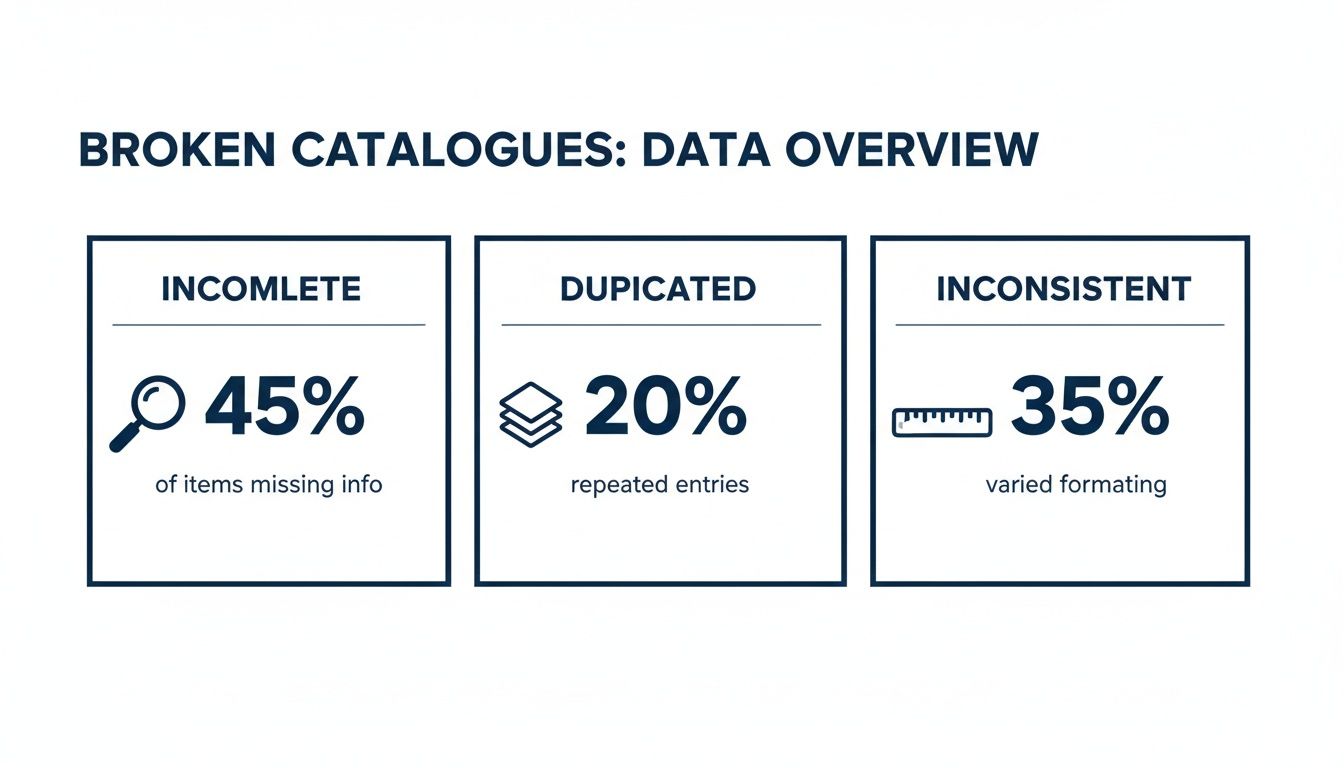
Incomplete data is typically the largest issue, directly preventing products from appearing in filtered searches and weakening the entire digital shelf.
Beyond search, a broken catalogue cripples conversion tools like cross-sell and recommendation engines. These systems depend on rich, accurate product attributes to make logical connections. When the data is sparse or inconsistent, recommendations become irrelevant or nonsensical. A fashion retailer’s “Complete the Look” feature fails if it cannot match styles or colours. An electronics site suggests an incompatible charger because the 'connector type' attribute is missing.
Each failure is more than a missed upsell. It damages customer confidence and delivers a disjointed experience, lowering conversion rates and lifetime value. These are not isolated glitches; they are the direct commercial result of treating product data as a low-priority task. Building a resilient commercial foundation is key, and you can learn more about how Optidan’s core platform addresses these structural challenges.
The Operational Cost Nobody Tracks
Revenue loss is only half the story. A broken catalogue injects enormous friction into daily operations, creating a persistent, unmeasured drag on efficiency. This hidden ‘data tax’ is paid daily by teams across the business.
It appears as wasted hours and duplicated effort. E-commerce managers manually fix supplier feed errors. Marketing teams scramble to find accurate product details for a campaign. Customer service staff deal with angry customers misled by incorrect online information. This is not strategic work; it is low-value, reactive firefighting that consumes valuable resources and creates content bottlenecks.

This operational drag kills agility. When product data is a mess, every new initiative begins with a data cleanup project. This reliance on manual workarounds and spreadsheet validation traps skilled people in a cycle of fixing problems instead of driving growth.
Consider these scenarios:
- Delayed Product Launches: A new seasonal collection cannot go live because supplier attributes are incomplete or do not map to the site’s taxonomy, forcing days of manual data entry.
- Ineffective Campaign Execution: A major sales event underperforms because the marketing team cannot quickly segment products on reliable attributes like ‘material’ or ‘colour family’, leading to generic, less effective targeting.
- Cross-Departmental Friction: A merchandising plan to feature a new brand is stalled because the digital team lacks the enriched content needed to build a compelling landing page.
Operational drag is the opportunity cost of manual intervention. Every hour your team spends correcting preventable data errors is an hour they are not spending on merchandising strategy, campaign optimisation, or improving the customer experience.
This constant reaction makes it impossible to scale without compromise. As SKU count grows, the manual workload explodes. The business is forced to move slower, leaving money on the table. For a deeper look into streamlining these processes, our guide on effective product feed management for Shopify SEO offers practical insights.
How Broken Catalogues Limit AI and Search Performance
The shift to AI-driven search is redrawing the map of product discovery. For years, SEO meant optimising pages for crawlers. The new reality, driven by systems like Google's AI Overviews and shopping assistants in ChatGPT and Perplexity, is about optimising structured product data for AI agents.
These agents ingest product feeds and APIs as their primary source of truth. Their purpose is to build confidence in your data to deliver a reliable answer to a user’s conversational query. When your catalogue data is incomplete, inconsistent, or untrustworthy, AI systems have low confidence. They will always favour a competitor with clean, reliable, and richly detailed data.

This is a fundamental change. If your product feed is flawed, you are building your entire digital shelf on a broken foundation and becoming invisible to the next wave of shoppers.
AI agents are designed to minimise risk. They dissect product data to match complex, conversational requests like, "Find me a waterproof jacket under $300 that’s good for hiking in Tasmania." To answer this, the agent needs to trust your data on multiple fronts: is the ‘waterproof’ attribute present? Is the price accurate? Is the product correctly categorised under ‘Outerwear’ or ‘Hiking Gear’? Is it in stock?
If any of this data is missing or contradicts what is on your website, the AI agent’s confidence plummets. It cannot risk a wrong recommendation, so it ignores your SKU and moves on to a competitor whose data is complete. This is where efforts in Generative Engine Optimization (GEO) fall flat without a solid data foundation.
For AI agents, incomplete data is treated as incorrect data. A missing attribute doesn’t just weaken a listing; it disqualifies it from consideration entirely, erasing your product from the new digital shelf.
This shift means traditional, page-level SEO is no longer enough. The product feed is the new source of truth for AI. Its quality, structure, and richness directly determine your visibility and commercial success in an AI-first world. To get ahead of this, you can explore our insights on preparing for agentic commerce readiness.
Why Traditional SEO and Paid Media Can’t Fix Catalogue Problems
A common and flawed assumption in retail is that you can out-market a messy catalogue by pouring more budget into paid media and tweaking on-page SEO. This approach is like painting over cracks in a crumbling wall; it may look better briefly, but it does nothing to fix the underlying structural problem.
The most brilliant marketing campaign is instantly sabotaged by bad product data. A perfectly targeted ad is wasted if it leads a high-intent customer to a page with incorrect stock levels, missing attributes, or a vague, duplicated description. This does not just burn marketing budget; it erodes customer trust.
The core issue is simple: marketing gets shoppers to the digital shelf, but your product data is the shelf. If the two are misaligned, the customer experience breaks down at the most critical moment.
This shows up in several ways:
- Wasted Ad Spend: You pay for a click, but the user bounces because the product’s colour options are missing or its specifications are too vague for a confident decision.
- Eroding Campaign ROI: A "20% off all leather goods" campaign is dead on arrival if half the leather products are missing the ‘material’ attribute in the product feed.
- Damaged Brand Reputation: A customer clicks an ad and finds the product is out of stock or the price is different. This does not just lose a sale; it teaches the customer your advertising cannot be trusted.
Trying to fix a catalogue problem with a marketing budget is a losing game. It addresses the symptom—low conversion—without touching the root cause: a fundamental lack of trustworthy product information.
Traditional SEO and paid media campaigns work by optimising what is visible on the page. But a broken catalogue’s issues run deeper, hiding in the product feeds and APIs that power the entire experience. A perfectly written meta description is useless if the product feed tells Google Shopping the item is out of stock.
Marketing can only amplify what is already there. If your catalogue is broken, you are simply paying to show more people a flawed experience. To learn more about how to prepare your content for the future, see our guide on AI SEO content optimisation.
Where Catalogue Breakage Starts at Scale
Product catalogues do not break overnight. The issues retailers face today are the result of specific operational habits that quietly degrade data quality over time.
The breakage often starts the moment new product data enters the business. The most common source is an over-reliance on raw, unvalidated supplier feeds. These feeds are built for the supplier's logic and rarely align with a retailer’s taxonomy or content standards. Without a rigorous enrichment process, their inconsistencies, gaps, and generic descriptions are piped directly into your system.
Rapid SKU growth accelerates the problem. As a retailer scales from 10,000 to 100,000+ products, manual oversight becomes impossible. Without automated rules and clear data standards, every new product launch introduces another potential point of failure.
Organisational and technical factors also play a huge role.
- Disconnected Systems: When PIM, ERP, and e-commerce platforms do not communicate seamlessly, data becomes fragmented and out of sync, forcing teams into manual workarounds.
- Lack of Ownership: Without a single, clear owner of product data quality, accountability dissolves. Merchandising, marketing, and digital teams work in silos, making localised fixes that create larger inconsistencies.
- No Clear Data Standards: A failure to define and enforce a consistent data model means every team interprets attributes and categories differently, guaranteeing chaos at scale.
Catalogue degradation is a symptom of misaligned processes. It reflects a gap between a retailer’s growth ambitions and the data infrastructure required to support that scale. The breakage isn't an accident; it's the predictable outcome of current operational design.
In the Australian market, these fragmented catalogues create massive opportunity costs. For instance, relying on supplier-fed data can lead to duplication rates as high as 30%, inflating costs through wasted ad spend and fuelling high cart abandonment rates. You can review the full Australian retail outlook to get a better handle on the market dynamics.
The Compounding Effect Over Time
The true danger of a broken catalogue is not a single lost sale but its compounding effect. Neglecting your catalogue creates data debt—an operational liability that grows quietly and relentlessly.
It starts with small, seemingly harmless compromises: an incomplete description here, an inconsistent tag there. These fixes are pushed to a backlog that never gets cleared. But this debt accrues interest. Every unresolved data issue becomes a weak foundation for the next problem. A poorly structured category forces marketing to create workarounds for every campaign. Duplicated supplier content from last season makes it harder for AI agents to trust your new products this season.
Over time, these layers of compromise harden into a rigid, inefficient system. The cost to fix everything grows exponentially, and operations slow down. What was once a simple data cleanup project now requires a complex overhaul. This is the compounding effect in action, where small neglects snowball into significant commercial risks.
A broken catalogue is not a static problem. It is an active drag on growth that makes your entire retail operation slower, more expensive, and less competitive with each passing day. The longer you wait, the higher the cost to catch up.
Ultimately, a broken catalogue is not a technical issue; it is a commercial risk. In an era where AI and agentic search depend on structured, trustworthy data, the quality of your product catalogue is a prerequisite for survival and growth.
Retailers who treat catalogue quality as core commercial infrastructure are the ones who will protect their revenue, maintain their velocity, and ensure their readiness for the future of commerce. A clean, structured, and enriched catalogue is no longer a best practice; it is a strategic imperative.
At Optidan, we provide the AI-powered workflows that transform your product catalogue from a commercial risk into your greatest competitive asset, ensuring you're ready for the future of retail. Learn more at https://optidan.com.
