

By 2026, the way products are found online will fundamentally change. AI agents will not be using search bars; they will bypass them entirely to analyse deep, structured product data directly from your catalogue.
To even be in the running, your products need rich, unique, and machine-readable content. We are talking about moving far beyond generic supplier descriptions and basic keyword stuffing.
The Inevitable Shift To Agentic Commerce
Picture your next customer. It is not a person browsing your website, but an intelligent AI agent working on a complex request like, "Find the best merino wool jumper under $200, made in Australia, and available for delivery to Melbourne by Friday."
This is not some far-off sci-fi concept. This is the immediate reality of agentic commerce, and for Australian retail leaders, it is the next digital battlefield.
The days of winning purely on clever ad copy and a slick website are numbered. Soon, victory on the digital shelf will be decided by the quality, structure, and uniqueness of your product data. To really get your head around this, it helps to understand the core technology. This guide on the concept of AI Agents is a great starting point.
Why Traditional SEO Is No Longer Enough
Think about it: traditional SEO is all about capturing human intent with keywords. Agentic SEO is completely different, it is about optimising for machine interpretation.
AI agents are not swayed by slick branding or emotional storytelling. They are all about the hard data. They will ruthlessly compare attributes like material, dimensions, warranty details, and shipping logistics with cold, hard efficiency. This is the core difference between AI SEO vs Traditional SEO teams.
Agentic commerce forces a shift from optimising for visibility to optimising for verifiability. An AI agent needs to trust that your data is accurate, complete, and better than your competitors' before it will even consider recommending your product.
This brings us to a huge opportunity for retailers who are ready to adapt right now. We are already seeing projections that by 2026, AI agents will influence up to 15% of all online product searches in Australia. That is a massive jump from less than 1% in 2023.
To give you an idea of the core differences, here is a quick comparison:
Traditional Search vs Agentic Search
| Aspect | Traditional SEO (Human-Led) | Agentic SEO (AI Agent-Led) |
|---|---|---|
| User Input | Keyword queries, browsing multiple sites | Complex, conversational requests to one agent |
| Evaluation | Emotional branding, reviews, site design | Hard data points, specifications, logistics |
| Content Focus | Persuasive copy, visuals, keywords | Structured, verifiable data and attributes |
| Key Metric | Page rankings, organic traffic | Data accuracy, completeness, trustworthiness |
| Goal | Attract and persuade a human visitor | Provide the best machine-verified solution |
This table just scratches the surface, but the takeaway is clear: the rules of the game are changing. The future of retail search hinges on your ability to move from manual content updates to scalable, automated SEO solutions. This is the very core of how agentic AI is changing the way retailers compete online.
So, how do you prepare? It comes down to three key priorities:
- Product Data Enrichment: Turn those basic supplier feeds into detailed, structured, and genuinely compelling product stories.
- Correcting Duplicated Supplier Content: Get rid of the generic supplier content that AI agents will either penalise or flat-out ignore.
- Optimised at Scale: You need AI-powered workflow automation to manage and optimise tens of thousands of SKUs without drowning your team.
How AI Agents Actually Discover Products
To win in the coming era of agentic commerce, you have to get inside the head of an AI agent like ChatGPT, Amazon's Rufus, or Perplexity. They are not just fancy search engines. Think of them as hyper-efficient digital research assistants that run on pure logic and data, completely immune to brand hype.
Picture an agent given this task: "Find a quiet, energy-efficient fridge that fits a 70cm-wide kitchen space in Perth, with a stainless steel finish and a water dispenser." The agent does not leisurely browse websites. It systematically queries all available data, hunting for products that perfectly match these structured attributes. Its mission is to find the best possible solution, not just a list of pages that happen to contain the right keywords.
This simple shift from human-led searching to machine-led discovery is a fundamental change in how retail works.
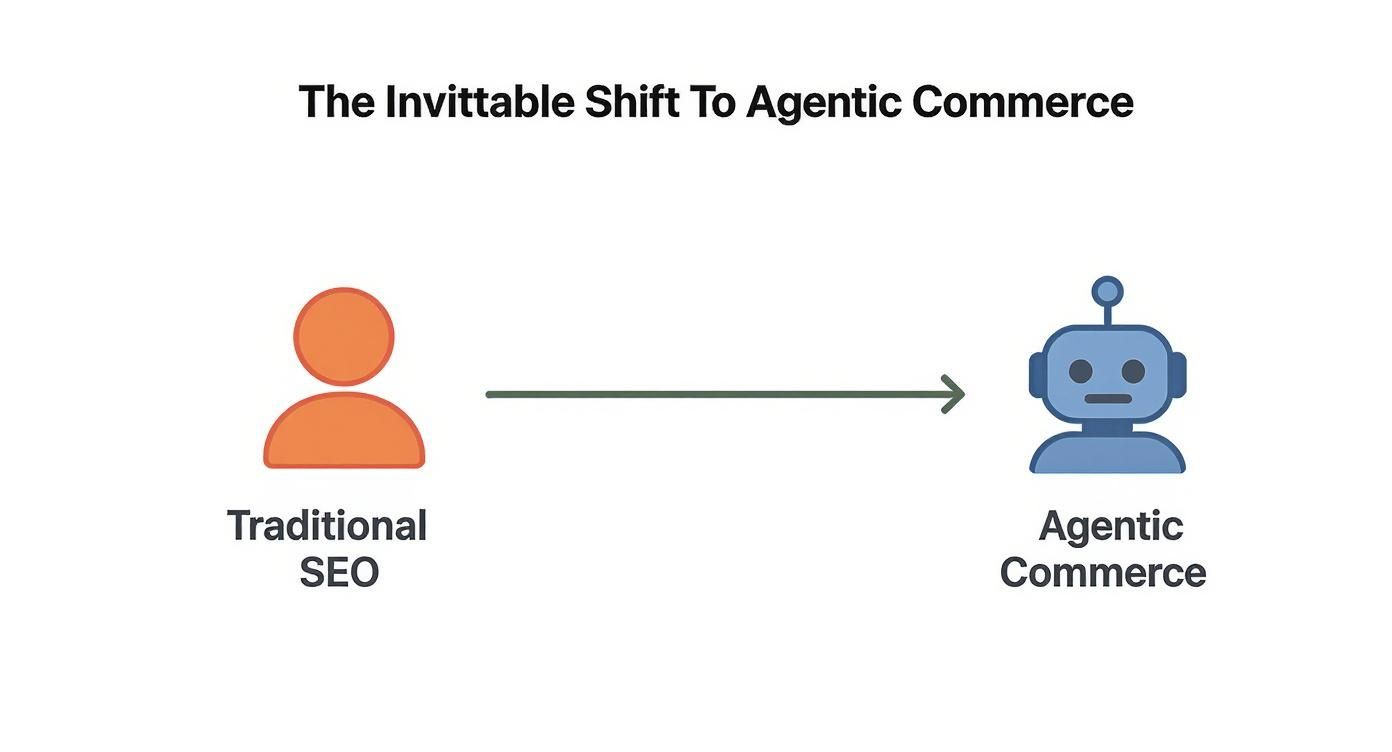
While old-school SEO was all about appealing to human behaviour, agentic commerce is about optimising for machine interpretation. That distinction is everything.
From Keywords to Concrete Attributes
A person might search for "best fridge Perth," but an AI agent breaks that request down into cold, hard data points. Its entire decision-making process is built on comparing these specific attributes across thousands of products in a fraction of a second. This is not a distant future, either, projections show that by 2026, AI agents could be handling over 40% of product discovery tasks for Australian online shoppers.
This is where the quality of your product data becomes your most valuable asset.
If your fridge's energy rating, noise level in decibels, and exact dimensions are buried in a generic paragraph copied from the supplier, the agent will probably just skip right over it. It craves clean, structured, and unique information. To really get a handle on this, you need to understand how to make your products visible in an AI-powered world.
The Key Signals AI Agents Prioritise
AI agents are programmed to value one thing above all else: accurate, complete information. They cross-reference data from multiple sources to build a confidence score before they will even think about making a recommendation. Your job is to feed them a steady diet of these high-quality signals.
Here is what they are looking for:
- Comprehensive Structured Data: This is the native language of AI. Schema markup that explicitly defines attributes like
width,height,energyEfficiencyClass, andnoiseLevelmakes your product instantly understandable to a machine. - Unique and Descriptive Content: AI penalises duplicated supplier content. Unique product descriptions that genuinely answer a buyer's questions provide the rich context agents need to see why your product is different from the rest.
- Detailed Image Metadata: Agents do not "see" images; they read the data behind them. AI image recognition paired with descriptive alt tags and file names (e.g., "70cm-stainless-steel-fridge-water-dispenser.jpg") offers crucial verification points.
- Logistical Clarity: Real-time stock levels, precise delivery timeframes, and clear return policies are not just for customer service anymore. For an AI agent, they are critical data points in its evaluation matrix.
In essence, an AI agent's "trust" in your product is directly proportional to the quality and consistency of your data. Vague, incomplete, or duplicated information is a red flag that will push your products down the consideration list.
This is exactly why Product Data Enrichment is no longer a "nice-to-have." It is the foundational work required to even compete. This means transforming basic supplier feeds into optimised, attribute-rich product pages. For any retailer with a large catalogue, doing this manually is impossible. The only way forward is with automated content workflows built for SKU-level SEO. Understanding the benefits of scale for AI product feeds is the first step toward building a retail content strategy that is actually ready for the future.
Preparing Your Product Data for Agentic Search
If you want to win in this new era of commerce, your product data needs to become your best salesperson, one that is articulate, reliable, and ready to answer any question thrown at it. AI agents do not browse like humans; they interrogate data. If your product catalogue cannot give them clear, structured, and trustworthy answers, your products will simply be ignored.
This is where most retailers hit a wall. They are still running on generic, duplicated content straight from their suppliers. In the world of agentic search, that is a fatal flaw. AI agents are built to sniff out and prioritise unique, authoritative information. When they see the same description across ten different retail sites, it screams low value, and your visibility gets penalised for it. This is a classic duplicate content SEO fix that must be addressed.
Moving Beyond Basic Supplier Feeds
The only way forward is to stop treating raw supplier feeds as a finished product and start seeing them as a raw ingredient. The process of turning them into a strategic asset is called Product Data Enrichment, and it is the absolute cornerstone of being ready for agentic search. It is all about expanding that basic product info into a rich, comprehensive format that machines can actually understand.
And this is not just about tweaking a few sentences here and there. It is a complete overhaul.
- SKU-Level SEO: This means every single product gets its own unique, detailed, and optimised description that goes way beyond the generic specs.
- Structured Data Implementation: You need to use Schema markup to explicitly label data points, think dimensions, materials, colours, and compatibility. This makes the information instantly machine-readable.
- Attribute Expansion: It is about adding those granular details that answer the very specific, nuanced questions a real person would ask an AI agent, like warranty info, country of origin, or sustainability credentials.
This strategic shift turns your product list from a simple catalogue into a powerful dataset primed for AI interrogation. For a deeper look, you can explore the core principles of effective product data enrichment and see how it gets your brand ready for what is next.
The Role of AI Workflow Automation
For any retailer juggling thousands of SKUs, the thought of manually enriching every single product page is a non-starter. This is exactly where AI Workflow Automation for Retail comes in, marking the shift from old-school manual SEO to modern AI SEO. It is not about replacing your team; it is about amplifying their skills through smart Human + AI Collaboration in SEO.
In an agentic commerce model, the biggest retail content bottlenecks become the greatest opportunities for differentiation. The ability to create unique, high-quality product content at scale is no longer an advantage; it is a prerequisite for survival.
Imagine optimising over 10,000 product pages in a few days, not years. AI-powered platforms can do the heavy lifting of generating unique product descriptions, optimising metadata, and even tagging images. This frees up your team to focus on the bigger picture, strategy, quality control, and creative direction. It is how you achieve SEO at scale, which is absolutely critical when you are competing in a machine-driven market. For industries like fashion or furniture where visuals are everything, AI image recognition and tagging can automatically identify and label features like "oak finish" or "linen fabric," feeding crucial data points to AI agents.
The table below breaks down the stark difference between the old way of thinking about product data and the new standard required for agentic commerce.
Product Data Readiness Checklist for Agentic Commerce
| Data Element | Traditional Approach | Agentic-Ready Standard | Business Impact |
|---|---|---|---|
| Product Descriptions | Keyword-focused, often uses duplicated supplier content. | Unique, attribute-rich, answers specific user queries. | Increases agent trust and SERP visibility. |
| Product Attributes | Basic details like size and colour. | Comprehensive structured data (Schema) for all specs. | Makes product data machine-readable and verifiable. |
| Content Scalability | Manual updates, slow and inconsistent. | AI-powered workflows for optimising thousands of SKUs. | Reduces content bottlenecks and accelerates time-to-market. |
| Image Data | Basic alt tags for keywords. | AI-tagged attributes (material, style) and descriptive metadata. | Wins visual search and provides critical evaluation data. |
Ultimately, getting ready for agentic search is about building a data infrastructure that is as smart and efficient as the AI agents that will soon be navigating it. By finally tackling supplier content duplication, embracing retail content automation, and investing in scalable SEO solutions, you can turn your product data from a passive liability into your most potent competitive weapon.
Winning The Visual Search In An AI-First World
In an agentic commerce world, your product images are no longer just for human eyes. They have become critical data assets that AI agents will interrogate with incredible precision. This means retailers need to shift from basic image SEO to a full-blown visual data strategy, where every picture tells a machine-readable story.
An AI agent does not "see" a stylish blue sofa. Instead, it uses advanced AI image recognition to break down the visual information into structured data points: colour: navy blue, material: velvet, style: mid-century modern, legs: tapered wood. If your image data is incomplete or your alt tags are generic, your product simply does not exist in their evaluation.
This evolution is a game-changer, especially for visually driven sectors. For retailers in fashion, furniture, or electronics, success in agentic search will be impossible without a robust approach to visual optimisation.
The Power of AI-Driven Product Image Tagging
Imagine a customer asks their AI agent, "Find me a four-door French door refrigerator with a brushed nickel finish." The agent's ability to find your product hinges entirely on its power to identify those specific visual attributes across thousands of websites. This is where AI-driven product image tagging becomes a non-negotiable part of your retail content automation.
Automated systems can analyse your entire product catalogue and apply highly specific tags at a scale no human team could ever manage. This process turns your images from passive visuals into active, searchable data sources.
- Fashion SEO Optimisation: AI can identify and tag attributes like neckline (
v-neck,crew neck), sleeve length (cap sleeve,full-length), and fabric pattern (floral,striped), providing the granular detail needed for complex queries. - Furniture Image Tagging SEO: For furniture retailers, AI can automatically tag material (
oak,walnut,leather), style (industrial,coastal), and specific features (tufted back,cabriole legs). - Electronics SEO Optimisation: In electronics, an AI can pick out port types, screen finishes, and button layouts from an image, cross-referencing this visual data with technical specs for verification.
This automated tagging provides the crucial context that AI agents use to build confidence in your product data. Get this right, and it will directly improve your digital shelf performance.
From Alt Tags To Comprehensive Metadata Optimisation
For years, alt tags felt like a simple SEO box-ticking exercise. Now, they are a cornerstone of your data strategy, working alongside a whole suite of other metadata that provides vital context. Think of it this way: descriptive, structured metadata is what allows an agent to trust what it sees.
An AI agent treats a product image like a primary source document. Descriptive alt tags, structured file names, and detailed metadata act as the citations that verify its authenticity and relevance. Without them, the image is just an unverified claim.
To get ahead, your team must move towards metadata optimisation at scale. This means creating a systematic process, often powered by AI content workflows, to ensure every visual asset is fully optimised. This includes:
- Descriptive Alt Tags: Go from "blue-dress.jpg" to something like "womens-a-line-navy-blue-floral-print-midi-dress.jpg".
- Structured File Names: Use a consistent, attribute-rich naming convention that reinforces the product's key features.
- EXIF Data Enrichment: Where possible, ensure relevant product information is embedded directly within the image file itself.
By combining AI image recognition with meticulous metadata practices, you build a powerful visual data foundation. This does not just prepare you for the future of retail search; it creates a more accessible and discoverable experience for all customers, right now.
If you are preparing your Shopify store, our guide on AI shopping agents for Shopify provides further insights into optimising your entire setup for this new reality. This is how you transform your visual assets from simple pictures into a real competitive advantage.
Moving From Manual SEO To AI-Powered Workflows
Let us be honest. For most retailers with a large catalogue, content creation is a massive bottleneck. Everyone knows you need unique, high-quality product content, but actually doing it across thousands of SKUs is a soul-crushing manual task. It is the core challenge traditional SEO teams face, and it is simply unwinnable with human effort alone.
Now, agentic commerce does not just raise the stakes, it flips the entire table. The sheer volume and speed of data required for this new world of search makes manual processes obsolete. An AI agent evaluating your products will not wait for your team to get around to updating a description. It needs accurate, rich, real-time data across your entire catalogue. Now.
This is where the conversation has to shift from manual SEO to AI-driven SEO, powered by intelligent, automated content workflows.
The Limits of Traditional SEO Teams
A traditional SEO team, no matter how skilled, works on a human scale. Their workflow probably involves rewriting a few top-selling product pages, fixing some duplicate content on key categories, and maybe optimising metadata for new product launches each month. It is valuable work, but it cannot keep up with the demands of a modern, large-scale retailer.
The limitations are painfully obvious:
- You Cannot Scale People: Manually optimising 10,000+ product pages is a multi-year slog, not a quarterly goal. By the time you are done, half the data is already out of date.
- Quality Becomes Inconsistent: Keeping a consistent brand voice and level of detail across thousands of products is nearly impossible when you have multiple writers and manual checklists.
- Always Playing Catch-Up: Teams are constantly stuck fixing old problems, like duplicate supplier content, instead of proactively enriching product data for the next wave of search technology.
This friction is precisely what holds retailers back.
Embracing Human + AI Collaboration in SEO
The answer is not to replace your expert team. It is to supercharge them. This is the heart of Human + AI Collaboration in SEO. By plugging in AI-powered content workflows, you free your team from being manual labourers and elevate them to strategic directors of your entire content ecosystem.
In this model, the AI handles the grunt work, the tasks that demand impossible scale and speed. Your human experts provide the critical oversight, brand alignment, and quality control that machines just cannot replicate.
AI workflow automation for retail is not about getting rid of people. It is about getting rid of the bottlenecks that stop your people from doing their best, most strategic work. It is the only way to do SEO at scale.
This partnership lets you achieve things that were unthinkable before. Imagine a workflow where AI instantly flags every product with thin or duplicated supplier content. It then drafts unique, attribute-rich descriptions based on your structured data feeds and pre-approved brand rules. Your content team then simply reviews, refines, and approves this content in batches, ensuring perfect brand consistency before it goes live.
This is how you fix tens of thousands of pages in days, not years. You can learn more about making this crucial shift from manual updates to autonomous workflows and see what the operational benefits really look like.
Building Scalable SEO Solutions for the Future
Adopting AI-powered workflows is the only way to build an SEO solution that is ready for agentic commerce. It lets you break free from the limits of manual effort and build a content engine that actually supports growth and speed.
The benefits are immediate and clear:
- Get to Market Faster: New product lines can be fully optimised and live in a fraction of the time.
- Optimise Everything: Every single SKU gets high-quality, unique content, not just your bestsellers. This is huge for long-tail search performance.
- Data-Driven Consistency: AI ensures every critical attribute is included, giving AI agents the structured, reliable data they need to recommend your products.
- Always Be Improving: Automated workflows can constantly monitor and update product info, making sure your catalogue is always accurate and competitive.
For any retailer with a large catalogue, these automated content workflows are not a "nice-to-have." They are a fundamental requirement for survival and growth in the age of AI. This is the future of retail work, where efficiency and automation create market leaders.
Your Agentic Commerce Readiness Action Plan
Alright, theory is great, but let us get practical. It is time to turn everything we have talked about into a concrete plan to get your business ready for an AI-driven market. Think of this as your step-by-step roadmap, designed to shift you from simply being aware of agentic commerce to actively preparing for it.
The goal here is not just to survive the coming shift. It is to master it. Getting this right turns a potential disruption into a massive competitive edge, and the future of work in retail really depends on making this move proactively.
Phase 1: Audit Your Data Foundation
Before you can build anything new, you need to know exactly what you are working with. The first move is a full-blown audit of your entire product data ecosystem. This is where you will find the weak spots and uncover hidden opportunities.
Your main goals here are:
- Hunt Down Duplicated Supplier Content: Go through your catalogue with a fine-tooth comb and find every single instance where you are leaning on generic, copy-pasted supplier descriptions. In an agentic search world, this is your biggest liability.
- Check for Data Gaps: How complete are your product feeds? Analyse them for missing attributes. Are you consistently providing dimensions, materials, warranty info, and compatibility details for every single SKU? Be honest.
- Assess Your Image Metadata: Take a hard look at your image SEO. Are your alt tags actually descriptive? Are your file names just random numbers or are they structured? This quick check will reveal huge gaps in your visual data strategy.
Phase 2: Implement AI Workflow Automation
Once you have got a clear picture of your data’s health, it is time to bring in the tech to fix it at scale. Trying to do this manually is a losing battle. You need to embrace retail content automation.
Your readiness for agentic commerce is directly proportional to your ability to scale high-quality, unique content. AI workflow automation is the engine that drives this capability, transforming content from a bottleneck into a strategic asset.
This phase is all about action:
- Evaluate Technology Partners: Start looking at platforms that specialise in AI SEO and product data enrichment for retail. You are looking for scalable SEO solutions that can handle optimising 10k+ pages in days, not years.
- Design Automated Workflows: Map out how you will automatically generate unique product descriptions, optimise metadata, and use AI for image recognition and tagging. Crucially, define the rules for human-led AI content QA to make sure everything stays on-brand.
Phase 3: Redefine Digital Shelf Performance
Finally, you need to start measuring what matters. Old-school KPIs like keyword rankings are quickly becoming irrelevant. Your focus has to shift to the signals that AI agents actually care about.
It is time to set some new benchmarks for success:
- Data Accuracy Score: Measure the percentage of your catalogue that has complete, verified, and structured data.
- Content Uniqueness Rate: Track the reduction of duplicated supplier content across every single one of your SKUs.
- Attribute Fill Rate: Keep a close eye on how many critical product attributes are properly filled out in your product feeds.
By following this action plan, you can start your retail transformation journey today. It is a structured, empowering path that will help you build a resilient, future-ready business poised to lead in the new era of agentic commerce.
Frequently Asked Questions
Jumping into agentic commerce brings up a lot of questions. Here are a few of the most common ones we hear from retail leaders, along with some straight answers to help you prepare.
What Is Agentic Commerce?
Think of agentic commerce as having a personal shopper who is an AI. Instead of you manually searching, you give a complex instruction to an AI assistant, like, 'find me the best waterproof hiking boots under $250 in a size 10 available in Sydney'.
The AI agent then does all the legwork, scouring multiple retailers to find the perfect match. Being ready for this means structuring your product data so these agents can easily find, understand, and trust what you are selling.
How Is Agentic SEO Different From Traditional SEO?
Traditional SEO is all about ranking for keywords people type into a search bar. Agentic SEO is a whole different ball game. It is about optimising your product data and content so AI agents can understand it.
This means shifting your focus to:
- Structured Data (Schema): Making every product attribute machine-readable.
- Highly Descriptive Content: Writing in a way that answers complex, conversational questions.
- Eliminating Duplicate Supplier Content: Building trust by providing unique, authoritative information.
- Ensuring All Product Attributes: Leaving no stone unturned. Every detail needs to be clear and complete.
It is less about broad keywords and more about optimising for detailed, conversational requests.
What Is The First Step To Prepare For Agentic Commerce?
The absolute first thing you need to do is a thorough audit of your product data. Get under the hood and see what is really there.
You need to figure out the quality of your current product information, pinpoint where you are leaning on duplicated supplier content, and find the gaps in your product feeds. This audit is the foundation for a successful Product Data Enrichment strategy.
Without a clean, unique, and structured data foundation, your products will be invisible to AI agents. This is not just a box-ticking exercise; it is the bedrock of your entire plan to be ready for agentic search and a critical part of the future of work in retail.
Ready to transform your retail content strategy and prepare for the future of agentic commerce? Optidan AI provides the AI-powered workflows you need to enrich product data, eliminate duplicate content, and achieve SEO at scale. Schedule a demo today and see how we can optimise thousands of your product pages in days.
