

Staring down rising operational costs and fierce competition? You’re not alone. The shift from manual updates to autonomous workflows isn’t a future concept anymore, it’s a present-day necessity for Australian retailers who want to achieve scalable SEO solutions and sharpen their digital shelf performance by Automating Retail workflows..
Why Australian Retailers Are Automating Now

The pressure on Australian retail leaders and ecommerce managers has never been higher. Manual processes, once the backbone of operations, are now just serious retail content bottlenecks.
Just picture it: your teams are spending countless hours manually optimising thousands of SKUs, trying to fix duplicated supplier content, and just generally struggling to keep up with a 24/7 marketplace. It is an impossible task, and frankly, it’s inefficient.
This operational drag hits your bottom line and your search visibility hard. Inconsistent product data and generic supplier descriptions damage your AI SEO readiness, making it tougher to rank in an era of agentic search. Without solid retail content automation, your business is stuck playing catch-up instead of setting the pace.
The Economic Driver for AI-Powered Transformation
The financial argument for making the switch is pretty compelling. The Australian retail automation market hit USD 548.8 million and is on track to reach USD 1.41 billion by 2033. This isn’t just random growth, it’s fuelled by rising costs and the clear efficiency gains that come from an AI-powered retail transformation.
With 82% of Australian retailers already piloting or actively using AI automation, waiting around isn’t really a viable strategy anymore.
This shift isn’t just about clawing back time, it’s a strategic move to build a future-proof operation. It unlocks the kind of SEO at scale that was previously unimaginable, like optimising over 10,000 pages in days, not months.
For retail leaders, the transition from manual SEO to AI SEO is about reallocating your most valuable asset, your team, from repetitive data entry to high-impact strategic initiatives that actually drive growth and innovation.
To really understand the difference, let’s break down the old way versus the new way.
Manual Processes vs Autonomous Workflows: A Retail Comparison
| Operational Area | Manual Process (The Bottleneck) | Autonomous Workflow (The Solution) |
|---|---|---|
| Product Descriptions | Copying and pasting generic supplier text across thousands of SKUs. | Automatically rewriting descriptions for a unique brand voice and SEO. |
| Data Enrichment | Manually adding attributes, often inconsistently or incompletely. | Systematically enriching product feeds with structured, relevant data. |
| SEO Optimisation | A slow, page-by-page process focused on a few “money” pages. | Optimising the entire product catalogue at scale for consistent visibility. |
| Time to Market | New products can take days or weeks to get online and optimised. | New products are enriched, optimised, and live within hours. |
| Error Correction | Relies on manual audits, which are prone to human error and are slow. | AI identifies and corrects inconsistencies and errors automatically. |
The table makes it clear: one approach is about maintenance, the other is about momentum.
Preparing for the Future of Agentic Commerce
The way customers find products is fundamentally changing. AI agents and new search models are redrawing the path to purchase, which makes unique, structured, and optimised content more critical than ever. Automated workflows are the only practical way to ensure your entire product catalogue is ready for this agentic commerce future.
So, what are the real benefits of embracing AI workflow automation for retail?
- Fixing Duplicated Supplier Content: You can automatically rewrite and enrich thousands of product descriptions, creating a unique brand voice while dodging SEO penalties.
- Smarter Product Data Enrichment: Turn basic supplier feeds into powerful, structured content that improves your rankings and boosts conversions.
- Better Digital Shelf Performance: Achieve superior visibility and a stronger competitive edge with consistent, high-quality content across your entire catalogue.
This AI-powered transformation is crucial for both survival and growth, as leading retailers are already showing. For example, the strategic moves by major players like Coles are signalling a new era for AI in Australian retail, setting a clear precedent for the rest of the industry.
Building Your Foundation with Product Data Enrichment
Effective retail automation has nothing to do with fancy dashboards. It all comes down to the quality of the data feeding the system. If you want to move from tedious manual updates to autonomous workflows, you have to start by taking a hard look at your product information.
For most retailers, this data is pulled straight from supplier feeds. And let’s be honest, those feeds are notoriously inconsistent, often incomplete, and almost always filled with generic, copy-pasted content.
This raw, unrefined data is the single biggest roadblock to achieving SEO at scale. If you’re just plugging it into your site, you’re inheriting duplicate content SEO issues that will actively sabotage your search rankings. Before you can automate anything meaningful, you have to turn those messy feeds into a structured, optimised asset.
This whole process is called product data enrichment. It’s the work of cleaning, standardising, and enhancing the information for every single SKU in your catalogue. It’s about moving beyond basic specs to create unique, SEO-friendly content that actually sounds like your brand and gives modern search algorithms what they need.
Turning Raw Feeds into a Competitive Edge
Your first job is to tackle the elephant in the room: supplier content duplication. When hundreds of retailers are using the exact same generic product descriptions, search engines can’t tell you apart. The result? Your visibility gets suppressed. An autonomous workflow can systematically rewrite these descriptions, ensuring your content is original and adds genuine value.
Next up, you need to standardise your attributes. An AI-powered content workflow can spot all the messy variations in supplier data, think “dark grey” versus “charcoal”, and normalise them into a consistent taxonomy. This kind of structure is absolutely vital for powering faceted search, comparison tools, and pushing clean data out to shopping channels.
By correcting duplicated supplier content and structuring your data, you’re not just cleaning up a spreadsheet. You are building the bedrock for superior digital shelf performance and preparing your catalogue for the future of agentic search.
The Role of AI in Scalable Enrichment
Let’s be realistic: manually enriching a catalogue with thousands of SKUs is a non-starter. It’s just not possible. This is where retail content automation becomes a genuine game-changer. AI agents can execute these complex enrichment tasks at a scale and speed no human team could ever hope to match.
If you want to dig deeper into the strategy, you can learn more about the advantages of product data enrichment in our comprehensive guide.
Here’s a quick look at how AI makes this transformation happen:
- Attribute Extraction: AI can scan unstructured text within supplier descriptions to pull out key attributes like material, size, or compatibility, then map them to the right structured fields. A great example is in fashion SEO optimisation, where it can identify “100% organic cotton” in a messy paragraph and tag the product correctly.
- Generative Descriptions: From a clean list of structured attributes, AI can create compelling, unique product descriptions, making sure every single page is distinct.
- Image Recognition and Tagging: For visual-heavy sectors like furniture or electronics, AI image recognition SEO can analyse product photos to automatically generate descriptive tags and alt text. This improves accessibility and gives your image search visibility a serious boost.
This process transforms your biggest liability, that messy supplier feed, into your greatest asset. You end up with a clean, unique, and highly optimised product catalogue that’s finally ready for automation.
Deploying AI for Advanced Content and Image Optimisation
Once you’ve got a clean, structured data foundation, the real fun begins. This is where you move from tidying up your data to actively deploying AI agents that drive serious retail efficiency. The focus shifts to automating those complex, time-consuming tasks like content creation and visual search optimisation, things that were practically impossible to do at scale before.
This is the point where human and AI collaboration in SEO becomes a powerful, everyday reality. AI workflows for ecommerce take over the repetitive, granular work, freeing up your team to focus on high-level strategy and creative direction. Instead of your team manually updating product pages one by one, they can now direct AI agents to enrich and roll out optimised content across your entire catalogue in a fraction of the time.
Automating Visual Search with AI Image Recognition
For retailers in visual-heavy industries like fashion, furniture, or electronics, your product images are everything. But manually optimising thousands of them with descriptive alt tags and relevant metadata is a soul-crushing, monumental task. This is exactly where AI image recognition SEO can deliver immediate, tangible value.
AI agents can analyse every single product image you have, automatically identifying key attributes and generating accurate, descriptive alt tags. This isn’t just about ticking an accessibility box, it’s crucial for boosting your visibility in visual search engines and getting ready for an agentic commerce future where AI shoppers will rely heavily on rich image data to make decisions.
- Fashion SEO Optimisation: AI can spot specific styles, patterns, and even tiny details like a “V-neck” or “puffed sleeves,” creating incredibly specific alt text that real shoppers are searching for.
- Furniture Image Tagging SEO: It knows the difference between a “mid-century modern oak coffee table” and a “rustic pine console table,” enriching your product pages with precise, highly searchable terms.
- Electronics SEO Optimisation: For complex gadgets, AI can tag specific ports, features, or screen types visible in a photo, helping you capture those long-tail, detail-oriented search queries.
If you’re in the fashion space, it’s worth digging into specific AI for fashion applications to see just how deep this technology can go for advanced content and image optimisation.
Scaling Metadata and Content Creation
It’s not just about images. Automated content workflows can create and deploy optimised metadata, like SEO titles and meta descriptions, across thousands of SKUs in days, not months. It can even generate unique, compelling product descriptions using that structured data you worked so hard to prepare.
The true power of AI in retail content isn’t just about speed, it’s about consistency. It ensures every single product, not just your top sellers, follows SEO best practices. This lifts your overall digital shelf performance across the board.
This scalable approach is the core of next-gen SEO for retailers. You’re moving away from sporadic optimisation projects and establishing an always-on system. AI agents can be tasked with rewriting duplicated supplier content, A/B testing different title formats, and making sure every product page is perfectly optimised for both traditional search and emerging AI shopping agents like Rufus or Perplexity. This shift completely removes the content bottleneck that holds so many retailers back. To get a better handle on this evolution, understanding how generative AI is transforming content creation for ecommerce offers a deeper look into these automated processes.
Creating Your Autonomous SEO Engine
Alright, let’s tie it all together. You’ve got the enriched data and the AI-generated content. The final piece of the puzzle is connecting them to move from clunky manual updates to a smooth, autonomous workflow.
The goal here is to build a self-optimising system, an autonomous SEO engine. Think of it as a smart system that’s always on, constantly monitoring performance, reacting to market shifts, and improving your digital shelf performance without you needing to manually pull the levers every day. This is where AI workflow automation for retail stops being a collection of separate tools and starts acting like a single, intelligent strategy.
This engine is built on the idea of creating automated content workflows. These aren’t just one-off tasks. They’re interconnected processes where performance data from one area automatically triggers an action somewhere else. For example, if organic traffic to a product category starts to dip, the system can flag those product descriptions for a rewrite or even A/B test new SEO titles to see what boosts the click-through rate.
Preparing for Agentic Search Optimisation
The way people find products is changing fast, and we’re heading straight for agentic search optimisation. AI agents like Amazon’s Rufus and conversational search tools like Perplexity are becoming the new gatekeepers for product discovery. If you want to win in this emerging agentic commerce future, your content has to be structured, precise, and built to answer questions directly.
Your autonomous engine needs to be fine-tuned to create AI-compatible SEO content. This means every single product page must be packed with structured data and unique, descriptive information that hits the nail on the head for potential customer queries. AI agents feast on this level of detail to make their recommendations, which makes solid SKU-level SEO more critical than ever.
This infographic breaks down the core process, showing how AI flows from visual analysis right through to deploying the metadata.
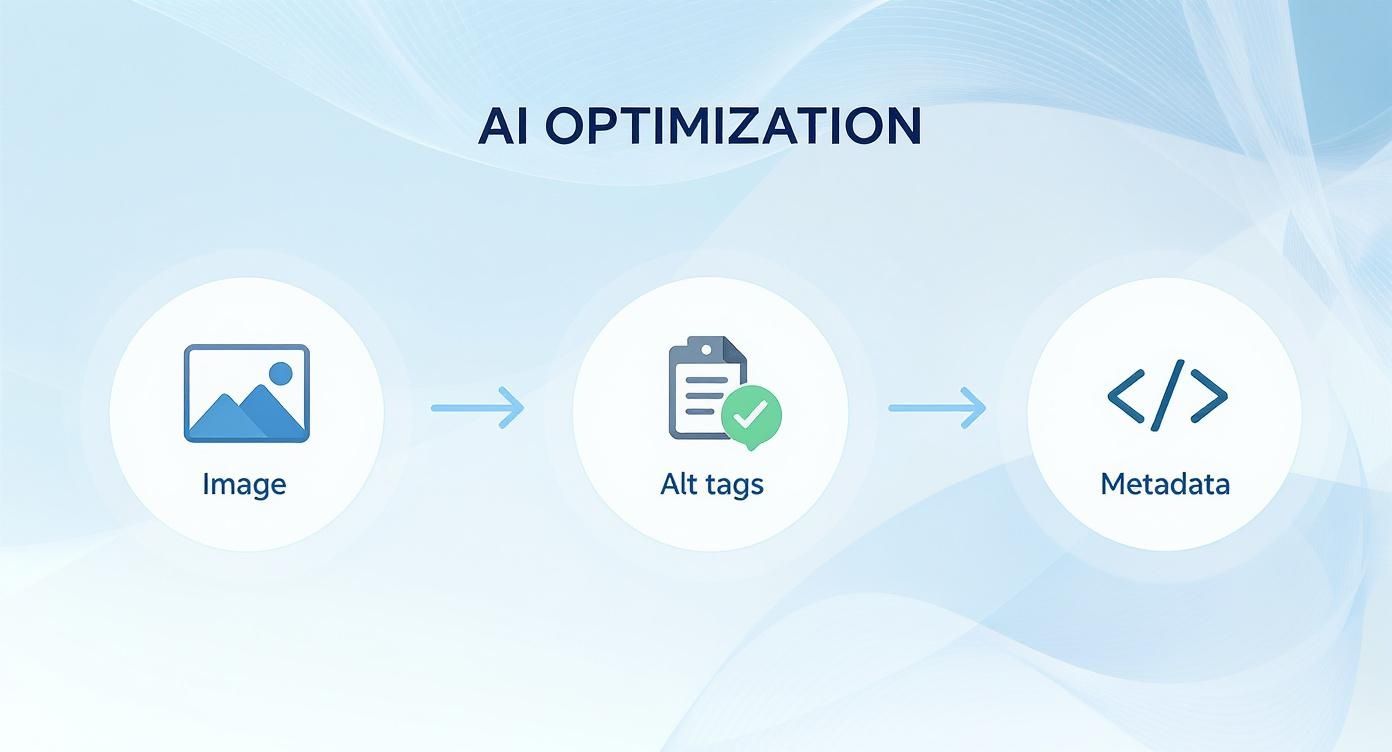
As you can see, it’s a systematic process where AI enriches visual assets with machine-readable data. This isn’t just a box-ticking exercise, it’s a fundamental step for both accessibility and getting your products ready for agentic search.
Integrating Retail Efficiency Tools
To actually build this engine, you need the right retail efficiency tools. These platforms act as the connective tissue, enabling seamless product feed optimisation and automated content deployment. They plug directly into your ecommerce platform, pull in the raw data, enrich it, and then push the optimised content back out in a continuous loop.
This level of automation is really taking off in Australia. We’re seeing over 30% of Australian retail businesses using AI technologies to make their operations more efficient and improve how they connect with customers. With 80% of Australians now preferring to shop online, it’s a trend that’s only getting stronger.
An autonomous engine doesn’t just execute tasks, it learns. By analysing performance metrics, it refines its approach to content generation and optimisation over time, ensuring your SEO strategy evolves with market demands and algorithm changes.
A truly autonomous system can’t operate in a vacuum. To keep it effective, you have to feed it intelligence. That means constantly monitoring the market, a task made much easier by leveraging competitive SEO analysis with Semrush. This ongoing analysis helps the system make smarter decisions about keyword targeting and content tweaks.
If you’re ready to start putting these pieces together, a great next step is to explore how to automate your SEO with search automation. It provides a practical roadmap for building out these advanced workflows.
Measuring Success in an Automated World
Switching to automated retail operations is a huge strategic move, but it’s definitely not a ‘set and forget’ deal. You need a solid way to measure what’s working to justify the investment and keep refining your approach. That means looking past the vanity metrics and focusing on the numbers that actually show the impact of your AI-powered retail transformation.
The real goal here is to draw a straight line from every automated workflow to a real-world business outcome. When you track the right data, you can build a strong case for more investment and create a culture of constant improvement. It’s the only way to know your AI agents for retail efficiency are actually delivering value.
Key Performance Indicators for Retail Automation
To really see the ROI from your new autonomous workflows, you need to track metrics across operational efficiency, digital shelf performance, and the bottom line. This gives you a complete picture of how automation is paying off.
We recommend starting with these:
- Reduction in Content Bottlenecks: How long does it take to get a new product from a supplier feed onto a fully optimised, live product page? A big drop in this number is a direct win for your team’s efficiency and speed to market.
- Improvement in Organic Rankings: Keep an eye on the average search position for your main product categories and individual SKUs. Proper scalable SEO solutions should lift visibility across your whole catalogue, not just a handful of hero products.
- Increase in Conversion Rates: A simple but powerful one. What percentage of visitors end up buying something? Enriched, unique, and well-structured product content has a massive influence on that final click.
- Decrease in Operational Costs: Tally up the hours your team used to spend on manual grunt work like writing product descriptions, alt tag optimisation for retail, and fixing messy supplier data. The savings add up fast.
These are just a few of the top metrics to track for ecommerce success, and they’ll give you a fantastic baseline for measuring your progress.
Fostering a Culture of Continuous Improvement
The data you’re collecting shouldn’t just be filed away in a report. It needs to fuel a constant cycle of optimisation. This is where the magic of human + AI collaboration in SEO really comes alive. Your team can spot performance trends and then guide the AI agents to refine their tactics.
Maybe that means A/B testing different styles of automated product descriptions, or tweaking metadata strategies based on what’s actually driving clicks.
This agile, data-first mindset is becoming the new standard. In Australia, a whopping 70% of small retail businesses are already using AI tools, and another 13% are getting ready to jump in. But here’s the catch: only 53% see AI as essential to their daily operations. That tells us there’s a big gap between just using AI and truly integrating it into the business strategy.
The real advantage isn’t just automating tasks, it’s using AI to learn, adapt, and get smarter. You can read more about how retail businesses are adapting to AI.
The future of retail work isn’t about replacing people, it’s about augmenting their capabilities. By measuring success and continuously refining your autonomous workflows, you empower your team to make smarter, data-driven decisions that propel the business forward in an ever-evolving market.
Frequently Asked Questions About Retail Automation
When you’re thinking about moving from manual updates to more autonomous workflows, a lot of practical questions come up. We get it. Here are some of the most common ones we hear from Australian ecommerce managers, along with our straight-to-the-point answers.
How Quickly Can We See Results from Automation?
This is always the first question, and the answer is: faster than you’d think. While a full-blown transformation takes time, the initial wins can show up in weeks, not years.
The first big impact usually comes from product data enrichment and stamping out supplier content duplication. Our automated workflows can process and rewrite thousands of product descriptions in just a few days. This immediately tackles duplicate content issues hurting your SEO and gives your digital shelf performance a serious lift. You’ll often see organic rankings for long-tail keywords start to climb within the first month as search engines crawl all that fresh, unique content.
What Is the Biggest Misconception About AI Retail Automation?
The most common myth is that automation is just about replacing jobs. That’s not how we see it. It’s about changing the future of work in retail. A successful rollout is always about human + AI collaboration in SEO, where AI takes on the repetitive, high-volume tasks that no human team could ever realistically manage.
Think about it: an AI agent can handle metadata optimisation at scale for 20,000 SKUs, a job that would tie up an entire team for months. This frees your people to focus on what they do best: strategy, creative campaigns, and digging into the performance data the AI serves up. It elevates their roles from data entry to genuine growth drivers.
Is This Only for Large Retailers like Fashion or Electronics Giants?
Not at all. While massive projects in fashion SEO optimisation or electronics SEO optimisation are great examples, the core principles work for retailers of any size. The fundamental challenge, managing a large product catalogue without drowning in manual work, is pretty universal.
Whether you sell pharmacy goods, furniture, or groceries, if you’re pulling in supplier feeds and dealing with a high number of SKUs, you’re facing the same bottlenecks. The good news is that the technology for AI SEO and automated content workflows has become far more accessible. It’s now a practical strategy for any retailer wanting to achieve SEO at scale and operate more efficiently.
The real value isn’t just in handling huge volumes. It’s about bringing a level of consistency and quality to your product content that’s simply impossible to do manually, no matter how big or small your business is.
How Does This Prepare Us for the Future of Search?
Getting these workflows in place is a direct investment in being ready for the agentic commerce future. Search is already moving past simple keywords. It’s becoming conversational, handled by AI agents like Rufus and Perplexity. These AI shopping assistants need highly structured, detailed, and unique product data to make their recommendations.
By focusing on product feed optimisation and creating AI-compatible SEO content today, you’re building the exact kind of high-quality, machine-readable catalogue that these new gatekeepers will prioritise. This is the heart of agentic search optimisation, making sure your brand stays visible as the customer journey continues to shift.
Ready to eliminate content bottlenecks and prepare your retail business for the future of search? Optidan AI builds autonomous workflows that enrich your product data, fix duplicate content, and deliver scalable SEO solutions. Discover how we can optimise thousands of your product pages in days.
