

Brand activation is the art of bringing your brand to life. It’s about creating interactive and engaging experiences that do more than just show customers your logo; they invite them to become part of your story. The goal is to shift people from passively knowing about you to actively engaging with you, building real connection and loyalty along the way.
Understanding Brand Activation In Modern Australian Retail
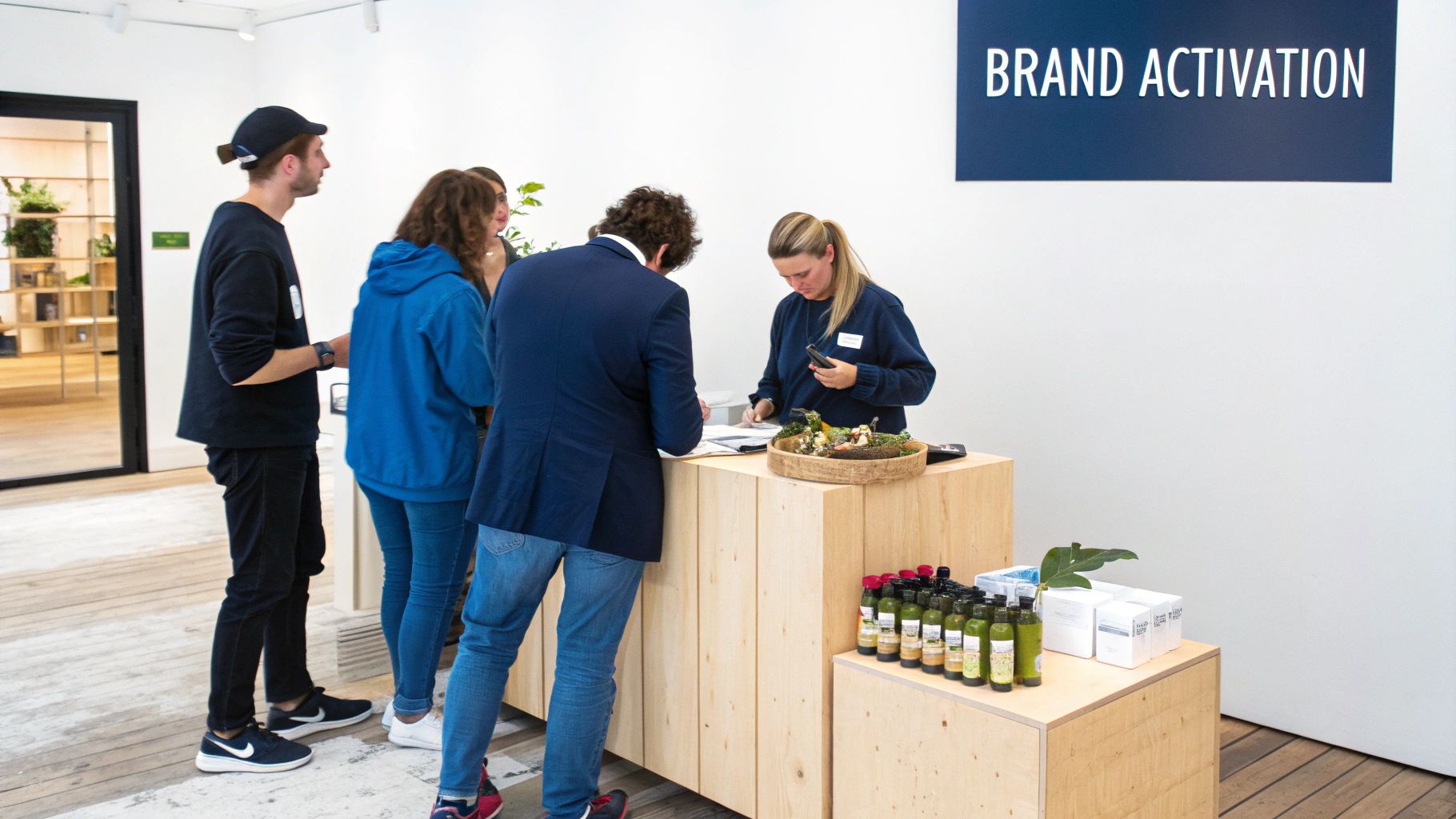
Think of it like this: traditional advertising tells someone about your brand, while activation lets them experience it firsthand. Instead of just broadcasting a message, you’re starting a conversation.
It’s the pop-up fashion store where customers can touch the fabrics, the in-store tech demo that shows off the latest gadget, or the beauty counter sample that creates a small moment of delight. These interactions are designed to forge a genuine emotional connection, a powerful advantage in a crowded market.
For a deeper look at why this matters for growth, this comprehensive guide on customer engagement is a fantastic resource.
The Strategic Value For Retail Leaders
Brand activation isn't just a gimmick; it's a core strategy, especially here in Australia. A landmark study of the ANZ market revealed that three-quarters (75%) of marketers put their biggest budgets into retail and in-store activations. It’s their number one area of investment for a reason.
But for today's ecommerce managers, the real power lies in connecting these physical moments to your digital ecosystem. A great activation is a goldmine of unique content just waiting to be used.
A successful activation is the starting point, not the finish line. It generates authentic, user-centric content that is the perfect fuel for an automated, AI-powered content engine, transforming a one-day event into a long-term digital asset.
From Event To Digital Asset
Every photo, video, and customer testimonial captured at an event is raw material for a sophisticated AI SEO workflow. Imagine using AI image recognition to instantly tag event photos with optimised metadata for your furniture or fashion SEO strategy. This is how you build a powerful branding strategy framework that works seamlessly both online and offline.
This approach directly solves one of retail’s biggest content bottlenecks: duplicated supplier content. Instead of using the same generic copy as everyone else, you’re generating unique, experience-driven descriptions and visuals.
By leveraging product data enrichment at scale, you improve your digital shelf performance and get your brand ready for the future of agentic search. AI agents will prioritise brands with rich, authentic, and well-structured content. This is the leap from old-school manual SEO to next-gen retail content automation.
What Are the Commercial Goals of Brand Activation?
Sure, a memorable experience and a bit of social media buzz are great. But for any retail leader or ecommerce manager, the investment has to translate into measurable results that justify the time and money spent. A successful brand activation is all about delivering tangible commercial outcomes. The goal is to push past passive awareness and get consumers to do something.
These activations aren't just creative flights of fancy. They are sharp, strategic tools designed to drive sales, build real customer relationships, and capture the kind of data that fuels future growth and improved digital shelf performance.
Driving Sales and Building Loyalty
The most obvious commercial goal is to sell more products, right now. Whether it’s an exclusive pop-up shop, an in-store event with a special deal, or a product sampling campaign, the aim is to shorten the path to purchase by giving customers a compelling reason to buy on the spot.
But it’s about more than just one sale. The real prize is long-term loyalty. Experiential campaigns are brilliant at this. The data shows that 91% of consumers are more likely to buy after being part of a brand activation, and a huge 40% go on to develop strong brand loyalty. In a market like Australia, where trust and connection are everything, that’s a powerful statistic. You can find more details in these powerful experiential marketing statistics.
By creating a positive, emotional connection, activations can turn one-time buyers into repeat customers and, even better, passionate brand advocates. That kind of advocacy is pure gold for sustained growth and a stronger digital shelf performance over time.
Capturing Leads and First-Party Data
In an age where data privacy is tightening, brand activations give you a golden opportunity to collect valuable first-party data directly from people who are genuinely interested in what you do. By offering a great experience in return for their details, retailers can build a rich, consent-based database for future marketing.
This helps you hit a few key objectives:
- Generate High-Quality Leads: Activations pull in an engaged crowd, so the leads you get are often far more qualified and receptive to follow-up messages than those from a broad, scattergun campaign.
- Get Direct Customer Feedback: The interactive setting is a natural space to gather honest opinions on your products, services, and how people see your brand.
- Build a Community: These events help you spot your biggest fans. You can then invite them into loyalty programs or exclusive online groups, strengthening that connection even further.
Connecting Physical Actions to Digital ROI
Ultimately, the success of any modern brand activation hangs on how well it’s tied into your digital strategy. The data and content you capture at a physical event aren’t just nice memories; they are critical assets that can feed into an AI-powered retail transformation.
This is where the future of work in retail takes shape. An AI workflow automation for retail can take customer data from your event and use it to personalise email campaigns. The photos and videos can be run through AI image recognition to generate optimised metadata at scale, giving your SKU-level SEO a massive boost, especially for categories like fashion SEO optimisation or furniture SEO services.
This human + AI collaboration turns a one-off event into a sustainable engine for better search visibility, proving a clear and powerful return on your investment.
Proven Brand Activation Tactics For Australian Retailers
Knowing what brand activation is and why it matters is the first step. The real challenge is figuring out which tactics actually connect with Australian shoppers. The best activations aren't just one-off events; they're experiences designed to delight customers and pull them back into your digital world.
Truly successful tactics create those memorable, shareable moments that do two jobs at once. They build real-world connections while spinning off a stream of authentic content that’s gold for your SEO and digital marketing efforts. Let's break down a few of the most powerful approaches for the local retail scene.
Experiential and In-Store Activations
These are all about bringing your brand to life in a physical space. It’s about creating an immersive environment customers can see, touch, and feel. This works especially well for categories like fashion, furniture, and electronics, where getting hands-on with a product is a massive part of the buying decision.
- Pop-Up Shops and Immersive Showrooms: A slick, temporary space can generate a huge amount of buzz. Imagine a fashion label setting up a pop-up atelier or an electronics store building an interactive smart-home experience for a weekend.
- In-Store 'Retail Theatre': This is about turning a piece of your permanent store into an event destination. Think live product demos, styling workshops, or hosting guest speakers. It adds value far beyond just a simple transaction.
- Product Sampling and Demos: The classic "try before you buy" approach is still incredibly powerful. But give it a twist. A grocery retailer could create a bespoke tasting bar, making a simple sample feel like a premium experience that people will want to talk about.
These physical events are the foundation of a modern retail content strategy. Every photo, video, and customer interaction is prime material for product data enrichment. It lets you swap out generic supplier content for unique, compelling assets that make your digital shelf stand out.
The goal of any in-person activation is to create an experience so good that your customers become your content creators. Every shared photo and Instagram story is a digital endorsement that feeds directly back into your online visibility and SEO at scale.
Digital-First and Hybrid Activations
Not every activation needs four walls and a roof. Digital tactics can hit a much wider audience and are crucial for connecting the dots between your offline events and online sales. These approaches are also key to getting your brand ready for the future of agentic commerce, where AI agents will rely on a rich tapestry of digital signals to recommend products.
- Influencer Collaborations and Takeovers: Partnering with the right Australian influencers introduces your brand to a ready-made, engaged audience. Better yet, get them to host an in-store event to create a powerful hybrid experience that bridges online and offline.
- Branded Augmented Reality (AR) Filters: For beauty, cosmetics, and fashion brands, AR filters on Instagram or TikTok are a game-changer. They let users "try on" products virtually, creating a low-cost, massively scalable activation that churns out user-generated content.
- Interactive Contests and Gamification: Running a contest that encourages people to create and share content with your products is a brilliant way to drive engagement. It builds a sense of community and leaves you with a library of authentic visuals for your marketing.
These digital-first tactics are vital for building a strong content ecosystem. For any retailer serious about SEO, having a clear strategy is non-negotiable. You can see a variety of great branding guide examples that show how powerful digital assets support this goal. The content you generate can be fed through AI image recognition tools to pull out valuable metadata, optimising your entire product catalogue for both today’s search engines and the future of retail search. This is how you turn a simple social media campaign into a powerful engine for SKU-level SEO.
Connecting Physical Events to Digital Ecosystems
The real magic of brand activation in modern retail isn't just about the event itself, it's about what happens next. A great activation is no longer a moment in time; it's the start of a powerful content engine that fuels your entire digital presence. This is where we move past clumsy manual follow-ups and siloed campaigns into an integrated, AI-powered workflow.
Imagine capturing every bit of content from your in-store event, from candid photos to direct customer feedback. Instead of that goldmine sitting on a hard drive, it's instantly fed into an AI SEO workflow. This system acts as a bridge, turning the energy of a physical experience into a durable digital asset that drives long-term value.
This process shows how different activation points, from pop-ups to in-store events, can all feed into one unified digital strategy.
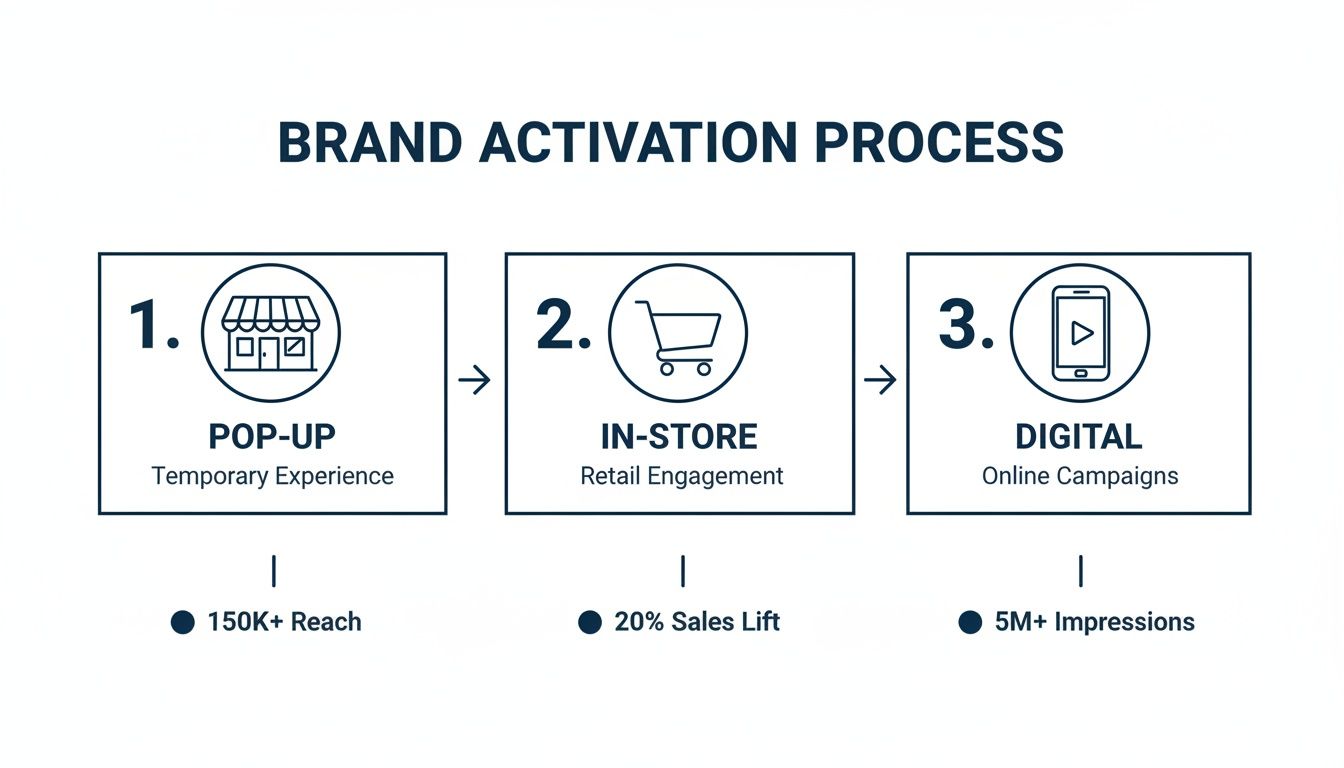
The key takeaway? Every physical touchpoint generates unique data and content. When amplified and optimised through digital channels, its impact multiplies.
From Manual Effort To Automated Excellence
For too long, the post-event process has been a major retail content bottleneck. Teams would manually sift through photos, struggle to write follow-up emails, and watch the rich insights from customer interactions fade away. That old-school approach is slow, inefficient, and simply can't operate at the scale needed for large product catalogues.
The shift to AI-powered content workflows changes the game. It's about letting human creativity direct automated execution. Think about the difference between a team spending weeks trying to update a handful of product pages versus optimising tens of thousands in just a few days.
This isn't just theory. It's a fundamental change in how retail teams operate, moving from reactive tasks to proactive strategy. Understanding the full journey from initial awareness to final purchase is key, and you can learn more about how this works within a complete digital marketing funnel.
This table breaks down the shift from the slow, traditional process to a modern, automated workflow that gets the most out of every activation.
From Manual Follow-Up To An AI-Powered Activation Workflow
| Stage | Traditional Manual Approach | AI-Powered Automated Workflow |
|---|---|---|
| Content Capture | Photos and notes stored on local drives, often forgotten. | All assets uploaded to a central system, tagged automatically by AI agents. |
| Content Creation | A single person writes a blog post or social update weeks later. | AI generates dozens of content variations (descriptions, social posts, ads) in minutes. |
| SEO Optimisation | Manually adding alt tags and keywords to a few selected images. | AI analyses all content, optimises metadata, and fixes duplication issues at scale. |
| Performance Tracking | Basic metrics like social engagement or email opens, disconnected from sales. | Integrated tracking from activation to purchase, measuring direct ROI. |
The contrast is stark. Automation doesn't just make things faster; it connects dots that were previously impossible to see, proving the real value of your marketing spend.
AI Image Recognition And Metadata Optimisation
Let's take a fashion SEO scenario. At a pop-up event, you capture hundreds of photos of customers trying on a new clothing line. In a traditional workflow, these images might get used in a single social media post and then disappear.
With an automated system, AI image recognition instantly analyses each photo. It can identify the product (e.g., "blue denim jacket"), its key attributes ("distressed," "oversized fit"), the setting ("urban"), and even gauge the customer's sentiment from their expression.
This data is then used for:
- Alt Tag Optimisation for Retail: Automatically generating descriptive, keyword-rich alt tags for every single image, boosting your visibility in image searches.
- Product Image Tagging: Creating detailed, structured tags that massively improve your on-site search and navigation.
- Metadata Optimisation at Scale: Applying consistent, optimised metadata across your entire product catalogue, ensuring every image is working hard for your SEO.
This automated process ensures that the content from your activation directly improves your digital shelf performance without anyone having to lift a finger.
Generating Unique Content and Fixing Duplication Issues
One of the most persistent challenges in ecommerce is supplier content duplication. Using the same generic product descriptions as hundreds of other retailers is an SEO death sentence. Brand activations are the perfect antidote.
By capturing real customer language, questions, and feedback during an event, you gather the authentic voice of your audience. Generative AI can then use these insights to craft unique, SEO-friendly product descriptions that resonate with shoppers and search engines alike.
This turns customer interactions into a scalable solution for fixing duplicate content. It enriches your product data with unique, experience-driven stories that help you stand out. This isn't just about avoiding penalties; it's about building a unique brand voice and getting your catalogue ready for the future of agentic search. AI agents like Google’s AI Overviews and Amazon Rufus will prioritise brands with rich, detailed, and non-duplicated content, making this workflow a strategic necessity for agentic search optimisation.
Measuring The True ROI Of Your Brand Activations

So, how do you actually prove your brand activation worked? For retail leaders, the answer has to go way beyond fuzzy metrics like social media likes or how many people showed up. The real test is drawing a straight, data-backed line from that cool interactive experience to real, tangible business growth.
Measuring the true return on investment means digging into the key performance indicators (KPIs) that actually hit your bottom line. This isn’t easy. It requires mapping the entire customer journey, from their first encounter at a pop-up store all the way to their final online purchase. The goal is to connect offline engagement to online revenue with total clarity.
Key Metrics Beyond The Vanity Numbers
To justify the budget and prove your activation was worth it, ecommerce managers have to track metrics that show genuine commercial impact. The first step is to shift your focus from simple reach to meaningful engagement. That’s when you start to really understand what brand activation is all about from a performance standpoint.
These KPIs give a much clearer picture of what success looks like:
- Sales Lift: Did sales for the promoted products go up, both in-store and online, during and right after the activation? This is your most direct measure of success.
- Lead Quality: Forget just counting leads; how good were they? Track the conversion rate of leads from the activation and see how they stack up against your other channels.
- User-Generated Content (UGC) Volume: How much authentic content did people create and share? A high volume of UGC is gold, it gives you powerful social proof and a stack of assets for future marketing.
- Customer Sentiment: What were people actually saying? Dive into social media mentions, survey feedback, and direct comments to get a real feel for how the activation shifted brand perception.
Tracking The Offline-To-Online Customer Journey
Connecting a physical event to a digital sale used to be the holy grail of marketing measurement, mostly filled with guesswork. Not anymore. With the right tech and a bit of smart planning, you can create a clear, trackable path.
Think about it. You could use unique QR codes at an event that send people to a specific landing page with an exclusive offer. By tracking the traffic and sales from that one page, you can directly attribute online revenue to your in-person activation. Simple. Or, collect email addresses for a prize draw, then monitor that group's buying behaviour over the next few months.
The most powerful ROI calculations come from a closed-loop system where every touchpoint is tracked. This is where AI-powered analytics tools really shine, delivering deep, actionable insights that connect every dollar you spend to a measurable result.
These automated systems cut out the manual grind and give you a complete picture of campaign performance, showing you exactly which activities are driving the needle.
Leveraging AI for Deeper ROI Insights
Today’s retail environment demands more than just basic analytics. AI-powered content workflows can crunch enormous amounts of data, uncovering patterns and proving ROI in ways that just weren't possible before. It's the key to moving from old-school manual SEO to a smarter, AI-driven strategy.
Look at what AI tools can bring to the table:
- Sentiment Analysis at Scale: AI can scan thousands of social media posts and reviews about your activation in real time, giving you an accurate measure of public feeling without lifting a finger.
- Attribution Modelling: Sophisticated AI models can analyse countless customer touchpoints to figure out which parts of your activation had the biggest impact on the final sale.
- Predictive Analytics: By learning from past activations, AI can help forecast the potential ROI of future campaigns. This lets you allocate your budget with a whole lot more confidence.
This level of insight proves the direct line between your activations and your digital shelf performance. For retailers trying to get ahead, understanding the real driver of AI ROI is essential for justifying tech investments and carving out a competitive edge in a tough market.
Future-Proofing Your Brand For Agentic Search
Brand activation is quickly moving from a clever marketing tactic to an absolute necessity for survival. The reason is simple: the rise of agentic search. The way people find products is changing. It's no longer about a human typing keywords into a search bar; it's about AI agents doing the heavy lifting for them.
AI assistants like ChatGPT, Perplexity, and Amazon's Rufus are becoming personal shopping concierges. They will sift through all the digital noise to find and recommend the best products for their users. And their decisions won’t be based on old-school keyword stuffing. They'll be based on rich, authentic, and structured data that proves a product’s real-world value.
Feeding the AI Agents of Tomorrow
So, what kind of information will these AI agents be looking for? They need signals that point to genuine customer experience and product quality.
- Real-world images and videos from your activations showing products being used.
- Authentic testimonials and reviews captured directly from engaged customers.
- Detailed product attributes pulled from real-world interactions, not just a generic supplier feed.
- Unique, descriptive content that answers subtle questions about a product's feel, fit, or function.
This is exactly the kind of content a well-run brand activation produces. Every photo, every quote, and every piece of customer feedback becomes a vital data point, a proof of quality that AI agents can trust. When you capture this content and structure it through product data enrichment, you’re building the foundation your brand needs for the age of agentic commerce. To get ahead, understanding the principles of Generative Engine Optimisation (GEO) is no longer optional.
In the agentic commerce future, the brands that offer the richest, most authentic, and best-structured data will win. Your brand activations are the primary source for this data, turning fleeting moments of customer engagement into a lasting competitive advantage.
From Manual SEO to Agentic Search Readiness
This marks a massive shift from traditional SEO to what we can call AI SEO. Your competitors still manually optimising pages one by one will be left in the dust. The future belongs to retailers who build an automated content workflow that turns real-world experiences into AI-compatible content at scale. Our detailed guide explains the critical steps for preparing your product catalogue for agentic search.
By connecting your brand activation strategy with an AI-powered content engine, you solve several problems at once. You eliminate duplicated supplier content, enrich your product data with unique insights, and use AI image recognition to tag visual assets with valuable metadata. This human-AI collaboration doesn't just improve your current digital shelf performance; it ensures your brand is found, understood, and recommended in the new era of AI-driven shopping.
Common Questions About Brand Activation
Got questions? You're not alone. Here are the straight answers to the questions I hear most often from retail leaders and eCommerce managers trying to get their heads around brand activation.
How Is Brand Activation Different From Traditional Advertising?
Think of it this way: traditional advertising is a monologue, while brand activation is a dialogue.
Advertising broadcasts a message at a wide audience, it’s one-way communication. Brand activation, on the other hand, is a two-way street. It’s about creating an interactive experience that invites people to participate, creating a genuine connection with your brand. It’s the difference between showing someone a photo of a delicious cake (advertising) and inviting them into the kitchen to help you bake it (activation). One tells, the other engages.
What Is a Common Mistake to Avoid In Brand Activation?
The biggest mistake I see is treating an activation like a one-off party. A successful activation isn't an isolated event; it has to be deeply integrated into your wider digital strategy, specifically to drive your digital shelf performance.
When you fail to capture content, gather data, and map out a post-event digital journey, you're leaving most of the value on the table. The real goal is to turn a one-day event into months of powerful marketing assets that can feed your retail content automation workflows.
An activation's true value isn't just the event itself, but the unique, AI-compatible content it generates. This content is essential for agentic search optimisation, future-proofing your brand against competitors who are still stuck in manual SEO.
How Can Small Retailers Execute Activations On a Limited Budget?
You don't need a stadium-sized budget to make a real impact. For smaller retailers, the key is to swap big spending for big creativity and genuine community engagement.
Focus on creating a memorable, shareable experience that fuels your digital ecosystem. You could host a targeted in-store workshop for your most loyal customers or team up with a local influencer for a meet-and-greet. Even a clever social media contest that encourages user-generated content can be a goldmine, giving you a steady stream of authentic material for product data enrichment and helping you fix messy supplier content duplication issues at scale.
Transform your retail content strategy from manual and slow to automated and scalable. Optidan AI empowers your team to enrich supplier data, fix duplication issues, and create thousands of SEO-optimised product pages in days, not months. Discover how our AI-powered workflows can boost your digital shelf performance by visiting https://optidan.com.
