

Exceptional copy for websites is no longer about clever wording. For Australian retailers, it�s about creating structured, machine-readable content that performs at scale. This means leaving manual, page-by-page writing behind and embracing an automated, data-driven system built for the future of agentic commerce. It's a strategic shift from manual SEO to AI SEO, essential for boosting your digital shelf performance and keeping ahead of the competition.
Moving Beyond Manual Copywriting in Retail
For ambitious Australian retailers, the days of writing copy one product at a time are numbered. The market is demanding a fundamental change, moving away from slow, manual processes toward scalable, AI-powered content workflows. This is not just about working faster; it's a necessary evolution to meet the demands of a new search era driven by AI agents.
The rise of AI SEO and the dawn of agentic search are completely changing how customers find products. AI shopping agents like Rufus and Perplexity do not just skim your marketing fluff, they parse structured data to find the best possible options. This means your website copy has to be optimised not only for humans but for these intelligent systems, a core principle of Agentic Search Optimisation.
The Problem with Traditional Retail Content
The old way of doing things creates massive content bottlenecks in retail. A single copywriter, no matter how talented, simply cannot manually optimise a catalogue of 10,000+ SKUs. This leads to common problems that directly hurt your digital shelf performance:
- Supplier Content Duplication: Using generic supplier descriptions results in duplicate content penalties from search engines, which chips away at your site's authority.
- Inconsistent Brand Voice: Manual writing often leads to a disjointed brand message across different product pages and categories.
- Slow Speed to Market: Launching new product lines or updating existing ones becomes a painfully slow process, costing you valuable sales opportunities.
The real challenge for modern retailers is achieving both quality and scale. An AI-powered content workflow allows you to fix duplicated supplier content, enrich your product data, and deploy thousands of optimised pages in days, not months. This is what retail efficiency tools and AI workflow automation are all about.
The chart below shows the direct impact that well-optimised, unique copy can have on key ecommerce metrics.
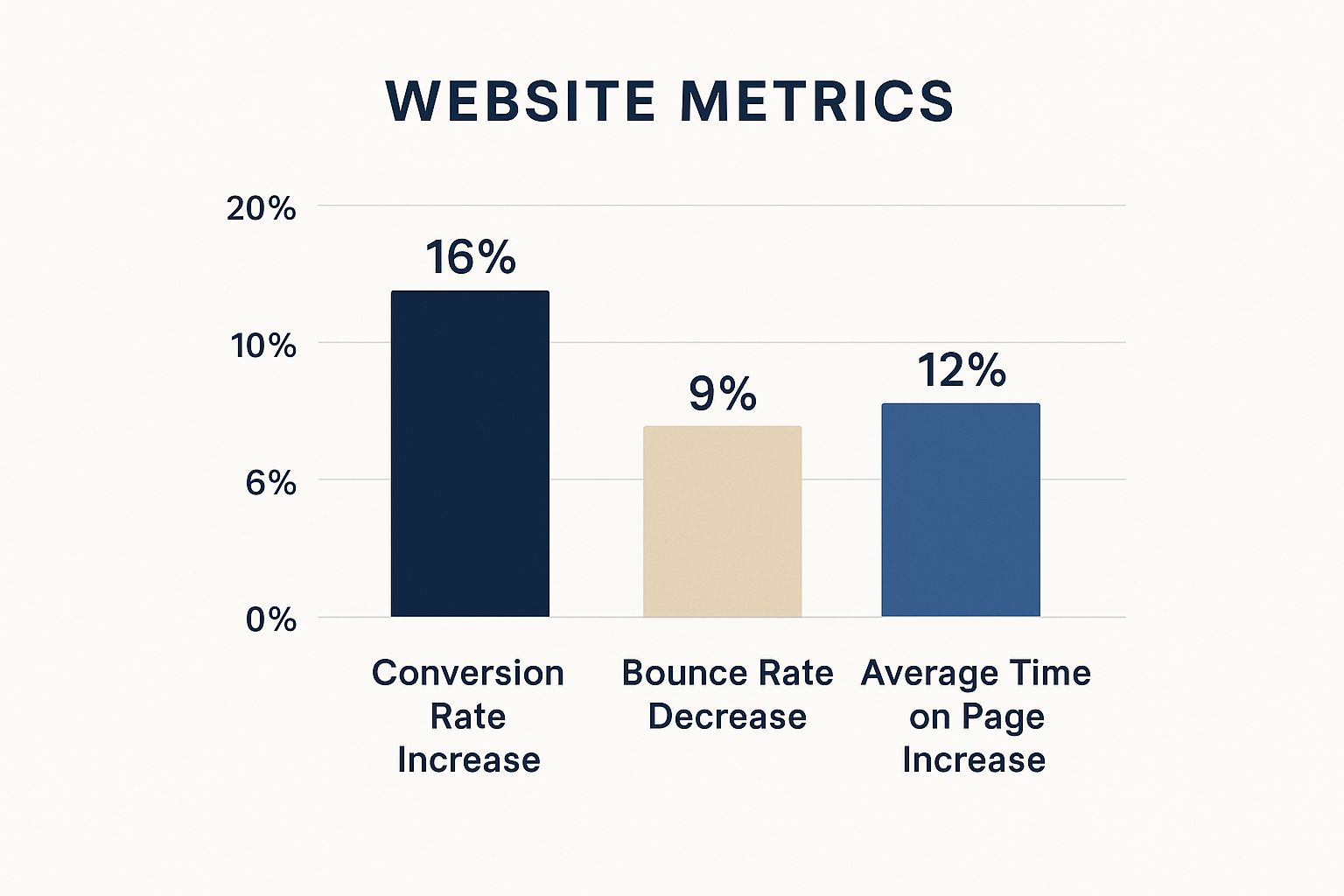
As the data shows, improving your website copy directly correlates with better user engagement and higher conversions. This level of impact highlights why Australian businesses are projected to spend about 1.5 billion Australian dollars on SEO services in 2025. This investment shows just how critical AI-powered content workflows are becoming in any digital strategy.
Manual vs AI-Powered Copy Workflows for Retail
The contrast between traditional and modern content strategies is stark. The table below breaks down the real-world differences in efficiency, scale, and strategic focus for retailers.
| Metric | Traditional Manual Copy | AI-Powered Content Workflow |
|---|---|---|
| Speed to Market | Weeks or months per product line | Days for thousands of SKUs |
| Content Quality | Inconsistent, prone to human error | Consistent brand voice, high accuracy |
| Scalability | Limited to copywriter's capacity | Nearly unlimited, handles large catalogues |
| Data Enrichment | Manual and time-consuming | Automated product data enrichment with key attributes |
| SEO Impact | Risk of duplicate content penalties | Unique content boosts authority and rank |
| Strategic Focus | Reactive, focused on individual pages | Proactive, focused on sitewide performance |
Adopting an AI-powered workflow is not just about producing more content faster. It's about shifting your team's focus from tedious manual tasks to high-value strategic initiatives that drive real growth and enhance retail efficiency.
This shift represents the future of work in retail, where human and AI collaboration drives unprecedented growth. For those looking to get ahead, it's crucial to understand how to begin streamlining content workflows for efficiency.
Turning Supplier Feeds into Conversion Assets
That raw supplier feed you�re using is a starting point, not the finish line.
For too many Australian retailers, this feed is just a jumble of generic descriptions, thin technical data, and content that�s already plastered across dozens of other websites. Relying on it is a fast track to poor search visibility and a bland brand voice, a major bottleneck holding back your growth.
Transforming this raw data is where effective copy for websites begins, especially when you�re dealing with thousands of products. The goal is not just to rewrite a few lines. It�s a strategic process of product data enrichment, where you layer on valuable attributes, customer-focused benefits, and the detailed specs that both shoppers and AI agents need to make a decision.

From Basic Data to Rich Product Narratives
Smart product feed optimisation is all about turning a boring list of features into a compelling reason to buy. Think of it as the difference between a product page that just says "cotton" and one that describes "breathable, organic cotton for all-day comfort." This is the kind of structured, detailed content that AI shopping agents crave for agentic search optimisation.
Let's take fashion SEO optimisation as an example. A basic feed might just list �blue dress�. An enriched feed tells the whole story, giving customers the details that actually drive sales and boost rankings:
- Style: A-line silhouette, midi length, puff sleeves
- Material Details: 100% GOTS-certified organic cotton poplin
- Occasion: Perfect for weekend brunch or casual office wear
- Fit: Relaxed fit with an adjustable waist tie for a customisable shape
This level of detail does not just help your customers; it makes your products far more discoverable for those specific, long-tail searches that convert. It�s a non-negotiable part of building a high-performing digital shelf.
Automating Enrichment with AI Image Recognition
Let's be realistic, manually tagging thousands of products is an impossible task for any lean retail team. This is where AI-powered content workflows and retail content automation come into play. Modern AI image recognition SEO tools can analyse your product photos and automatically generate descriptive tags to enrich your data at scale.
A furniture retailer, for example, could use this tech to instantly identify and tag attributes like 'mid-century modern design', 'solid Tasmanian oak construction', or 'velvet upholstery'. This automated process completely solves the supplier content duplication problem by creating a unique, structured data foundation for every single SKU in your catalogue.
This is not just about saving hundreds of hours. It�s about creating AI-compatible SEO content that positions your brand for the future of retail search. As you start building out these automated content workflows, getting a handle on managing all this data is critical. For a deeper dive, our guide on how to optimise and scale your product feed management is a great place to start. It�s the first real step in moving away from manual SEO and toward an efficient, AI-driven strategy that actually delivers results.
Writing Product Descriptions That Rank and Convert
Once your product data is clean and structured, it's time to get down to the real work: writing the compelling copy for websites that actually drives rankings and revenue. This is where all that data prep pays off, giving you the raw materials for persuasive, benefit-led descriptions that connect with Australian shoppers and give AI agents exactly what they need.
This is the step where you move beyond just listing features. A truly great product description closes the gap between a product's technical specs and a customer's real-world problems. It�s the difference between saying �lithium-ion battery� and explaining you can �enjoy up to 12 hours of uninterrupted listening on your commute�.

Blending Persuasion with SEO at Scale
Writing effective copy is a balancing act. You need the persuasive flair that nudges a customer toward purchase, but it has to be woven together with the keyword-rich details essential for strong digital shelf performance. This dual focus ensures your pages get found in search and are compelling enough to convert visitors once they land.
The demand for quality content is booming. The Australian content writing services market has shot up to a revenue base of around 186 million Australian dollars, all driven by the need for copy that boosts both engagement and sales.
But here�s the problem: executing this at scale is a massive challenge. Manually creating unique, optimised descriptions for thousands of SKUs is a huge bottleneck for retailers. This is where AI workflow automation becomes a genuine game-changer, letting you generate distinct copy for your entire catalogue. For a deeper dive into this, you can learn how to craft product descriptions that truly sell.
The Human-Led AI Quality Assurance Process
Automated workflows are powerful, but they are absolutely not a "set and forget" solution. The final, most crucial step is a human-led AI content QA process. This ensures every piece of copy the AI agent generates is on-brand, accurate, and actually connects with your audience. It's the perfect example of human + AI collaboration in SEO.
Our quality assurance framework is built to verify a few key things before any content goes live:
- Brand Voice Alignment: Does the tone sound like us?
- Factual Accuracy: Are all the specs, dimensions, and materials correct?
- Persuasive Flow: Does the copy actually highlight the customer benefits?
- SEO Integration: Are target keywords included naturally, without sounding forced?
This human oversight is what turns a good AI output into great website copy. It guarantees that your scalable SEO solutions don�t just pump out content, but produce content that performs, preventing the brand damage that comes from robotic-sounding or inaccurate descriptions.
By putting this QA process in place, you get the speed of AI combined with the strategic nuance of your expert retail team. It�s how you finally solve supplier content duplication for good and build a unique, authoritative voice in the market.
Optimising Your Metadata and Images for AI Agents
Great website copy is not just about the words your customers read on the page. In the era of agentic commerce, some of the most important content is completely invisible to the human eye but absolutely critical for AI agents.
This includes your metadata, like title tags and meta descriptions, and image data, specifically alt tags. These elements provide the structured information that AI shopping assistants need to understand, categorise, and ultimately rank your products.
For retailers managing thousands of SKUs, manually optimising every piece of metadata is a non-starter. This is where retail content automation delivers a massive advantage. Using an AI-powered workflow, you can generate unique, SEO-friendly title tags and meta descriptions for your entire catalogue in a matter of days, not years. This process primes every single product page for both traditional search engines and the coming wave of generative AI SEO.
Preparing Images for the Future of Retail Search
Images are a huge part of the customer journey, particularly in visual-heavy sectors like fashion and furniture. And yet, so many retailers completely overlook image SEO for ecommerce, leaving a goldmine of data untapped.
Preparing your visual assets for AI agents means going beyond basic accessibility and focusing on descriptive, highly accurate alt tags.
This is where AI image recognition SEO becomes a game-changer. An automated system can analyse your product images and generate detailed, relevant tags at scale, turning a simple image file into a rich, machine-readable data point.
- For a fashion retailer: It could automatically tag attributes like �V-neckline�, �floral print�, or �linen blend fabric�.
- For an electronics store: It might identify and tag features like a �USB-C charging port� or a �matte black finish�.
- For a furniture business: It can specify details such as �solid oak construction� or �mid-century modern design�.
This level of detail is exactly what AI agents are looking for when they match products to complex user queries. It's a fundamental part of getting ready for the future of retail, freeing up your team to focus on high-level strategy while automated workflows handle the granular, time-consuming details.
Properly tagged images do more than just improve search visibility. They provide crucial, structured data that directly feeds AI shopping agents, influencing your ranking and performance on the digital shelf of tomorrow. This is SKU-level SEO at its most effective.
Take a look at this simple HTML snippet. It shows how a descriptive alt tag provides vital context for both search engines and visually impaired users.

The alt attribute here clearly describes the image, making it machine-readable and incredibly valuable for an AI agent trying to understand the page. This kind of automated product data enrichment is a core part of future-proofing your ecommerce strategy. For a deeper dive, you can explore how the Shopify Catalog API can be leveraged by AI agents to access this exact type of structured data.
Building Your AI Content Workflow for Efficiency
Moving from theory to practice is where Australian retailers find their real competitive edge. An effective AI-powered content workflow is the engine that drives scalable SEO, turning a slow, manual process into a high-speed production line for quality copy for websites.
This is not about replacing your team. It�s about empowering them to break free from content bottlenecks and focus on the high-level strategy that actually moves the needle.
The old way of doing things, where a marketing team manually writes, edits, and optimises product pages one by one, is fundamentally broken for modern retail. It's painfully slow, incredibly expensive, and simply can't keep up with large catalogues or frequent product updates.
From Data Integration to Automated Copy Generation
The first step in building an efficient workflow is integrating your enriched product data feed. This clean, structured data becomes the �single source of truth� for the AI, giving it the raw materials it needs to generate unique, accurate, and on-brand copy.
Once that feed is connected, the process kicks into gear:
- Template Creation: Your team sets the rules, defining the structure, tone of voice, and key messages for different product categories.
- AI-Powered Generation: The system takes the enriched data and templates to create thousands of unique product descriptions, title tags, and meta descriptions in minutes.
- Initial Review: AI agents perform a first-pass quality check, flagging any potential errors or inconsistencies before a human even sees them.
- Human-Led QA: Your team steps in for the final strategic review, ensuring everything is perfectly aligned with the brand and persuasively written before it goes live.
This blend of automation and human oversight is the heart of human + AI collaboration in SEO. It's not one or the other; it's both working together.
Empowering Your Team with Retail Efficiency Tools
Adopting this model completely changes the game for your retail content team. Instead of getting bogged down in the weeds of manual writing, their roles evolve to become far more strategic. They become the architects and guardians of the brand voice, overseeing an AI-powered system that handles all the heavy lifting.
This is a critical part of the future of work in retail. A skilled copywriter�s value is not diminished; it's amplified. In Australia, the salary difference between a senior copywriter earning around 100,000 Australian dollars annually and a junior at $45,000 says it all. The market values strategic expertise, not just manual output.
This shift allows your best talent to focus on conversion rate optimisation, campaign strategy, and market positioning. Meanwhile, AI agents for retail efficiency manage the scalable production of SEO content. It's how leading retailers are preparing for agentic commerce.
This approach completely eliminates the content creation delays that hold back so many businesses. You can see a real-world example of this in action and learn how Optidan AI transformed content workflows from months to minutes. This is not the future, it's the new standard for achieving SEO at scale.
Answering the Tough Questions About AI Website Copy
As Australian retailers start looking at AI to handle their website copy, a few practical questions always come up. Moving from the old manual way of doing things to an AI-assisted approach is a big step, so let's clear the air on some of the most common concerns.
Will AI Make My Brand Sound Robotic?
This is the number one worry we hear, and it�s a fair one. The short answer is no, not if you do it right.
A smart AI content workflow is not a "set it and forget it" machine. It�s a powerful tool that�s still guided by your team. Think of it less like a robot writer and more like a highly efficient assistant who never gets tired.
Your experts are still in the driver's seat. They define the brand voice, set the style guides, and map out the strategy. The AI then works within those boundaries to execute at speed. The final copy always gets a human review to ensure it sounds exactly like your brand, giving you the best of both worlds: the speed of automation and the touch of human creativity.
How Does AI Handle Unique Product Details at Scale?
This is where the magic really happens, and it all comes down to the quality of your data. The AI is only as good as the information you give it, which is why product data enrichment is so critical.
We start by taking your basic supplier feed, which is often messy and generic, and turning it into a detailed, structured dataset. This means adding specific attributes, materials, dimensions, and the actual benefits a customer cares about for every single product.
Often, we even use AI image recognition to automatically pull out visual details. It can spot a 'mahogany finish' on a table or a 'v-neckline' on a dress, adding rich, specific details that make each description unique. This enriched data gives the AI agent the raw materials it needs to avoid supplier content duplication and write something compelling for every item.
Feed the AI a foundation of rich, unique data, and it will generate equally unique and detailed copy. You move from generic, copy-pasted text to specific, conversion-focused stories for every product in your catalogue.
Is It Expensive to Implement an AI Content Workflow?
While there's an upfront investment to get the technology and processes in place, the real question is: what�s the cost of not doing it?
Think about the time and money spent on manually writing, editing, and optimising thousands of product pages. It�s a massive content bottleneck that slows everything down.
An automated content workflow shatters those bottlenecks and slashes the associated labour costs. It allows you to achieve SEO at a scale that's impossible for a human team to match. This means getting products to market faster, improving your digital shelf performance, and ultimately, driving more revenue. It�s not an expense; it�s a strategic investment in efficiency and growth.
Ready to eliminate content bottlenecks and get your entire catalogue optimised at scale? Optidan AI helps retailers create thousands of unique, SEO-ready product pages in days, not months. See the future of retail content automation and book your demo.
