


For Australian retail leaders, digital marketing campaigns are no longer just about driving website traffic. They have become sophisticated, multi-channel operations designed to carve out market share in a brutally competitive space. The old playbook is dead and gone, replaced by a new reality where efficiency, scale, and AI-powered intelligence are the difference between success and failure.
The New Reality of Retail Digital Marketing
The shift from slow, manual marketing tasks to automated, intelligent workflows is not just an advantage anymore, it is essential for survival.
Think about an ecommerce manager juggling thousands of SKUs. The old methods of creating content and managing campaigns are crippling bottlenecks. The future of retail marketing depends on adopting solutions that can keep up with the speed and complexity of the modern market. It is time to move beyond the basics and embrace a much more dynamic approach.
This evolution is plain to see in the market’s explosive growth. The Australian digital marketing sector was valued at around USD $13.03 billion in 2024 and is expected to nearly double to USD $25.39 billion by 2034. It is telling that SEO is the fastest-growing channel, which signals a massive investment in organic search as a core part of any serious campaign.
Core Pillars of Modern Retail Campaigns
To win today, digital marketing campaigns need to be built on a few key principles that tackle the unique challenges of Australian retail head-on:
- From Manual SEO to AI SEO: This is the leap from one-off optimisations to continuous, AI-powered content workflows. It is the only practical way to manage huge product catalogues and get ready for the future of retail search.
- Retail Content Automation: Automating product descriptions and metadata is not a luxury, it is a necessity. It is about correcting duplicated supplier content at scale to dodge SEO penalties and build a unique brand voice across every single product page.
- Optimised at Scale: Success looks like optimising 10,000+ pages in days, not months. This kind of speed boosts your digital shelf performance, improves search visibility, and gets your products in front of customers faster.
- Preparing for Agentic Commerce: The rise of AI shopping agents like ChatGPT and Rufus demands a whole new level of content quality. AI-compatible SEO, built on rich product data, makes sure your products are actually seen by these new gatekeepers.
This strategic pivot is about more than just technology, it is about building a marketing foundation that can withstand anything. By embracing AI-driven content strategies, retailers can transform their operational efficiency and gain a decisive competitive advantage.
To really grasp this shift, it helps to understand the core advantages of modern digital strategies, like the 8 Unmissable Benefits of Digital Marketing. Leaning into these next-gen SEO tactics is crucial for any retailer aiming to dominate their category, whether it is fashion, furniture, or electronics.
This guide will walk you through how to build and execute these campaigns, turning potential headaches into powerful opportunities for growth.
Building Your Foundation with AI Product Data Enrichment
Every powerful digital marketing campaign starts with a solid foundation. It is not about clever ads or flashy promotions, it is about exceptional product data. For Australian retailers juggling thousands of products, that foundation is often shaky, built on inconsistent and incomplete supplier feeds.
This is where Product Data Enrichment becomes the most critical first step.
Think of it like a chef transforming basic, raw ingredients into a gourmet dish. AI workflow automation takes messy supplier data, cleans it, standardises it, and enhances it with the rich details customers and search engines crave. This process shifts you from a slow, manual grind to an efficient, automated system that can handle entire catalogues at speed.
The result? An immediate uplift in your Digital Shelf Performance. When your product data is complete and accurate, your products rank higher in search, appear in more relevant filtered results, and give customers the confidence to buy.
From Raw Feeds to Retail-Ready Content
Getting from a basic supplier CSV to a fully optimised product page is a journey. It is a structured process that turns chaos into a strategic asset, and AI agents for retail efficiency are key to making this possible at scale. They can handle tasks that would take a human team months to complete.
This infographic shows how quality data enables the foundational process of understanding your customer.
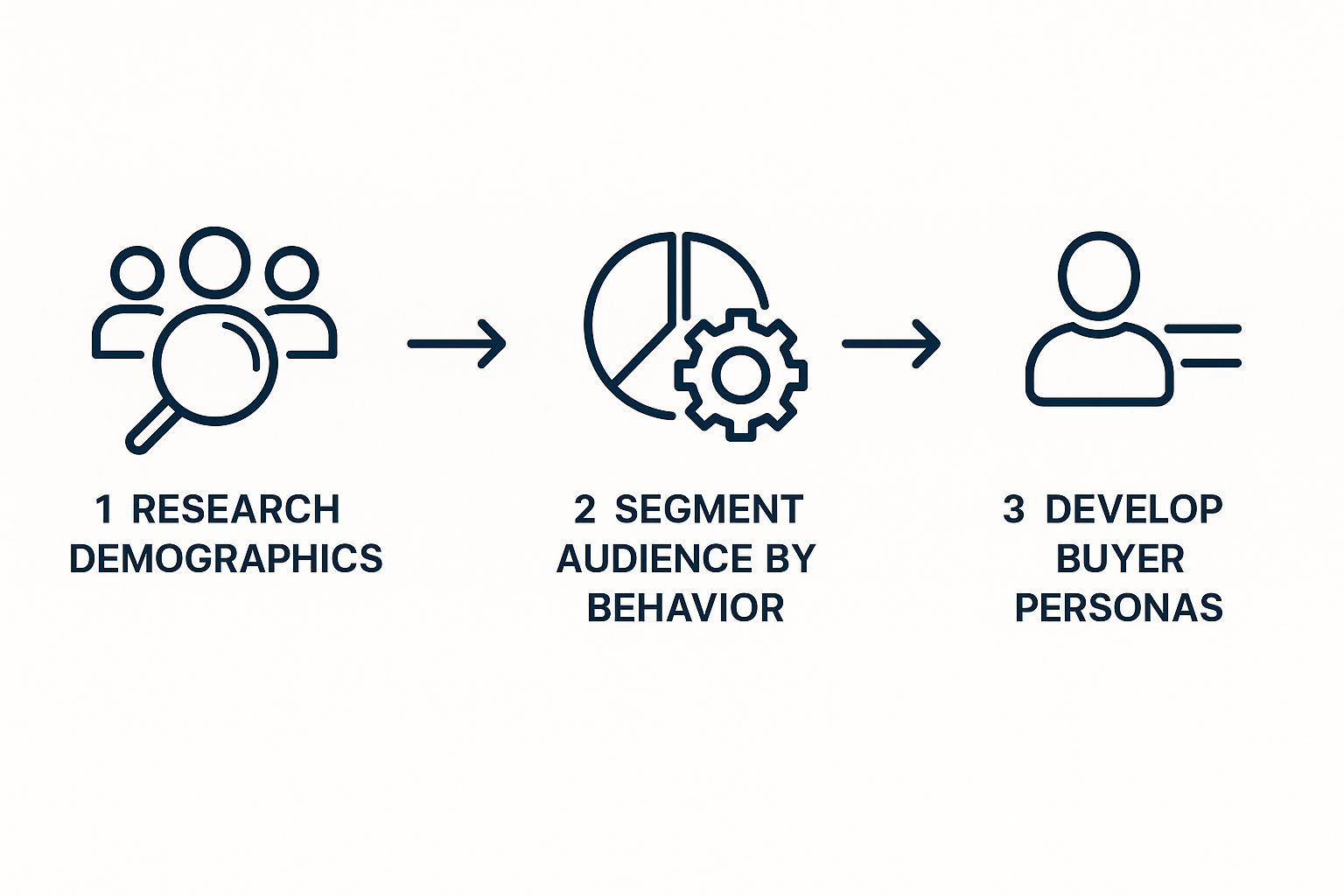
As you can see, by first researching demographics and then segmenting by behaviour, you can develop precise buyer personas. Rich, enriched data is the fuel for this entire process, allowing for a level of granular segmentation that manual approaches simply cannot match.
Correcting Duplicated Content at the Source
One of the biggest headaches for multi-brand retailers is supplier content duplication. Using the same generic descriptions provided by suppliers across hundreds of websites creates a massive SEO problem. It leads to penalties from search engines and dilutes your brand voice.
Manually rewriting thousands of descriptions is a retail content bottleneck that just stalls growth.
AI-powered content workflows solve this by creating unique, on-brand product descriptions for every single SKU. This automated approach not only fixes duplicate content issues but also establishes a distinct and authoritative voice in the market, which is crucial for building customer trust and loyalty.
Taking this step is fundamental to preparing for the future of retail search. As AI shopping agents like Rufus and Perplexity become more common, they will rely on structured, unique, and detailed product information to make recommendations. A clean, enriched product catalogue is your entry ticket to this new era of agentic commerce.
Effective product feed optimisation is the engine that drives this entire strategy, ensuring your enriched data is correctly formatted and sent out across all your sales channels. You can learn more about how to optimise and scale your ecommerce strategy in our detailed guide on the topic. It is a scalable SEO solution that ensures every product has the best possible chance to be seen.
The Power of SKU-Level SEO
True optimisation happens at the individual product level. SKU-level SEO means tailoring titles, descriptions, and attributes to capture highly specific, long-tail search queries. Think about it: a customer is not just searching for a "dress", they are looking for a "blue floral midi dress with puff sleeves".
AI makes this level of detail achievable across your entire inventory.
- Automated Attribute Tagging: AI can identify and tag key product features from images and text, like sleeve length in fashion or material type in furniture.
- Dynamic Metadata Optimisation: It generates unique meta titles and descriptions for every product, incorporating critical keywords and attributes.
- Consistent Data Structure: It ensures all products follow a logical and consistent data schema, improving both user experience and search engine crawlability.
This is the shift from a manual, often tedious approach to a modern, AI-driven workflow. It is about moving away from time-consuming tasks and toward scalable, intelligent systems.
From Manual Product SEO to an AI-Powered Workflow
The table below illustrates the strategic shift from old-school, labour-intensive SEO practices to a modern, AI-powered workflow for managing retail product data. It is a move from being reactive to being proactive.
| Aspect | Traditional SEO (Manual Approach) | AI SEO (Automated Workflow) |
|---|---|---|
| Content Creation | Manual rewriting of descriptions, slow and inconsistent. | AI-generated, unique descriptions for every SKU at scale. |
| Attribute Tagging | Manual data entry, prone to human error and omissions. | Automated tagging from images and text, ensuring completeness. |
| Scalability | Limited by team size, struggles with large catalogues. | Handles tens of thousands of products simultaneously. |
| SEO Focus | Broad keywords, focuses on a few high-value pages. | Long-tail keywords and SKU-level optimisation sitewide. |
| Speed to Market | Weeks or months to update product lines. | New products are optimised and live in hours or days. |
| Data Consistency | Varies by team member, often leads to messy data. | Enforces a consistent data structure across the entire site. |
Ultimately, this transition from manual SEO to AI SEO is about letting technology handle the scale and complexity. This frees up your team to focus on high-level strategy and crucial tasks like human-led AI content QA. You are building a smarter, more resilient foundation for all your digital marketing campaigns to come.
Achieving SEO at Scale for a Competitive Edge
For Australian retailers juggling thousands, or even tens of thousands, of SKUs, getting SEO right at scale is often the biggest mountain to climb. The old days of painstakingly tweaking a handful of key pages are over. Moving to dynamic, AI-powered content workflows is not some far-off idea anymore, it is a necessity to stay competitive right now.
The new benchmark for success? Optimising over 10,000 product pages in a matter of days, not months. This massive leap in speed is the heart of modern retail efficiency. It means new product lines can go live, fully optimised from day one, capturing sales opportunities that would have been lost in long, drawn-out content cycles.

This kind of performance hinges on AI agents for retail efficiency. These are not general-purpose tools, they are specialised systems built to handle the repetitive, high-volume tasks that tie up human teams in knots. This frees up your people to focus on high-impact strategy and quality control, where their expertise truly matters.
Automating Content from Descriptions to Metadata
So what does this look like in practice? The applications of scalable SEO directly impact how your products show up on the digital shelf. Take the classic headache of creating unique product descriptions to avoid supplier content duplication penalties. Manually rewriting an entire catalogue is a non-starter.
Retail content automation tackles this head-on, generating distinct, on-brand descriptions for every single product. This does not just keep the search engines happy with original content, it also weaves a consistent brand voice across your entire inventory.
Beyond descriptions, metadata optimisation is another game-changer. AI-driven workflows can pump out SEO-friendly meta titles and descriptions for your full product list in a tiny fraction of the time, making sure every page is properly structured to pull in organic traffic.
Here is where it really makes a difference:
- Unique Product Descriptions SEO: Wipes out duplicate content from supplier feeds by creating original copy for each SKU.
- SKU-Level SEO Strategies: Generates tailored metadata and attributes that target the long-tail keywords specific to each individual product.
- Multi-Channel Product Optimisation: Ensures your optimised content is consistently deployed across all the platforms you sell on.
The Shift to Proactive, AI-Driven Workflows
Bringing in an AI SEO framework is a fundamental shift from being reactive to proactive. Instead of chasing down and fixing SEO problems after they pop up, you are building a system that optimises content right from the start. This human + AI collaboration in SEO is where retail work is headed.
Your team’s job changes for the better. They are no longer buried under tedious data entry or repetitive writing. Instead, they become the strategic conductors of an automated content engine, focusing on:
- Setting the Strategy: Defining the brand voice, keyword targets, and overall content goals that steer the AI.
- Quality Assurance: Performing human-led AI content QA to check that the final output meets brand standards and is factually correct.
- Analysing Performance: Keeping an eye on how the automated optimisations are affecting search visibility and making smart adjustments.
This transition is about building intelligent, automated content workflows that empower your team, not replace them. It allows retailers to focus on what matters most, high-level strategy and delivering an exceptional customer experience, while AI handles the heavy lifting of execution at a scale previously unimaginable.
By embracing these AI workflows for ecommerce, retailers can finally break through the content bottlenecks that have held them back for years. It opens the door to a much more agile and responsive way of doing business. For those looking to dig deeper, you can explore more about content scale solutions and how generative AI can help grow your library effectively. This is the new standard for winning on the digital shelf.
Optimising Visual Commerce with AI Image Recognition
In retail, especially in sectors like fashion, furniture, and beauty, customers absolutely buy with their eyes. But in a crowded market, having high-quality product images is no longer enough to win. To succeed, modern digital marketing campaigns need to turn those images into powerful, data-rich SEO assets that both human shoppers and AI agents can actually understand.
This is where AI image recognition becomes a genuine game-changer for ecommerce.
Instead of relying on generic file names or basic alt tags, AI systems can now analyse an image and automatically generate a huge amount of descriptive metadata. This process, known as product image tagging, transforms a simple photo into a structured source of information that directly improves your search visibility and gets your catalogue ready for the future of agentic commerce.
From Simple Pictures to Searchable Attributes
Think about the difference here. You could tag a product as just a 'dress', or you could describe it as a 'long-sleeve blue floral A-line midi dress made from cotton'. The first option is vague and gets lost competing against millions of other products. The second one? It captures high-intent, long-tail search traffic from customers who know exactly what they want.
AI image recognition SEO automates the creation of these super-detailed attributes at a massive scale. For a fashion retailer, this means identifying and tagging things like necklines, sleeve lengths, patterns, and materials for every single item. For a furniture store, it could mean tagging wood type, style, and colour.
This level of detail is critical for a few key reasons:
- Alt Tag Optimisation for Retail: It automatically creates descriptive alt text that not only improves accessibility but also tells search engines exactly what an image contains. This gives a serious boost to your fashion product image SEO or furniture image tagging SEO.
- Enhanced On-site Search: It allows customers to filter your search results with incredible precision, leading to a much better user experience and, ultimately, higher conversion rates.
- Agentic Search Readiness: It provides the rich, structured data that AI shopping agents like Rufus and Perplexity need to properly understand and recommend your products.
This shift is crucial, especially when you look at the wider market. Online advertising spend in Australia just hit a record $17.2 billion for the 2025 financial year, and search advertising makes up a whopping 44% of that total. This just goes to show how fierce the competition for visibility is, making this kind of granular, AI-driven optimisation a key way to get ahead. You can find more on these online advertising trends on iabaustralia.com.au.
Scaling Visual SEO with Automated Workflows
Let us be realistic, manually tagging thousands of images is an impossible task. It creates a massive retail content bottleneck. An AI-powered content workflow completely removes this obstacle. It integrates image recognition directly into your product enrichment process, making sure every single visual asset is fully optimised from the moment it is uploaded.
This is not just about being more efficient, it is about unlocking entirely new revenue streams. By making your entire visual catalogue machine-readable, you surface products for niche queries that were previously invisible, driving incremental traffic and sales you would have otherwise missed.
This automated approach to metadata optimisation at scale is a cornerstone of modern ecommerce content optimisation. It ensures every image contributes directly to your digital shelf performance, helping you rank higher and convert more effectively. By implementing these top product and category page optimisation techniques, you can make sure your visual assets are working as hard as possible to drive real business growth.
Activating Your Content Across Every Channel
You have done the hard work of creating a solid foundation of perfectly optimised content. Now it is time to put it to work. This is where you activate that content with maximum impact across every channel you operate on.
It is the moment your investment in product data enrichment and AI SEO really starts to pay off, turning your marketing from a collection of separate efforts into a single, powerful machine. The goal is to launch multi-channel campaigns that deliver a consistent, compelling message everywhere your customers are looking.
This is all about creating a seamless customer journey. Imagine a shopper discovering a product on Instagram, seeing a targeted ad for it on Facebook, getting a promotional email, and finally buying it on your website. At every step, they experience your brand's voice perfectly and see the same rich product details. That is what effective Multi-Channel Product Optimisation looks like in the real world.

Repurposing Enriched Content for High-Performance Ads
Those unique, detailed product descriptions your AI-powered content workflows generated are not just for your website. Think of them as potent fuel for your paid media campaigns across social platforms and search engines. Instead of falling back on generic ad copy, you can pull specific, long-tail details straight from your enriched product feeds.
This allows you to run highly targeted ads that speak directly to niche customer interests, which dramatically reduces ad fatigue and boosts your relevance scores. For instance, a generic ad for a "women's dress" becomes a specific, high-intent ad for a "linen blend V-neck midi dress in navy blue," instantly capturing a customer much closer to making a purchase.
This targeted approach is absolutely vital in the competitive Australian market. As of January 2025, Australia had 20.9 million social media user identities, that is about 77.9% of the total population. With platforms like Facebook offering fantastic demographic targeting, using precise, data-rich content is the only way to cut through the noise. You can discover more insights about Australia's digital landscape on datareportal.com.
Creating a Cohesive Brand Experience
When you get your product data right at the source, you amplify the performance of every single marketing channel. Your investment in correcting supplier content duplication and building a unique voice pays dividends far beyond just SEO. It makes your brand story coherent and trustworthy, no matter where a customer bumps into it.
The core principle is simple: a single source of truth for your product content drives consistency everywhere. This builds brand equity, improves customer trust, and ultimately leads to a higher return on investment across your entire marketing spend.
Maintaining this consistency is not an accident, it is a strategic discipline. Our guide on the top tips for maintaining a consistent brand voice offers practical advice for keeping your messaging aligned as you grow.
Leveraging Automation for Multi-Channel Success
Trying to manage content across multiple channels can quickly turn into a logistical nightmare, especially for retailers with massive product catalogues. This is another area where AI workflows for ecommerce give you a serious edge.
- Dynamic Ad Creative: Automated systems can pull optimised images, descriptions, and pricing directly from your product feed to generate thousands of ad variations for platforms like Google Shopping and Meta.
- Personalised Email Campaigns: Enriched product attributes allow for incredibly granular segmentation. This means you can send highly personalised email campaigns featuring products perfectly matched to a customer's browsing history or past purchases.
- Social Commerce Feeds: Your clean, structured data ensures that your product feeds for Instagram Shopping and Facebook Shops are always accurate and complete, creating a frictionless shopping experience right inside the apps.
By automating these processes, you do not just become more efficient, you make your campaigns more relevant and effective. This strategic activation turns your optimised content into a dynamic asset that drives engagement and conversions across the entire digital ecosystem, cementing your digital shelf performance and building a powerful, cohesive brand.
Measuring Success and Preparing for an Agentic Future
A digital marketing campaign is only as good as its results. For today's retailers, that means cutting through the noise of vanity metrics and focusing on what actually moves the needle: better Digital Shelf Performance, higher conversion rates, and a clear return on investment.
It is all about drawing a straight line from your AI SEO and content automation efforts to real-world growth in organic rankings and, ultimately, revenue.
But tracking today's success is just one piece of the puzzle. The other is getting ready for what is coming next, the rise of Agentic Commerce. This is not a small shift, it is a fundamental change in how people discover and buy products. We are moving away from customers doing the searching themselves, towards AI assistants that research, compare, and purchase on their behalf.
Defining Your Key Performance Indicators
To really understand the impact of your campaigns, you need to track the right numbers. Knowing your key digital marketing performance metrics is non-negotiable for figuring out what is working and what is not. In an AI-driven retail world, your main KPIs should tell a story about both efficiency and performance.
Here is what you should be watching:
- Content Velocity: How fast can you get from a raw supplier data feed to a fully optimised, live product page? This metric is a direct reflection of how efficient your automated content workflow really is.
- Organic Ranking for Long-Tail Keywords: Are you showing up for those super-specific, SKU-level searches? This shows whether your product data enrichment and unique descriptions are actually hitting the mark.
- Conversion Rate by Traffic Source: Dig into how well your optimised content converts visitors coming from organic search, paid ads, and social media.
- Digital Shelf Share: How visible is your brand across key product categories compared to your competitors? This is a crucial health check for your overall market presence.
Preparing for the Agentic Commerce Future
The future of retail search is not about someone typing keywords into a search bar. It is about AI agents like ChatGPT, Perplexity, and Rufus understanding complex requests and finding the best products to fulfil them.
This is where Agentic Search Optimisation comes in. It is the art and science of structuring your product content so that machines can easily understand it, trust it, and recommend it.
An AI shopping agent will not be swayed by clever marketing copy. It will make decisions based on structured, factual, and comprehensive data. The retailer with the most complete and unique product information will win the AI's recommendation.
This AI-powered transformation is already happening. To get ready, your focus needs to be on creating AI-compatible SEO content. The hard work you put in today, like product feed optimisation, getting rid of supplier content duplication, and using AI image recognition for detailed tagging, is exactly what will make your brand the top choice in an agentic future.
This is not just a small adjustment. It is a strategic pivot that ensures your business is leading the charge as the future of work in retail shifts towards human + AI collaboration in SEO. The rich, unique, and structured content you create at scale today is the very foundation that will get you chosen by the AI shopping agents of tomorrow.
Frequently Asked Questions
We get a lot of questions from Australian retail leaders trying to navigate modern, AI-driven digital marketing campaigns. Here are a few of the most common ones, with practical answers that cut through the noise.
How Is AI SEO Different From What We Are Doing Now?
Think of traditional retail SEO as a manual, one-at-a-time process. It is slow, tedious, and simply cannot keep up when you have thousands of products. AI SEO flips that on its head. It automates the heavy lifting, allowing you to manage optimisation at a massive scale.
Instead of manually correcting issues, AI can rewrite thousands of unique product descriptions to eliminate supplier content duplication. It can optimise metadata across your entire catalogue in a fraction of the time and even use AI image recognition to write useful alt text for every single product photo. This frees up your team to focus on strategy, not spreadsheets.
What Exactly Is Product Data Enrichment?
Product Data Enrichment is the process of taking the basic, often messy, product information you get from suppliers and turning it into clean, structured, and marketing-ready content. It is about standardising attributes, filling in the gaps, and optimising all the details for search.
This is not just a nice-to-have, it is the foundation for any successful digital marketing campaign. Enriched data fuels your on-site search, helps you rank for specific long-tail keywords (digital shelf performance), and gives you the compelling details needed for effective ads. Without it, you are building everything on shaky ground.
How Do We Get Our Site Ready For Agentic Search?
Agentic search is what happens when AI assistants, think Rufus or ChatGPT, do the shopping for users by finding and suggesting products. To prepare for this future of retail search, you need to make your product data incredibly clear and easy for machines to understand.
The same AI-driven SEO work that lifts your rankings today is exactly what will make your products the top choice for the AI shopping agents of tomorrow.
Getting ready involves a few key steps:
- Create Unique Content: Use AI to finally get rid of those duplicate supplier descriptions.
- Enrich Everything: Make sure every product attribute is complete and accurate through product feed optimisation.
- Automate Your Metadata: Lean on AI image recognition to generate descriptive image tags and other metadata across your whole site.
This ensures your catalogue is not just optimised for today's search engines, but is ready for the agentic commerce future that is already arriving.
Ready to transform your retail content strategy and get ahead of the future of search? Optidan AI provides the AI-powered content workflows you need to optimise thousands of product pages, fix duplicate content, and achieve unparalleled efficiency. Discover scalable SEO solutions that drive real results by visiting https://optidan.com.
