

Let's be honest, the classic digital marketing funnel is broken. That neat, linear path from awareness to purchase? It's a relic. For ambitious Australian retailers, clinging to it is like navigating today's web with a map from 2005. The modern customer journey is a chaotic, tangled web of interactions, and AI is pulling all the strings.
True growth now demands a dynamic approach, one that embraces AI-powered automation and gets you ready for the fast-approaching future of agentic commerce.
Why Your Funnel Needs an AI Upgrade
The traditional funnel worked on a simple, predictable premise: customers would discover a brand, get interested, weigh their options, and then, hopefully, buy something. It was a straight line. But that model is crumbling under the weight of new search behaviours and AI discovery engines like ChatGPT, Perplexity, and Amazon's Rufus.
For Australian ecommerce leaders, sticking to this outdated framework creates huge retail content bottlenecks. Manual SEO, painfully slow content creation, and an inability to optimise at scale leave you wide open. Your competitors are already adopting AI workflow automation for retail, and that gap is only getting wider.
The New Customer Journey
In this new era, the path to purchase is fragmented and totally unpredictable. A potential buyer might start by asking an AI agent a conversational question, spot a product in an influencer's tagged photo, and then jump to a third-party review site to compare options, all before they even think about visiting your website.
This massive shift makes a few new concepts urgent priorities for any forward-thinking retail strategy:
- AI SEO: This is about optimising your digital shelf not just for keywords, but for the complex, data-hungry AI agents that are now the gatekeepers to consumer decisions.
- Agentic Commerce: You need to prepare for a future where AI agents shop on behalf of consumers. This will fundamentally change the entire game of retail search.
- Scalable SEO Solutions: It's time to move beyond tedious, page-by-page optimisation. The future is automated content workflows that can manage and enrich tens of thousands of SKUs without breaking a sweat.
The core challenge for retailers is to stop being reactive with manual SEO and start being proactive with an AI-powered content strategy. This isn't just about being more efficient; it's about survival in an agentic shopping future.
This guide is your blueprint for rebuilding your digital marketing funnel around these new realities. We're going to move from theory to practical steps, showing you how to implement AI-powered content workflows that fix everything from supplier content duplication to product data enrichment at scale.
To get a deeper handle on your current funnel's performance and spot where the leaks are, check out this complete guide to funnel analysis. It's time to build a funnel that works for the AI-powered world, not against it.
Scaling Your Brand Awareness with AI SEO

Visibility is the first, non-negotiable step in any digital marketing funnel. For Australian retailers, this isn�t just about ranking for a few big keywords; it�s about owning the search results for thousands of very specific, long-tail product searches. This is the top of the funnel, where your brand first meets a new customer, and AI SEO is what makes this introduction possible at a massive scale.
Let's be honest, traditional SEO teams just can't keep up. Trying to manually optimise thousands of individual product pages is a logistical nightmare. It creates huge content bottlenecks that completely stifle growth. This is the point where shifting from manual SEO to AI SEO isn't just a nice-to-have, it's a strategic must. It's how you achieve true SEO at Scale and seriously improve your digital shelf performance.
Fixing Duplicated Supplier Content at Scale
One of the biggest hurdles for any retailer is supplier content duplication. Using the same generic product descriptions provided by suppliers is a recipe for disaster. When your site uses the same copy as hundreds of others, you get poor search rankings and a diluted brand voice. Search engines see this as unhelpful and push your products so far down the search results they'll never be found.
This is where AI-powered content workflows offer a powerful fix. Instead of taking months for a team to manually rewrite thousands of descriptions, AI can generate unique, optimised, and on-brand product content in a matter of days. This automated approach gives every single product page a distinct voice, helping you stand out and climb the rankings.
By automating the fix for duplicated supplier content, you�re not just avoiding penalties. You�re building a foundation of unique, high-quality content that AI search agents like ChatGPT and Rufus need to recommend your products confidently.
What was once a major liability is now a genuine competitive advantage. This is a perfect example of how AI workflow automation for retail directly feeds the awareness stage of your funnel, driving organic traffic at a SKU-level that was impossible before. You can get a deeper look at how this technology is changing the game in our comprehensive guide to understanding AI SEO.
Automating Image Optimisation for Visual Search
For retailers in visual-heavy categories like fashion, furniture, and electronics, image search is a massive discovery channel. A shopper might not know the name of a particular style of chair, but they'll absolutely search for it visually. If your product images aren't properly optimised, you're invisible to this entire group of buyers.
This is where AI image recognition and tagging comes in. This technology automates the tedious but vital job of alt tag optimisation for retail. It analyses your product images and generates descriptive, keyword-rich alt text for thousands of images at once.
This process ensures your products show up not just in traditional text search, but also in the fast-growing world of visual and agentic search. Just think about the advantages:
- Fashion SEO Optimisation: AI can automatically tag images with attributes like "linen blend," "midi-length," or "puff sleeve," capturing those super-specific searches.
- Furniture Image Tagging SEO: It can identify and tag details like "solid oak," "mid-century modern design," or "velvet upholstery," matching how real customers actually look for products.
By using these retail efficiency tools, you make sure every image on your site is working to build your brand's visibility. It funnels shoppers who think in pictures directly to your product pages. This isn't just some technical tweak; it's a core part of building a resilient and future-proof digital marketing funnel.
The online behaviour of Australian consumers really drives this home. With search engines accounting for 62.5% of brand discovery and social media close behind at 33.6%, the link between optimised text and discoverable images is essential for grabbing attention across a highly engaged audience. Discover more about Australian digital trends and how they impact marketing strategies.
Winning Customer Interest with Enriched Product Data
Once someone knows your brand exists, the real work begins. The next challenge in the digital marketing funnel is to grab their attention and actually hold their interest. This is the consideration stage, where Australian shoppers start sizing up your products and comparing them to what your competitors are offering. Thin, generic content just doesn't cut it anymore. Today's buyers, and the AI agents they're starting to use, expect rich, detailed, and accurate information.
This is where Product Data Enrichment becomes your secret weapon. It�s the process of taking those basic, often duplicated and uninspiring supplier feeds and turning them into highly structured, unique, and search-optimised product assets. For any retailer managing thousands of SKUs, this is how you move past just being seen and start building real trust.
The image below shows how a massive audience at the top of the funnel gets whittled down as they move towards making a decision.
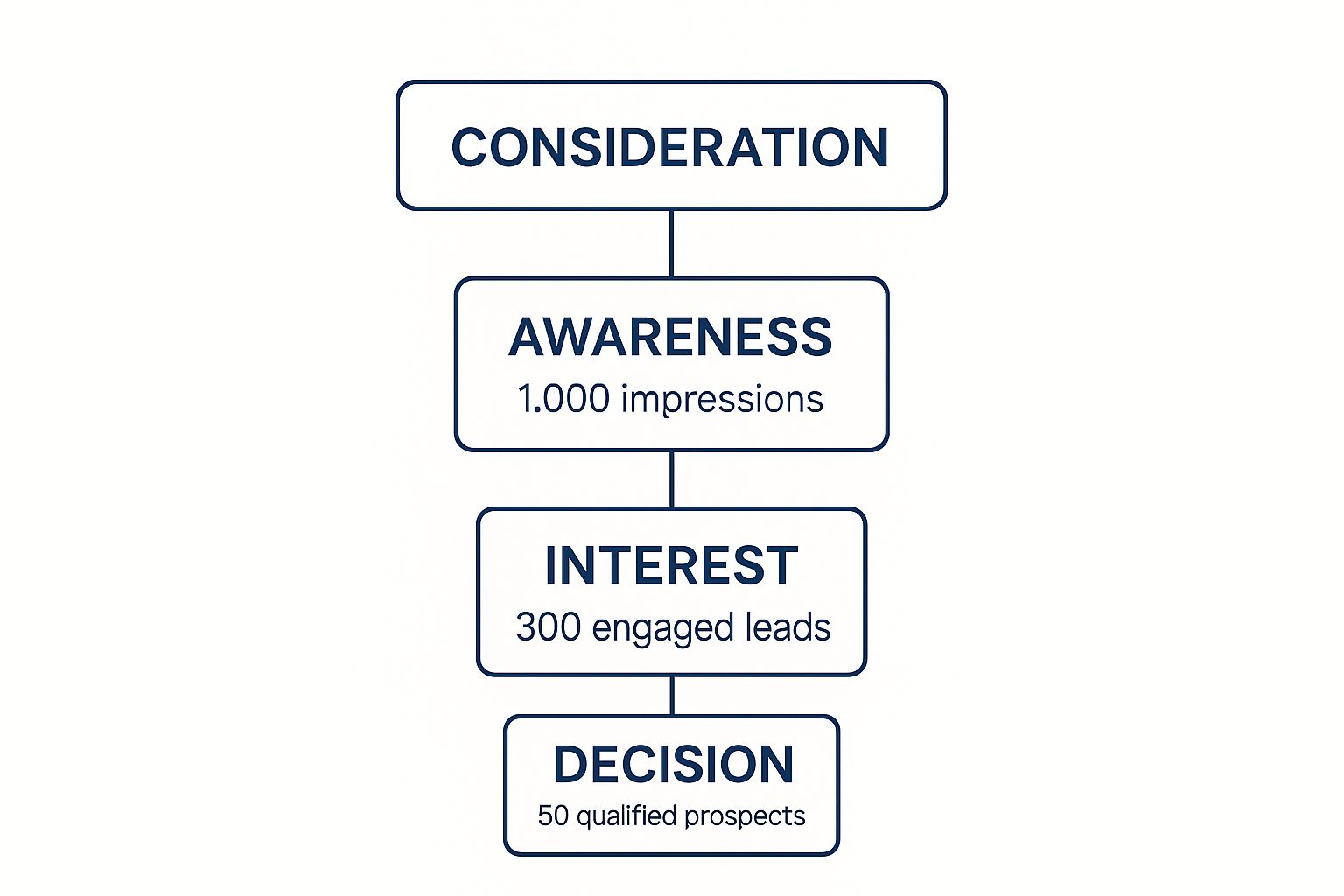
It�s a great visual of that critical narrowing process, reminding us that only a tiny fraction of the people who first see your brand will become qualified prospects. That's why the quality of your content at every single step is so vital.
From Basic Feeds to AI-Ready SEO Content
At the heart of this stage is Supplier Feed Enrichment. Your typical supplier feed might give you a model number, a generic title, and maybe a single, unhelpful sentence. That's nowhere near enough information to convince a customer or satisfy an AI shopping agent like Perplexity.
An AI-powered content workflow can take these bare-bones feeds and enrich them automatically, and at a massive scale. This isn't just about spinning the same old information. It's about adding layers of genuinely valuable detail that help a customer make a confident, informed decision.
This includes things like:
- Detailed Specifications: Automatically adding dimensions, materials, power consumption, and compatibility details for electronics.
- Feature-to-Benefit Translations: Turning technical jargon into clear, customer-focused benefits. For instance, a "10,000 mAh battery" becomes "All-day power for work and streaming on the go."
- Use Cases and Scenarios: Adding context that helps shoppers picture the product in their own lives, like suggesting a laptop is "perfect for university students and creative professionals."
This is exactly the kind of structured, detailed information that SEO for AI Agents thrives on. These systems need comprehensive, machine-readable data to properly compare products and give confident recommendations. Without it, your products are basically invisible in this new era of agentic search, leaving a massive hole in the middle of your digital marketing funnel.
SKU-Level SEO and Building Customer Trust
When you get your data enrichment right, it unlocks incredibly powerful SKU-Level SEO. By creating unique and detailed content for every single product, you can start ranking for those highly specific, long-tail search queries that signal strong buying intent. This is an absolute game-changer in competitive markets.
For example, in Electronics SEO Optimisation, a generic page for a "4K TV" is going to get lost in the noise. But a fully enriched page optimised for a "65-inch OLED 4K TV with 120Hz refresh rate for gaming" will attract a highly qualified buyer who knows exactly what they're looking for.
By providing granular, accurate, and easily accessible information, you reduce friction in the customer's decision-making process. This builds trust and positions your brand as a helpful authority, not just another retailer.
This process directly boosts your Retail Search Visibility for the searches that actually convert. Instead of battling it out for broad, expensive keywords, you start winning the specific queries that lead straight to a sale.
Crafting these unique narratives is essential. You can learn more about how to craft high-converting product descriptions for Shopify in our detailed guide, which walks through how a human-led AI content approach ensures every description is not only optimised for search but truly connects with your audience.
Manual SEO vs AI SEO for Product Data Enrichment
Moving from traditional manual processes to an AI-powered workflow for enriching product data isn't just an upgrade, it's a fundamental shift in efficiency and scale. The difference is stark, especially when you're dealing with thousands of products.
| Process | Traditional Manual SEO | AI-Powered Content Workflow |
|---|---|---|
| Initial Setup | Manual data entry, spreadsheet management. | Connects directly to Shopify API or PIM. |
| Content Creation | Copywriters manually write each description. | Generates thousands of unique descriptions in minutes. |
| Data Enrichment | Researchers manually look up and add specs. | Automatically pulls and structures specs. |
| Scalability | Very limited; slow and expensive to scale. | Nearly limitless; scales across entire catalogue. |
| Consistency | Tone and style vary between writers. | Consistent brand voice across all products. |
| Speed to Market | Weeks or months for a full catalogue. | Days or even hours. |
Ultimately, an AI-powered approach lets you achieve a level of depth and consistency that's simply not feasible with manual effort alone. It frees up your team to focus on strategy while ensuring every single product is perfectly positioned to capture customer interest.
Driving Conversions with Unique and Optimised Content

This is the sharp end of the funnel. It's where casual browsing needs to become a confident purchase, and your content is what gets it over the line. Your customer is right on the edge of making a decision, so your job is to strip away every last bit of friction and doubt.
This means deploying unique, optimised, and trustworthy content that directly encourages a sale. For any retailer, this is the moment your entire strategy translates into actual revenue.
One of the biggest conversion killers at this critical point is poor content quality. Relying on generic, duplicated supplier descriptions is a guaranteed way to lose a sale. It creates a bland, untrustworthy experience and actively harms your search rankings, pushing you out of sight right when customers are ready to pull out their wallets. This is where automating product descriptions becomes a serious conversion tool, turning every page into a high-performing sales asset.
From Duplicate Content to a Distinct Brand Voice
The fastest way to drive conversions is by building trust and creating a distinct brand identity. A Duplicate Content SEO Fix isn't just a technical task, it's a commercial necessity. When a potential customer sees the exact same description on five different websites, it screams a lack of effort and authority. Why should they possibly buy from you?
AI-powered content workflows offer a genuine solution to this problem, delivering quality at speed and scale. By automating product descriptions, you can generate thousands of unique, on-brand narratives that do the heavy lifting for you.
- Highlight unique selling points: AI can be trained to zero in on the specific benefits and features that matter most to your target audience.
- Establish a consistent tone of voice: Every product page reinforces your brand, building a cohesive and memorable customer experience from top to bottom.
- Avoid search engine penalties: Unique content is rewarded with better visibility, ensuring your products are seen at the crucial moment of decision.
By replacing supplier boilerplate with unique, benefit-driven copy, you give customers a clear reason to choose you over the competition. This isn't just about SEO; it's about building the confidence needed to click "add to cart."
Ensuring Quality and Trust with Human-Led AI QA
Automation gives you speed, but trust is built on accuracy. In categories like electronics or pharmacy ecommerce, a single incorrect detail can destroy a sale and damage your reputation for good. This is why an effective Ecommerce Content Quality Assurance process is non-negotiable for maximising conversions.
A robust Human-Led AI Content QA process gives you the best of both worlds. The AI generates optimised content at scale, while your human experts step in to verify critical details, ensuring every claim is accurate and every specification is correct. This hybrid approach guarantees your product pages are not only persuasive but also completely reliable, vital for securing high-value purchases.
For a deeper dive into this, you might be interested in the ultimate guide to product page optimisation for higher conversions.
Powering Multi-Channel Optimisation and Social Proof
Today�s customer journey is rarely confined to a single platform. Your bottom-of-funnel strategy needs to reach beyond your website to channels like Google Shopping, social commerce platforms, and marketplaces. High-quality, enriched product data is the foundation for effective Multi-Channel Product Optimisation. Unique, detailed descriptions and specs ensure your products stand out everywhere they appear.
On top of that, social proof plays a massive role in sealing the deal. This is especially true in Australia, where influencer marketing is projected to hit AU$943.8 million in ad spending in 2025. This channel leverages trusted figures to guide consumers through the funnel, with transparent and authentic content being the key to converting interest into sales.
Likewise, your email marketing efforts at this stage must be flawless. To get the most out of your unique content and drive conversions, it's crucial to understand the importance of robust email list validation to make sure your messages are actually reaching active prospects.
Ultimately, by combining unique AI-generated content with rigorous quality checks and a strong multi-channel presence, you create a powerful, trustworthy experience that turns consideration into conversion.
Building Loyalty and Advocacy After the Purchase
Getting the sale is a huge milestone, but it's not the finish line. The real magic happens after the purchase. This is where you turn one-time buyers into loyal fans who champion your brand, and for Australian retailers, it's the key to lowering customer acquisition costs and building a business that lasts.
This entire process rests on the foundation you've already laid. When you commit to high-quality, organised Product Catalogue SEO, you don't just win the first sale, you create a trustworthy experience that keeps customers coming back. A product page rich with accurate, helpful detail reinforces the value you provide long after the checkout is complete.
Automating Engagement and Personalisation
Keeping customers engaged after they've bought something requires a consistent, personal touch that�s just impossible to manage by hand when you're growing. This is exactly where Retail Efficiency Tools come in. With AI Workflow Automation for Retail, you can set up personalised follow-up emails, suggest other products based on their purchase history, and even ask for a review at just the right moment.
These automated touchpoints are gold for a few reasons:
- They make the customer feel good about their purchase: A quick email with tips on how to use their new product or info on the warranty shows you're still thinking about them.
- They open the door for more sales: AI can intelligently suggest a perfect accessory for that new camera or matching items for a piece of clothing they just bought.
- They build social proof: Automatically asking for reviews helps you collect testimonials that convince new customers at the top of your funnel.
The goal is simple: make every customer feel seen, not forgotten. Smart, automated communication turns the silence after a sale into an ongoing conversation, building the groundwork for real loyalty.
This is more important than ever when you consider the massive investment in social media advertising, which is set to hit AU$7.5 billion in Australia in 2025. Social media is great for finding new customers, but you need a solid post-purchase strategy to keep them. That spending is only going up, which means having an efficient retention funnel is non-negotiable if you want to see a real return on your investment.
Fostering Advocacy Through Human + AI Collaboration
The Future of Work in Retail isn't about replacing people with technology; it's about using tech to make your team's expertise even more powerful. The strategic insights from your marketing team are what shape a truly great customer loyalty experience. Human + AI Collaboration in SEO allows for smarter segmentation and campaigns that turn happy customers into vocal advocates.
Your team can dive into the data from these automated campaigns, pinpoint your most loyal customers, and create something special for them, like an exclusive community or early access to new products. This creates a powerful cycle where your biggest fans not only buy again but also bring in high-quality new leads by telling everyone they know about your brand.
To keep customers engaged and turn them into advocates, you need to implement proven customer retention strategies. These systems transform satisfied buyers into a volunteer marketing force, feeding the top of your funnel with the best kind of prospects. To see how this all connects, you can explore how AI and machine learning are transforming ecommerce content performance and get a deeper understanding of this synergy.
Preparing for the Future of Agentic Commerce
The traditional digital marketing funnel is facing its biggest shake-up yet. We're rapidly moving towards a future where AI does the shopping for us. This isn't some far-off sci-fi concept; it's the emerging reality of agentic commerce, and Australian retailers need to start preparing for it right now.
The entire customer journey is being redrawn by AI agents in ecommerce that can discover, compare, and even buy products on behalf of a user. The future of retail search will be less about keywords punched into a search bar and more about conversational, automated, and deeply personalised chats with AI agents. Your product data has to be structured and rich enough for these agents to find and recommend you.
Shifting from Traditional to AI SEO Services
Adapting means pivoting from old-school SEO tactics to comprehensive AI SEO services. This is more than just a small operational tweak, it�s a critical investment in your business�s future. While traditional SEO was all about human search behaviour, AI SEO is about getting your entire digital shelf ready for machine-led discovery.
This means focusing on:
- Structured Data First: Making sure every single product attribute is machine-readable, so AI agents can make accurate, apples-to-apples comparisons.
- Conversational Content: Writing product descriptions and FAQs that directly answer the kinds of questions a person would naturally ask their AI agent.
- Agentic Readiness: Auditing your entire product catalogue to find and fix the data gaps that would stop an AI agent from ever recommending your products.
This switch from manual, page-by-page SEO to a holistic AI SEO approach is fundamental. It breaks through content bottlenecks and ensures your brand stays visible as search becomes more automated and agent-driven.
Adopting AI workflow automation for retail is no longer just about gaining an efficiency edge. It's about securing a decisive competitive advantage in the new era of agentic commerce, where the best data wins.
Securing Your Competitive Advantage
The move toward an agentic future is a massive opportunity for retailers who are willing to think ahead. By embracing AI agents for retail efficiency, you can automate complex content workflows and ensure your product information is always optimised for the next wave of search.
This is the real difference between AI SEO vs traditional SEO; one is reactive, always playing catch-up, while the other is predictive, preparing you for what's next.
Starting this journey today puts you in a position to capture market share while your competitors are still trying to figure out what happened. It�s about building a resilient, future-proof strategy where your products become the default choice for AI shopping agents.
For a deeper dive on how to get your content strategy ready, you can find answers to common questions about agentic AI SEO content optimisation in our detailed FAQ guide.
Frequently Asked Questions
Got questions? Here are a few common ones we hear from Australian retail leaders about what it takes to build a modern, AI-ready digital marketing funnel.
How Is AI SEO Different from Traditional SEO?
The biggest differences are scale, speed, and where your audience is headed. Traditional SEO is a manual grind of keyword research and content writing, which is painfully slow, especially if you have a massive product catalogue. This is why so many retailers hit a content bottleneck.
AI SEO, on the other hand, is all about SEO at scale. It uses smart automation to enrich product data and fix the widespread problem of Duplicated Supplier Content across thousands of products in just days. But the real game-changer? It optimises your content not just for people, but for AI agents like ChatGPT and Rufus, getting you ready for the future of agentic commerce.
Can AI Really Write High-Quality Product Content?
Absolutely, but there�s a catch. It needs what we call a Human + AI Collaboration in SEO approach. AI is brilliant at churning out unique, optimised product descriptions at a scale that's impossible for humans, finally solving the headache of supplier content duplication. This is the core of retail content automation.
But you can't just set it and forget it. A human-led AI content QA process is non-negotiable to ensure everything is accurate, sounds like your brand, and builds trust. This is especially true for technical products in categories like electronics or pharmacy ecommerce. It's this combination that gives you both speed and quality.
How Do I Get My Ecommerce Store Ready for Agentic Search?
Getting set for agentic search optimisation all comes back to your data. AI agents need clean, structured, and detailed information to feel confident enough to recommend your products.
The entire foundation for the agentic commerce future is having best-in-class product feed optimisation. Your mission is to create AI-compatible SEO content that leaves zero room for misinterpretation.
Here�s where to start:
- Enrich Your Product Data: Go way beyond the basic supplier feed. Add in detailed specs, real-world benefits, and different ways to use the product.
- Optimise for Conversation: Structure your content to answer questions the way a person would actually ask an AI agent. Think "what's the best…" or "how do I…".
- Use AI Image Recognition: Make sure every single product image has a descriptive, accurate alt tag. This is crucial for getting found in visual searches.
What�s the ROI on Using AI Workflows?
The return on your investment in AI workflow automation for retail shows up in three key areas: efficiency, visibility, and sales. By automating huge tasks like writing product descriptions and optimising metadata, you slash your content production costs and get products to market faster.
This directly improves your digital shelf performance, pushing you up the rankings for thousands of long-tail product searches. The end result is a massive lift in organic traffic and conversions that hits your bottom line, all while building a solid foundation for growth in the new agentic era.
Ready to stop the slow, manual SEO grind and move to a scalable, AI-powered content strategy? Optidan AI smashes content bottlenecks, enriches your product data, and gets your retail brand ready for the future of agentic search. Learn how we can optimise 10,000+ pages in days.
