


For Australian retail leaders, the choice between a Product Information Management (PIM) system and a Product Data Enrichment platform isn't just a technical one, it's a core strategic decision. A PIM acts as your internal library, organising raw data to create a single source of truth for SKUs and specifications. But Product Data Enrichment is the customer-facing engine that turns that organised data into high-performing, optimised content, essential for scalable AI SEO.
Defining the Core Dilemma for Retailers
Figuring out whether you need Product Data Enrichment or a PIM starts with understanding their very different roles in your retail content workflow. A PIM system is fundamentally an internal data governance tool. Its main job is to pull in raw information from various supplier feeds, then centralise and standardise it to establish a clean, reliable foundation.
Think of it as the meticulously organised stockroom where every single item has a specific place and a clear label. This process is absolutely crucial for operational efficiency and data accuracy across your business.

Here’s the catch: that organised data is rarely ready for the digital shelf. This is where Product Data Enrichment steps in. It takes the clean data from the PIM and transforms it into compelling, unique, and search-optimised content. It’s the art of turning a basic supplier feed into a powerful sales tool by correcting duplicated supplier content and building a unique brand voice.
Product Data Enrichment isn't just about data accuracy; it's about adding commercial value. It’s the engine that powers next-gen SEO for retailers, turning static data into dynamic content that drives digital shelf performance and prepares your catalogue for agentic commerce.
This transformation is what overcomes common retail challenges and unlocks SEO at scale. A PIM organises, but an enrichment platform performs. To get a better handle on this crucial first step, see our guide on how to align supplier feeds with search performance.
Key Distinctions at a Glance
To really nail the difference, just look at their primary goals and what they produce. A PIM chases internal consistency, while enrichment targets external performance.
| Aspect | Product Information Management (PIM) | Product Data Enrichment |
|---|---|---|
| Primary Goal | Internal data governance and accuracy | External customer engagement and conversion |
| Core Function | Centralising and standardising raw data | Transforming data into optimised marketing content |
| Key Output | A single, reliable source of truth for data | Unique product descriptions and optimised metadata |
| Focus | Efficiency and consistency | AI SEO performance and digital shelf visibility |
| Solves | Data chaos and internal inconsistencies | Duplicated supplier content and low search rankings |
Getting this distinction right is the first step toward building an efficient retail content automation process. It helps you pinpoint the true bottlenecks in your current workflow. While a PIM solves the problem of messy data, enrichment solves the problem of invisible products. For modern retail leaders focused on the future of work in retail and AI efficiency, knowing which problem to tackle first is everything.
Understanding PIM Systems as Your Data Foundation
A Product Information Management (PIM) system is your central, organised library for all foundational product data. Its main job is to act as the single source of truth for your business, holding, managing, and distributing core information like SKUs, technical specifications, and raw supplier details.
Think of a PIM as the essential first step in ditching chaotic spreadsheets and disconnected systems. It pulls together information from Enterprise Resource Planning (ERP) systems, supplier feeds, and other sources into one clean, reliable repository. This centralisation is crucial for streamlining internal workflows, cutting down on costly data entry errors, and keeping data consistent across your operations.
The Core Role of PIM in Data Governance
The whole point of a PIM is to enforce data governance and accuracy. It’s an internal-facing tool built to bring order to your product catalogue, something that's absolutely critical for retailers managing thousands of SKUs. By setting clear rules for data quality and completeness, a PIM makes sure every team, from procurement to logistics, is working from the same correct information.
This organised foundation is a non-negotiable for any scalable ecommerce operation. However, it's vital for retail leaders to understand where a PIM’s function stops.
A PIM is fundamentally a data governance tool, not a content optimisation engine. It organises the 'what' (SKUs, dimensions, materials) but does not transform it into the 'why' (unique descriptions, SEO keywords, customer benefits).
This distinction is the key to understanding its place in your technology stack. While a PIM delivers huge value through efficiency and data integrity, its output is organised raw data, not customer-centric or SEO-ready content. You can explore more on the differences between PIM, DAM, and product optimisation platforms.
PIM's Limitations in Content Performance
A PIM won’t fix the problem of duplicated supplier content that’s hurting your SEO rankings, nor will it magically generate unique product descriptions that drive sales. It gives you the clean, structured data needed for these activities but doesn't perform the transformation itself. This is where its role ends and the need for a different kind of solution begins.
Australian retailers, in particular, face a massive challenge with data fragmentation. Research shows 58% of Australian retailers get data from over 50 different suppliers, each with its own unique format. A PIM helps standardise this mess, but retailers who also use data enrichment solutions see a 40% reduction in time-to-market for new products. It’s a powerful testament to an integrated workflow.
Without that next step, you’re left with accurate but uninspiring product information that just doesn’t perform on the digital shelf. This reality perfectly sets the stage for understanding where Product Data Enrichment fits in, turning your clean data foundation into a high-performing commercial asset.
Unpacking Product Data Enrichment for Performance
While a PIM gets your internal data organised, Product Data Enrichment is what turns that raw information into customer-facing content that actually drives sales. This isn't just about making sure the data is accurate; it's about adding real commercial value to every product on your digital shelf. Think of it as the engine powering a modern, scalable SEO strategy.
The process involves transforming basic supplier feeds into unique, compelling product descriptions, weaving in high-intent SEO keywords, and applying structured data. This kind of preparation is critical for AI SEO, getting your catalogue ready for AI agents and the future of retail search on platforms like Google's AI Overviews and Amazon Rufus.

From Data Points to Selling Points
Product Data Enrichment solves critical retail problems that a PIM, on its own, simply can't. By systematically enhancing your product data, you can see significant lifts in key performance areas.
Here are the key outcomes of effective enrichment:
- Correcting Duplicated Supplier Content: It gets rid of the risk of SEO penalties by creating unique, on-brand descriptions for every single SKU, moving you away from the generic copy everyone else is using.
- Improving Digital Shelf Performance: Optimised titles, descriptions, and metadata don't just look better, they boost rankings, improve visibility, and ultimately drive higher conversion rates.
- Enabling Optimised at Scale Workflows: AI-powered retail transformation means you can process and enrich over 10,000 pages in days, clearing content backlogs that would take manual teams months to get through.
- Boosting Agentic Search Readiness: Well-structured, AI-friendly content ensures your products are easily understood and recommended by the new wave of AI shopping agents.
The core function of enrichment is to translate product features into customer benefits. It’s the difference between listing '100% merino wool' and describing a jumper as 'incredibly soft, breathable, and naturally temperature-regulating for all-season comfort'.
This strategic layer of content is what truly influences a customer's decision to buy. For retailers in visual-heavy sectors like fashion or furniture, this process is even more vital. AI-powered image recognition and tagging can automatically apply relevant attributes, making products far more discoverable through visual search and improving alt tag optimisation at scale.
For Australian retailers, this process is fast becoming a key competitive advantage. Recent studies show businesses that adopt robust Product Data Enrichment strategies are reporting up to a 30% increase in online sales compared to those stuck with basic data. In one survey, 68% of e-commerce businesses that prioritised enrichment saw higher customer engagement, while 42% pointed to improved SEO rankings as a direct result.
Ultimately, enrichment isn't a one-off task but a continuous cycle of optimisation. It represents the shift from manual SEO to an AI-driven approach, where AI workflow automation for retail turns your product catalogue into your most powerful marketing asset. It’s the essential next step after you've established a clean data foundation with a PIM. Discover the fundamentals of this strategy in our complete guide to Product Data Enrichment.
A Head-to-Head Comparison for Retail Leaders
To make the right call, you need a straight, no-nonsense comparison. While a PIM system and a Product Data Enrichment platform both touch your product information, they are built for entirely different jobs. Think of a PIM as your internal data librarian, obsessed with accuracy and order. Enrichment, on the other hand, is your external marketing engine, focused on performance and sales.
Getting this distinction right is the first step. Are you drowning in internal data chaos, or are you invisible on the digital shelf? The answer points directly to your next move.
Core Strategic Differences
Let’s get past the high-level definitions and look at how each solution actually impacts your retail operations. A PIM lays the foundation for consistent data, which is an essential first step. But Product Data Enrichment is what builds on that foundation to drive real commercial results, such as better digital shelf performance and getting your catalogue ready for agentic search optimisation.
Here’s a practical example: a PIM makes sure the attribute 'material' is always listed as '100% Cotton' across every system. An enrichment platform takes that fact and spins it into a compelling, SEO-friendly description that highlights its benefits, like 'breathable, soft, and perfect for sensitive skin'.
The critical takeaway for retail executives is this: A PIM organises facts. An enrichment platform creates assets. One fixes internal efficiency, while the other drives external growth and prepares your business for the future of agentic commerce.
This difference really comes to life with SEO. A PIM supports SEO by serving up accurate data, but it doesn't actively optimise it. In contrast, enrichment platforms are built from the ground up to generate unique, keyword-rich content and structured data at scale, directly boosting your AI SEO performance. Many retailers are finding that to genuinely compete, they need to move beyond the PIM to build a living product data ecosystem that’s geared for continuous optimisation.
PIM vs Product Data Enrichment Core Differences
For busy decision-makers, this table breaks down the core differences across the most important strategic areas. Use it as a quick reference to figure out where your most pressing needs are.
| Dimension | PIM (Product Information Management) | Product Data Enrichment |
|---|---|---|
| Core Function | Centralises and standardises raw product data from various sources like supplier feeds into a single, reliable repository. | Transforms raw, organised data into unique, customer-facing content optimised for performance across multiple channels. |
| Primary Goal | To achieve internal data governance, consistency, and operational efficiency by creating a 'single source of truth'. | To drive external growth by improving digital shelf performance, boosting conversions, and enhancing search visibility. |
| Key Outputs | Clean, structured, and accurate foundational data (SKUs, technical specs, dimensions) ready for internal use. | SEO-optimised product descriptions, titles, AI-generated image tags, and structured data for AI agents and search engines. |
| Impact on AI SEO | Supports AI SEO by providing accurate, consistent data. It is a passive enabler of good SEO practices. | Actively drives AI SEO by creating unique content, integrating keywords, and implementing structured data for agentic search. |
| Scalability Focus | Manages a large volume of SKUs and attributes efficiently, ensuring data integrity as the product catalogue grows. | Enables content optimisation at scale, capable of enriching 10,000+ pages in days through AI workflow automation for retail. |
| Role in Agentic Commerce | Provides the foundational, factual data that AI agents will rely on for basic product specifications. | Creates the rich, contextual, and persuasive content that AI agents need to confidently recommend your products to shoppers. |
| Resolves Bottlenecks | Solves internal data chaos, reduces manual data entry errors, and eliminates inconsistencies across business systems. | Solves duplicated supplier content issues, poor search rankings, low conversion rates, and long content creation cycles. |
Ultimately, the choice depends on where you're feeling the most pain. If your internal data is a mess, a PIM is your starting point. But if your data is clean but your online sales are flat, enrichment is where you'll find the growth.
How PIM and Enrichment Create a Powerful Synergy
The whole “Product Data Enrichment vs. PIM” debate completely misses the point for retail leaders. It’s not an either/or decision. The real power comes when these two systems work together, creating a seamless, automated content pipeline that drives performance on the digital shelf. This is the shift from manual SEO to a scalable, AI-driven strategy.
Think of it like this: a PIM builds the clean, structured foundation. It’s your single source of truth for all that raw product data. But an AI enrichment platform is the engine that turns that organised data into a high-performing commercial asset. Put them together, and you solve the biggest headaches in modern retail, like fixing duplicated supplier content and getting products to market faster.
The Modern AI Workflow Automation Model
Imagine a best-practice content workflow where technology does the heavy lifting, freeing up your team to focus on strategy. This model transforms a disconnected, manual process into a fluid, automated system built for the future of retail search.
The integrated process breaks down into a few clear stages:
- Ingestion and Organisation (PIM): It all starts with raw supplier feeds flowing into the PIM. This is where the data gets standardised, organised, and validated, creating a clean, reliable repository for every single SKU in your catalogue.
- Transformation and Optimisation (Enrichment Platform): Next, that clean data is channelled into an AI-driven enrichment platform. This is where the magic happens. Generative AI crafts unique, SEO-optimised product descriptions, titles, and metadata, turning basic specs into compelling content that actually sells.
- Visual Intelligence (AI Image Recognition): For categories like fashion SEO optimisation or furniture SEO services, AI image recognition adds another critical layer. It automatically analyses product images to generate precise tags and alt text, which massively improves accessibility and discoverability through visual search.
- Deployment and Performance: Finally, the fully enriched, market-ready content is pushed out to all your ecommerce channels. This automated workflow ensures every product page is optimised for both human shoppers and the AI agents that are increasingly driving discovery.
This synergistic workflow isn't just about efficiency. It's about building a genuine competitive advantage. By integrating a PIM’s data governance with an enrichment platform's AI-powered content creation, retailers can achieve SKU-level SEO at a scale that was previously unimaginable.
This combined approach is also foundational for strong marketing data integration, ensuring accurate and comprehensive product information is consistently available for all your marketing efforts.
Real-World Scenarios in Action
The power of this synergy really clicks when you look at specific retail verticals. For an electronics retailer, the PIM organises all the complex technical specifications. The enrichment platform then translates those specs into benefit-led descriptions and makes sure the product is correctly structured for AI shopping agents like Amazon Rufus.
Likewise, a fashion retailer uses their PIM to manage all the SKU variants for size and colour. The enrichment platform then creates evocative descriptions for each item and uses AI to tag images with attributes like ‘V-neck’, ‘long-sleeve’, or ‘floral print’. This massively improves on-site search and filtering. This level of detail is a core part of moving toward agentic commerce. To see how this works in the real world, you can get an inside look at how AI workflows drive ROI for retailers.
Ultimately, integrating your PIM with AI-driven enrichment moves your business from just managing data to actively using it for growth. It’s the key to reducing retail content bottlenecks and unlocking scalable SEO solutions for the modern digital shelf.
Making the Right Choice for Your Retail Business
Deciding between a PIM and a Product Data Enrichment platform really just comes down to one question: what's your biggest business bottleneck right now? This isn't just about picking a new piece of software. It’s a strategic choice that determines how you move from manual SEO slogs to a scalable, AI-driven future.
Where you start depends entirely on where you are.
If your business is drowning in data chaos, with inconsistent supplier feeds, messy spreadsheets, and internal confusion, you need to build a foundation first. A PIM is non-negotiable here. It’s about creating that single source of truth that every other system needs to function, cleaning up the core data before you can do anything else with it.
But what if you've already got an organised PIM, yet your search visibility is poor, conversion rates are flat, and you’re getting penalised for using the same supplier content as everyone else? Your data is clean, but it's not working for you. In this case, a Product Data Enrichment solution is the clear priority. It’s what turns your static, organised data into a high-performing asset on the digital shelf.
A Decision Framework for Retail Leaders
To make the call, have an honest look at your business and figure out where the real pain is. Your primary bottleneck points directly to the right path forward.
-
Prioritise a PIM if: Your main challenges are internal. You’re fighting data inaccuracy, wasting hours manually updating spreadsheets, and you have no central view of your product catalogue. Your goal is operational efficiency and getting your data house in order.
-
Prioritise Product Data Enrichment if: Your main challenges are external. You have clean data but suffer from low organic traffic, poor conversion rates, and no way to create unique content at scale. Your goal is market growth, AI SEO readiness, and stronger digital shelf performance.
The end game for any retailer with ambition is an integrated system. A PIM provides the clean data foundation, and an enrichment platform transforms it into optimised, customer-facing content. Your first investment should tackle the problem that’s holding back your growth the most right now.
Making this choice is a critical step in getting your business ready for the future of work in retail, where AI agents in ecommerce will depend on rich, structured data. Enrichment is what makes your catalogue compatible with agentic search, turning your products into assets that AI shopping assistants can actually discover and recommend.
The diagram below shows the ideal workflow, illustrating how data flows from its raw state, through organisation and enrichment, to become a powerful driver of sales.
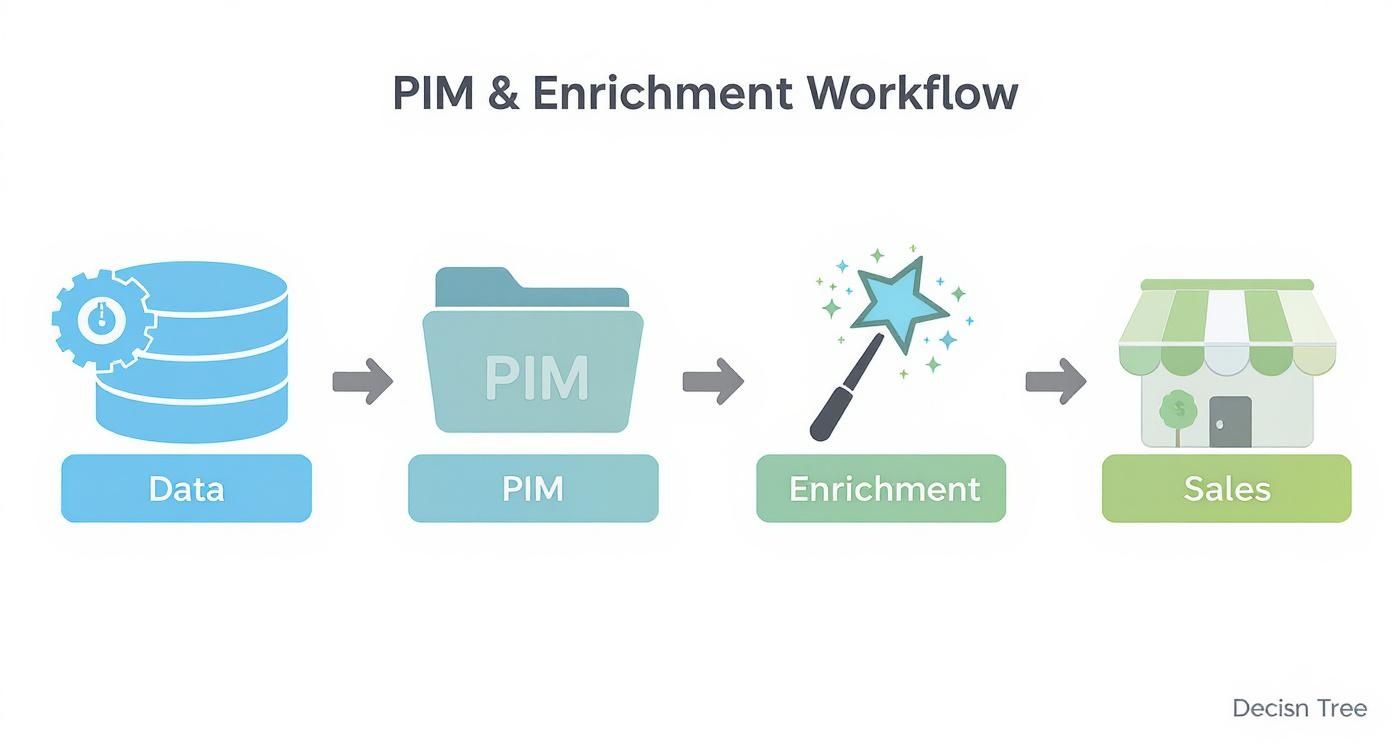
This visualises how a PIM and an enrichment platform are meant to work together, creating a high-performance content engine for your retail business.
Charting Your Path Forward
Ultimately, peak performance comes when PIM and enrichment work together. A PIM delivers the stable, governed data that an enrichment platform needs to craft compelling, unique, and search-optimised content at scale. To help you map out your next steps, you can explore potential PIM and enrichment solutions from different providers.
Whether you start with a PIM to create order or an enrichment platform to drive performance, the key is to see this as the first move on your journey toward an AI-powered retail transformation. Your choice will define how quickly you can solve content bottlenecks, achieve scalable SEO, and position your brand for the coming era of agentic commerce.
Frequently Asked Questions
Here are some of the most common questions we hear from retail managers and ecommerce leaders figuring out whether a PIM or a Product Data Enrichment platform is the right move.
Can a PIM System Handle Product Data Enrichment On Its Own?
While some newer PIMs have basic features like attribute mapping, they aren't built for sophisticated content optimisation at scale. A PIM’s real job is data governance, making sure you have one single source of truth for all your SKUs.
Real enrichment, the kind that involves writing unique, SEO-ready descriptions, adding AI-powered image tags, and creating structured data for AI agents like Google Search and Amazon Rufus, calls for a dedicated Product Data Enrichment platform. These platforms use generative AI and smart retail content automation to turn your raw data into marketing assets that actually perform.
We Already Have a PIM. Why Do We Need a Separate Enrichment Solution?
That’s a great starting point. A PIM means your data is clean and organised, which is the perfect foundation. But it doesn’t make that data persuasive or easy for search engines to find. An enrichment solution takes your PIM's clean data and solves the critical problems retailers face.
A dedicated platform gets rid of duplicated supplier content, boosts your AI SEO, and improves your overall digital shelf performance. It automates the creative and optimisation work that usually creates bottlenecks, allowing you to enrich thousands of SKUs with unique content in days, not years. This is how you achieve SEO at scale for retailers and drive real growth in organic traffic and sales.
What is the ROI of AI-Driven Product Data Enrichment?
The return you get from AI-driven enrichment isn’t just about one thing; it’s a combination of financial, operational, and strategic wins that builds a strong business case for any retail leader focused on efficiency and what’s next.
- Financial ROI: Retailers see higher conversion rates and a big jump in organic traffic. This comes from better SKU-level SEO and unique content that makes your products stand out from the crowd.
- Operational ROI: The efficiency gains are massive. With AI workflow automation for retail, you cut down on manual work, clear out content backlogs, and get new products to market much faster.
- Strategic ROI: This isn't just about today. You're setting your business up for agentic commerce and the future of AI-powered search. It ensures your products are found and understood by the next generation of shopping assistants, giving you a lasting competitive edge.
Turning your manual content process into an automated, AI-driven workflow doesn't just lift sales now, it positions your brand to win in the future of retail search. It’s a strategic move that builds a more resilient and high-performing ecommerce operation.
Ultimately, a PIM and an enrichment platform work together to create a powerful engine for growth. The PIM provides the clean fuel, and the enrichment platform optimises it for peak performance on the digital shelf, getting your business ready for the next wave of AI agents in ecommerce.
Ready to move from manual SEO to an AI-powered content strategy? Optidan AI turns your raw product feeds into thousands of unique, optimised pages in days, enhancing your digital shelf performance and preparing you for the future of agentic commerce. Discover how our automated content workflows can transform your retail business.
