


For Australian retail leaders, a traditional Product Information Management (PIM) system used to be the gold standard for control and order. It was a digital library for product data, and for a while, that was enough.
But in today's retail climate, it has become a bottleneck. To compete in an era of AI-powered search and automation, retailers must move beyond this digital filing cabinet. The future is a living product data ecosystem, one that actively enhances, optimises, and drives performance on the digital shelf. This shift represents the move from manual SEO to AI SEO, a critical step for staying competitive.
The Limitations of Legacy PIM Systems
Let’s be clear: your PIM is probably great at its core job of storing and organising product information. It’s a reliable single source of truth for basic SKU data, dimensions, and supplier codes. But it was never designed to be a dynamic, strategic asset for growth in the age of agentic commerce.
The reality for modern retail is that a static PIM creates more problems than it solves. It cannot keep up with the sheer scale and speed required for modern ecommerce, leaving your teams stuck in manual, soul-destroying workflows. This is a classic example of a retail content bottleneck that hinders growth.
The result? A product catalogue that is merely managed, not optimised for performance.
Correcting Duplicated Supplier Content
One of the biggest drags on performance from a standard PIM is its inability to tackle duplicated supplier content. When you ingest hundreds of supplier feeds, you inherit their generic, uninspired, and often identical product descriptions. This is a massive SEO own-goal that leads to duplication penalties.
A PIM can tell you that two different suppliers provided the same description for a similar product. What it cannot do is use AI to rewrite one of them to reflect your brand's unique voice, inject target keywords, and ensure both pages can rank independently without cannibalising each other.
This passive approach leaves your team with the impossible task of manually fixing thousands of pages. A living ecosystem, on the other hand, uses AI workflow automation for retail to identify and rewrite this duplicate content systematically. It turns a significant SEO risk into a genuine competitive advantage by building unique product descriptions at scale.
Preparing for an AI-Powered Future
The future of work in retail isn't about users typing keywords into a search bar. It's about AI agents conducting complex queries on their behalf. Agentic search, powered by models like ChatGPT, Perplexity, and Amazon's Rufus, requires deeply structured, attribute-rich, and contextually relevant product data. Your PIM was never designed for this world of agentic search optimisation.
Key limitations include:
- Lack of Enrichment: A PIM stores data, but it doesn't enrich it. It won't analyse a product image and automatically generate tags for "mid-century modern," "walnut finish," or "bouclé fabric", all critical for things like furniture image tagging SEO. This is where product data enrichment becomes vital.
- Static Nature: It can’t dynamically create optimised content tailored for different channels or audiences. Multi-channel product optimisation demands adaptation, not just syndication.
- Inability to Scale Optimisation: Manually optimising 10,000+ pages for agentic search is a non-starter. This is where AI SEO and scalable SEO solutions become absolutely essential for achieving retail efficiency.
To truly support a living product data ecosystem, a robust and adaptable ecommerce platform is the crucial backbone. Investing in a future-ready setup means finding the right ecommerce platform that can grow with these new demands.
Traditional PIM vs Living Product Data Ecosystem
The shift from a static PIM to a living ecosystem isn't just an upgrade; it's a fundamental change in how you treat product data, from a liability to be managed into an asset to be leveraged. It’s the core difference between traditional SEO teams and next-gen SEO for retailers.
| Feature | Traditional PIM | Living Product Data Ecosystem |
|---|---|---|
| Core Function | Static storage and organisation | Dynamic optimisation and enrichment |
| Content Handling | Stores supplier-provided content | Identifies, rewrites, and enhances content at scale |
| Workflow | Manual, requiring team intervention | Automated, using AI to manage and improve data |
| AI Readiness | Lacks structured data for agentic search | Built to provide attribute-rich data for AI agents |
| Strategic Value | An operational cost centre | A revenue-driving asset that improves SEO and conversion |
| Scalability | Limited by manual processes | Scales instantly with AI-powered workflows |
This table makes the difference clear. One is about keeping records, and the other is about winning customers and improving digital shelf performance.
The global PIM market is projected to reach USD 37.02 billion by 2030, showing just how much businesses are investing in data management. In Australia, this trend is even more pronounced, driven by the need for omni-channel consistency and compliance.
This is pushing businesses to adopt systems that extend far beyond a traditional PIM's capabilities. It’s no longer about just storing data; it’s about putting that data to work through retail content automation.
Building Your Foundation with AI Data Enrichment
A living product data ecosystem isn't just about storing information; it's about actively turning that data into a valuable asset. The first real step is to take all that raw, often chaotic, supplier data and transform it into something optimised and structured. This isn't a job for manual data entry, it’s about letting smart AI workflow automation for retail do the heavy lifting.
It all starts with ingesting messy supplier feeds. Anyone in retail knows what these look like: riddled with inconsistencies, missing attributes, and worst of all, generic, duplicated content. For an Australian retailer juggling thousands of SKUs, this flood of identical descriptions is a huge SEO liability. It tells search engines your pages offer nothing new, which directly tanks your digital shelf performance.
This is where AI agents for retail efficiency really shine. Instead of a team spending months manually rewriting copy, these agents can process an entire catalogue. They generate unique, brand-aligned product descriptions, titles, and metadata right down to the individual SKU. This is automating product descriptions effectively.
From Duplication to Differentiation
Tackling supplier content duplication is one of the quickest and most impactful wins you can get. A traditional PIM might flag a duplicate entry, but a living ecosystem powered by AI actually solves the problem at the source.
Let's say you're an electronics retailer. You get feeds from three different suppliers for the exact same TV model, and the descriptions are almost word-for-word identical. An AI workflow can jump in and:
- Pull out the core technical specs (screen size, resolution, refresh rate).
- Analyse your brand’s specific tone of voice.
- Generate three completely distinct, SEO-optimised descriptions. Each one might highlight a different benefit, one for gaming performance, another for the cinematic experience, and a third for its smart home integration.
This automated approach turns a duplicate content SEO fix from a logistical nightmare into a real strategic advantage. Now, every single product page has a unique reason to rank, a cornerstone of electronics SEO optimisation.
By systematically wiping out duplicated content, we've seen retailers get a major lift in organic visibility and a sharp drop in page cannibalisation. This is what SEO at scale looks like, turning a defensive chore into an offensive play for market leadership.
Architecting Scalable Content Workflows
The real power here is in creating automated content workflows that can handle massive scale. We're talking about a system that can process 10,000+ pages in days, not months. It completely removes the content bottleneck that holds back so many growing retail businesses. This is the core of true ecommerce SEO automation.
The infographic below shows how you move from a static PIM to this dynamic, living ecosystem.
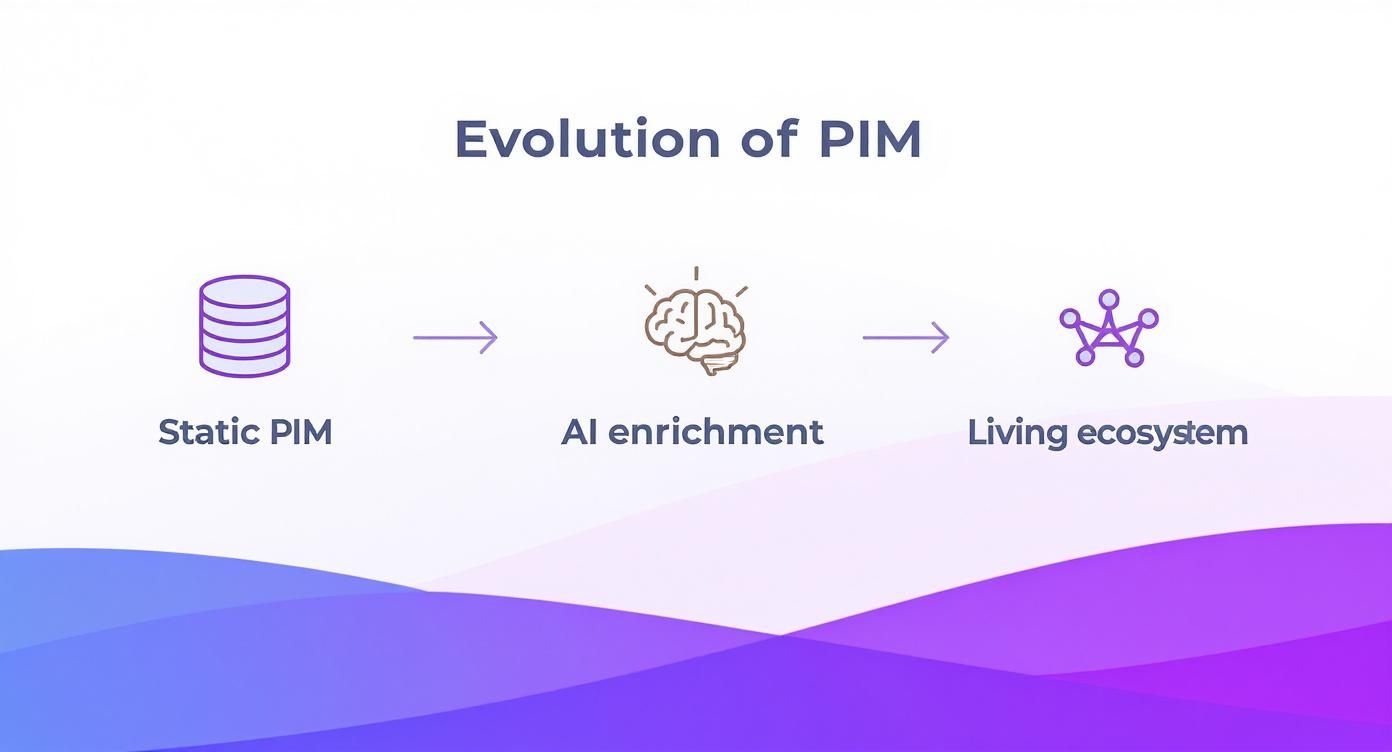
As you can see, that middle step, AI enrichment, is the engine that turns a simple database into a high-performance strategic asset.
A scalable workflow is about more than just rewriting descriptions. It's a complete product feed optimisation process. It standardises attributes, cleans up messy data, and gets your entire catalogue ready for the next wave of search. For retailers wanting to get into the nitty-gritty, our guide offers a deeper look into product data enrichment. It’s all about building AI-compatible SEO content from the ground up.
This foundational layer makes sure every bit of product data is clean, unique, and strategically optimised. It's built to be understood by both human shoppers and the AI agents that will increasingly guide their buying decisions. It's the critical first step in building a truly living ecosystem that drives retail search visibility and gets your business ready for what's next.
Unlocking Value with AI Image Recognition
When you're selling anything visual, think fashion, furniture, or electronics, the product image often does more heavy lifting than the description. A living product data ecosystem gets this. It uses AI image recognition to transform those pictures from simple visuals into a goldmine of structured, high-value data.
This isn't just about creating better alt tags. We are talking about a whole new layer of product enrichment that fuels your digital shelf performance and gets you ready for the future of agentic commerce.
Traditional PIMs see images as static files, maybe linked to a SKU. That's old-school thinking. An AI-driven ecosystem, on the other hand, sees them as a rich source of untapped information, analysing every pixel to identify and tag crucial attributes that a supplier feed would almost certainly miss.

This process unlocks huge potential. It massively boosts your SEO, enhances the user experience, and prepares your entire catalogue for the hyper-specific, visual-first nature of tomorrow's retail search.
From Pixels to Performance Data
Let's make this real. Say you're a furniture retailer and a supplier sends over a crisp photo of a new armchair. An AI image recognition SEO workflow doesn't just see "armchair." It instantly identifies and tags a host of specific attributes:
- Style: Mid-Century Modern, Scandinavian, Industrial
- Material: Bouclé fabric, Walnut wood legs, Brass accents
- Colour: Off-white, Natural wood, Gold
- Features: Wingback design, Button-tufted, Tapered legs
This kind of automated furniture image tagging SEO instantly generates dozens of specific, long-tail keywords for a single product. All of a sudden, you’re not just trying to rank for "armchair." You're showing up for "off-white bouclé wingback chair with walnut legs", a search query that screams purchase intent and brings in highly qualified shoppers. This is a core part of effective furniture SEO services.
This level of granular detail is flat-out impossible to achieve manually, especially if you have hundreds or thousands of products. By embedding AI image recognition into your content workflows, you turn your visual assets from static pictures into a powerful engine for discovery and conversion.
This newly enriched visual data then flows directly into other critical parts of your retail operation. It can power more intelligent faceted search filters on your website, sharpen the accuracy of your product recommendations, and ensure your products appear in relevant visual searches on platforms like Google Lens.
Preparing for the Future of Agentic Search
The value here goes well beyond today’s search engines. We are rapidly moving into an era of agentic search optimisation, where AI shopping agents will make buying decisions on behalf of users. These agents will rely entirely on structured data to do their job.
A query like, "Find me a pet-friendly, dark grey linen sofa that fits a coastal decor style," won't be answered by a human browsing websites. It will be answered by an AI agent that can process these exact, visually-derived attributes in seconds. This is the agentic commerce future.
Retailers who have already tagged their products with this level of detail will have a massive head start. Their products will be easily understood and recommended by AI agents like ChatGPT, Perplexity, and Amazon's Rufus, making their catalogue genuinely AI-compatible.
This is also a vital piece of metadata optimisation at scale. With thousands of SKUs, manually tagging every image with nuanced attributes is a non-starter. AI-powered content workflows make the process efficient and systematic, ensuring every single product is optimised for the next generation of search.
This fundamental shift highlights the difference between AI SEO vs traditional SEO. It's no longer just about text-based keywords. It’s about building a complete, multi-modal data profile for every product. By unlocking the data trapped inside your images, you're not just optimising for today, you’re future-proofing your business for the agentic commerce world of tomorrow.
Winning the Digital Shelf with Agentic Search
Let's be clear: a living product data ecosystem isn't just a clever way to improve internal workflows. Its real purpose is to completely dominate the digital shelf of the future. Once you’ve enriched your supplier feeds and started pulling structured data from your images, the next move is to activate all that powerful information for the new world of agentic search optimisation. This is where your investment starts paying for itself in visibility and sales.
The game has totally changed. Old-school SEO was all about matching keywords to pages. AI SEO, on the other hand, is about getting your data ready to be understood, interpreted, and ultimately recommended by AI agents like ChatGPT, Perplexity, and Amazon's Rufus. These tools don't just search for you; they evaluate, compare, and make decisions for the user. This is the new reality of AI shopping SEO.
https://www.youtube.com/embed/15_pppse4fY
To win here, your product pages need to be the definitive source of truth, answering complex, conversational questions. This isn't a small tweak; it's a fundamental shift in how you think about and present product information.
What AI-Compatible SEO Content Looks Like
Content that's ready for AI goes way beyond a few fluffy marketing lines. It's about building a complete product story from a solid foundation of granular, structured attributes. For an AI shopping agent, a vague description is noise. A detailed set of attributes? That’s a clear signal of relevance.
This means your product feed optimisation has to be laser-focused on creating data that answers questions before a shopper even thinks to ask them. Imagine an AI agent processing a query like, "find me a quiet, energy-efficient dishwasher for an open-plan kitchen." It needs to find structured data for:
- Noise Level: A specific number, like 44 dB.
- Energy Star Rating: The actual certification and annual kWh consumption.
- Capacity: How many place settings it holds.
- Features: Specifics like "third rack," "bottle jets," or "soil sensors."
- Suitability: Contextual tags like "open-plan living" or "quiet operation."
Here’s the key difference between AI SEO vs traditional SEO: old SEO might target the phrase "quiet dishwasher." AI SEO provides the specific decibel rating, the energy data, and the contextual tags that allow an AI agent to confidently conclude why your product is the best choice for that open-plan kitchen.
Structuring Data for AI Recommendations
If you want AI agents to recommend your products, your data needs to be structured for machines, not just for people flicking through your website. That’s the core of SEO for AI agents. It’s about giving them clean, unambiguous data points they can easily compare and rank.
This kind of proactive data structuring is becoming more important every day. We're seeing government and industry bodies push for better digital infrastructure. For example, the Australian Bureau of Statistics is launching a revised Business Characteristics Survey in 2025-26, which will include digital activity metrics to get better microeconomic insights. Initiatives like this, detailed in the ABS corporate plan, are laying the groundwork for the kind of granular, cloud-enabled data that modern retail absolutely needs to build resilient product ecosystems.
Optimising Product Narratives at Scale
Trying to create these deeply detailed product narratives for thousands of SKUs manually is a non-starter. It's just not possible. You need AI-powered content workflows that can weave all that structured data into compelling, human-friendly descriptions, while making sure every critical attribute is there for the AI agents.
This is what we mean by agentic SEO. It's about building a system where your enriched data automatically populates templates designed for both people and machines, letting you create thousands of perfectly optimised pages in a matter of days. This scalable approach is the only way to get your entire catalogue ready for the future of agentic commerce. To get a much deeper look into how this all works, check out our guide on preparing your product catalogue for agentic search.
By turning your static product info into a living, attribute-rich ecosystem, you're doing more than just improving your current SEO. You're building a foundational asset that guarantees your products are seen, understood, and recommended in the next generation of retail.
Embedding AI Into Your Retail Workflows
Setting up a living product data ecosystem isn't a "set and forget" project. It’s a permanent operational shift that completely redefines how retail teams work. You’re moving your people away from reactive data entry and into a world of proactive, strategic optimisation.
It's all about building smarter, automated content workflows. Let the AI agents in ecommerce handle the repetitive, high-volume tasks so your human experts can focus on driving strategy, refining the output, and making sure your digital shelf performance is top-notch.
This isn't some futuristic idea; it's happening right now in Australia. The Australian Industry Group's 2025 outlook shows a massive +67 net balance in technology and innovation optimism. As they outlined in their outlook on Australian industry, Aussie companies are investing heavily in advanced systems to make their operations more nimble and improve customer experiences in real time.

Human-Led AI Content Quality Assurance
One of the most important new roles in this new world is human-led AI content QA. Sure, an AI can pump out thousands of unique product descriptions in a few minutes, but it cannot perfectly capture brand voice, subtle nuances, or strategic messaging on its own. That's where your team's oversight becomes absolutely critical, especially when you're managing a massive catalogue.
This isn’t about your team manually proofreading every single word. It's about creating a smart framework where they review a strategic sample of the AI-generated content. Their feedback is then used to tweak the AI's prompts and models, creating a powerful loop of continuous improvement.
Think about a fashion retailer. Their AI might generate technically perfect descriptions for a new line of dresses. But a human QA expert would step in to ensure the language truly connects with the target audience, maybe shifting the tone from simply descriptive to something more aspirational and on-trend. This human + AI collaboration in SEO is the key to getting both technical accuracy and genuine brand authenticity.
Redefining Roles From Manual Entry to Strategic Optimisation
This new ecosystem gives your team a massive upgrade by killing off the soul-crushing job of manual data entry. Instead of spending their days copying and pasting supplier specs, their roles evolve. They become strategists and analysts.
This is the future of work in retail:
- AI Agents take care of the heavy lifting. Think correcting supplier content duplication, writing initial drafts of product descriptions, and handling basic product feed optimisation.
- Human Experts focus on the high-value stuff. They're refining AI prompts, doing deep-dive competitor analysis, spotting new content opportunities, and overseeing the quality of the entire ecosystem.
This shift completely shatters content bottlenecks. It frees your team to work on strategic projects that actually grow revenue, instead of being trapped in a never-ending cycle of data maintenance. It’s the definition of working smarter, not harder.
Building Automated Content Workflows
The end game here is to create solid, automated content workflows that plug right into your daily operations. These workflows are the engine behind SEO at scale, letting you roll out complex optimisation strategies across thousands of SKUs with very little manual effort. To see this in action, you can dig into the real driver of AI ROI for retailers.
These automated systems do more than just write copy; they manage the entire content lifecycle. It becomes a well-oiled machine that starts by pulling in raw supplier data, enriches it with AI-generated copy and image tags, and finishes by sending it out to all your different channels. This delivers an incredible level of retail efficiency, setting your business up to win in the new world of agentic commerce.
Frequently Asked Questions
Moving from a standard PIM to a living product data ecosystem is a big step. It’s natural for retail leaders and ecommerce managers to have questions about how it all works, what to expect, and how AI fits in. Here are some straight answers to the most common queries we hear.
What Is the Biggest Difference Between This and Our Current PIM?
The simplest way to think about it is moving from a passive database to an active, dynamic asset. A traditional PIM is just storage for your product information. A living product data ecosystem, on the other hand, uses AI workflow automation for retail to constantly enrich, correct, and optimise that data for actual performance.
It’s the difference between a system that just holds whatever content your suppliers send over and one that’s actively fixing supplier content duplication, writing unique descriptions, and structuring all that data for the future of retail search. Your PIM is a library; a living ecosystem is your strategic content factory.
How Do We Prepare Our Team for These New AI Workflows?
Getting your team ready is less about technical skills and more about shifting mindsets. The goal is to move them away from tedious, manual data entry and toward strategic oversight. Instead of copying and pasting, they’ll be analysing performance and refining the system.
This AI-powered retail transformation really comes down to a few key areas:
- Training on New Tools: Get your team comfortable with the AI platforms that will handle the heavy lifting of content creation and optimising product feeds efficiently.
- Defining QA Processes: You still need a human touch. Set up clear guidelines for human-led AI content QA to ensure your brand voice and accuracy are locked in across thousands of SKUs.
- Focusing on Strategy: Free up your team to analyse digital shelf performance, spot content gaps, and tweak AI prompts for better results. This is where the real value of human + AI collaboration in SEO shines.
Ultimately, you’re turning your team into system optimisers, not data clerks. This focus on retail teams and AI efficiency is central to the future of work.
How Long Until We See Improvements in Digital Shelf Performance?
Every catalogue is different, of course, but you can see results surprisingly fast. That’s the power of doing SEO at scale. Once the AI-powered content workflows are humming, the first changes can appear within weeks.
A huge advantage is the ability to tackle widespread problems like duplicate content almost instantly. When you correct thousands of pages with unique, optimised content, you can see noticeable ranking improvements within the first 1-2 months as search engines recrawl your site.
Deeper benefits, like getting ahead in agentic search, build over a longer period as your highly structured data starts to build authority. We cover a lot of these concepts in our detailed guide on Agentic AI SEO content optimisation FAQs.
What Is the ROI on Implementing an AI-Driven Ecosystem?
The return on investment shows up in a few key areas, building a strong business case that goes far beyond just saving time. It’s about creating real growth and a competitive advantage that’s hard to copy.
Here’s where you’ll see the biggest returns:
- More Organic Traffic: By fixing duplicate content and applying SKU-level SEO across your entire catalogue, you directly improve search visibility and rankings.
- Higher Conversion Rates: Richer content, detailed attributes pulled from AI image recognition, and unique descriptions give shoppers the confidence they need to click "buy".
- Serious Operational Efficiency: Slashing the manual effort needed for content management frees up your team to focus on strategy, which has a direct impact on productivity. These are the kinds of retail efficiency tools that transform operations.
- Future-Proofing Your Business: Building an AI-compatible SEO foundation today means you're ready for the next wave of agentic commerce, protecting your revenue streams for years to come.
This isn't just about fixing today’s content problems; it’s about setting your business up to win in tomorrow’s search world.
Ready to move beyond your PIM and build a true performance asset? Optidan AI uses AI-powered content workflows to help leading retailers achieve SEO at scale, fix duplicated content, and dominate the digital shelf. Learn how we can transform your product catalogue today.
