

While they're often lumped together, PIM, DAM, and Product Optimisation Platforms play completely different roles in a retail tech stack. Think of it this way: a Product Information Management (PIM) system is your central library for structured product data, all the SKUs, specs, and logistical details. A Digital Asset Management (DAM) system is the vault for your media, like product images, videos, and brand creative.
Then you have a Product Optimisation Platform. This is the strategic engine that takes the raw data from your PIM and the beautiful assets from your DAM and turns them into high-performance, customer-facing content. It's the missing piece that connects storage to sales, moving you from manual SEO to AI SEO.
Choosing Your Core Retail Technology Stack
For Australian retail leaders, picking the right technology isn't just about efficiency; it's a critical move for gaining a competitive edge. The real difference between these three platforms isn't just what they do, but why they do it.
A PIM is foundational, laser-focused on data accuracy and consistency. A DAM is all about organisation, ensuring brand control and proper asset governance. Together, they create a solid base of reliable information and media. It's a great start.
But here’s the thing: neither a PIM nor a DAM is built to drive search performance or automate customer-facing content at scale. That’s just not their job.
This is exactly where a Product Optimisation Platform comes in. It plugs into your existing systems and focuses exclusively on performance outcomes. We’re talking about improving your digital shelf performance, climbing the search rankings, and getting your entire catalogue ready for the future of retail search, which includes AI shopping agents like Rufus and Perplexity. This is about building AI-compatible SEO content for the agentic commerce future.
This strategic layer is what turns your static product repository into a dynamic sales driver. It’s built to solve the tough retail challenges that PIM and DAM systems simply can't touch on their own:
- Correcting Duplicated Supplier Content: Using generative AI to create unique, compelling product descriptions that sidestep SEO penalties and build a distinct brand voice. This is a core part of effective ecommerce content quality assurance.
- AI SEO at Scale: Applying advanced optimisation techniques across thousands of SKUs in days, not months. This AI-powered content workflow makes scalable SEO solutions a reality for retailers.
- Product Data Enrichment: Turning basic, boring supplier feeds into rich, structured product content that’s primed and ready for agentic search.
- Automated Image Recognition & Tagging: Boosting image SEO for ecommerce by automatically generating descriptive alt tags for every item in your fashion or furniture catalogue.
For any of this to work seamlessly, understanding API integration is non-negotiable. It’s what allows your PIM, DAM, and product optimisation platform to talk to each other and share data efficiently. The goal is a fluid ecosystem where data flows from storage (PIM/DAM) straight into an optimisation engine that powers real growth, a prime example of AI workflow automation for retail.
Platform At a Glance: PIM vs DAM vs Product Optimisation
To put it simply, each platform has a distinct job to do. This table breaks down their core purpose, who uses them, and the business outcome they’re designed to deliver.
| Platform | Core Purpose | Primary Users | Key Business Outcome |
|---|---|---|---|
| PIM | Centralise and manage structured product data. | Product Managers, Data Stewards | Data accuracy & consistency across channels. |
| DAM | Store, organise, and distribute digital media assets. | Marketing Teams, Creatives | Brand consistency & asset governance. |
| Product Optimisation | Transform data & assets into high-performance content. | SEO & Ecommerce Managers | Increased search visibility & conversions. |
As you can see, it's not about choosing one over the other. It's about understanding how they work together, with the optimisation platform acting as the performance layer that turns your well-managed data and assets into revenue.
The Foundational Role of Product Information Management (PIM)
Think of a Product Information Management (PIM) system as the operational backbone for any serious retail operation. Its core mission is simple but critical: create a single source of truth for all your structured product data. It pulls information from messy supplier feeds, ERPs, and spreadsheets into one centralised, reliable hub.
For Australian retailers juggling thousands of SKUs, a PIM isn't a 'nice-to-have', it's a necessity. It’s what enforces data governance, cleans up inconsistent supplier data, and ensures the information pushed to your website, marketplaces, and physical stores is accurate and uniform. This focus on operational efficiency provides the clean, structured data that’s essential for any downstream optimisation, setting the stage for more advanced AI workflows for ecommerce.
Core Functions and Business Impact
At its heart, a PIM system is about control and consistency. By managing every product attribute, from technical specifications to logistics data, it solves one of retail’s biggest headaches: supplier content duplication. It provides the framework to standardise this information long before it ever reaches a customer, preventing the manual errors that cost real time and money.
The impact of this centralisation is huge. The global PIM market is tipped to grow to over USD 37 billion by 2030, with the Asia-Pacific region, including Australia, showing some of the fastest adoption. Australian businesses are particularly leaning into cloud-based PIMs, which can slash the total cost of ownership by 45-55% by ditching on-premise servers and allowing for dynamic scaling during peak retail seasons.
The Limits of a PIM in Modern Retail
While a PIM is absolutely essential, its role is primarily internal and operational. It’s built to manage data, not to optimise it for search performance or customer engagement.
A PIM delivers clean, organised data. It does not, however, create unique, SEO-rich product descriptions or prepare your catalogue for the nuances of agentic search and AI shopping assistants. That’s where its role ends.
This is a crucial distinction for any ecommerce manager. A PIM provides the raw materials, but it doesn't build the high-performance final product. To learn more about this, check out our guide on building a living product data ecosystem. For true digital shelf performance, retailers need a solution that takes this clean data and transforms it into content that actively drives traffic and conversions. It’s about bridging that gap from data management to revenue generation.
Why Digital Asset Management (DAM) Is Non-Negotiable
While a PIM is the master of structured text and numbers, a Digital Asset Management (DAM) system is the guardian of your brand’s visual soul. Think of it as a secure, central library for all your rich media, from high-res product photos and campaign videos to brand logos and marketing brochures. Its entire purpose is to store, organise, and control how these critical assets get used.
For Australian ecommerce managers in visual-heavy sectors like fashion, furniture, or beauty, a DAM isn’t a nice-to-have; it's essential. It’s what keeps your brand looking consistent across every channel. It also gives you tight control over who uses what, preventing that outdated or unapproved image from ever making its way to a customer. This organised approach delivers the high-quality assets that are the perfect partner to the data living in your PIM.

Asset Governance Over Performance Optimisation
A DAM is all about governance, not performance. Its core features are built around control and accessibility for your internal teams. It focuses on:
- Centralised Storage: A single source of truth for all creative assets, finally ending the chaos of files scattered across local drives.
- Advanced Metadata Tagging: Makes assets easy to find using keywords, product codes, or campaign names. This is the foundation for any future AI Image Recognition SEO.
- Version Control: Ensures marketing and creative teams are always using the most current, approved version of an asset.
- Rights Management: Controls who can access, use, and share assets, which is critical for managing licensed content and campaign-specific imagery.
This push for organised, accessible brand assets is reflected in the market’s rapid growth. The Australian Digital Asset Management market was valued at around USD 88.9 million in 2024 and is forecast to hit USD 412.4 million by 2033. That explosion is tied directly to Australia's booming ecommerce sector, which needs efficient systems to handle huge volumes of product media. You can read more about the growth of Australia's DAM market on imarcgroup.com.
The DAM and PIM Partnership
A DAM truly shines when it’s tightly integrated with a PIM. The PIM holds the SKU-level data, while the DAM serves up the corresponding lifestyle images and packshots. It’s a powerful combination that ensures when product information is sent to a new sales channel, the correct, high-quality visuals are automatically pulled along with it.
But here’s the catch: a DAM does not optimise these assets for search. It won’t write compelling, keyword-rich alt tags or make sure your images are structured to appear in AI-driven shopping results. Its job is to serve the correct file, not to make that file a performance driver.
This is where the limitations become clear. While a DAM is non-negotiable for brand management, it doesn’t solve the critical need for SKU-level SEO or improving your digital shelf performance. To bridge that gap, you can explore how AI makes it possible to deliver unique, site-wide brand content in 30 days. That requires a platform built specifically for content optimisation.
The Strategic Impact of Product Optimisation Platforms
Think of a Product Optimisation Platform as the strategic layer that sits on top of your existing tech stack, bridging the critical gap between just storing your data and actually making money from it. It’s designed to take all that raw product data and your beautiful digital assets and turn them into high-performing, search-optimised content on a massive scale.
Unlike a PIM or a DAM, its main job isn't storage, it's commercial performance.
These platforms plug into the systems you already use, pulling clean, structured data from your PIM and high-quality assets from your DAM. From there, they use AI workflow automation to solve the big retail problems that storage systems were never built to handle. It's the difference between having organised data and having data that actively sells your products.
From Data Management to Revenue Generation
At its core, a product optimisation platform is all about turning static information into dynamic content that performs. This is where retailers can finally move beyond tedious manual SEO and embrace AI SEO, hitting a level of scale and precision that was simply out of reach before. This is the core of the AI SEO vs Traditional SEO debate.
What does that look like in practice?
- Automating Product Descriptions: Using generative AI to write unique, on-brand descriptions for every single SKU. This directly tackles the problem of supplier content duplication and helps you avoid the SEO penalties that come with it.
- Product Data Enrichment: It takes basic supplier feeds and transforms them into rich, structured content formatted for agentic search optimisation. This ensures your products can be properly understood and recommended by AI shopping agents like Rufus or Perplexity.
- SKU-Level SEO at Scale: Imagine rolling out sophisticated SEO strategies across more than 10,000 pages in just days. That’s a task that would take a traditional team months, if not years, to get through.
Where a PIM or DAM worries about the accuracy and organisation of your internal data, a Product Optimisation Platform is completely focused on the external performance of your content. Its success is measured by hard metrics: better rankings, more traffic, and higher conversions on the digital shelf.
This shift in focus is what really matters. While DAM adoption is certainly growing in Australia for asset organisation, vendors like databasics reported a 30% customer base expansion in a single year, optimisation platforms answer the next logical question: how do we make all those assets actually work for us? You can discover insights about who uses digital asset management on databasics.com.au.
To get a clearer picture, let's break down how each platform handles core retail tasks. While PIM and DAM systems excel at organisation and storage, a Product Optimisation Platform is built for activation, turning stored information into revenue-generating content.
Core Functionality Comparison
| Function | PIM (Product Information Management) | DAM (Digital Asset Management) | Product Optimisation Platform |
|---|---|---|---|
| Product Descriptions | Stores and centralises basic text descriptions and technical specs. | Not its primary function; stores assets associated with products. | Generates unique, SEO-optimised, and brand-aligned descriptions at scale using AI. |
| Image SEO | May store alt text as a data field, but requires manual input. | Centralises images and their metadata but doesn’t actively optimise them for search. | Uses AI image recognition to automatically generate descriptive alt tags and metadata for improved visibility. |
| Data Enrichment | Facilitates manual enrichment by centralising data entry workflows. | Enriches assets with metadata like usage rights, but not product-specific attributes. | Automates enrichment, transforming basic supplier data into structured, search-ready content. |
| Content Uniqueness | Stores supplier content, often leading to duplication issues if not manually overwritten. | Stores assets, which are typically unique, but doesn’t address text duplication. | Eliminates duplication by rewriting supplier content into original copy for every SKU. |
| Search Optimisation | Provides the data for SEO but doesn't perform the optimisation itself. | Provides the assets for SEO but doesn't optimise the surrounding content. | Executes SEO strategies across the entire catalogue, from keyword integration to internal linking. |
As the table shows, a Product Optimisation Platform doesn't replace your PIM or DAM. Instead, it leverages their organised data and assets to drive real commercial outcomes, filling a crucial gap in the modern retail tech stack.
AI-Powered Optimisation for Modern Retail
A huge differentiator for these platforms is how they use AI for much more than just simple data management. Take AI image recognition SEO, for example. This is an absolute game-changer for retailers in visual categories like fashion or furniture.
By automatically analysing product images, the platform generates highly specific and descriptive alt tags that give your image SEO for ecommerce a massive boost. This automated approach to fashion product image SEO or furniture image tagging SEO ensures every single visual asset is actively contributing to your search visibility. This comprehensive strategy is a key part of how end-to-end product optimisation reduces retail operating costs, it automates thousands of hours of manual work.
Ultimately, these platforms are about future-proofing your retail operation. They deliver the scalable SEO solutions and automated content workflows you need to compete in an era defined by agentic commerce and AI-driven search. They turn your product catalogue from a simple database into your most powerful marketing asset.
How to Choose the Right Platform for Your Business Goals
Figuring out whether you need a PIM, a DAM, or a Product Optimisation Platform isn’t about finding the “best” tool. It's about correctly diagnosing your biggest business bottleneck. Each platform is a serious investment designed to solve a very specific problem, and choosing the right one comes down to where your current processes are actually breaking down.
Think of it as a process of elimination. If your biggest headache is messy, inconsistent product data creating chaos across your sales channels, your foundation is weak. A PIM is your non-negotiable first step.
What if your data is clean but your marketing team is drowning in disorganised creative assets, leading to brand inconsistency? That’s an asset governance problem, and a DAM is the priority. But if both your data and assets are sorted and you’re still losing to competitors on the digital shelf, your problem isn’t storage, it's performance.
Pinpointing Your Core Challenge
To make the right call, you need to ask a few direct questions about your operations. The answers will quickly point you to where the real opportunity for improvement is hiding.
- Is our product data inconsistent across our website and marketplaces? If yes, you have a data integrity problem. Start with a PIM.
- Do our teams struggle to find and use the correct, on-brand images and videos? If yes, you have an asset governance problem. A DAM is what you need.
- Is our organic search traffic stagnant despite having organised data and assets? If yes, you have a content performance problem. You need a Product Optimisation Platform.
This decision tree gives you a clear visual path, guiding you from the primary pain point to the most logical solution.
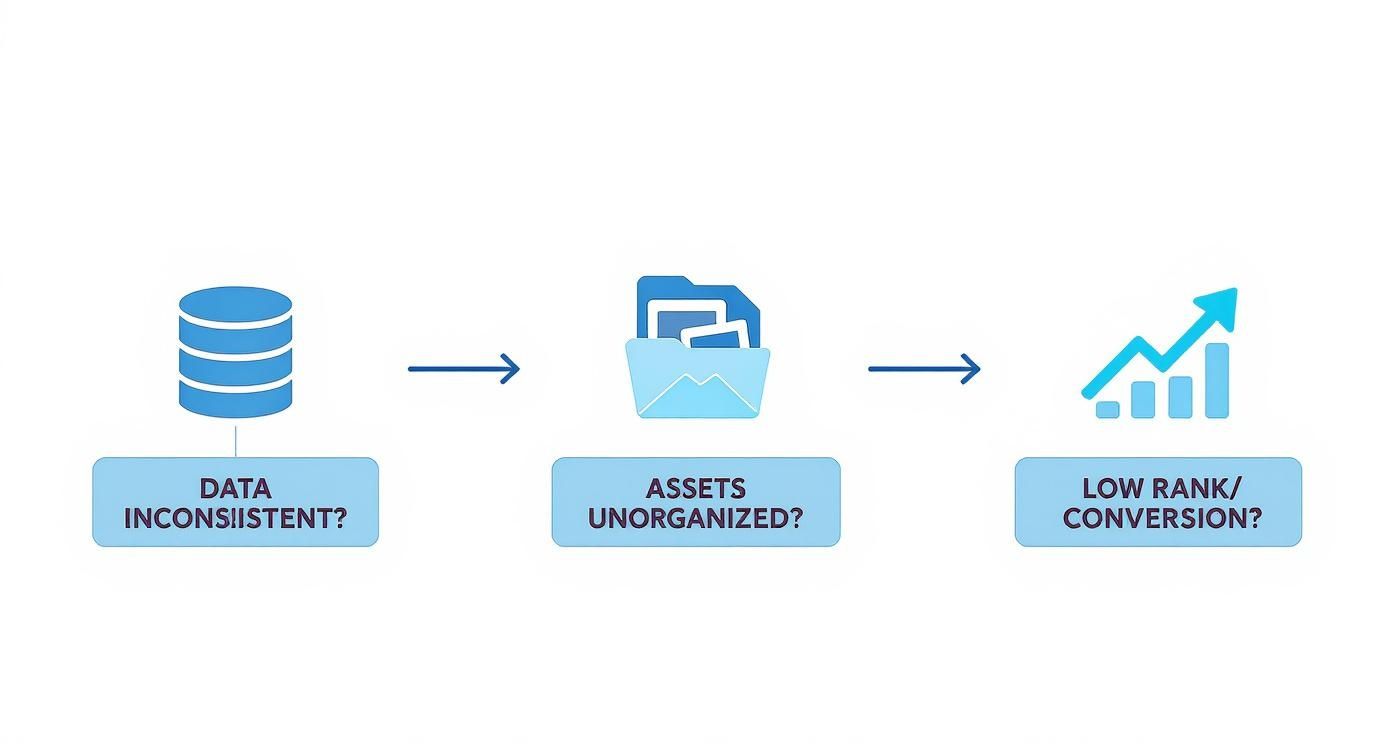
The key takeaway here is simple: getting your data and assets organised is foundational, but it doesn't automatically translate to better search rankings or more sales.
The Strategic Choice for Growth
If your foundational systems are solid but you’re failing to scale content, rank for competitive terms, or prepare for agentic search optimisation, then a Product Optimisation Platform is the strategic move. This is the investment for businesses laser-focused on AI SEO, fixing supplier content duplication at scale, and achieving superior digital shelf performance. As you evaluate options, it’s worth checking out guides on the best ecommerce platforms for small businesses to make sure your whole tech stack is working in harmony.
Ultimately, you choose a Product Optimisation Platform when the goal shifts from internal efficiency to external market dominance. It’s the tool that activates the potential sitting dormant in your PIM and DAM. It transforms static information into your most powerful driver of organic growth through advanced product data enrichment and AI-powered workflows.
Frequently Asked Questions
Here are a few of the most common questions Australian retail leaders ask when weighing up PIM, DAM, and Product Optimisation Platforms.
Can a PIM or DAM Handle AI SEO and Content Optimisation?
While modern PIM and DAM systems might have some AI features for data cleaning or basic image tagging, their core job is storage and governance. They're built to create a clean, internal source of truth for your data and brand assets, not to drive search performance.
A dedicated Product Optimisation Platform, on the other hand, is purpose-built to turn that stored information into content that actually ranks and sells. Its entire focus is on AI SEO, getting your catalogue ready for agentic search, and generating unique, optimised descriptions and metadata at scale to boost your digital shelf performance.
Think of it like this: PIM and DAM systems are the well-organised warehouses for your product information. A Product Optimisation Platform is the automated factory that turns those raw materials into a finished product ready for the customer.
Do I Need All Three Platforms for My Ecommerce Business?
Not always. The right tech stack really depends on your business's scale, maturity, and what you’re trying to achieve.
As your product catalogue grows, a PIM becomes non-negotiable for keeping data straight, and a DAM is essential for brand consistency. But a Product Optimisation Platform becomes the priority when organic search is your main growth channel and you need AI workflow automation for retail to create high-quality content across thousands of SKUs. It's about breaking through the content bottlenecks that are holding back your growth.
How Do Product Optimisation Platforms Fix Duplicated Supplier Content?
This is one of their core functions and a massive differentiator. These platforms plug into your PIM or raw supplier feeds, pull in the basic (and often duplicated) product info, and then use generative AI to rewrite unique, brand-aligned, and SEO-optimised product descriptions, titles, and attributes for every single SKU.
This automated process directly solves the supplier content duplication problem that tanks your SEO. Even better, it establishes a unique brand voice across your entire catalogue, which is crucial for standing out and improving conversions. It’s the perfect example of shifting from manual SEO to AI SEO.
What Is the Typical Integration Workflow for These Systems?
A solid workflow is all about seamless integration. Typically, your PIM and DAM connect with each other and your ecommerce platform, creating the foundation of your tech stack.
A Product Optimisation Platform then connects to this stack, usually via APIs. It pulls structured data from the PIM and the relevant digital assets from the DAM. Once the product data enrichment and optimisation is done, the high-performance content is pushed directly to your ecommerce platform or back to the PIM for syndication. This creates a smooth, automated workflow from data storage all the way to customer-facing content, showing what the future of work in retail looks like: human strategy guiding AI execution.
Ready to bridge the gap between data storage and revenue generation? Optidan AI uses AI-powered content workflows to transform your product catalogue into your most powerful marketing asset. Learn how Optidan AI can help you achieve SEO at scale and dominate the digital shelf.
