


Product attributes are the lifeblood of your ecommerce store. They are the invisible engine powering how customers find, filter, and ultimately buy your products. When this data is messy, incomplete, or inconsistent, your entire discovery process breaks down. The result? Zero-result pages, frustrated shoppers, and abandoned carts, even when the perfect product is sitting right there in your warehouse.
Why Your Website Search Fails Customers
That sinking feeling is all too familiar for retail leaders. A customer searches for a 'blue cotton shirt' and gets nothing back, despite you having dozens in stock. This is not just a random glitch in your search software; it is a symptom of a much deeper data problem. In almost every case, the real reason your faceted navigation and on-site search are failing is because of messy, inconsistent, and incomplete product attributes.

Think of your product data as the digital DNA of your catalogue. Each attribute, like 'colour', 'material', 'size', or 'style', is a genetic marker that tells your website what an item is. When these markers are missing, misspelled, or all over the place (e.g., 'Navy', 'Dark Blue', 'navy blue'), your search function effectively goes blind. It simply cannot connect the dots.
The Disorganised Digital Warehouse
Imagine a massive warehouse where none of the products have labels, or the labels are just plain wrong. A request for a specific item would be almost impossible to fulfil. This is exactly what is happening on your website when you rely on raw, duplicated supplier content. Supplier feeds are notoriously inconsistent, creating a chaotic digital shelf where nothing can be found.
This chaos leads directly to poor digital shelf performance and, more importantly, lost revenue. For any large retailer looking to improve conversions, understanding these root causes of search failure is the critical first step. The only way to stop your website search from failing customers is to implement robust ecommerce site search best practices grounded in solid data.
The table below highlights just how big the gap is between relying on messy supplier data and investing in a properly structured attribute system.
The Business Impact of Poor vs Enriched Product Attributes
| Business Metric | Impact of Poor Attributes | Impact of Enriched Attributes |
|---|---|---|
| Search Performance | High rate of "0 results" pages, low query relevance. | 90%+ reduction in search failures, high relevance. |
| Conversion Rate | Low, as customers cannot find what they want. | 15-25% uplift in conversions from search. |
| Customer Experience | High frustration, bounce rates, and cart abandonment. | Seamless filtering, intuitive navigation, higher satisfaction. |
| Operational Efficiency | Manual data cleaning, endless back-and-forth. | Automated content workflows, faster time-to-market. |
| AI Readiness | Invisible to AI shopping agents, poor data for models. | Structured, machine-readable data for AI discovery. |
As you can see, the difference is not subtle. Enriched attributes create a positive feedback loop that lifts performance across the board, while poor data creates friction at every turn.
For retail leaders, fixing this is not just a technical task; it is a strategic imperative. Correcting your product attributes is the foundation for improving customer experience, winning back lost sales, and preparing for the future of AI-driven retail search.
The shift from manual SEO to AI-powered product data enrichment is no longer just an option; it is a necessity for staying competitive. With the right AI workflow automation, retailers can finally turn messy, inconsistent supplier feeds into optimised, structured product content at scale. This ensures every single search query connects a customer with the exact product they came looking for.
The Hidden Link Between Product Data and SEO
Great on-site search is a fantastic start, but it is only one piece of the digital shelf puzzle. The critical connection many retail leaders miss is how structured product attributes directly fuel your visibility on Google.
Think about it. The granular details you use for faceted navigation, like 'material', 'colour', and 'style', are the exact long-tail keywords your highest-intent shoppers are typing into search engines. Nailing this data is the true foundation of modern retail SEO automation.
When you move from manual SEO to an AI-driven approach, you start embedding this clean, structured data across your product titles, descriptions, and metadata. This is not just about tweaking a few pages; it is about unlocking scalable SEO solutions that pull in valuable, bottom-of-funnel traffic right across your entire catalogue. For instance, a search for a "navy blue linen short-sleeve shirt" is a buyer on a mission. You can only capture that sale if 'navy blue', 'linen', and 'short-sleeve' actually exist as clean attributes in your system.
From Supplier Feeds to Search Rankings
One of the biggest hurdles for retailers is dealing with supplier content duplication. Those raw product feeds are often generic, used by dozens of your competitors, and create a massive duplicate content problem for SEO. Correcting duplicated supplier content is essential for SEO success.
By using product data enrichment to transform this raw data, you can generate unique, attribute-rich descriptions that signal quality and authority to search engines. This automated content workflow is essential for carving out a distinct brand voice and climbing the search rankings, delivering optimised content at scale.
This is especially true in Australia’s booming ecommerce market, where 9.8 million households now shop online. With shoppers demanding ever more precise product specifications, the retailers who get their product attributes right are the ones who will win. You can see more on Australia's digital shopping trends over at Meltwater.
Preparing for an Agentic Search Future
The need for structured data is only going to accelerate. The future of retail search is rapidly shifting towards Agentic Search Optimisation, where AI shopping agents like Google's AI Overviews and Amazon's Rufus will find and recommend products for users. These AI agents will rely almost exclusively on clean, structured product data to make their decisions.
In this new era of agentic commerce, catalogues with messy or incomplete attributes will not just rank poorly; they will be completely invisible. Making your product catalogue AI-compatible today is the only way to future-proof your business against this monumental shift.
This transition throws the difference between AI SEO and traditional SEO into sharp relief. Old-school methods were all about keywords. Next-gen SEO for retailers is about building a machine-readable foundation of data. Understanding the link between your metadata and customer intent is the first step. By focusing on SKU-level SEO through attribute enrichment, you ensure your products are ready for both human shoppers and the AI agents of tomorrow.
How to Build Your Attribute Strategy
Okay, let's move from theory to action. Building a proper attribute strategy is like drawing up the blueprint for your entire product data ecosystem. Without it, you end up with chaos, the kind of chaos that breaks your faceted navigation and sends customers running when they cannot find what they are looking for. This is about creating a logical, scalable system that can handle thousands of SKUs without falling apart.
This is not just a nice-to-have, either. It is absolutely essential for enabling effective AI workflow automation for retail. AI models, whether they are writing product descriptions or cleaning up messy supplier feeds, need structured, reliable data to do their job. If you feed your AI chaos, you can only expect chaos in return.
Create a Logical Product Taxonomy
First things first: you need to organise your products into a logical hierarchy. This is your product taxonomy. Think of it as creating the aisles and shelves in a physical store. You start broad, like 'Womenswear', and then get more specific: 'Dresses', then 'Cocktail Dresses'.
A well-designed taxonomy does not just make it intuitive for shoppers to browse; it provides a clear structure for all your data. More importantly, it is the skeleton you will build your attribute schema on, making sure every product has a sensible home.
Define a Consistent Attribute Schema
Once your taxonomy is locked in, you need to decide which attributes apply to each category. This is your attribute schema. For example, every product in your 'Dresses' category might need attributes like 'Colour', 'Size', 'Material', 'Neckline', and 'Sleeve Length'. But for 'Handbags', you would need a different set, like 'Material', 'Colour', and 'Strap Type'.
The real key here is consistency. A customer filtering for 'Linen' in the dress category should not get an empty results page because some products are tagged 'linen-blend' while others are tagged 'Linen Mix'. Nailing down these standardised values is critical for filter performance.
This is one of the core challenges of product data enrichment, turning messy, inconsistent supplier feeds into a clean, unified source of truth. If you're wrestling with how this differs from simply using a PIM, you can explore the nuances of product data enrichment vs a PIM in our detailed guide.
Establish Data Governance Rules
Finally, you have to establish clear rules to keep your data clean as you grow. This is all about setting standards for how new products are added and how existing ones are updated. For instance, you could implement rules that automatically reject products with missing essential attributes, or use AI agents to standardise inconsistent values before they ever go live.
For Fashion SEO Optimisation, this could mean defining a fixed list of 'fit' types ('Slim', 'Relaxed', 'Regular'). For Furniture SEO Services, it means having a controlled vocabulary for 'wood type' ('Oak', 'Pine', 'Walnut'). This kind of governance ensures your data quality does not degrade over time, protecting your investment in scalable SEO and maintaining a high-performing digital shelf.
Using AI for Product Data Enrichment at Scale
Manually enriching thousands of SKUs is the kind of retail bottleneck that drains resources and kills momentum. It is a slow, soul-crushing task in the face of modern catalogue sizes, yet it is absolutely essential for making sure your on-site search and filters actually work. This is where retailers need to shift from old-school manual SEO to a smarter, AI-driven approach that finally achieves optimisation at scale.
AI-powered workflows are the answer to this massive challenge. Just think about the process of pulling attributes from product photos, a critical job for retailers in visually driven categories like fashion or homewares. AI image recognition and tagging can automatically analyse a picture of a dress and extract attributes like 'Colour: Navy Blue', 'Pattern: Floral', and 'Neckline: V-Neck' in seconds. This is a complete game-changer for fashion SEO optimisation and furniture image tagging SEO, where those visual details are everything.
From Messy Supplier Feeds to Optimised Pages in Days
AI agents are built to take raw, messy supplier feeds and turn them into gold. Instead of your team spending months correcting duplicated content and filling in gaps, these automated workflows can fix inconsistencies, generate unique attribute-rich product descriptions, and populate your entire catalogue with clean data in days.
This allows you to achieve true SKU-level SEO and multi-channel product optimisation without the manual grind.
The diagram below shows the core pillars of a solid attribute strategy, the very process AI helps execute at a speed that was once unimaginable.
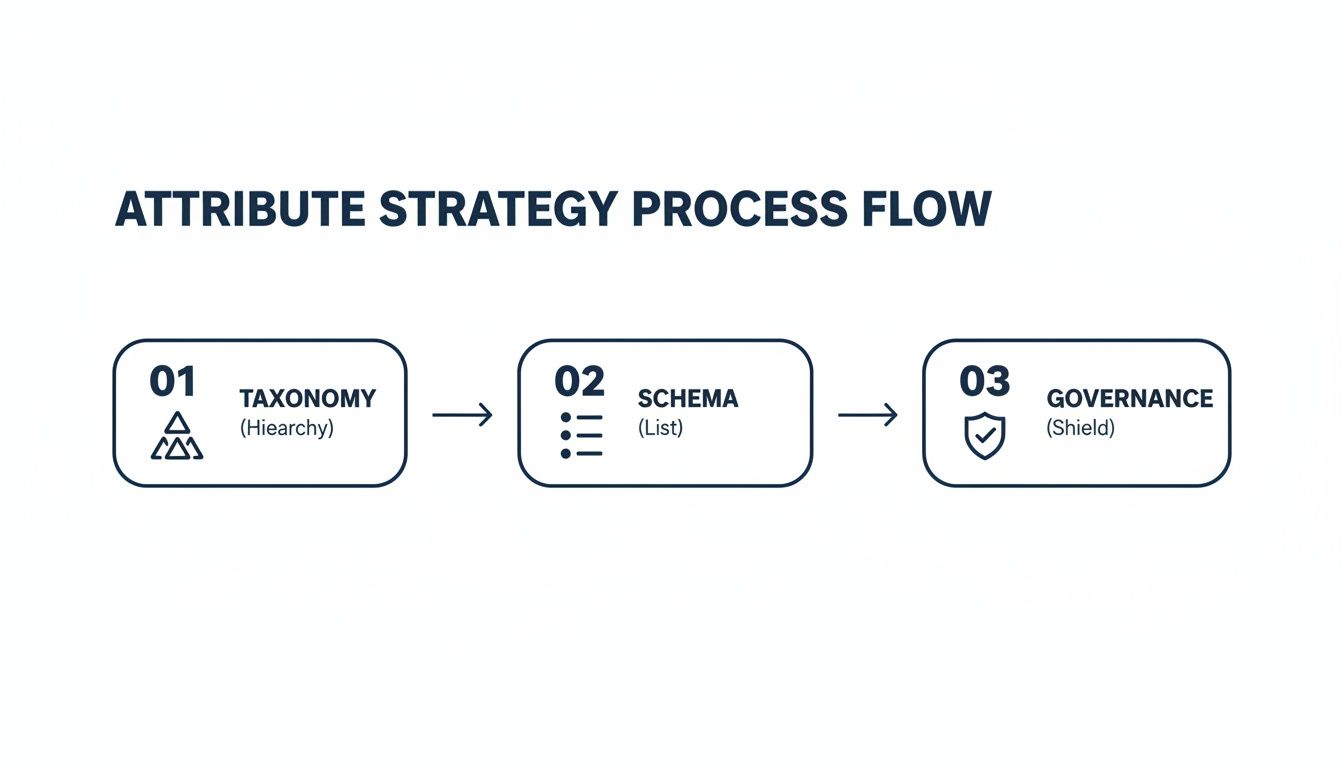
This journey, from a clear taxonomy to a consistent schema and strong governance, is the bedrock of a high-performing digital shelf. AI simply acts as a massive accelerator at each step, ensuring data quality is enforced automatically across your entire product range.
This kind of automation is a powerful example of human + AI collaboration in SEO. By offloading the monumental task of data enrichment, your team is freed up to focus on high-level strategy and creative campaigns. This is how you finally fix broken faceted navigation and enhance both discovery and search performance across your site.
A Real-World Comparison: The Power of AI Workflows
To see just how big the difference is, let's compare the traditional manual approach to an AI-powered one for a typical 10,000 SKU catalogue. The time and cost savings are staggering.
Manual vs AI-Powered Enrichment for a 10,000 SKU Catalogue
| Task | Manual Process (Time & Cost) | AI Automated Workflow (Time & Cost) |
|---|---|---|
| Attribute Extraction | 833 hours. (5 mins/SKU) | 8 hours. (AI extracts in seconds) |
| Description Rewriting | 1,667 hours. (10 mins/SKU) | 16 hours. (AI generates unique copy) |
| Image Tagging | 417 hours. (2.5 mins/SKU) | 4 hours. (AI tags visuals instantly) |
| Data Standardisation | 250 hours. (QA & manual fixes) | 8 hours. (AI applies rules consistently) |
| TOTAL TIME: | 3,167 hours (~1.5 years for 1 FTE) | 36 hours (< 1 week) |
| EST. COST (at $40/hr): | $126,680 | $1,440 |
As you can see, what would take a full-time employee over a year to complete can be handled by an AI workflow in less than a week. This is not just about saving money; it is about getting to market faster and capturing sales you would have otherwise missed.
Powering the Next Wave of Commerce
The need for precise, structured attributes goes well beyond your own website. By 2025, Australia's social commerce market is set to surge to $3.76 billion, but success on these platforms hinges on attribute-rich product showcases.
With 53% of consumers now discovering and buying via platforms like Facebook and TikTok, features like colour, size, and rating filters are what turn casual scrolling into actual sales. You can dig into more data on Australia's social commerce growth in this Business Wire report.
This trend makes one thing clear: attribute enrichment at scale is not just about fixing your website. It is about being able to compete effectively across every single digital channel.
Preparing for the Future of Agentic Commerce
The meticulous work of structuring your product data today is not just about tweaking your website’s filters. Think of it as a direct investment in your readiness for the AI-powered retail shift that is already happening. We are quickly moving from a world of manual searches to one of agentic commerce, where AI shopping assistants do the heavy lifting for consumers.
Picture a future, just around the corner, where a shopper simply tells their personal AI what they want. This agent will then crawl ecommerce sites, comparing products based on hyper-specific, structured attributes like ‘sleeve length is three-quarter’ or ‘material is organic cotton’. It will not browse visually; it will query your data directly.
The Invisibility Cloak of Poor Data
In this fast-approaching agentic commerce future, retailers with messy, incomplete, or inconsistent product attributes will be completely invisible. An AI agent built for efficiency will not be able to guess that ‘Dk Blue’ and ‘Navy’ are the same colour. If your data is not structured, machine-readable, and accurate, your products simply will not exist in the AI’s consideration set.
This makes product data enrichment the foundational layer for competing in this new arena. It is not just about improving your current tools; it is about future-proofing your entire business. With inventories swelling beyond 50 products, shoppers already filter ruthlessly. Data shows that unoptimised attributes lead to 40-60% cart abandonment rates as frustrated users bounce to competitors with smarter search.
The strategic shift from manual SEO to a next-gen, AI-driven retail approach is no longer optional. Agentic SEO is not a distant concept; it is the next evolution of search, and it is powered entirely by the quality of your product attributes.
Preparing for AI Shopping Agents
To get ready, retailers have to focus on building a pristine data foundation. This means prioritising workflows that turn messy supplier feeds into clean, structured assets. Honestly, AI-powered workflow automation is the only way to achieve this at the scale required.
Here are the key steps to get started:
- Standardise Your Taxonomies: Make sure every product has a logical, predictable home in your catalogue.
- Enforce Attribute Schemas: Define and require specific, consistent attributes for each product category. No more guesswork.
- Automate Enrichment: Use AI tools for tasks like image recognition and tagging to extract visual attributes without manual effort.
This is the only viable path forward. It ensures your digital shelf is ready for both today's savvy customers and tomorrow's AI agents. To dig deeper into how these systems will operate, explore our guide on how AI agents will find products in 2026. Getting your data right now is the key to being seen and sold in the very near future.
Your Path to Smarter Filters and More Sales
We have laid it all out: clean, consistent product attributes are the absolute backbone of your customer experience and your search visibility. Fixing broken filters or a clunky faceted search is not just a UX task to be ticked off a list. It is a core data strategy initiative that hits your digital shelf performance right where it counts.
For retail leaders and ecommerce managers, the path forward is pretty clear.

You can keep wrestling with manual processes and the content bottlenecks that never seem to go away. Or, you can embrace AI workflow automation for retail. This is the move that takes you from traditional SEO into a next-gen, AI-powered approach built for the future of agentic commerce.
At the end of the day, the goal is turning visitors into buyers. How well your products are presented, which includes everything down to writing compelling product descriptions, has a massive influence on that outcome.
For modern retail, attribute enrichment at scale is the most direct path to improving on-site discovery, increasing conversions, and achieving a truly scalable SEO solution that delivers measurable results.
Ready to swap the manual chaos for automated efficiency? Investing in an AI-powered strategy for your product attributes is how you build a resilient, high-performing ecommerce operation ready for whatever comes next.
Frequently Asked Questions
We often hear the same questions from retail leaders who are ready to move away from messy, manual processes and build a scalable, attribute-driven strategy. Here are a few of the most common ones.
Where Do We Even Start with Fixing Our Product Attributes?
The best place to begin is with a full audit of your current product catalogue. You are looking for attributes that are inconsistent, missing, or just plain wrong. Do not try to boil the ocean, pick a single, high-value category to run as a pilot project before you think about scaling across the entire range.
From there, you need to define a clear taxonomy and standardise your values. For example, make sure all your colours are listed as ‘Navy Blue’, not a random mix of ‘Navy’ and ‘Dark Blue’. Getting this foundation right is critical before you can bring in AI workflows to enrich and standardise your data at scale.
How Does AI Actually Enrich Data from a Supplier Feed?
Think of it like this: your supplier feed is full of unstructured data, like generic, block-text descriptions. AI models are trained to read that unstructured text and pull out structured attributes. For instance, an AI can read a simple phrase like ‘a long-sleeved shirt made from cotton’ and automatically tag the product with structured attributes like ‘Sleeve Length: Long’ and ‘Material: Cotton’.
It gets even better. AI image recognition can analyse your product photos to identify visual attributes like colour, pattern, and even the style (think ‘V-Neck’ or ‘Crewneck’). This turns a painstaking manual task that would take your team months into a process that can be completed in just a few days.
Is There a Measurable ROI on All This Attribute Work?
Absolutely. The return on investment shows up across several key areas of your digital shelf performance.
- Better Conversions: When customers can easily find what they are looking for through search and filters, your on-site conversion rates get a direct lift. It is that simple.
- More Organic Traffic: Suddenly, your product pages start ranking for thousands of specific, long-tail keywords. This drives significant, sustainable growth in your organic search visibility.
- Serious Operational Efficiency: Automating your product feed optimisation means you can finally stop wasting time and money on manual data entry. It frees up your team to focus on higher-value, strategic work that actually moves the needle.
Ready to turn your messy supplier feeds into a powerful asset for search and sales? Optidan AI provides the AI-powered workflows you need to achieve product data enrichment at scale, preparing you for the future of agentic commerce. Learn more at https://optidan.com.
