

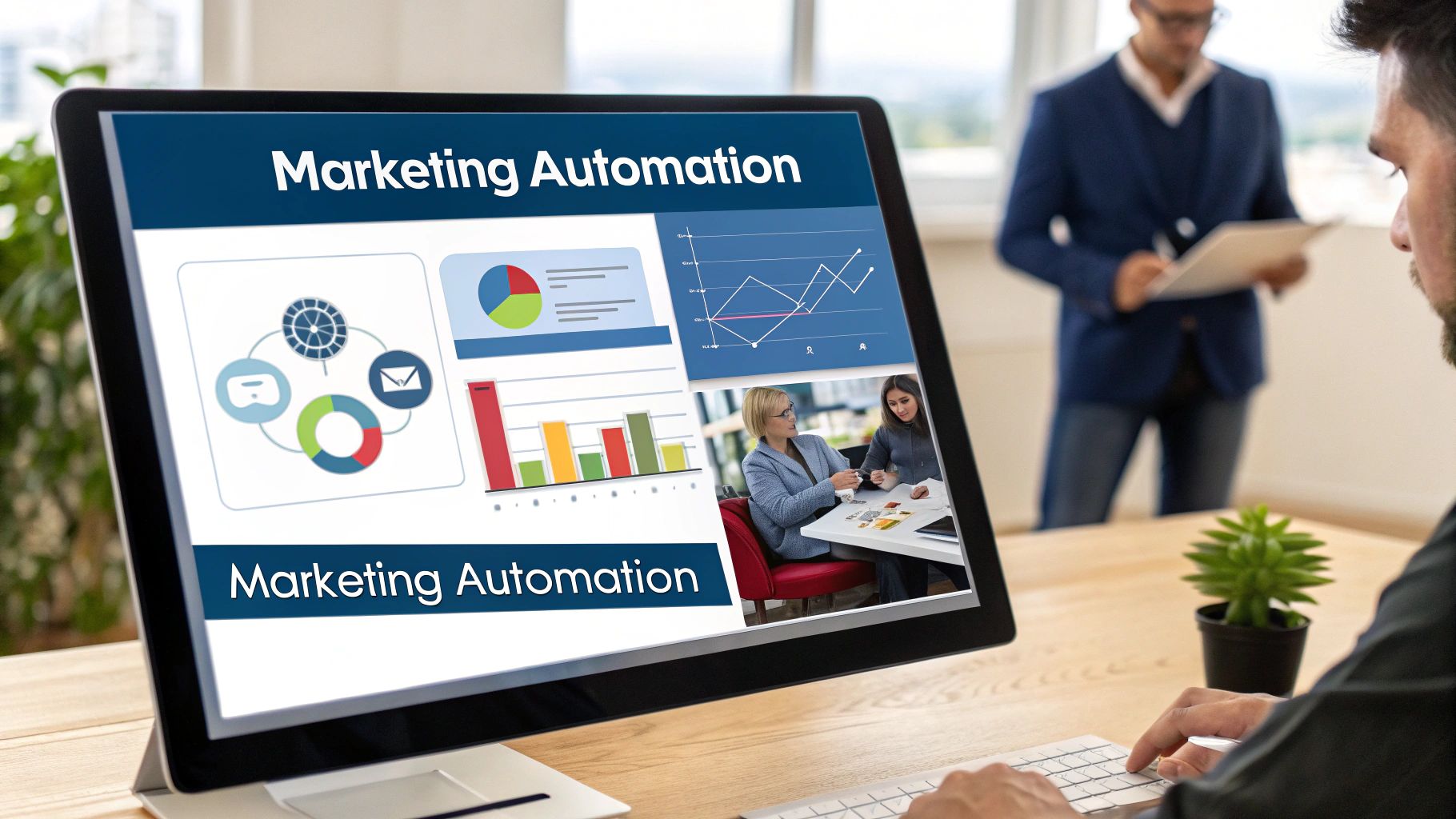
When you’re staring at a catalogue with thousands of products, the idea of manually updating every single one is enough to make anyone’s head spin. So, what is marketing automation in a real-world retail setting?
It’s your ticket to moving past the endless grind of manual updates and repetitive tasks. Think of it as building a smart system that does the heavy lifting for you, like fixing duplicated supplier content across your entire product range or optimising thousands of pages for search engines, all at once. For ecommerce managers, this is how you transition from manual SEO to AI SEO, unlocking scalable growth.
Putting Your Retail Marketing on Autopilot
For Australian retailers, the shift from a slow, manual SEO process to a dynamic, AI-powered one isn't some far-off concept. It’s happening right now, and it's a necessity for achieving better digital shelf performance. Marketing automation is the engine that drives this change.
It’s about far more than just scheduling a few emails. We're talking about building intelligent, automated content workflows that tackle the biggest headaches in ecommerce head-on. This is the core of AI workflow automation for retail.
This means leaving behind one-off fixes and finally embracing SEO at scale. Instead of your team spending weeks correcting product descriptions, an automated system can knock it over in a matter of days. This frees up your experts to focus on strategy, creating a powerful human and AI collaboration in SEO that drives real results.
Where Automation Delivers Immediate Value
You'll see the impact almost immediately in a few key areas:
- Product Data Enrichment: Automatically turning basic supplier feeds into optimised, structured product content that actually performs on the digital shelf.
- Correcting Duplicated Supplier Content: Systematically finding and rewriting duplicate descriptions to build a unique brand voice and dodge SEO penalties.
- Optimised at Scale: Applying consistent metadata and SEO best practices across 10,000+ pages without a single person having to do it manually.
This approach is absolutely fundamental for getting ready for the future of retail search, especially with the rise of agentic search optimisation. As AI agents like ChatGPT and Amazon Rufus start to influence buying decisions, having richly detailed and structured product data is no longer a nice-to-have. It's non-negotiable.
By automating the foundational work of content and SEO, retailers can finally shift their focus to high-level strategy. This ensures their digital presence is not only efficient but also ready for the next wave of agentic commerce.
The Shift From Manual to Automated Retail Marketing
The table below breaks down just how stark the difference is. It’s a complete strategic pivot from time-consuming manual labour to efficient, AI-driven workflows that give you a serious competitive edge. This is the difference between traditional SEO teams and next-gen SEO for retailers.
| Marketing Function | Traditional Manual Approach | AI-Powered Automation Approach |
|---|---|---|
| Product Descriptions | Manually writing or copy-pasting from supplier feeds. | Generating unique, brand-aligned descriptions at scale. |
| SEO Optimisation | Updating titles and meta tags page by page. | Applying consistent optimisation rules across thousands of SKUs. |
| Content Audits | Spot-checking pages for errors and duplication. | Systematically identifying and flagging issues sitewide. |
| Data Enrichment | Adding attributes and specs one product at a time. | Automatically enriching feeds with structured data for AI agents. |
| Campaign Readiness | A last-minute scramble to update seasonal content. | Proactively optimising pages months in advance for peak visibility. |
The move to automation isn't just about saving time; it's about fundamentally changing how you compete. You're shifting from reactive fixes to proactive, strategic growth.
The appetite for these solutions is blowing up in Australia. The local marketing automation market is projected to grow at a compound annual rate of 19.9% between 2025 and 2030, largely driven by the adoption of AI-powered retail tools.
As you can read more about how AI SEO software is reshaping retail, it's clear this is a foundational shift. According to insights from Grand View Research, this explosive growth shows just how central AI workflows are becoming for staying competitive and dominating the digital shelf.
Building Your Retail Automation Engine
A powerful automation strategy isn't just one piece of software; it's a complete engine built from interconnected parts working in harmony. Let's look under the hood to see how these components combine to create a powerhouse for modern ecommerce.
At the centre, you have workflow builders and CRM integrations. But for retail leaders, their true value is unlocked when they power large-scale content operations. Imagine these tools working together for massive product data enrichment, turning basic supplier feeds into compelling, SEO-friendly product content that both customers and AI agents can understand.
Instead of just firing off emails, these smart workflows can be set up to automatically spot and rewrite duplicated supplier content for thousands of SKUs. This systematic approach is crucial for fixing duplication penalties, carving out a unique brand voice, and protecting your site’s search authority at a scale that's impossible to manage manually.
Core Components for Scalable SEO
To deliver scalable SEO solutions and full-funnel content automation, your engine needs a few key parts:
- Workflow Automation: This is the brains of the operation. It defines the rules and triggers for tasks like rewriting descriptions or optimising metadata, ensuring consistency right across your entire product catalogue.
- AI Content Generation: Modern platforms use generative AI to create unique product descriptions, alt tags, and meta titles, shifting you from manual SEO to AI SEO. This is essential for achieving SEO at scale.
- Product Information Management (PIM) Integration: Your automation engine needs to seamlessly connect with your source of product data, whether that's a PIM, an ERP, or even a humble spreadsheet.
To truly put your retail marketing on autopilot, it helps to first get your head around the fundamentals of ecommerce automation and how it works. This foundational knowledge helps you connect the dots between individual tasks and a fully integrated, automated content strategy.
This infographic breaks down the primary benefits you can expect from building such an engine.
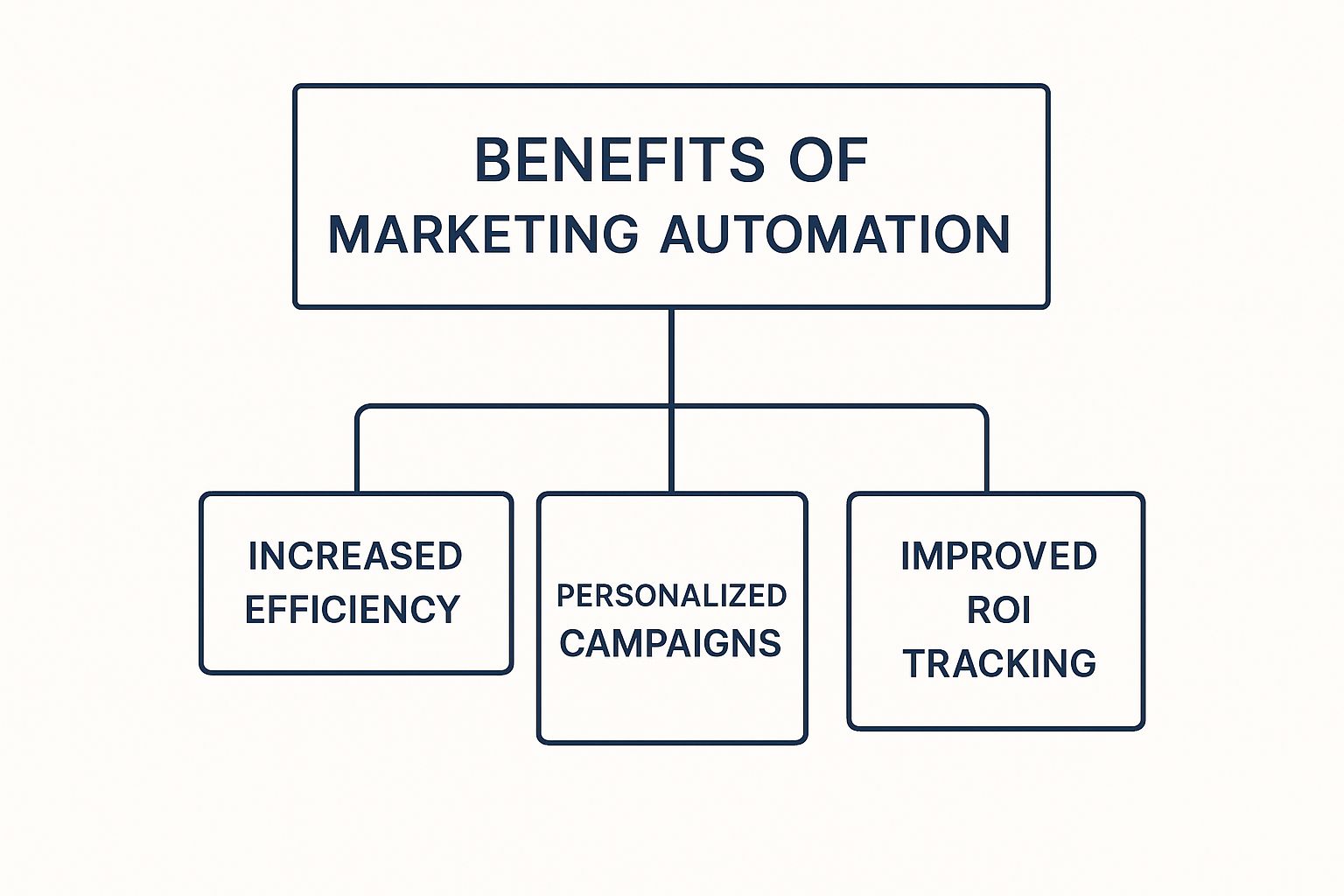
The diagram shows how increased efficiency, personalised campaigns, and better ROI tracking are the direct results of a well-oiled automation strategy. All of this content and data must be managed effectively, which is where your central system comes into play. For a deeper dive into managing this data, you can explore our guide on what a content management system is and how it fits into your tech stack.
Ultimately, these components combine to create a system that doesn’t just save time, it fundamentally transforms your ability to compete on the digital shelf. It’s about building a scalable, resilient content machine ready for the future of retail search.
The Real Wins of Automation for Ecommerce
Sure, automation saves time, but what does that actually mean for Australian retailers? What are the real, tangible results you can expect?
The advantages are huge, shifting your business from a reactive stance, always playing catch-up, to a proactive one where you dominate the digital shelf.
It’s all about achieving SEO at scale, something that used to feel out of reach for most businesses. Imagine optimising product descriptions, image alt tags, and metadata for your entire catalogue of 10,000+ SKUs in a matter of days, not months. This speed gives your digital shelf performance a direct boost through better search visibility and rock-solid brand consistency across every single product page.

Another massive win is breaking through the common retail content bottlenecks. Manual work ties up your most skilled people in repetitive, low-value tasks. Automated content workflows set them free to focus on what really matters: high-level strategy, market analysis, and creative direction. This creates a powerful human and AI collaboration that drives genuine retail efficiency.
Unlocking Strategic Growth and Efficiency
The benefits of automation don't just stop with the marketing team; they create a ripple effect of positive change across the entire business. It’s a fundamental shift in how you operate.
- Accelerated Speed to Market: Launch new product lines or seasonal collections with fully optimised pages ready from day one. You'll capture that peak search interest immediately, without any delays.
- Reduced Operational Costs: Slash the hours spent on manual content updates, tedious data entry, and correcting duplicated supplier content. You can then reallocate those resources to initiatives that actually grow the business.
- Enhanced Data Quality: Use automated product data enrichment to ensure your catalogue is accurate, detailed, and structured for the future of agentic commerce.
This isn't just theory. In Australia, AI and machine learning are completely changing the game. Recent studies show that 41% of marketers report a direct increase in sales after bringing AI into their advertising efforts. This highlights the measurable financial impact of adopting smarter, automated technologies.
By automating the foundational, repetitive tasks of content and SEO, retailers can pivot from merely managing their online presence to actively engineering its growth. This creates a definitive edge in an increasingly competitive market driven by AI agents.
This new model of efficiency is non-negotiable for long-term success. It allows you to systematically fix problems like supplier content duplication and get your product data ready for AI shopping agents.
These are crucial steps for retailers who want to learn how to increase online sales in a rapidly changing digital world. Ultimately, automation is your key to building a scalable, resilient, and future-proof ecommerce operation.
Automation in Action Across Australian Retail
Theory is one thing, but seeing marketing automation out in the wild is where its real impact becomes clear. Let's look at some real-world examples from Australian retail, such as fashion, furniture, and electronics, where AI-powered workflows are tackling some of the industry's biggest headaches.

These aren't just fancy email campaigns. This is automation working as a core engine for growth, efficiency, and a stronger digital shelf. The goal here is achieving SEO at scale, a massive competitive edge in today's crowded market.
SKU-Level SEO and Unique Descriptions
One of the most persistent problems for Aussie retailers is duplicated supplier content. Using the same generic product descriptions as hundreds of other stockists is a surefire way to get buried in search results. This is where automated content workflows come in.
An AI agent can take a standard supplier feed with 15,000 SKUs and, in a matter of hours, generate unique, on-brand product descriptions for every single item. This isn't just about dodging Google penalties; it's about building a distinct brand voice and unlocking true SKU-level SEO. Each product page finally gets the chance to stand on its own and rank.
AI-Powered Image Optimisation
For visual-heavy sectors like fashion and furniture, image SEO for ecommerce is absolutely critical. But who has the time to manually write descriptive alt text for thousands of product photos? It’s a massive job that usually gets pushed to the bottom of the list, leaving a huge amount of SEO potential untapped.
This is where AI image recognition SEO changes the game. An automated system can look at a photo of a handbag and instantly create descriptive alt text like, "tan leather crossbody bag with gold hardware and adjustable strap." When you apply this across your entire catalogue, you dramatically improve accessibility and boost your visibility in image search, a huge discovery channel for shoppers.
By automating foundational tasks like image tagging and description writing, retailers are not just saving time. They are building a more resilient, scalable, and AI-compatible content foundation for the future of agentic commerce.
Multi-Channel Product Feed Optimisation
Your digital presence goes way beyond your own website. Marketplaces like Google Shopping, The ICONIC, and social commerce platforms all demand product data formatted in their own specific way. Manually creating and managing all those different feeds is a major content bottleneck.
Retail content automation solves this with product feed optimisation. A single, master feed can be automatically reshaped and sent out to multiple channels, perfectly matching each one's unique requirements. This ensures your brand messaging and product data are consistent and powerful, no matter where your customers are shopping.
The result is better visibility and a smoother customer experience, which is what successful digital marketing campaigns are all about. This shift from endless manual updates to automated, scalable SEO is exactly how leading retailers are getting ready for the AI-powered future of work.
Getting Your Business Ready for AI Agents
The way customers find and buy products is about to completely change. We're stepping into an era of agentic commerce, where AI assistants like ChatGPT, Perplexity, and Amazon Rufus do the shopping for us. For any retail leader, this isn't some far-off idea, it's the next frontier of search, and you need to get ready for it now.
This new world calls for a new playbook: agentic search optimisation (ASO). It’s all about structuring your product information so that machines can easily understand, compare, and recommend what you sell. This is where your marketing automation setup becomes non-negotiable.
Building an AI-Compatible Foundation
At its core, ASO is all about rich, structured product data. AI shopping agents couldn’t care less about clever marketing slogans. They make decisions based on detailed, machine-readable facts, like the material of a shirt, the exact dimensions of a table, or the specific compatibility of a phone charger.
This is why product data enrichment is no longer just a "nice-to-have." It's the price of admission to the future of retail search. The single most important thing you can do right now is invest in automated content workflows that can turn basic supplier feeds into deeply enriched, structured data.
The entire shift to agentic commerce comes down to one thing: data quality. The retailers who are automating the enrichment of their product catalogues today are building the very foundation that AI shopping agents will use to make buying decisions tomorrow.
From Manual SEO to Agentic SEO
Traditional SEO was all about keywords and backlinks designed to catch a human’s eye. Agentic SEO is completely different. It focuses on structured data and comprehensive attributes to appeal to machine shoppers. The aim is to create AI-compatible SEO content that an AI agent can confidently serve up to a user as the best possible choice.
This requires a fundamental pivot in strategy:
- Correcting Duplicated Supplier Content: You need to give every single product a unique, detailed digital footprint.
- Implementing SKU-Level SEO: It’s time to move beyond optimising category pages and start optimising every individual item.
- Automating Content Workflows: Using AI to enrich data at a scale that human teams could never hope to match.
Retailers sticking to manual processes are going to become invisible in this new landscape. On the other hand, those who get on board with retail content automation aren't just optimising for today's search engines, they're future-proofing their entire business.
To dive deeper, you can learn more about preparing for AI shopping agents for Shopify and other platforms. It’s about making your products the default choice for the next generation of commerce.
Launching Your First Automated Workflow
Ready to dive in? Taking that first step into marketing automation is a lot more straightforward than you might think. This is not about tearing down your entire strategy overnight. It's about making small, targeted changes that deliver an immediate impact and pave the way for bigger wins down the track.
The whole process kicks off with a simple content audit to find your biggest headache. For a huge number of Australian retailers, that problem is duplicated supplier content. It’s a single issue that can drag down your search rankings and water down your brand voice, making it the perfect target for your first automated workflow. By zeroing in on a high-impact area like product feed optimisation, you’ll see real, tangible results, fast.
A Simple Playbook for Getting Started
This mini-playbook is designed to demystify the shift from a traditional SEO team to a nimble, AI-powered retail model.
- Identify the Bottleneck: Start by pinpointing one major source of inefficiency. Are you stuck manually rewriting hundreds of product descriptions? Or maybe it's optimising metadata for thousands of SKUs? That’s your starting line.
- Choose Your Tools: Next, select the right retail efficiency tools for the job. You’ll need a platform that can handle SEO at scale, something specifically designed for tasks like enriching product data and fixing that pesky supplier content duplication.
- Implement Human-Led QA: Automation is a powerful engine, but it still needs a driver. Set up a human-led AI content QA process to make sure every piece of automated content hits your brand standards and truly lifts your digital shelf performance.
As you get closer to launching, it’s a great idea to explore various marketing automation workflow examples. They can provide some invaluable inspiration and practical guidance.
Here in Australia, we're seeing a significant trend where Customer Data Platforms (CDPs) are merging with marketing automation tools. This allows for hyper-personalised campaigns that still respect our strict data privacy laws, like the Privacy Act 1988. This integration is absolutely crucial for building trust while delivering the timely, relevant interactions that Aussie consumers now expect. As you can find out more about the future of marketing automation in Australia, you’ll see this focus on compliance and personalisation is central to modern retail success.
Frequently Asked Questions
Got questions? Here are a few straight answers for Australian retail managers trying to make sense of marketing automation and AI SEO.
How Does Automation Fix Duplicated Supplier Content?
Think of it this way: supplier content is a massive headache for retailers. You get the same generic descriptions that hundreds of your competitors are also using, which is a red flag for search engines.
Automation, particularly with AI, solves this problem at scale. Instead of asking your team to manually rewrite thousands of product descriptions, an impossible task, an automation platform can take that basic supplier data and generate unique, brand-aligned descriptions for every single SKU. It’s a core part of retail SEO automation that gets rid of SEO penalties while building a consistent brand voice across your entire catalogue.
What Is The Difference Between AI SEO And Traditional SEO?
Traditional retail SEO has always been a manual grind. It’s slow, expensive, and usually focused on just a handful of your most important pages because that's all the team has time for. The rest of your site is often left untouched.
AI SEO, on the other hand, takes those same optimisation principles and applies them across your entire product catalogue with incredible speed. It uses AI to handle tasks like product data enrichment, creating unique metadata for thousands of images, and writing fresh content for every single product.
This is what allows you to achieve true SKU-level SEO. It’s also how you prepare your business for agentic search, where AI assistants like ChatGPT rely on clean, structured data to recommend products. You’re essentially shifting from manual effort on a few pages to a scalable SEO solution that covers everything.
Will Marketing Automation Replace My Content Team?
Not at all. The real goal here is a powerful human and AI collaboration. Automation is perfect for the grunt work, the repetitive, high-volume tasks that are a complete waste of human talent, like optimising 10,000 product pages or fixing supplier content issues.
This frees up your content and SEO teams from those manual bottlenecks. Now, they can focus their brainpower on high-value strategic work, like defining the brand voice, digging into market trends, and performing human-led reviews of the AI-generated content. It’s a partnership that drives far better results and efficiency than either could ever achieve alone, and it's shaping the future of work in retail.
Ready to stop wrestling with manual bottlenecks and start building scalable, AI-powered workflows? Discover how Optidan AI can help you optimise your entire product catalogue, fix duplicated content, and get ready for the future of agentic commerce. Start automating your SEO today.
