


Here's a little secret about AI search: it can't recommend a product it doesn't understand. At its core, an AI relies on structured, descriptive, and unique data to figure out what a product is and who it's for. When your product information is thin, copied and pasted from a supplier feed, or just plain messy, the AI sees digital noise. Your products become effectively invisible.
The AI Visibility Gap in Ecommerce
Many retail leaders see generative AI as a magic bullet for ecommerce, a plug-and-play fix. There's this idea that new AI search tools, from Google's AI Overviews to Amazon's Rufus, will just work. They'll instantly get your massive product catalogue and connect the right shoppers with the right products. But there's a huge gap between that expectation and the technical reality, and it's creating a serious visibility problem for retailers who aren't prepared for the future of work in retail.
The heart of the issue is that AI needs clean, understandable data. It can't guess the value of a product from ambiguous information. Think of it like a state-of-the-art robot in a chaotic warehouse. It’s been told to find a specific item, but the aisles are a mess, boxes aren't labelled, and the inventory list is wrong. The robot fails, not because it isn't smart, but because its environment is broken. Your product catalogue is that warehouse.
Why Your Products Are Invisible to AI
This invisibility problem isn't new. It’s caused by common data issues that have plagued large retail operations for years, turning a potentially great AI search ecommerce experience into a dead end for customers. For most retailers, these challenges are baked right into their content workflows, leading to significant retail content bottlenecks.
Here’s what’s making your products invisible:
- Sparse Product Data: Attributes like material, dimensions, compatibility, or where something was made are often missing. This leaves the AI with no context to match your product to what a customer is asking for.
- Duplicated Supplier Content: Using the generic descriptions from your suppliers is a killer. It makes it impossible for an AI to tell your listing apart from dozens of others, wrecking your digital shelf performance.
- Unstructured Information: Key details buried in a long, dense paragraph of text are easily missed. AI thrives on information that’s clearly structured and tagged, making product data enrichment essential.
These aren't just minor technical glitches; they're a direct threat to your future in retail search. As agentic commerce grows, AI agents will start making buying decisions for people, and they’ll rely solely on the data they can parse and trust. If your product feed is a mess of duplicated copy and missing attributes, your brand will be systematically shut out of this new AI-driven sales channel. The problem is a lot like why on-site search fails for large retailers, bad data leads to bad customer experiences.
The big shift for retail leaders is realising that product data isn't just for humans anymore. It has to be meticulously structured for machines. This means moving from manual SEO to AI SEO, embracing scalable AI workflow automation for retail that puts product data enrichment and content uniqueness first.
The answer is to start creating AI-compatible SEO content. This isn't just about fixing a few duplicate descriptions. It's a strategic overhaul of your entire product information setup. It means enriching supplier feeds, automating product descriptions at scale, and implementing solid structured data. Only by making your products genuinely 'understandable' to AI can you make sure they'll be seen, found, and ultimately, bought in the new era of agentic shopping.
Why AI Fails to Understand Your Products
Let's get one thing straight: AI search isn't magic. It’s a highly sophisticated pattern-matching engine that is completely dependent on the data you feed it. So, when an AI agent fails to surface your products, it's not some random glitch. It's a direct result of the information it finds, or more often, what it doesn’t find, in your product catalogue.
The system simply cannot recommend what it doesn’t comprehend.
This problem is getting more urgent by the day. As AI adoption skyrockets, new data shows a huge portion of Australians are already using generative AI. This trend is quickly exposing how AI search can't surface ecommerce products it fails to grasp, crippling AI product discovery for retailers who aren't prepared.
With shoppers increasingly relying on AI for recommendations, having an AI-incompatible catalogue means becoming invisible to a massive, and growing, part of the market.
The Damage Done by Duplicated Supplier Content
One of the biggest roadblocks to AI understanding is the lazy, widespread practice of using supplier content duplication. When your product descriptions, specs, and titles are identical to those on dozens of other retail sites, AI agents see a sea of sameness. They have no unique signal to latch onto, making it impossible to differentiate your offering from anyone else's.
This forces the AI to default to the only clear differentiator it can find: price. In effect, relying on generic supplier feeds erodes your brand value and throws you into a race to the bottom on margin.
Fixing this isn't just about old-school SEO penalties; it’s about giving AI a compelling reason to recommend your product over another. You can learn more about how supplier product descriptions are costing retailers sales and what to do about it.
An AI shopping agent is like a personal shopper. If it asks three stores for a specific blue shirt and gets the exact same generic description back from all three, it can’t recommend based on quality, brand story, or unique features. It will simply pick the cheapest one.
This is a critical bottleneck for any retailer. Without a system for product feed optimisation, your catalogue is fundamentally unprepared for the new world of agentic commerce.
Ambiguity and Inconsistency Are AI Kryptonite
Beyond simple duplication, AI models struggle immensely with ambiguous and inconsistent data. This is a particularly nasty problem in verticals with complex product catalogues, like fashion, electronics, and furniture, where the details make all the difference.
These data gaps directly sabotage AI product discovery in a few key ways:
- Ambiguous Metadata: Vague terms like "regular fit" without specific measurements or "high-performance" without technical specs leave the AI guessing. It can't confidently match these products to a user's precise query, like "find me a slim-fit business shirt with a 42cm collar".
- Inconsistent Attributes: If one product lists its colour as "Navy Blue," another as "Midnight," and a third simply as "Blue," an AI may fail to group them together. This lack of a normalised taxonomy breaks the connections AI needs to understand the full breadth of your product range.
- Complex SKU Structures: A single product in fashion SEO optimisation or electronics might have dozens of variants (size, colour, storage capacity). If this variant data isn't perfectly structured, the AI may surface the parent product without showing available options or, worse, fail to show the product at all if the specific requested variant isn't clearly defined.
The table below breaks down exactly how these common data problems translate into poor visibility and lost sales.
Common Data Deficiencies and Their Impact on AI Search
| Data Deficiency | Example | Impact on AI Search | Business Consequence |
|---|---|---|---|
| Sparse Metadata | A handbag listed as "leather" without specifying "full-grain" or "vegan". | AI can't match it to specific, high-intent queries like "full-grain leather tote bag". | Lost visibility for valuable long-tail searches and missed sales opportunities. |
| Inconsistent Attributes | A t-shirt's colour is listed as "Forest" in one SKU and "Olive Green" in another. | The AI fails to recognise these as similar shades, fracturing your product catalogue. | Shoppers see incomplete search results, assume you lack options, and leave. |
| Missing Structured Data | A product page lacks Schema markup for price, availability, and reviews. | AI agents cannot reliably extract key purchasing information, making your listing less trustworthy. | Lower click-through rates and exclusion from rich results and AI-powered product carousels. |
| Ambiguous Copy | A drill is described as "powerful" without listing its torque (Nm) or RPM. | The AI cannot compare your product's specs against competitors for a "best drill for hardwood" query. | Your product is overlooked in comparison-driven searches, leading to lost sales. |
As you can see, the connection is direct and painful. These aren't minor technical issues; they are fundamental barriers that prevent AI from doing its job.
AI model embeddings, the process AI uses to turn words into numerical representations, can easily lose these subtle but critical nuances. A generic term gets a generic embedding, causing your product's most important features to be lost in translation. This is exactly why SKU-level SEO and meticulous attribute tagging are no longer optional.
Without this clarity, AI search ecommerce tools will consistently overlook your products, directly tanking your rankings and conversions.
The Business Cost of an Invisible Digital Shelf
When your products are invisible to an AI, the fallout isn't just technical, it hits your bottom line, hard. A product catalogue that AI can't understand doesn't just underperform; it actively bleeds revenue and market share in this new era of AI product discovery. This isn't some far-off problem. It's hurting retail efficiency tools and digital shelf performance today.
The technical data headaches we've covered translate directly into serious business consequences that every ecommerce manager and retail leader needs to get their head around. When AI search fails to grasp what you're selling, your brand is hit with a cascade of negative effects that choke off growth and profitability.
These challenges are getting worse as AI becomes the default way people search. In Australia, the vast majority of Google's users are now seeing AI-powered features. For retailers, this means products with nuanced details, from the specific cut of a dress in fashion SEO optimisation to the specs of complex electronics, get buried if an AI can’t parse their unique attributes. This often leads to zero-click searches that never even make it to your site. You can find out more about how AI is changing Australian search habits on roi.com.au.
Plummeting Traffic and Vanishing Conversions
The first and most obvious hit you'll take from poor AI visibility is a sharp drop in qualified organic traffic. As AI agents like Google's AI Overviews and shopping assistants like Rufus increasingly serve up direct answers, they are becoming the new top of the funnel. If your products aren't surfaced in these summaries, you're effectively cut off from a massive, high-intent audience.
This spirals into several critical problems:
- Decreased Organic Traffic: AI-generated answers mean people don't need to click through to individual websites as often. If your product isn't featured in the AI summary, that potential customer will never know your site exists.
- Lower Conversion Rates: Even if a user does land on your site, poor data quality creates a frustrating experience. It’s a common story where customers can't find products you definitely sell, which leads directly to high bounce rates and abandoned carts.
- Exclusion from Recommendations: AI shopping agents will soon be making proactive recommendations. Without rich, structured data, your products will be left out of these AI-curated shortlists, handing sales directly to your competitors.
When your product data is generic, duplicated supplier content, AI has no choice but to treat your product like a commodity. It forces you into a price war because brand value, unique features, and quality craftsmanship have been rendered invisible to the machine.
The True Cost of Content Bottlenecks
Relying on duplicated supplier content isn't just a lazy SEO mistake; it's a strategic failure. It tells AI that your offering is identical to everyone else's, making it impossible to justify a premium price or build any real brand loyalty. This is exactly where product data enrichment becomes your competitive edge. By creating unique, descriptive, and structured content, you give AI the signals it needs to understand your unique value.
This shift from manual, reactive SEO to automated, proactive AI SEO is essential for survival. The future of retail search hinges on your ability to feed AI agents the high-quality, unique data they need to make confident recommendations. Investing in retail content automation and AI workflow automation for retail is no longer a luxury, it's the fundamental price of admission to the modern digital shelf. Without it, your products stay invisible, and your business pays the price.
Creating an AI-Ready Product Catalogue
Realising you have an invisible digital shelf is the first step. The second is actually doing something about it. To make your products show up for AI, you need to ditch the old-school, reactive manual SEO and get proactive with automation. This means building a product catalogue from the ground up that machines can actually understand.
This isn’t about small tweaks. It’s a complete shift towards product data enrichment at scale, transforming those thin, generic supplier feeds into the rich, structured content AI agents need to do their job. For retailers juggling thousands of SKUs, this requires a fundamental change in how you handle content, moving away from manual bottlenecks and toward AI workflow automation for retail.
The journey from a product having weak data to becoming invisible in an AI's eyes is a quick one, and it always ends in lost revenue.
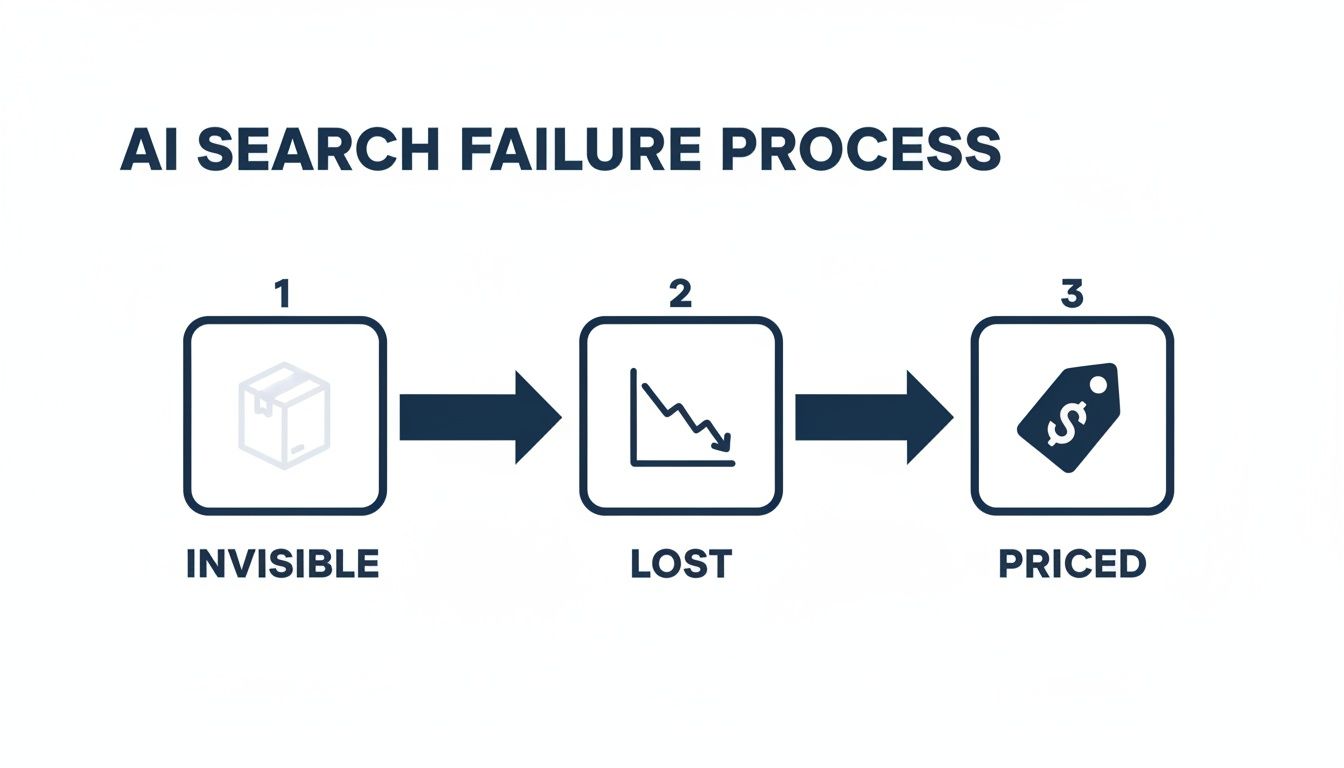
This diagram shows a critical failure point in modern retail. Poor data leads directly to lost sales, pushing retailers into a race to the bottom on price because the AI has no other unique qualities to show customers.
The Foundation of an AI-Ready Catalogue
Building a catalogue that’s ready for AI starts with a content-first mindset. Instead of treating product data as a clean-up job for later, it becomes the central pillar of your AI SEO strategy. The goal is to create a single source of truth for every product that’s compelling for humans and perfectly structured for machines.
This foundational work involves a few core strategies that have to be executed at scale, especially in categories like fashion, furniture, and electronics where the small details make all the difference.
Key remediation strategies include:
- Comprehensive Supplier Feed Enrichment: This means taking basic, generic supplier data and turning it into detailed, attribute-rich product information. You're adding the specifics AI needs to match products with highly specific questions, things like materials, dimensions, compatibility, country of origin, and ideal use cases.
- Taxonomy Normalisation: You need to establish and enforce a consistent set of attributes and values across your entire catalogue. This gets rid of the inconsistencies (like "Navy Blue" vs. "Midnight") that confuse AI agents and split your product listings.
- Unique Product Description Generation: This is a big one. It's about fixing the duplicate content SEO fix by replacing every single supplier-provided description with unique, on-brand copy. Trying to do this manually for a large catalogue is impossible, which makes automating product descriptions a necessity, not a luxury.
An AI-ready catalogue treats every product attribute as a potential answer to a future customer's question. By structuring this information clearly, you are pre-emptively optimising your digital shelf for the conversational, intent-driven queries that define the future of retail search.
Implementing Structured Data at Scale
Once your product content is enriched, unique, and consistent, the next step is to communicate it clearly to AI agents using structured data, specifically, Schema.org markup. Think of it like adding clear, universally understood labels to your product information, leaving no room for misinterpretation.
Implementing robust schema isn't negotiable for agentic search optimisation. It lets AI instantly grab key details without having to guess.
Your schema strategy should cover:
- Product Schema: Clearly defining the product's name, brand, description, and SKU.
- Offer Schema: Specifying the price, currency, availability, and condition.
- Variant Schema: Structuring complex options like size, colour, and storage capacity so AI understands every single combination available.
For retailers managing tens of thousands of pages, metadata optimisation at scale is a monumental task. This is where AI-powered content workflows become indispensable. Platforms that offer retail SEO automation can apply these structured data rules across an entire catalogue in days, a job that would take a traditional SEO team months or even years. This is the very essence of achieving SEO at scale.
Ultimately, creating an AI-ready catalogue is about building a clean, consistent, and deeply descriptive data foundation. This move from manual chaos to automated content workflows is what prepares your business for the next generation of AI-driven commerce.
From Manual SEO to Scalable AI Workflows
The old way of doing retail SEO is officially broken. Manually optimising thousands, or even tens of thousands, of product pages is slow, expensive, and riddled with human error. This old-school approach creates massive retail content bottlenecks, leaving product catalogues full of duplicated supplier copy and thin data that makes them invisible to AI search.
The future isn't about doing the old things a little bit better; it's about adopting entirely new systems.
This shift to AI SEO is no longer just a good idea, it's a strategic necessity. It’s about ditching the reactive, page-by-page model for proactive, automated content workflows that can enrich an entire product catalogue in days, not months. This is the only way to build the next-gen SEO for retailers needed to actually compete in a world run by AI.
The Limits of Traditional SEO Teams
Even the most talented SEO team is still working on a human scale. Their day might be spent rewriting a few top-selling product descriptions or fixing a small batch of duplicate content. While these tasks are useful, they're a drop in the ocean for a retailer with 10,000+ SKUs.
The limitations really stand out when you think about the demands of agentic search optimisation:
- It just doesn't scale. A team might get through a few dozen pages a week. An AI-powered content workflow can enrich thousands of SKUs in a single day.
- Quality is all over the place. When multiple people write content, you get inconsistencies in tone, style, and accuracy. This confuses both customers and AI algorithms.
- The opportunity cost is huge. Every hour your team spends on repetitive tasks is an hour they aren't spending on high-impact strategy, brand building, or competitive analysis.
This problem is hitting the Australian eCommerce market particularly hard. AI search tools, set to handle 39% of Google queries by mid-2025, are already failing to surface products they can't properly understand. With zero-click rates hitting 60-65%, retailers are simply becoming invisible. Research shows 48% of Aussies already use AI for shopping, yet these systems choke on product-specific details, favouring generic overviews instead.
The real difference between AI SEO vs Traditional SEO isn’t just speed, it’s capability. AI makes optimising every single SKU economically viable. It turns your product data from a liability into your most powerful asset for winning on the digital shelf.
Embracing Human + AI Collaboration in SEO
Bringing in retail content automation isn't about replacing your team; it's about making them more powerful. This is the core of a Human + AI Collaboration in SEO model. You let technology handle the repetitive, heavy lifting, freeing up your human experts to focus on what they do best: strategy, creativity, and quality control.
Imagine your team is no longer bogged down rewriting endless supplier descriptions. Instead, they’re directing an AI system to generate thousands of unique, on-brand descriptions based on properly enriched product data. Their job transforms from manual labour to strategic oversight. They’re refining AI prompts, reviewing outputs, and ensuring the final content perfectly aligns with your brand voice and SEO goals.
This model makes optimising product feeds efficiently possible at a scale that was once unimaginable. Tasks that used to be impossible projects become routine.
- Product Data Enrichment: Automatically pull in critical attributes like material, dimensions, and compatibility for every single product from unstructured supplier feeds.
- Unique Descriptions at Scale: Generate thousands of SEO-optimised descriptions, completely wiping out supplier content duplication penalties across your entire catalogue.
- AI Image Recognition SEO: Automatically tag images with descriptive alt text, which is a game-changer for fashion product image SEO and other visual-heavy categories like furniture image tagging SEO.
To get your product data ready, you need to look beyond manual fixes. Understanding how to automate content creation effectively is the key to building a truly AI-ready product catalogue. This strategic shift is the only sustainable way forward, preparing your business not just for today's AI search but for the future of agentic commerce.
Preparing for the Future of Agentic Commerce
The chatter around AI SEO is already moving past today's search engines. We’re on the verge of agentic commerce, a future where autonomous AI agents will research, compare, and even purchase products on behalf of consumers. This isn't just a futuristic idea; it's the next logical step in how retail will operate, representing a major shift in the future of work in retail.
Think of these AI agents in ecommerce as the ultimate personal shoppers, tasked with finding the perfect product based on a user's complex and specific needs. They'll make their decisions in milliseconds, relying entirely on the data they can understand and trust. They won't browse your beautiful website; they'll query your structured product data directly.
What Is Agentic Commerce?
Agentic commerce is a new kind of ecosystem where AI agents, not people, are the ones driving product discovery and transactions. An agent might get a prompt like, "Find me the best waterproof jacket for hiking in Tasmania under $300, made from recycled materials, with at least three pockets."
To handle that request, the agent will instantly scan product feeds from thousands of retailers. It will only show products that have clear, structured, and complete data for every single one of those attributes. If your product feed is missing the material composition or doesn't mention the pocket count, your jacket is effectively invisible. It just won't make the cut.
The core takeaway is this: getting your product feed right today isn't just about optimising for current AI search. It's a non-negotiable step toward agentic search readiness. The work you do now on product data enrichment and fixing supplier content duplication is what will decide your visibility in this new landscape.
Your Roadmap to Agentic Readiness
The only way to ensure AI can find and surface your products is by creating deep, structured, and unique content at scale. This demands a shift away from manual SEO work toward automated, AI-powered content workflows. To really get ready for the next generation of AI-powered shopping, you need to understand how to implement autonomous agentic workflows.
Your readiness comes down to your ability to turn your product catalogue into an asset that AI can actually use. The strategies we've covered, from SKU-level SEO to image recognition and tagging, are the foundational blocks for this future. Retailers who embrace retail content automation will thrive, while those who don't will find themselves systematically shut out from the next generation of commerce.
The path forward is clear. To learn more about this shift, explore our deep dive into how AI agents will find products in 2026. It's time to prepare your product feed for the new era of AI discovery.
Frequently Asked Questions
What Is the Difference Between AI SEO and Traditional SEO?
Think of traditional SEO as preparing your site for Google's crawlers, it's all about keywords, links, and technical health. AI SEO, on the other hand, is about preparing your products to be understood and recommended by intelligent agents. It goes deeper, focusing on rich product data enrichment and unique, descriptive content at scale. The goal is to make your catalogue ‘speak’ the language of AI so it can be surfaced in conversational search.
How Can We Fix Duplicated Supplier Content Across Thousands of SKUs?
Trying to rewrite thousands of product descriptions by hand is a non-starter. It's just not scalable. This is where retail content automation comes in. By using AI-powered content workflows, you can generate unique, brand-aligned, and SEO-optimised product descriptions for your entire catalogue in a matter of days. This approach gets rid of the penalties that come with supplier content duplication and gives AI agents the distinct information they need to pick your products over a competitor's.
Why Is Product Data Enrichment So Important for AI?
AI shopping agents rely on detailed, structured data to figure out a product's features, benefits, and if it's the right fit for a customer's specific question. Your basic supplier feed just doesn't have that level of detail. Product data enrichment fills in those gaps, adding crucial attributes like materials, dimensions, compatibility, and use cases. It turns a generic product listing into a rich, detailed profile that AI can confidently match with a high-intent search in this new era of agentic commerce.
How Does AI Image Recognition Help with SEO?
For categories like fashion or furniture where visuals are everything, AI image recognition is a game-changer. It automatically looks at your product images and generates descriptive alt tags and metadata for you, and it can do it for thousands of products at once. This seriously boosts your image SEO for ecommerce by helping AI understand the visual context, things like a "blue linen midi dress with puff sleeves", making your products easy to find through both visual and conversational search.
Ready to make sure your products are visible to the next generation of search? See how Optidan AI uses AI workflow automation to enrich your product feed, create unique content at scale, and prepare your digital shelf for the future of agentic commerce.
Discover how Optidan AI can transform your retail efficiency
