
When we talk about AI SEO for ecommerce, we're discussing the use of artificial intelligence to automate and scale up search engine optimisation for online stores. It’s all about enriching your product data, creating unique content to get rid of generic supplier copy, and getting your product catalogue ready for agentic search. The end goal? Better digital shelf performance and a far more efficient workflow.
The New Digital Shelf: Why AI SEO Is a Retail Necessity
The way customers find products is changing rapidly. For retail leaders and ecommerce managers in Australia handling massive product catalogues, old-school, manual SEO methods are no longer just slow, they represent a serious competitive disadvantage. The sheer volume of modern ecommerce, with thousands of SKUs and constant updates, creates a retail content bottleneck that traditional teams simply cannot push through.
This is exactly where AI SEO for ecommerce stops being a buzzword and becomes a business essential. It tackles the biggest headaches for online retailers, especially the rampant problem of duplicated supplier content. When you simply copy and paste manufacturer descriptions, you end up with a website that looks and sounds like everyone else's, which tanks your brand voice and can even get you penalised by search engines. Addressing this supplier content duplication is critical for digital shelf performance.
From Manual Effort to Automated Excellence
The move from traditional SEO to an AI-powered approach is about more than just getting things done faster, it’s about gaining a strategic edge. It means leaving behind the tedious, one-by-one SKU updates and embracing intelligent, automated content workflows that operate at a scale we couldn't have imagined a few years ago. This is the essence of SEO at scale.
This shift allows your team to focus on strategy instead of getting bogged down in execution. Rather than spending months manually writing thousands of meta descriptions, they can oversee AI agents that generate fully optimised content in a matter of days. This blend of human and AI collaboration in SEO is the future of work in retail, unlocking a new level of efficiency and automation.
The real promise of AI SEO is turning your biggest liability, a massive and undifferentiated product catalogue, into your greatest asset. It’s about building a unique, optimised digital shelf that’s ready for the future of retail search.
This is especially critical now that we're heading into the era of agentic commerce. AI shopping assistants like ChatGPT, Perplexity, and Amazon's Rufus are fast becoming the new front door for product discovery. These AI agents for retail efficiency need structured, clear, and unique product data to make their recommendations. If your catalogue is full of thin, duplicated content, you’ll be invisible in this new agentic search landscape.
To get a clearer picture of this shift, let's compare the old and new ways of working.
A Retail Leader's Look at AI SEO vs Traditional SEO Teams
The table below breaks down how AI is fundamentally changing the day-to-day tasks of an ecommerce SEO team, moving from slow, manual processes to fast, scalable SEO solutions.
| SEO Task | The Traditional Approach (Manual & Slow) | The AI SEO Approach (Automated & Scalable) |
|---|---|---|
| Product Descriptions | Manually writing a few descriptions per day. Often relies on generic supplier copy. | Generating thousands of unique, brand-aligned descriptions in hours through automated content workflows. |
| Keyword Research | Tedious analysis of spreadsheets and manual tools for a limited set of terms. | Continuous, real-time analysis of keyword trends and customer intent across the entire catalogue. |
| On-Page Optimisation | Manually updating meta titles, descriptions, and alt tags for priority products only. | Automatically optimising on-page elements for every single SKU, category, and brand page. |
| Content Gap Analysis | A quarterly project, identifying a handful of opportunities based on competitor research. | An ongoing, automated process that constantly identifies and fills content gaps at scale. |
| Internal Linking | Manually adding links between pages, often inconsistently and with limited scope. | Intelligently building a robust internal linking structure across the entire site automatically. |
| Performance Tracking | Monthly reports showing high-level traffic and ranking changes for a small set of keywords. | Real-time dashboards tracking digital shelf performance down to the individual SKU level. |
As you can see, the difference isn't just about efficiency, it's about capability. AI allows retailers to achieve a level of optimisation that was simply impossible before, giving them a significant advantage in a crowded market.
Embracing AI SEO as a Core Strategy
The adoption of AI-powered SEO tools is already happening across Australia. In fact, industry analysis for 2025 shows that 56% of Australian businesses now use AI-powered SEO tools. Those businesses are reporting an average 23% improvement in keyword ranking velocity and a 31% reduction in content production time. These aren't just numbers on a page, they represent a clear trend. AI isn't some far-off concept, it's a tool that's delivering a competitive edge right now.
By using AI for product data enrichment, image recognition, and scalable content creation, retailers can finally fix long-standing SEO problems while building a solid foundation for the future of agentic commerce. Acting now is the only way to secure your spot on the digital shelf of tomorrow.
Building Your AI SEO Foundation with Product Data
Your AI-powered SEO strategy is only as good as the data fuelling it. For many retailers, the constant stream of raw supplier feeds feels like a necessary evil, but these basic files are often a huge liability. They're a primary source of the duplicate content SEO fix needed to improve your search rankings and correct a bland, cookie-cutter experience for shoppers.
This is where the real work begins, not with flashy tools, but with the fundamental process of product data enrichment. It’s about methodically turning thin, generic supplier information into a rich, structured, and unique asset. This enriched data becomes the foundation for every AI workflow automation for retail you build, allowing your AI to perform at its peak.
Forget manual copy-pasting. With a solid data foundation, you can start automating the creation of compelling, on-brand descriptions, detailed specifications, and SEO-friendly attributes for every single SKU in your catalogue.
From Supplier Feed to Strategic Asset
The journey from a basic supplier feed to an optimised product catalogue is the first critical step. Raw feeds are almost always missing the very details that both customers and AI search agents need to make informed decisions.
A typical supplier feed gives you just the bare minimum:
- A generic product name (e.g., "Blue T-Shirt").
- A basic, duplicated description used by hundreds of other retailers.
- Limited attributes like size and colour.
- A single, often low-quality, product image.
This isn’t enough to compete. Product data enrichment is about layering in the specific, structured details that create a unique and valuable product page. This means turning "Blue T-Shirt" into "Men's Classic Crew Neck T-Shirt in Navy Blue," complete with specifics on fabric composition, fit, care instructions, and its country of origin. This level of detail is crucial for both SKU-level SEO and preparing for agentic search. Optimising product feeds efficiently is a cornerstone of modern retail.
The core principle is simple: turn every piece of product information into a structured data point. This structured data is the language AI understands best, allowing it to generate high-quality, AI-compatible SEO content at scale.
This transformation is what separates market leaders from the pack. It’s the difference between showing up for a generic search and capturing a customer looking for a very specific product, a query style that’s becoming far more common with AI shopping agents.
The Power of AI in Data Enrichment
Manually enriching thousands of SKUs is an impossible task, which is why AI is so essential here. AI image recognition is a perfect example of this in action. For retailers in visually driven categories like fashion or furniture, this technology is a genuine game-changer.
An AI model can analyse a product image and automatically generate a rich set of descriptive tags and attributes that would take a human merchandiser hours to compile. For a sofa, it might identify the style ("Mid-Century Modern"), material ("Velvet"), colour ("Emerald Green"), and even features like "Tapered Wooden Legs" or a "Button-Tufted Back." This is where AI image recognition SEO delivers immense value, especially for fashion product image SEO or furniture image tagging SEO.
These tags do more than just populate filters on your website. They become the building blocks for:
- Highly descriptive alt text for images, improving accessibility and image SEO for ecommerce.
- Unique, attribute-rich product descriptions generated by AI.
- Targeted metadata optimisation at scale, making sure every page is precisely tuned.
This automated process breaks a massive retail content bottleneck. It tackles the challenge of supplier content duplication head-on by creating a unique data profile for every product before a single word of the final description is even written. To truly get the most out of your product visuals, check out this comprehensive AI Product Photography Guide for E-commerce.
Ultimately, enriched product data, powered by both text and visual AI, isn’t just a nice-to-have. It’s the engine for your entire AI SEO program.
Automating On-Page SEO with Content Workflows
Once you’ve got a solid data foundation, it’s time to execute. This is where you set up automated content workflows built specifically for the chaos of retail. Think AI agents for retail efficiency generating unique product descriptions, meta titles, and detailed specs for thousands of pages in days, not months.
This is how you finally break the retail content bottleneck. By automating product descriptions, you can get rid of duplicated supplier content for good and establish a consistent, powerful brand voice across your entire catalogue. Your team’s role shifts from tedious manual data entry to strategic oversight of powerful retail content automation systems.
This infographic shows the basic process, moving from raw data to the optimised content that fuels your entire workflow.
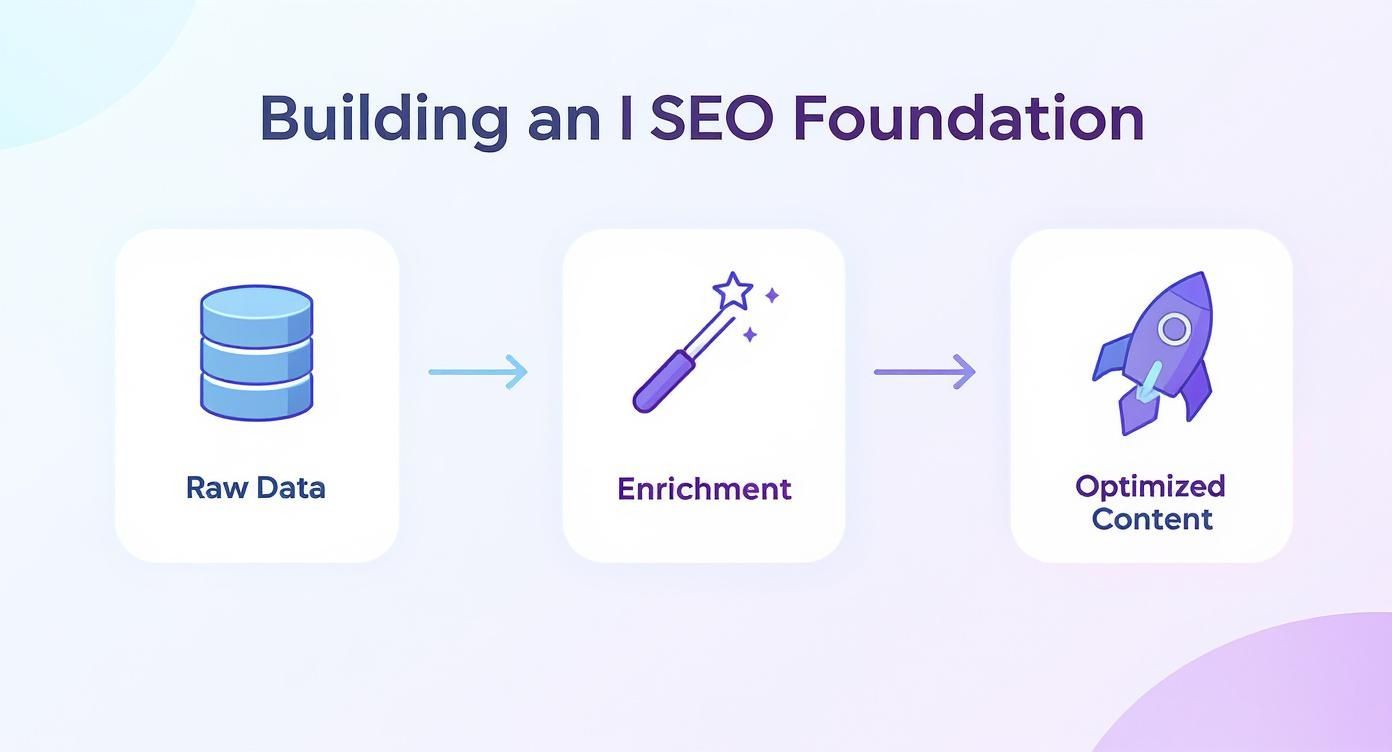
As you can see, high-quality, optimised content is the direct result of a structured data enrichment process. You can’t skip this step if you’re serious about any scalable AI SEO initiative.
The Human and AI Collaboration Model
The future of work in retail isn't about replacing human expertise, it's about amplifying it with AI. An effective AI-powered content workflow absolutely depends on a human-led AI content QA process. Sure, AI agents can generate thousands of product descriptions with incredible speed, but human oversight is what brings the nuance, brand alignment, and final approval.
This collaborative model changes your team's role entirely. They stop being content creators and become content directors and quality assurance specialists, guiding the AI and refining its outputs.
This approach gives you a few key advantages:
- Brand Consistency: Human reviewers ensure every piece of content, from fashion SEO optimisation to electronics SEO optimisation, aligns perfectly with your brand’s unique tone and voice.
- Accuracy and Fact-Checking: Your team can verify critical details, making sure the AI hasn’t misinterpreted technical specs or product features.
- Creative Refinement: People can add that creative flair and persuasive language that builds a real connection with customers, a task where AI still needs a helping hand.
Building Scalable Content Workflows
Setting up an automated content workflow means integrating retail efficiency tools that connect your enriched product data directly to a generative AI model. These systems are designed for SEO at scale, turning your product attributes into prompts that guide the AI in creating perfectly optimised on-page elements.
Take a furniture retailer, for example. A workflow could automatically generate a meta description by combining attributes like "Mid-Century Modern," "Solid Oak," and "Apartment Sized." This process is then repeated for every single SKU, ensuring your entire catalogue is optimised. Understanding how AI optimizes keywords is central to making these workflows both efficient and effective.
The goal of an automated content workflow is not just speed, but precision. It’s about using structured data to generate highly relevant, long-tail content for every product, something that’s impossible to achieve manually.
This scalable approach has a direct impact on your digital shelf performance. By ensuring every product page is unique and fully optimised, you improve your chances of ranking for a much wider range of specific search queries, driving more qualified traffic to your site. You can explore this further in our guide on https://optidan.com/content-automation-for-retailers/.
Australian ecommerce businesses are already seeing real results from this shift. A May 2025 study found that businesses using AI-driven SEO strategies saw a 13.8% increase in organic traffic. While informational content faces challenges from new AI search models, core commercial and product pages continue to perform strongly. In fact, 97% of organic traffic for most retailers still comes from traditional search channels. As the market evolves, it’s clear why 67% of businesses plan to increase their AI investment this year.
Preparing Your Catalogue for Agentic Search

The next big shift in search isn't coming, it's already here. It's called agentic search, and it’s completely changing how customers find products. We're moving away from simple keyword searches and into conversational, task-focused interactions with AI agents.
For retail leaders, this means you need to start optimising your product catalogue for AI agents like ChatGPT, Perplexity, and Amazon's Rufus, not just for human shoppers. This is the new frontier of SEO for AI agents.
This is where all that hard work on product data enrichment really starts to pay off. AI agents don’t browse like people do, they process raw data. They need structured, factual, and crystal-clear information to recommend your products over a competitor's. If your product pages are still running on thin, duplicated supplier content, you'll be completely invisible in this new world of agentic commerce.
Creating AI-Compatible Content
To get your catalogue ready for agentic search, your content must be machine-readable and trustworthy. Think of AI agents as super-efficient research assistants. They pull together information from all over the web to answer a user's complex request, and they'll always prioritise data that is clear, consistent, and well-structured.
This boils down to a few core elements:
- Structured Data: Using detailed schema markup for your products is no longer optional. It's essential. This gives AI agents a clean, organised roadmap to your product’s key details like price, stock levels, materials, and dimensions.
- Factual Language: Cut the vague marketing fluff. Instead of saying a sofa is "incredibly comfortable," get specific: "features high-density foam cushions with a feather-blend top layer." AI values hard facts, not subjective claims.
- Unambiguous Attributes: Make sure every product attribute is clearly defined and granular. This is what allows an AI agent to match your product to a very specific user query, like, "Find me a three-seater sofa made from full-grain leather under $2,500 that is suitable for a small apartment."
Agentic search optimisation is less about keywords and more about facts. The retailer with the most comprehensive, structured, and accurate product data will win the AI's recommendation, and the customer's wallet.
The Australian Shift to AI-Powered Search
The impact of AI on ecommerce SEO is picking up speed in Australia, largely driven by new consumer habits. In 2025, over 38 million AI-powered searches are conducted in Australia, with Aussies using platforms like ChatGPT and Gemini at higher rates than any other country.
This research shows that 70% of AI search traffic in Australia is driven by ChatGPT, with Perplexity following at 19%. Retailers who don't adapt to this dual reality of traditional and AI search are going to be left behind.
This shift just highlights how urgent agentic search optimisation has become. It's not some future trend to keep an eye on, it's a necessity for protecting your digital shelf performance right now.
From Product Feeds to Agentic Readiness
Making the move from a basic supplier feed to an agentic-ready catalogue is a strategic must. By automating the enrichment of your product feeds, you're also building the foundation for the future of retail search.
Those unique descriptions, detailed attributes, and structured data points are exactly what AI shopping agents are looking for. You can dive deeper by exploring our detailed article on preparing your product catalogue for agentic search.
Retailers who act now to structure their data for agentic commerce will lock in a major competitive advantage. As these AI-powered tools become the main way people shop, having an AI-compatible catalogue will be the difference between being the top recommendation and not showing up at all. This prep work ensures your products aren't just seen by humans, but are understood and trusted by the AI agents guiding their decisions.
How to Implement and Measure AI SEO Success
Turning your strategy into action is where the real value of AI SEO for ecommerce comes to life. A project of this scale needs a smart, methodical approach. The key is to start small, prove the value, and then roll it out across your entire product catalogue. It's about getting past vanity metrics and focusing on the KPIs that show a clear return on your investment.
A phased rollout is the smartest way to kick things off. Don't try to overhaul your entire site at once, that’s just a recipe for chaos. Instead, pick a single product category or brand to act as your pilot program.
This controlled environment lets you test your automated content workflows, fine-tune your human quality assurance process, and gather initial performance data without messing with the rest of the business. This first phase is crucial for building a solid business case. You can directly compare the performance of the new AI-optimised pages against the old, manually managed ones, creating a powerful story to justify scaling the program across tens of thousands of SKUs.
Choosing the Right Retail Visibility Tools
Let's be honest, traditional SEO tools often can't keep up with the demands of AI-driven optimisation at scale. When you start implementing your program, you need technology that’s built to support and enhance these new workflows, giving you insights that go way beyond simple keyword rankings.
Your toolkit needs to let you:
- Track SKU-Level Performance: This is non-negotiable. You have to monitor organic traffic, visibility, and conversion rates for individual product pages, not just broad categories. This granular data is the only way to prove the real impact of your product data enrichment.
- Analyse SERP Features: You need to understand how your products show up in AI-generated answers and rich snippets, which is critical for agentic search optimisation.
- Integrate with Your PIM/CMS: Choose tools that plug straight into your existing retail systems. This creates a smooth, end-to-end workflow from enriching the data to deploying the content.
- Measure Content Production Velocity: Track how fast you can get a new product from a raw supplier feed to a fully optimised, live page. This metric is a direct measure of the efficiency you've gained from automation.
Picking the right retail search visibility tools is a strategic move. It ensures you have the data to not only measure success but also to constantly refine your AI models and content strategies for better digital shelf performance.
The core of measuring AI SEO success lies in connecting optimisation efforts directly to commercial outcomes. It’s not just about ranking higher, it’s about selling more products, more efficiently.
Focusing on Metrics That Matter to Leadership
When you’re reporting on your AI SEO program, you have to speak the language of the C-suite. Your team might get excited about ranking velocity, but leadership wants to see how it hits the bottom line. This means shifting your focus from traditional SEO KPIs to metrics that show real business growth.
The key performance indicators for an AI SEO program are the ones that tell a commercial story:
| Metric | Why It Matters for AI SEO |
|---|---|
| Organic Traffic to Product Pages | Measures the direct impact of your SKU-level SEO. It proves that unique, optimised content is pulling in qualified buyers. |
| Conversion Rate Uplift | Compares the conversion rates of AI-generated content against the old supplier copy, showing its clear commercial value. |
| Content Production Time Reduction | Quantifies the operational efficiency gained. It shows a dramatic drop from months to mere days for large-scale optimisation. |
| Share of Voice for Long-Tail Keywords | Demonstrates your ability to capture those highly specific, purchase-intent queries that are driven by detailed product attributes. |
Ultimately, a successful implementation provides clear proof of both top-line growth through more sales and bottom-line savings through retail efficiency tools and automation. To get a better handle on what to measure, our guide on the top metrics to track for ecommerce success offers some valuable insights. By focusing on these outcomes, you can show exactly how AI SEO is turning your retail operation from a cost centre into a powerful engine for growth.
Answering Your AI SEO Questions
Whenever a new way of doing things comes along, it’s smart to ask questions. Retail leaders and ecommerce managers are right to wonder about the cost, team impact, and real-world results of shifting from manual work to AI-powered workflows. This section tackles the most common questions we hear about bringing AI SEO into an ecommerce business.
Our goal is to give you straight, practical answers, with no fluff. We want to help you understand what this change really means and how to handle it well.
How Is AI SEO Different from Traditional SEO?
The main goal hasn't changed: get more visibility, sell more stuff. But how you get there is a whole new ball game. Traditional SEO is all about manual effort. Someone has to physically write product descriptions, optimise metadata, and do keyword research. It's slow, costs a fortune, and is practically impossible to do properly for a catalogue with 10,000+ SKUs.
AI SEO for ecommerce, on the other hand, is all about SEO at scale. It uses AI workflow automation for retail to knock out those repetitive tasks with incredible speed and accuracy.
Here’s where they really differ:
- Scale: AI can optimise your entire product catalogue in days, not months or years.
- Data-Driven: Instead of relying only on a writer's creativity, it uses structured product data enrichment to generate high-quality content.
- Agentic Readiness: It gets your content ready for AI shopping agents, which is a massive part of the future of retail search.
In short, you’re moving from doing the grunt work yourself to overseeing a system that does it for you.
Will AI Replace My Current SEO Team?
No, but it will absolutely transform their jobs. The future of retail work is about human + AI collaboration in SEO. Your team will stop doing the tedious, manual stuff and shift their energy to high-value, strategic work.
Instead of writing meta descriptions until their eyes glaze over, they'll be:
- Overseeing AI Content Workflows: They'll be the ones setting the rules, defining the brand voice, and tweaking the optimisation settings for the AI.
- Human-Led AI Content QA: They'll review and polish the AI-generated content, making sure it’s accurate, on-brand, and genuinely useful.
- Analysing Performance Data: They'll use sophisticated retail search visibility tools to track what's working and spot new opportunities.
- Strategic Planning: Their time will be freed up for big-picture thinking, like competitor analysis, market trends, and getting ready for the agentic commerce future.
This AI-powered retail transformation makes your team more strategic and efficient, clearing content backlogs and delivering much better results.
AI doesn't replace your experts, it gives them superpowers. It automates the 80% of repetitive work that bogs them down, freeing them up to focus on the 20% that truly drives growth and innovation.
What Is the First Step to Getting Started?
The first and most important step is product feed optimisation. Your AI strategy is only ever as good as the data you feed it. Raw supplier feeds are a nightmare, they're often riddled with supplier content duplication and missing critical information. That's not a solid foundation to build on.
Start by focusing on product data enrichment. This means turning that basic supplier data into a rich, structured asset. You can use AI tools for image recognition and tagging to automatically pull out key attributes for fashion, furniture, or electronics. The aim is to create a detailed, unique data profile for every single SKU.
This clean, structured data is the fuel for all your retail SEO automation and content workflows. Once your data is clean and organised, you can confidently start building your automated systems.
Ready to ditch manual SEO and move to an automated, scalable solution? Optidan AI is built for retailers who need to optimise thousands of pages without the quality dropping off a cliff. We turn your product data into a powerful asset, delivering unique, SEO-ready content that boosts your digital shelf performance and gets you ready for the future of agentic search.
Find out how we can clear your content bottlenecks at https://optidan.com.
