


Why Retail Product Feed Management Is Now Performance Infrastructure
What Is Retail Product Feed Management?
Retail product feed management is the process of ingesting, structuring, enriching and optimising product data so it performs across search engines, marketplaces, paid channels and AI-driven discovery systems.
Traditionally, product feed management focused on:
- Mapping attributes
- Formatting SKUs for Google Shopping
- Distributing feeds to marketplaces
- Maintaining price and availability accuracy
In 2026, that definition is incomplete.
Retail product feed management is no longer just about distribution. It is about performance infrastructure.
Why Traditional Product Feed Management Is No Longer Enough for Digital Shelf Performance.
Platforms such as Feedonomics, Productsup, ChannelEngine, DataFeedWatch and similar tools solve important operational problems:
- Channel syndication
- Feed mapping
- Compliance formatting
- Marketplace integration
But they were built for distribution.
They were not designed to:
- Decide relevance
- Improve discovery
- Enrich incomplete supplier data
- Differentiate duplicated content
- Strengthen brand authority across category structures
That gap is now where competitive advantage sits.
The Hidden Product Data Quality Problem
Across large retail catalogues, common issues repeat:
- Supplier data reused across competitors
- Missing ingredients, specifications, materials, compatibility data
- Thin or templated descriptions
- Inconsistent category hierarchies
- No contextual brand positioning
In our 2024 industry study analysing over 780 retailers and 22,000 product pages, more than 85% failed basic search quality benchmarks due to duplication, structural gaps, or weak product content signals.
When content is duplicated or under-structured:
- Organic visibility drops
- AI systems struggle to recommend products
- Paid acquisition costs increase
- Conversion rates decline
- Return rates rise due to unclear product information
This is not a feed formatting issue.
It is a product data infrastructure issue.
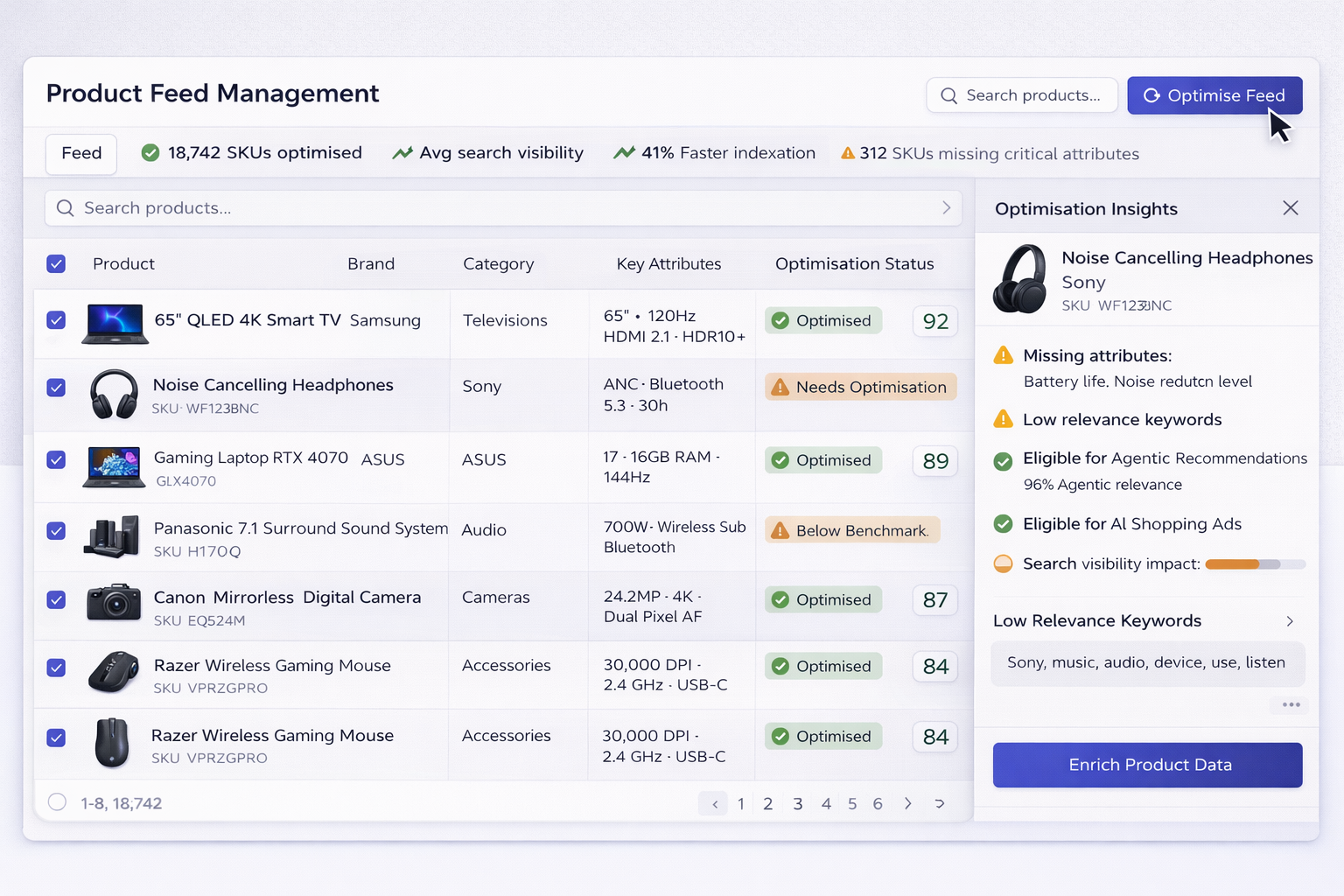
Retail Product Feed Management vs Product Data Management
These terms are often confused.
Product Feed Management
Focuses on distribution, mapping and compliance across channels.
Product Data Management (PDM / PIM)
Focuses on centralising product attributes, specifications and metadata.
Retail Product Feed Management at Scale
Combines both — but goes further.
It includes:
- Data sourcing
- Attribute gap detection
- Structured data enrichment
- SEO-aligned product content
- Category and brand authority building
- Schema optimisation
- Internal linking alignment
- AI compatibility preparation
This is the difference between moving data and creating discoverability.
From Distribution to Performance Infrastructure
Modern retail discovery is no longer linear.
Products are surfaced through:
- Google Search
- Google Shopping
- Marketplaces
- Social commerce
- AI agents
- Conversational search
- Recommendation engines
These systems evaluate:
- Structured attributes
- Content depth
- Contextual authority
- Brand consistency
- Category relationships
A compliant feed is not enough.
Retailers need a performance infrastructure that:
- Identifies supplier duplication
- Enriches missing attributes
- Aligns product and category content
- Creates consistent brand language
- Prepares product data for AI-driven discovery
This is where most retailers are structurally underprepared.
Measurable Outcomes of Product Feed Optimisation
When retail product feed management is treated as infrastructure rather than formatting, outcomes change.
Retailers typically see:
- Faster indexing of new products
- Reduced duplication across competitors
- Increased long-tail search visibility
- Improved category authority
- Higher qualified traffic
- Stronger conversion performance
- Lower return rates due to clearer product information
This is not a marketing uplift.
It is operational efficiency translated into performance.
How Optidan Core Transforms Retail Product Feeds
Optidan Core sits between brands and retailers, but works for the retailer.
It ingests existing product feeds and site content, then:
- Audits duplication across competitors
- Identifies attribute gaps
- Enriches missing product data
- Optimises product descriptions at scale
- Strengthens category and brand pages
- Structures metadata and schema
- Aligns internal linking
- Publishes back into ecommerce platforms
The focus is not on generating copy.
The focus is on strengthening product data infrastructure so it performs across:
- Search
- Marketplaces
- Social
- AI discovery systems
From entry to indexing, the goal is to bring sales forward.
Preparing for Agentic Commerce
AI systems do not browse the way humans do.
They interpret:
- Structured product attributes
- Contextual category signals
- Brand credibility
- Content depth
- Cross-page consistency
Retailers relying solely on feed compliance tools risk invisibility in AI-driven recommendation systems.
Retail product feed management must now prepare data for:
- Agentic search
- AI shopping assistants
- Conversational commerce
- Intelligent comparison engines
Infrastructure determines inclusion.
Retail Product Feed Management Is Now Strategic
The question in 2026 is no longer:
How do we distribute our product feed?
It is:
How do we strengthen our product data so it wins discovery before checkout?
Distribution is operational.
Performance infrastructure is strategic.
Retailers that make this shift move from competing on budget to competing on structure.
Ready to move beyond manual SEO and deliver scalable results for your retail clients? Discover how Optidan AI automates product data enrichment, corrects supplier content duplication, and optimises thousands of pages in days. Book a demo of Optidan AI today and build the AI-powered workflows that will define the future of your agency.
