

AI search engines no longer just crawl websites; they directly ingest structured data from sources like Google Merchant Centre, APIs, and on-page schema. This is a profound shift for retail. It means your product feed is now the primary source of truth, making clean, consistent, and complete data absolutely essential for your products to be understood, trusted, and recommended in AI-generated results. For enterprise ecommerce managers, mastering this is the core of next-gen SEO.
How AI Search Engines Access Product Feeds
The era of search engines relying solely on crawling and indexing web pages is over. The future of retail search, powered by AI agents and generative experiences, is being built on a foundation of structured data. For enterprise retail teams, this is not a minor adjustment; it is a fundamental change from traditional SEO to AI SEO, where the quality of your product data dictates your visibility.
Instead of an AI trying to piece together information from a webpage, it now accesses a neatly organised catalogue. Think of it less like reading a brochure and more like querying a database. This direct ingestion is faster, more accurate, and allows AI systems to build a much higher degree of confidence in the information they find. This shift requires a focus on AI workflow automation for retail to manage data at scale.
The New Access Points for AI Search
AI systems consume product data from several key sources, often combining them to create a complete picture of your offerings:
- Structured Feeds: Dedicated files, like those you submit to Google Merchant Centre, provide a clean, attribute-rich source of truth.
- Direct API Integrations: For real-time updates on pricing and stock levels, APIs offer a direct line of communication between your systems and the search engine.
- On-Page Structured Data: Schema markup on your product and category pages acts as a verification layer, confirming the information provided in your feeds.
This diagram shows the new process flow, moving from product feeds to AI search and finally to AI Overviews.
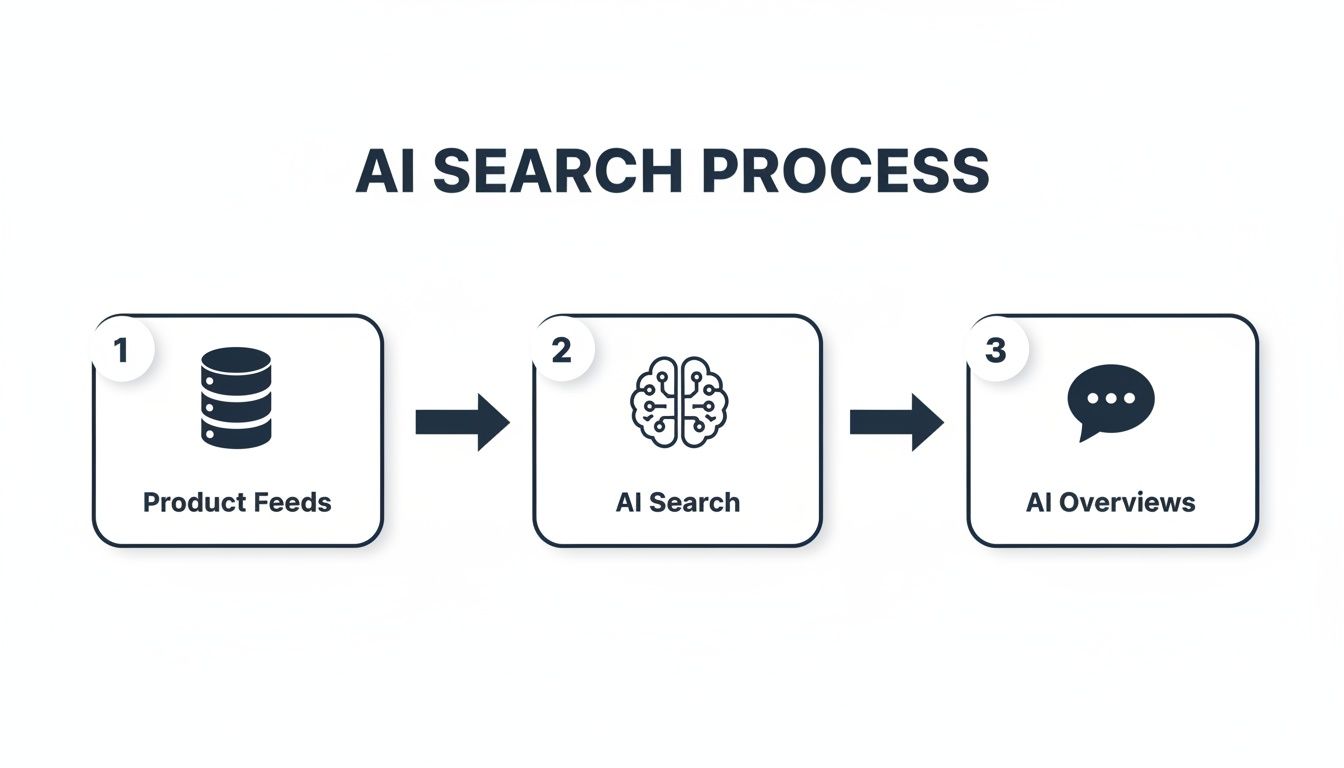
It is a clear illustration of how AI search now prioritises structured feeds as the starting point for understanding and presenting your product information, a cornerstone of agentic search optimisation.
Why This Matters for Australian Retailers
The impact of this shift is already massive. In Australia, Google’s AI Overviews are now showing up in a staggering 39% of all searches. For commercial queries, the ones that drive ecommerce sales, AI summaries are triggered in 22% of cases, pulling information directly from structured product feeds.
Here is the critical part: when these AI Overviews appear, the click-through rate for the top organic results plummets by 34.5% if your feed is not optimised. The game has changed from manual SEO to AI SEO.
Your product feed is no longer just a channel for shopping ads. It has become the foundational data layer for your entire digital shelf. For AI agents, your feed is your catalogue.
To really understand how AI search engines process this information, it is worth understanding core technologies like what is vector search, which powers the conceptual understanding of your products. This move means preparing for agentic shopping and the future of work starts with treating your product feed like critical infrastructure, not just another marketing task.
What AI Looks for in Product Feed Data

When an AI agent scans your product feed, it is not just looking for keywords. It is hunting for clarity, consistency, and signals of trust. The goal is something called entity resolution, a technical way of saying it wants to build a complete, crystal-clear profile for every single product you sell to improve its recommendation confidence.
To do that, the AI is looking for signals of authority. It needs to understand exactly what a product is, how it compares to others, and whether your information is reliable enough to present to a user who is ready to buy. This structured approach is fundamental to AI-powered retail transformation.
The Anatomy of an AI-Ready Feed
An AI-ready feed begins with a foundation of clean, structured data. While every product category has its nuances, some attributes are universally non-negotiable for building trust with AI systems. The more complete and consistent this data is, the more confidence an AI will have in your listings.
Here are the core elements that AI agents truly care about:
Unique Product Identifiers: Think of Global Trade Item Numbers (GTINs), Manufacturer Part Numbers (MPNs), and SKUs as a product's fingerprint. They are the bedrock of entity resolution, allowing an AI to know for sure that your product is the exact same one another retailer is selling, or to distinguish it from a near-identical alternative.
Rich, Specific Attributes: Vague descriptions are dead ends for an AI. It needs granular details: dimensions, materials, colours, power usage for electronics, or fabric composition for fashion. This is critical because product attributes matter more than you think for search and filters. This is the data that lets an AI answer highly specific questions from shoppers. Image recognition and tagging can help automate this for categories like fashion or furniture.
Accurate Taxonomy and Categorisation: Placing a product in the right digital aisle is essential. Correctly categorising a sofa (e.g.,
Home & Garden > Furniture > Living Room Furniture > Sofas) gives the AI crucial context. Poor categorisation confuses it and ensures your products will not appear in relevant comparisons.
This is the kind of structured information that allows an AI to move beyond simple keyword matching to genuinely understanding what you are selling, forming the basis of product data enrichment.
Real-Time Signals That Build Trust
It is not just about the static data in your feed. AI agents place huge importance on real-time signals that demonstrate your business is operationally sound. These signals can make or break an AI's decision to recommend your product.
Key real-time signals include:
- Availability: Is the item in stock, on backorder, or sold out? Stale inventory data is a fast way to lose trust.
- Pricing: The price must be accurate and consistent everywhere, in the feed, on the product page, and at checkout. Any mismatch is a major red flag.
- Location Data: If you have physical stores, accurate local inventory levels are invaluable. This is what powers answers to queries like, "where can I pick up one of these near me today?"
A product feed with missing GTINs, vague attributes, or outdated stock information is seen by an AI as a high-risk, low-confidence source. It will almost always favour a competitor’s feed that provides complete, reliable, and real-time data.
The difference between a basic, supplier-led feed and an enriched, AI-ready one is stark. For any retail leader, getting your data from the left column to the right column below is not just a good idea, it is the only way to stay visible in this new era of search.
Weak vs. AI-Ready Product Feed Attributes
| Attribute | Weak Feed Example (Low AI Confidence) | AI-Ready Feed Example (High AI Confidence) |
|---|---|---|
| Product Title | "Blue Sofa" | "Artiss 3-Seater Linen Fabric Sofa Lounge in Navy Blue" |
| GTIN | Missing | 9350062123456 |
| Dimensions | Missing | "195cm W x 85cm D x 80cm H" |
| Material | "Fabric" | "Frame: Solid Eucalyptus Wood; Upholstery: 100% Linen Fabric" |
| Category | "Furniture" | "Furniture > Living Room > Sofas & Couches" |
| Stock Status | "In Stock" (Updated daily) | "In Stock: 14 units" (Updated every 15 minutes via API) |
Ultimately, how AI search engines interpret product feeds all comes down to data quality. They prioritise rich, structured, and trustworthy information because their job is to provide reliable answers, not just a messy list of links. This is the foundation of achieving high digital shelf performance.
Why Duplicated or Supplier-Led Data Breaks AI Understanding

One of the biggest roadblocks for large retailers in the era of agentic search optimisation is the heavy reliance on generic, supplier-provided product descriptions. While efficient for getting products online, this common practice directly undermines your visibility in AI-driven search by creating identical content across multiple retailers, which weakens relevance and recommendation confidence.
This creates a digital echo chamber where dozens of websites say the exact same thing about a product. For an AI agent, this duplication is a serious problem. Its primary function is to find the single best, most authoritative answer.
When it encounters identical content across multiple domains, it gets stuck. Which source should it trust? Which one offers any unique value? Unable to pick a clear winner, the AI’s confidence in recommending any of the listings plummets. This often leads to suppressed visibility for everyone using that content, as the AI defaults to a source with even slightly more unique data or creates a generic answer that credits no one. This is why correcting duplicated supplier content is not optional.
The Problem of Undifferentiated Signals
AI agents evaluate content based on signals of authority, uniqueness, and relevance. When your product pages mirror your competitors', you are sending weak, low-value signals. The AI sees a crowd of retailers all shouting the same message, making it impossible to pick a leader and demonstrating the key difference between AI SEO vs Traditional SEO teams.
This goes beyond old SEO penalties for duplicate content. In the world of AI shopping SEO, duplicated supplier information actively confuses the machine's learning process.
- It weakens entity resolution: The AI cannot figure out which retailer adds unique context or value to the product.
- It erodes trust: A lack of original content suggests a lack of expertise or authority.
- It prevents meaningful comparison: If all the specifications and descriptions are identical, the AI has fewer data points to compare your offering against others.
This is a critical challenge for Australian ecommerce retailers. In fact, analysis shows that 73% of GenAI referral traffic to AU retail sites shows 12% more pages viewed and 23% lower bounce rates. This proves that AI-driven shoppers are far more engaged when they land on a page with optimised, unique product information.
Moving Beyond Manufacturer Copy
The only way forward is to invest in product data enrichment at scale. This means transforming generic supplier feeds into unique, high-quality content that reflects your brand’s voice and helps the shopper. This is not just an SEO "best practice" anymore; it is a foundational requirement for building the trust signals AI agents need to improve digital shelf performance.
An AI agent is designed to find the 'signal' in the 'noise'. When your content is identical to everyone else's, you are part of the noise. Unique, enriched product descriptions are the signal that proves your authority.
This process involves more than just rewriting a few sentences. It requires a strategic approach to automating product descriptions and enriching data with unique attributes, benefits-focused copy, and structured information that sets you apart. By doing this, you solve the problem of why supplier-led content breaks ecommerce discovery and give AI agents a clear, confident reason to choose your listing over a competitor's. This represents a core part of human + AI collaboration in SEO.
The Role of Product Feeds in AI-Driven Discovery
A well-optimised product feed does more than power external search results; it becomes the central nervous system for your entire retail operation. Enterprise retailers who treat their feed as a siloed marketing asset miss the enormous internal efficiency gains it can unlock. The same structured, trustworthy data that satisfies an AI search agent can fuel consistency and intelligence across your business, from category and brand pages to customer support bots and AI recommendations.
This is where the real value of product feed optimisation truly shines. Investing in a single source of truth creates a powerful ripple effect, improving performance and reducing retail content bottlenecks across multiple customer touchpoints. It prepares your whole business for a future of agentic commerce by ensuring every interaction is powered by accurate, consistent, and reliable data.
Powering On-Site Discovery and Navigation
Your product feed is the perfect engine for on-site discovery. The same structured attributes and precise taxonomy that help external AI agents make sense of your catalogue can be used to dramatically improve your own internal systems.
Consider these applications:
- Category and Brand Pages: Instead of manually building and maintaining these critical landing pages, an optimised feed can dynamically populate them with the right products, specifications, and marketing copy. This ensures everything stays consistent and frees up your teams from tedious, repetitive work.
- On-Site Search: A clean, attribute-rich feed is the key to more accurate and relevant internal search results. When a customer searches for a "waterproof jacket with fleece lining," a system drawing from a detailed feed can deliver precise results. One crawling messy page content might fail.
- Faceted Navigation and Filters: Those granular attributes in your feed, think size, colour, material, compatibility, are the building blocks of effective filtering. A well-maintained feed makes these filters more reliable and genuinely useful, improving a customer's ability to find exactly what they need.
Fuelling AI-Driven Customer Interactions
Beyond your website's architecture, the product feed is becoming a critical knowledge base for the AI tools that interact directly with your customers. The rapid rise of AI agents in ecommerce is making this connection more important than ever, heralding the agentic commerce future.
An AI customer support bot can only be as smart as the data it is given. When connected to a real-time, attribute-rich product feed, it can answer complex customer queries with confidence and accuracy, turning a potential support ticket into a sale.
Think about the potential here for AI workflow automation for retail. Your feed can serve as the brain for:
- Customer Support Chatbots: These bots can be empowered to answer detailed product questions like, "Does this television have three HDMI ports?" or "Is this sofa available for delivery to my postcode this week?", all without needing human intervention.
- Personalised Recommendations: AI recommendation engines can dip into the rich data in your feed to make much smarter suggestions based on a customer's browsing history. This moves you beyond simple "customers also bought" logic to more nuanced, attribute-based recommendations that feel genuinely helpful.
- AI-Powered Merchandising: Automated systems can use feed data to dynamically adjust category page layouts or promotions based on stock levels, seasonality, or real-time sales trends.
Ultimately, a high-quality feed ensures that every system, from Google's AI Overviews to your own internal chatbot, is working from the same script. This systemic approach moves product data from being just another channel asset to becoming core business infrastructure, essential for both retail content automation and future growth.
Common Feed Issues That Limit AI Visibility

Even the smartest AI agent is useless if it is fed inconsistent or incomplete information. For large retail teams, understanding how AI search engines interpret product feeds means first understanding what causes them to lose confidence. These are not minor technical glitches; they are fundamental breaks in trust that cause an AI to ignore your products, such as data gaps, poor categorisation, and unscalable manual processes.
An AI builds confidence through consistency. When it hits persistent gaps or contradictory information, it immediately flags your feed as a high-risk source. This kills your digital shelf performance because the AI will always favour a competitor's cleaner, more reliable data. Fixing these issues is not just a cleanup job; it is the foundation of agentic search optimisation.
Data Gaps and Inconsistent Attributes
One of the most common issues is simply missing data. When an AI agent is comparing products, it needs a complete set of information. A feed that is missing critical details, like materials for a jumper, dimensions for a table, or compatibility for electronics, creates a black hole in the AI’s understanding.
Just as damaging are inconsistent attributes. If you call the attribute colour for shirts but finish for furniture, you confuse the AI’s ability to build a coherent map of your catalogue. This lack of a standard prevents it from making accurate comparisons, which tanks its confidence in recommending your products. You can learn more about how AI search can’t surface products it can’t understand.
Shallow Taxonomies and Stale Data
A badly organised product catalogue is another huge red flag. A shallow taxonomy that dumps thousands of SKUs under a generic category like "Women's Clothing" forces the AI to do all the heavy lifting. That is a task it will often give up on, moving on to a source that has already done the work.
But nothing erodes an AI’s trust faster than stale data.
- Outdated Availability: Showing a product as in-stock when it is sold out creates a terrible user experience, and AI agents are specifically programmed to avoid that risk.
- Incorrect Pricing: A mismatch between your feed price and your website price is an immediate signal of an unreliable and untrustworthy source.
This is becoming more critical by the day, especially as Australian consumers start using AI for shopping. With 49% of Aussies expected to use GenAI daily by 2025 and AI Overviews already showing up in commercial searches, your feed quality has a direct impact on your bottom line. Data already shows GenAI referrals to retail sites lead to 12% more page views and 23% lower bounce rates, proving the massive potential when feeds are properly tuned.
The Problem with Manual, Unscalable Processes
For large retailers juggling tens of thousands of SKUs, these issues are usually symptoms of a much bigger problem: manual workflows that do not scale. One-off cleanups are like putting a band-aid on a broken leg. The sheer volume of data means that without AI workflow automation for retail, errors and inconsistencies are guaranteed to creep back in. This is why enterprise retailers need workflows, not one-off cleanups.
Your product feed is not just a marketing channel; it is a core piece of your business infrastructure. AI search performance depends entirely on how well that infrastructure is built and maintained at scale.
This is the real challenge as we move from traditional SEO to AI SEO. Preparing for the future of retail search means building robust, automated systems for product data enrichment and quality control. It is about putting scalable SEO solutions in place that guarantee your data is always clean, complete, and trustworthy, ready for any AI agent that comes knocking.
Why Product Feed Optimisation Must Scale: A Practical Takeaway
For too long, retail teams have treated the product feed as just another box to tick for running ads. In the new era of AI SEO, that thinking is a liability. It is time to reframe the conversation for your leadership team: your product feed is no longer a marketing channel, it is core business infrastructure. AI search performance depends on how well that infrastructure is maintained at scale.
AI search engines, from Google SGE to Perplexity and ChatGPT, now see your feed as the foundational data layer for your entire product catalogue. It is the single source of truth they use to build trust, draw comparisons, and make recommendations. When that infrastructure is shaky, your visibility simply collapses.
From Channel to Foundation
The points laid out in this guide all circle back to a few critical realities for the future of retail search. First, data quality has become the new currency of trust for AI agents. Second, consistency across all your product data is what powers everything from your internal chatbots to external discovery on AI shopping assistants.
Preparing for agentic commerce and the future of work in retail is not about doing a few manual cleanups here and there. That is not scalable and it will not last. What is needed is a strategic, systemic approach to managing your product data with workflows, not one-off cleanups.
Your product feed is the digital equivalent of your supply chain. If it is slow, unreliable, or inaccurate, the entire system breaks down. AI will simply route around the damage and find a more dependable supplier.
This reality means implementing automated content workflows and scalable SEO solutions that can handle tens of thousands of SKUs with absolute precision. Product feed optimisation is the logical next step for any enterprise retailer.
Building for the Future of Retail Search
The final, actionable takeaway is clear. The future of your brand's performance on the digital shelf depends entirely on the quality and integrity of your product data infrastructure. Without robust, AI-powered content workflows to manage product feed optimisation at scale, retailers are going to hit massive content bottlenecks and lose ground to nimbler competitors.
This is not just an SEO problem; it is an operational readiness problem. An optimised feed is the bedrock of modern retail efficiency tools, powering everything from your on-site search to AI agents for retail efficiency. Maintaining this critical infrastructure is no longer a choice, it is the price of admission to the future of AI-led commerce.
We Get Asked These Questions a Lot
What’s the Single Biggest Mistake Retailers Make with Product Feeds for AI?
Thinking of a product feed as a static, one-time upload for shopping ads. That is the old way. In the world of agentic search optimisation, your feed is a live, dynamic handshake with AI platforms.
The most damaging mistakes all stem from that outdated mindset. It leads to stale availability data, inconsistent attributes across your catalogue, and a heavy reliance on duplicated supplier content that completely erodes an AI’s trust in your brand.
How Does AI Handle Missing Product Attributes?
It does not guess. If a critical attribute like 'material' or 'dimensions' is missing, the AI agent simply cannot use your product when a customer asks a comparative question. It is an instant disqualification.
The AI will always favour a competitor's product that has a complete, structured data profile. This is why product data enrichment is not a nice-to-have; filling those gaps is fundamental to even being seen in the first place.
Is It Better to Have More Products with Basic Data or Fewer with Rich Data?
Fewer products with complete, enriched data will win every time in an AI-driven search. AI prioritises trust and confidence, not the raw size of your catalogue.
A smaller, well-maintained feed with unique descriptions, rich attributes, and accurate real-time data sends far stronger signals of authority than a massive feed full of gaps and copy-pasted content. This is a core principle of SKU-level SEO and a key benefit of focusing on optimised at scale workflows.
Can I Still Just Rely on Traditional SEO for My Product Pages?
Traditional on-page SEO is still a piece of the puzzle, but it is no longer the whole game. AI SEO demands a dual focus. Your on-page content needs to be fantastic for your human customers, but your structured product feed has to be pristine for AI agents.
The two work in tandem. The feed acts as the primary data source for discovery, and the page acts as the confirmation and final destination. A great-looking page cannot make up for a poor feed when an AI is doing the initial shortlisting. The shift is from manual SEO to AI SEO.
How Often Should I Update My Product Feed for AI Search?
For dynamic data like pricing and stock levels, you need to be as close to real-time as possible, ideally through an API. For static data like descriptions and specifications, the focus is less on update frequency and more on continuous enrichment.
The real goal of optimising product feeds efficiently is to build automated content workflows. This ensures your data is always accurate and prevents the stale information that shatters AI confidence.
Prepare your retail business for the future of agentic commerce. Optidan AI provides the AI-powered content workflows and scalable SEO solutions you need to transform your product data into a competitive advantage. Discover how we help enterprise retailers achieve visibility and readiness at https://optidan.com.
