

Creating a content page that actually performs is no longer about one-off manual efforts. The real win comes from building an automated, scalable engine that works for you. It’s a complete shift in thinking that involves enriching your product data, automating unique descriptions, and optimising every single element for the future of retail search.
Shifting From Manual Content to an Automated Engine
Staring at a blank template for a single content page is tough. Now, imagine trying to scale that across thousands of SKUs. For too long, Australian retailers have been bogged down by this old, one-by-one manual process. It’s a content bottleneck that holds back growth and slows down retail content automation.
It’s time to reframe the challenge. The modern approach is built on AI-powered content workflows, turning tedious page creation into a scalable engine that drives performance on the digital shelf. The core of this shift is using AI SEO and product data enrichment to transform generic supplier feeds into unique, optimised content that truly connects with customers and prepares you for agentic search. This transition from manual SEO to AI SEO is critical for retail efficiency.
This data shows the massive performance gap between a basic, manually created page and a structured, data-enriched one.
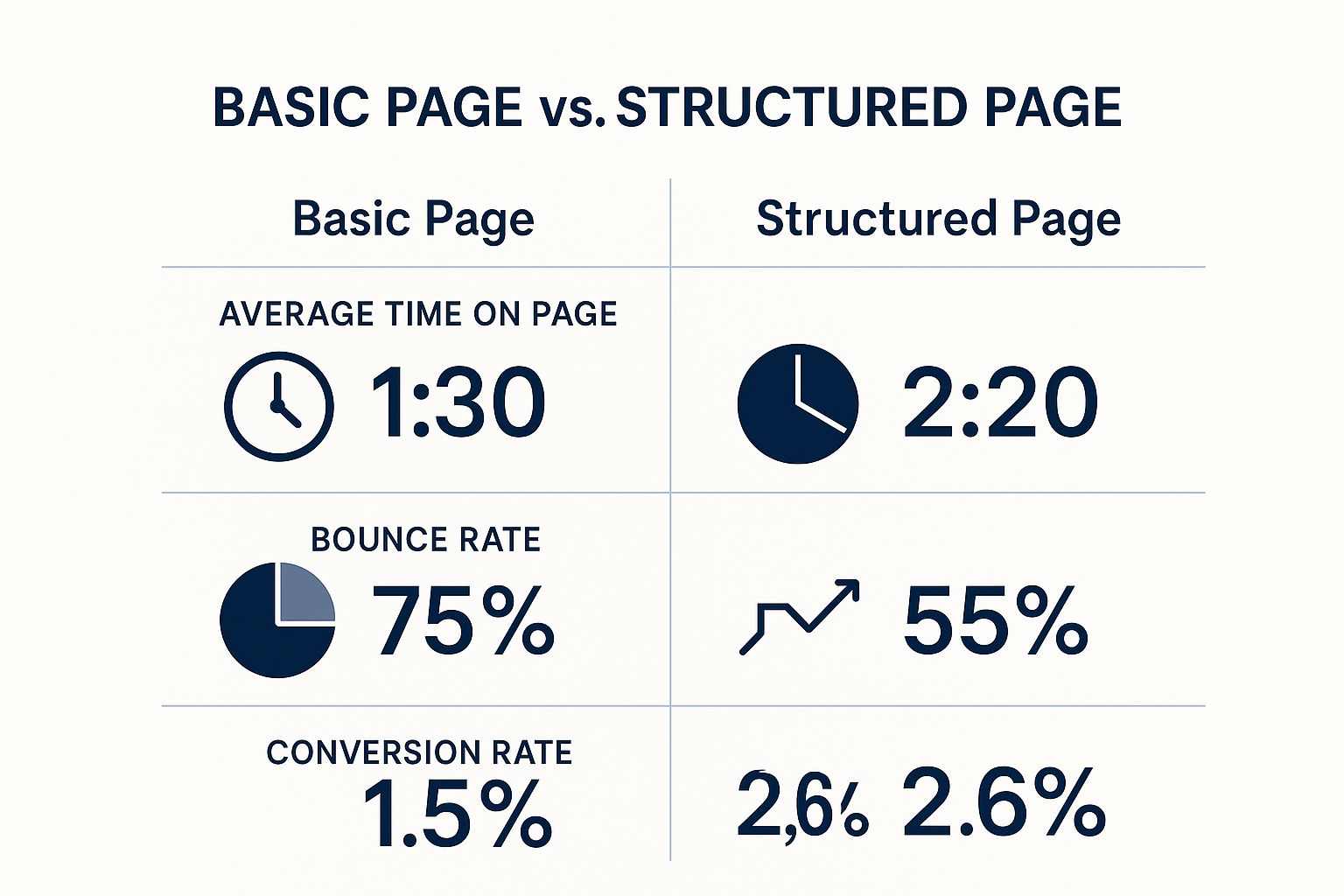
The insights are clear. A structured page, fuelled by enriched data and automation, delivers a serious lift in key engagement and conversion metrics. This transformation is critical, especially as Australia’s digital content creation market is projected to grow at a CAGR of 16.3% from 2025 to 2030. AI-powered retail transformation tools are expected to account for over 74% of that market share.
The future of work in retail isn't about replacing teams but empowering them with AI workflow automation. It's about achieving SEO at scale, correcting duplicated supplier content, and ensuring every page is optimised for both humans and AI agents.
This new approach allows retailers to produce thousands of high-quality pages in days, not months, delivering scalable SEO solutions previously unimaginable.
For a deeper dive into how content automation transforms marketing, this guide to Master Content Creation Automation for Better Marketing is a great resource. Adopting these retail efficiency tools isn't just an option anymore; it's essential for staying competitive and achieving next-gen SEO for retailers.
Traditional vs AI-Powered Content Page Creation
The difference between the old manual way and a modern AI-powered workflow is stark. One is slow, costly, and inconsistent, while the other is fast, scalable, and built for performance. Here’s a quick comparison to put it into perspective.
| Aspect | Traditional Manual Process | AI-Powered Workflow |
|---|---|---|
| Speed | Weeks or months per thousand pages | Days per thousand pages |
| Scalability | Extremely limited; requires more staff | Highly scalable to any catalogue size |
| Consistency | Varies by writer and over time | Uniform brand voice and structure |
| Data Utilisation | Basic product specs | Enriched data, attributes, and benefits |
| Optimisation | Basic keyword placement | Deep SEO and AI-agent readiness |
| Cost | High cost per page, low ROI | Low cost per page, high ROI |
As you can see, the AI-powered approach doesn't just speed things up. It fundamentally improves the quality, consistency, and strategic value of your content, making it a far more effective investment for any retail business focused on agentic commerce future.
Building a Strong Foundation with Product Data Enrichment
Great content pages are not born from a blank slate; they are built on a foundation of rich, structured data. Before you even think about writing a single word, the first real step is to turn those messy, inconsistent supplier feeds into a genuine asset. This whole process is known as product data enrichment.
For retail leaders, this is the jumping-off point from old-school, manual SEO to a smarter, AI-driven approach. It’s all about using AI-powered tools to automatically standardise attributes, fix errors, and fill in the blanks across thousands of SKUs. This directly solves the massive problem of supplier content duplication, which is a silent killer for your digital shelf performance. A focus on optimising product feeds efficiently is a non-negotiable for success.
Just look at how raw, basic data gets transformed into a rich, structured format that’s actually ready for optimisation.
This image perfectly shows the journey from a simple supplier feed to a detailed, customer-focused product profile. This isn't just a cleanup job; it's a core part of building AI-compatible SEO content for the future of retail search and agentic shopping.
Turning Data into a Performance Asset
Once your product data is enriched, it directly fuels better on-page content and even improves how your site functions. Think about fashion SEO optimisation for a minute. By standardising messy inputs like "Navy" and "Midnight Blue" into a single, clean "Blue" attribute, you make your faceted search instantly better. Customers can actually find what they are looking for, faster.
It's the same story for electronics SEO optimisation. Detailing technical specs like "refresh rate" or "processor speed" gives both human shoppers and AI shopping agents like Rufus or ChatGPT the exact information they need to make a decision.
This focus on SKU-level SEO isn't just about keywords. It’s about providing the deep, structured information that powers next-gen SEO for retailers and gets your catalogue ready for agentic commerce.
This process is absolutely central to a winning ecommerce strategy. If you want to go deeper, our guide on product feed management offers insights into how to optimise and scale your approach. By automating these data workflows, you get rid of retail content bottlenecks and create the foundation for scalable SEO solutions that drive real, measurable results.
Automating Unique Content to Eliminate Duplication
Copy-pasting generic supplier descriptions is one of the fastest ways to kill your SEO performance and wash out your brand voice. For Australian retailers, the biggest hurdle is often fixing this duplicated supplier content issue across thousands of product pages. Manually rewriting every single page is a massive bottleneck, it's just not practical.
This is where AI can completely change the game for your retail business. By setting up automated content workflows, you can generate thousands of unique, on-brand product descriptions in days, not months. This isn't about spinning text for the sake of it. It’s a strategic move to give every single product page its own identity, helping you sidestep search penalties and really own your space on the digital shelf. This is retail SEO automation in action.

The process uses generative AI to rewrite and flesh out the supplier information you already have, turning a huge SEO risk into a genuine asset. To get a better idea of how these systems operate, check out our guide on the AI product description generator.
Human-Led AI Content QA
Automation gives you incredible speed, but you still need quality control to protect your brand. The best way to do this is with a human-led AI content QA process. This hybrid approach combines the raw efficiency of AI with the critical thinking and brand knowledge of your team, exemplifying human + AI collaboration in SEO.
This model ensures the final output isn’t just unique, but also compelling, geared for conversion, and a perfect match for your brand. It’s the secret to maintaining quality while scaling up your content efforts.
On top of that, it's crucial to bring in other media. Video now makes up 64% of all digital content consumed in Australia, and a staggering 91% of Australians used online video services in 2024. This just goes to show how important it is to embed videos on your content pages to drive engagement and improve performance. A data-driven approach like this gets your content ready for the future of retail search.
Optimising Your Visuals and Metadata at Scale
For so many online retailers, especially in fashion, furniture, and beauty, the images are the product. Your customers can't touch or feel the item, so the visuals have to do all the heavy lifting. But manually tagging and optimising thousands of product photos just doesn't scale.
This is where AI image recognition completely changes the game. It’s a massive leap forward for any ecommerce content optimisation strategy, especially for furniture image tagging SEO or fashion product image SEO.
Instead of someone manually typing out descriptions, this tech analyses your product photos and automatically creates the metadata that search engines and AI agents need. It goes way beyond just basic alt text. An AI can instantly spot key attributes, like ‘linen armchair with timber legs’ or ‘V-neck cotton T-shirt’, and turn them into descriptive, keyword-rich metadata for your entire catalogue. This is metadata optimisation at scale.
From Manual Tagging to Automated Insights
Making the switch from manual grunt work to an AI-powered content workflow is huge. It frees up your team from the tedious, time-consuming task of optimising alt tags, allowing them to focus on high-value strategy instead. This automation also brings a level of consistency and accuracy across your product range that's almost impossible to achieve by hand.
Here’s what that really means for your store:
- SKU-Level SEO: Every single image gets tagged with specific, relevant keywords. This boosts its visibility everywhere, from a standard Google search to a visual search on Pinterest.
- Agentic Search Readiness: This rich, detailed metadata makes your products perfectly understandable to AI shopping agents like Rufus or Perplexity. You’re essentially future-proofing your catalogue for the next wave of agentic commerce.
- Improved Accessibility: Properly generated alt text makes your site far more accessible to all users, which is no longer a nice-to-have but a critical part of any modern web experience.
This level of metadata optimisation directly impacts how well your products perform on the digital shelf. It’s not just about telling search engines what an image shows anymore; it's about structuring your visual data so AI agents can confidently recommend your products to shoppers.
This is particularly important in a market like Australia, where over 91% of the population are active internet users. With such a connected audience, getting your visual and metadata optimisation right is key to grabbing their attention. To make sure your automated content pages are built for maximum impact, it’s worth reviewing some proven SaaS landing page best practices.
Preparing Your Content for the Future of Agentic Search
Building a content page today isn't just about winning over a human reader; it's about preparing for the customer of tomorrow. The future of retail is being shaped by AI agents in ecommerce and agentic search, where tools like ChatGPT, Perplexity, and Amazon's Rufus are the new personal shoppers, finding and recommending products based on complex, conversational queries.
This shift demands a new playbook. We are moving towards creating AI-Compatible SEO Content, which goes far beyond basic keyword tactics. The focus now is on structured data and natural language that AI agents can parse and understand instantly. This is the heart of agentic search optimisation, where clarity and context are everything. Your content pages must be built to provide direct, unambiguous answers.
Take a look at the kind of conversational interface that's quickly becoming the new search engine for countless users.
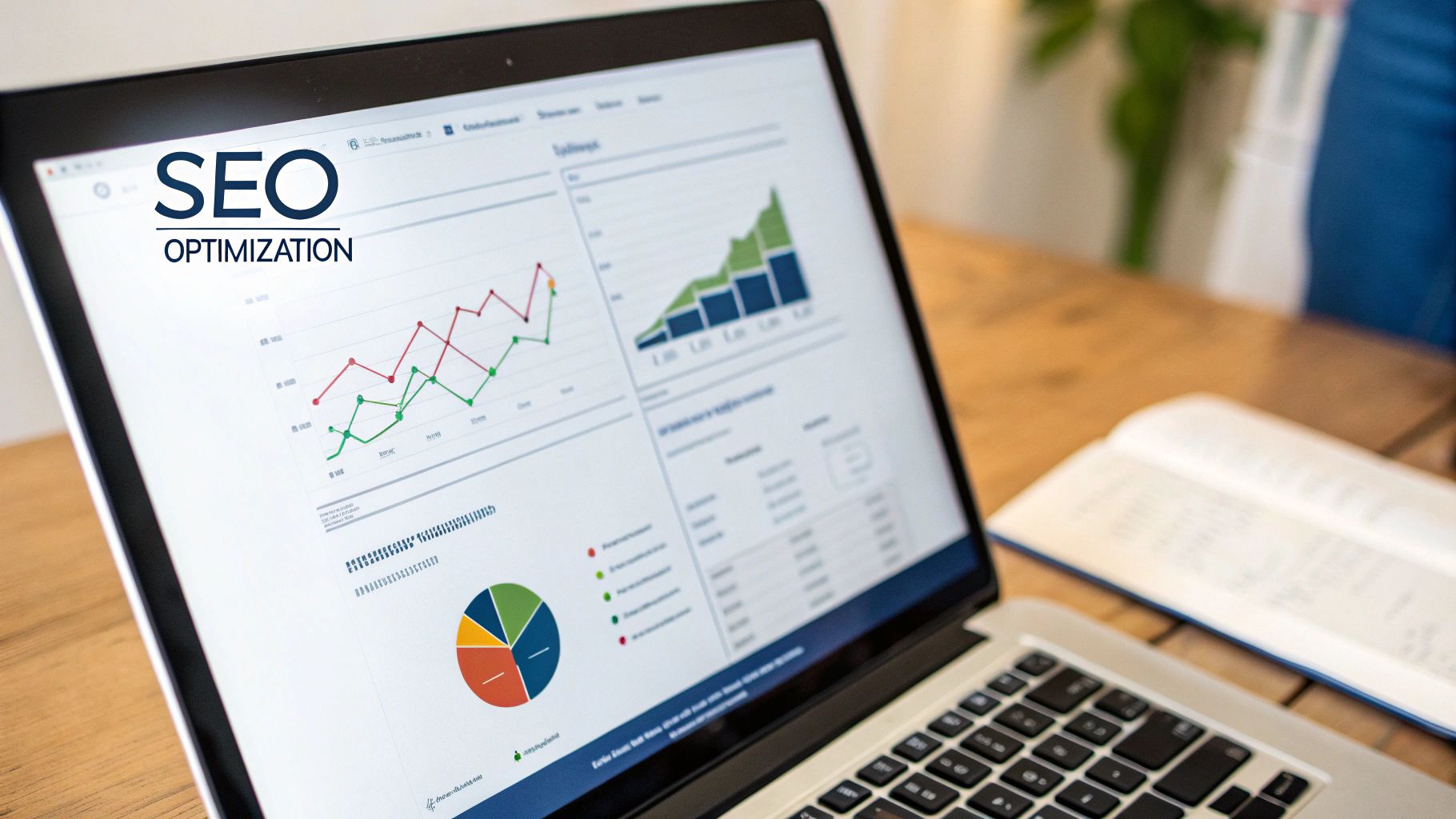
It's clear that people aren't just typing in keywords anymore. They are having detailed conversations and expecting specific, tailored recommendations in return.
Structuring Content for AI Shopping Agents
To win in this new era of agentic commerce, your content needs to be exceptionally well-organised. Think less like a copywriter and more like a data architect. This is where product data enrichment becomes absolutely critical, providing the granular details AI agents thrive on.
Here’s how to get your pages AI-ready:
- Go Beyond Basic Descriptions: Forget simple overviews. Detail every last attribute, materials, dimensions, compatibility, and origin. For fashion SEO, that means specifying fabric blends and care instructions. For electronics, it means listing every port and the exact processor speed.
- Use Clear Question-Answer Formats: Embedding FAQs directly on your product pages is a goldmine for AI. This format is easily digestible for machines and gives human shoppers immediate answers to their most common questions.
- Implement Structured Data: Use schema markup to explicitly label key information like price, stock availability, and customer reviews. This removes any guesswork for AI agents and makes your data perfectly machine-readable.
By focusing on SKU-level SEO with this depth of detail, you’re not just optimising for today's search engines. You’re building a foundation for the future of retail search, ensuring your products are the ones AI agents trust and recommend.
To get a better handle on what this means for your workflow, check out these answers to common questions about Agentic AI SEO. Adopting these next-gen SEO strategies isn't optional anymore; it's essential for driving your digital shelf performance.
Your Top Questions on AI Content Automation
Moving to an AI-powered content workflow is a big step, and it's natural for retail leaders to have questions. Getting your head around how automation works with your brand standards and existing data is the key to getting it right. Here are some of the most common queries we hear.
How Can We Maintain Brand Voice With AI?
This is a big one, and the answer is all in the setup. You do not just turn an AI on and hope for the best. You start by feeding it detailed brand voice and style guides, covering everything from tone and specific terms to formatting rules.
But the real secret is a human-led AI content QA workflow. The AI does the heavy lifting, producing the initial drafts at scale, and then your team steps in to review and refine. This blend of machine speed and human creativity ensures the final output is always perfectly on-brand.
What Is the First Step in Enriching Supplier Data?
Before you can enrich anything, you need to know what you are working with. The first, most critical step is a data audit and standardisation process.
It starts with consolidating all your supplier feeds into a single platform. From there, you can use AI to map and standardise attributes. For example, it can automatically turn messy variations like ‘Charcoal’ and ‘Dk Grey’ into a clean, consistent ‘Grey’. Once you have that clean base, you are ready to start enriching the data by adding missing details and generating unique, SEO-optimised content.
How Does Agentic SEO Differ From Traditional SEO?
This is a fundamental shift. While traditional SEO is often about chasing specific keywords, Agentic SEO is about providing structured, comprehensive data for AI agents like ChatGPT or Perplexity. This new approach prioritises clarity, making it dead simple for an AI to understand your product and why it's the best answer for a user's question. This is the core difference between AI SEO vs traditional SEO.
Many are still wrapping their heads around this change. If you are wondering about the nuts and bolts, you can dig deeper into our analysis of whether AI-generated content can impact SEO performance. The core difference is you're now structuring content for machines, not just humans.
Ready to swap manual bottlenecks for scalable, high-performance content? See how Optidan AI can automate your retail content strategy and get you ready for the future of agentic commerce. Visit us at https://optidan.com to learn more.
