

The world of online shopping is no longer about just having a decent ecommerce website. We’re now in an era of intelligent, automated systems built for efficiency and growth. For retail leaders and ecommerce managers in Australia, this is a signal to move on from manual updates and start embracing AI-powered workflows, automated content generation, and a new way of thinking about search.
The New Reality of Australia’s Digital Shelf

The Australian ecommerce market isn’t just a nice-to-have anymore, it’s a core part of our national economy. This isn’t just a fleeting trend, it represents a deep, fundamental shift in how people shop. The numbers tell a powerful story: over 9.8 million Australian households are now shopping online.
Those households spent a jaw-dropping $69 billion online last year alone, a massive 12% jump from the year before. This isn’t just growth, it’s an explosion.
This surge in online activity has turned the digital shelf into a battlefield for visibility. Winning is no longer about just being present online. It’s about having the most optimised, relevant, and easily discoverable products at every single customer touchpoint. For retail leaders and ecommerce managers, the question becomes obvious: how on earth do you manage thousands, or even tens of thousands, of product pages and make sure every single one is perfect?
The answer is to stop thinking in terms of manual SEO and start embracing AI SEO. The old ways are just too slow and expensive to keep up, creating significant retail content bottlenecks.
The future of work in retail is a powerful partnership between humans and AI. Let AI handle the massive task of optimising product data at scale, and free up your team to focus on what they do best: strategy, brand oversight, and creative direction.
The Imperative for Automation and Scale
Manual processes are the enemy of growth. They create massive bottlenecks in your content workflow. Think about all the hours your team wastes correcting duplicated supplier content, writing unique product descriptions from scratch, or tweaking metadata for every single SKU. These tasks, when done by hand, are what stop your team from working on high-impact strategic projects.
This is exactly where AI workflow automation for retail steps in. Imagine taking raw supplier feeds and turning them into rich, structured, and completely unique product content for your entire catalogue, not in months, but in days. This is the new standard for retail efficiency. It unlocks:
- Scalable SEO Solutions: You can achieve detailed, SKU-level SEO across your entire product range without needing to hire a huge content team, moving from manual SEO to AI SEO.
- Enhanced Digital Shelf Performance: Improve your rankings and boost conversions by getting rid of duplicate supplier content and enriching your product data through automated content workflows.
- Agentic Search Readiness: You’re not just optimising for today. You’re preparing your product catalogue for the future of retail search, where AI agents will find and recommend products based on highly structured, detailed data.
To really get ahead on Australia’s digital shelf, you also need to master the platforms where your customers are already searching, like Google Shopping. Getting your products to stand out there is crucial, and these Google Shopping optimization tips can give you a serious competitive advantage.
Preparing for the Agentic Search Revolution

The way your customers find products is going through its biggest shake-up in over a decade. The old rules of SEO, built around keywords typed into a search bar, are quickly becoming obsolete. We’re now stepping into the world of agentic search.
This is where AI assistants like ChatGPT, Perplexity, and Google’s AI Overviews do the heavy lifting, finding and piecing together answers for users. It’s a fundamental change to the entire search landscape.
This shift signals the end of manual SEO as we know it and the beginning of AI SEO. It’s no longer good enough to just rank for a search term. Your product content now has to be AI-compatible SEO content, built for machines to understand. This allows AI agents for retail efficiency to easily compare your products and recommend them with confidence. If your data is messy, generic, or just copied from a supplier, these AI shopping agents will simply look right past you.
For Australian retailers, getting an agentic search optimisation strategy in place early is a massive competitive advantage. The businesses that prep their product catalogues for this new reality will be the ones getting found and recommended, grabbing market share while their competitors become invisible to AI.
From Human Keywords to Machine Understanding
The biggest difference between the old SEO and the new AI SEO is who you’re optimising for. For years, we’ve all focused on human search habits, targeting popular keywords and writing content that reads well for a person. Agentic SEO flips that script. Now, you have to optimise for machine comprehension.
Think of it this way: an AI shopping assistant is given a task to find a “blue, v-neck, linen-blend dress perfect for a summer wedding”. This AI doesn’t browse websites. It dives straight into structured data to find products that match those exact attributes.
For your products to even be in the running, your data needs to be:
- Highly Structured: Key details like material, colour, style, and occasion must be clearly defined and tagged.
- Detailed and Granular: Vague descriptions are useless. The AI needs specifics, like ‘100% European linen‘ or a ‘mid-century modern oak finish‘.
- Unique and Authoritative: Copied supplier content creates confusion and kills trust. The AI will always favour original, enriched descriptions.
This is where product data enrichment becomes absolutely essential. It’s the engine that turns basic supplier feeds into the high-quality, structured information that AI agents need to do their job. This methodical approach is the bedrock of any resilient ecommerce strategy. For a deeper look, check out our insights on the future of retail growth from optimisation to agentic commerce.
AI SEO vs Traditional SEO Teams
The limitations of doing things by hand become painfully obvious with agentic search. A traditional SEO team, no matter how good they are, can’t manually rewrite and structure data for tens of thousands of products. That workflow belongs to a different era, creating content bottlenecks that kill growth.
The new benchmark for retail efficiency is not about how many people you have, but how effectively you deploy automation. AI workflow automation for retail allows you to achieve SKU-level SEO at a scale previously unimaginable, turning a major operational challenge into a strategic advantage.
Let’s put the two approaches side-by-side. A traditional team might spend weeks optimising just one product category. An AI-powered content workflow, on the other hand, can process an entire product catalogue, fix duplicated supplier content, write unique descriptions, and apply structured data across thousands of pages in a couple of days. That’s the definition of SEO at scale.
This new world shines a spotlight on the need for retail efficiency tools that can handle both volume and complexity. The future of work in retail will be about human + AI collaboration in SEO, where expert teams set the strategy and AI agents handle the massive optimisation tasks.
By automating product descriptions and optimising product feeds efficiently, you free up your team to focus on high-value strategic work instead of drowning in manual content creation. This isn’t just an online shopping innovation, it’s a fundamental change in how retail businesses must operate to win.
Building Your Core Engine for Product Data
Your product catalogue is the single most valuable digital asset you own. Yet for many Australian retailers, this asset is trapped in a chaotic state, buried under thousands of inconsistent, messy, and duplicated supplier data feeds.
This mess is a major bottleneck that stalls growth and torpedoes your search visibility. The solution is to build an automated engine for product data enrichment.
This process is all about creating automated workflows that take raw supplier files and systematically turn them into structured, compelling, and SEO-optimised product listings. Think of it as an expert librarian instantly organising a chaotic warehouse of books into a perfectly catalogued library, ready for anyone to find exactly what they’re looking for.
This engine is the foundation of SEO at scale. It’s what allows a fashion or furniture retailer to properly optimise over 10,000 product pages in just a few days, a task that would take a manual team months to even attempt.
From Supplier Duplication to Unique Content
One of the biggest silent penalties in ecommerce SEO is supplier content duplication. When multiple retailers use the same generic descriptions provided by a manufacturer, search engines struggle to tell them apart. It’s a recipe for suppressed rankings for everyone involved.
Your digital shelf performance suffers because, in the eyes of Google, your products look identical to your competitors.
AI workflow automation for retail solves this problem head-on. Instead of just copying and pasting supplier text, the system rewrites and restructures it, creating unique, high-quality product descriptions for every single SKU.
This automated process ensures that:
- Each product page finds its own voice, aligning with your brand’s specific tone and style.
- Key features are highlighted differently, creating distinct value propositions for both search engines and customers.
- Technical specs are structured uniquely, avoiding the obvious red flags of duplicated content.
This systematic approach to the duplicate content SEO fix is a critical first step in building an authoritative, high-ranking product catalogue. For a deeper dive, check out our guide on how to optimise and scale your product feed management.
The infographic below shows how different AI personalisation methods, all powered by clean data, can significantly lift conversion rates.
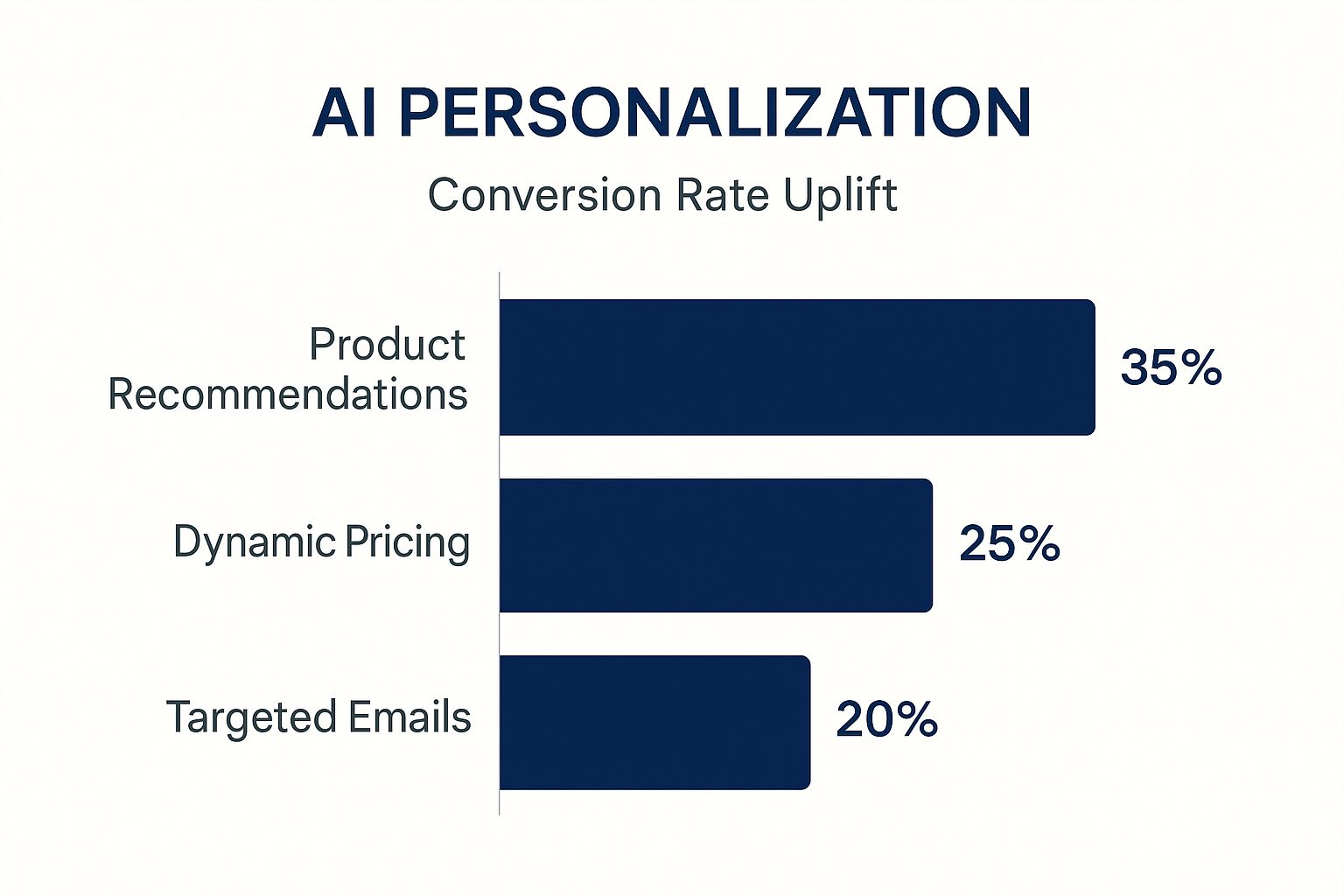
It’s clear from the data that a well-structured product feed is the key to unlocking powerful recommendation engines, which deliver the biggest returns.
Manual vs AI-Powered Product Data Enrichment
Moving away from manual content processes is no longer a choice, it’s a necessity for survival and growth. The table below breaks down just how much more efficient an AI-driven approach is compared to the old, manual way of doing things.
| Task | Traditional Manual Approach | AI-Powered Automation Approach |
|---|---|---|
| New Product Onboarding | Days or weeks per product line. Involves copy-pasting, manual rewrites, and checking spreadsheets. | Minutes. AI ingests supplier data, rewrites descriptions, and structures attributes instantly. |
| Content Uniqueness | Low. Relies heavily on supplier-provided text, leading to high duplication rates across the web. | High. Every product description is rewritten to be unique, on-brand, and SEO-friendly. |
| Attribute Enrichment | Inconsistent and often incomplete. Relies on team members manually finding and adding specs. | Comprehensive. AI extracts key attributes from raw text and populates structured fields automatically. |
| Scalability | Extremely limited. Adding thousands of SKUs requires a massive increase in headcount and time. | Near-infinite. Can process tens of thousands of SKUs in a matter of hours without extra staff. |
| Error Rate | High. Prone to human error, typos, and inconsistencies from manual data entry. | Minimal. Automated workflows ensure consistency and accuracy across the entire catalogue. |
The difference is stark. Automation doesn’t just make the process faster, it fundamentally improves the quality and consistency of your most important digital asset.
Automating the Foundation for Growth
Achieving real retail efficiency means moving away from manual content creation and embracing automated content workflows. This is especially true in categories with huge, constantly changing catalogues, like fashion, electronics, and furniture.
When you can automate product descriptions and enrich data feeds, you free up your expert teams from soul-crushing, repetitive tasks. Instead of drowning in spreadsheets, they can focus on high-value work like market analysis, campaign creative, and human-led quality assurance for the AI’s output.
Building a robust product data engine isn’t just about SEO. It’s about creating a single source of truth that powers every part of your ecommerce operation, from on-site search and AI shopping agents to multi-channel product optimisation and personalised marketing.
This operational shift aligns perfectly with spending trends across Australia. Department stores currently account for nearly 20% of all online spending, with homewares and appliances right behind at 19.1%. These are categories where detailed, accurate, and unique product data is absolutely essential to stand out.
Drilling down further, Millennials are leading the charge with US$14.8 billion in online spending, but Gen Z is catching up fast with US$7.1 billion, showing a huge appetite for these retail innovations. You can discover more insights about Australian online spending habits on Statista.com.
Ultimately, investing in a powerful product data engine is a foundational step in preparing for the future of work in retail. It creates a seamless model for human + AI collaboration, ensuring your business is agile, scalable, and ready for the next wave of agentic commerce.
Turning Product Images into Search Assets

In visual-heavy sectors like fashion, furniture, and beauty, your product images are some of your most powerful and most underused SEO tools. They’re the first thing a shopper sees and a huge part of their buying decision, yet most brands aren’t unlocking their full potential to drive traffic.
This is where AI image recognition for ecommerce comes in. It’s a massive step forward.
The technology automates the painstaking process of analysing thousands of product photos, pulling out the rich, descriptive data that search engines crave. It takes your visuals beyond simple file names and turns every single one into a hardworking asset that pulls qualified organic traffic straight to your product pages.
This marks a crucial shift away from manual, time-consuming metadata creation. It’s an automated, scalable solution for metadata optimisation at scale that boosts your digital shelf performance without burying your team in busywork.
How AI Image Recognition Powers Retail SEO Automation
At its core, AI image recognition SEO works like a highly specialised expert who can instantly spot hundreds of specific attributes in a photo. The tech scans an image and automatically generates optimised file names, descriptive alt tags, and structured metadata based on what it actually sees. It’s a game-changer for both accessibility and search visibility.
Think about the old way of doing things. You might end up with an image file named IMG_8432.jpg and a completely empty alt tag. An AI-powered workflow transforms this into an SEO powerhouse.
The system analyses the image on the fly and spits out:
- An Optimised File Name:
womens-v-neck-floral-linen-blend-dress.jpg - A Descriptive Alt Tag: “A model wearing a women’s v-neck floral print midi dress made from a white linen blend fabric.”
- Structured Data Tags:
v-neck,floral print,linen blend,midi length,summer dress.
Trying to achieve this level of detail manually across a large catalogue is practically impossible. But it’s exactly what you need to rank in image search, which is a vital discovery channel for shoppers in visual categories.
AI image recognition closes the gap between what a customer sees and what a search engine understands. By translating visual cues into machine-readable data, you ensure your products are discoverable through highly specific, long-tail search queries that signal strong purchase intent.
Vertical-Specific Applications for Maximum Impact
The real power of AI image tagging becomes crystal clear when you apply it to specific retail verticals where visual details are everything. The technology can be trained to recognise nuanced attributes unique to each category, giving you a serious competitive edge.
Fashion SEO Optimisation:
AI can identify and tag granular details like the neckline (crew, scoop, v-neck), sleeve length (cap, three-quarter, full), fabric (cotton, silk, linen), and pattern (striped, floral, polka dot). This lets a fashion retailer capture traffic from ultra-specific searches like “black long-sleeve silk blouse.”
Furniture Image Tagging SEO:
For furniture retailers, the AI can pick up on styles (mid-century modern, Scandinavian, industrial), materials (oak, walnut, marble), and specific features (tapered legs, button tufting, brass hardware). This helps you rank for valuable terms like “solid oak dining table with tapered legs.”
By bringing this technology into your workflow, you’re not just optimising images. You’re creating a deeply interconnected product catalogue where every visual attribute becomes a new pathway for a customer to find you. This is a core part of modern SKU-level SEO and is vital for improving your rankings across the board. For more on this, check out our guide on the top product and category page optimisation techniques to really boost your digital shelf presence.
Creating the Future-Ready Retail Team
The conversation around AI in retail isn’t about replacing your team, it’s about empowering them. The whole narrative is shifting from a fear of replacement to the reality of powerful human + AI collaboration. This new model isn’t just a nice-to-have, it’s essential for staying competitive and keeping up with what shoppers actually want.
The core idea is simple: let technology do what it does best, so your people can focus on what they do best. AI agents for retail efficiency are built to handle the repetitive, large-scale work of enriching product data and generating initial content, tasks that create massive bottlenecks for most ecommerce teams right now.
This frees up your expert ecommerce and marketing teams from the daily grind. Instead of spending weeks correcting duplicated supplier content or writing basic descriptions, they can shift their energy to high-impact strategy, creative oversight, and telling your brand’s story in a way only a human can.
Redefining Roles with Human-Led AI QA
A critical piece of this new workflow is human-led AI content QA. This ensures that while AI does the heavy lifting, your team remains the final guardian of your brand’s integrity and accuracy. It’s a system where AI generates the foundation, and your experts are there to refine, approve, and add that final human touch.
This process completely transforms traditional roles. A category manager, for example, moves from tedious data entry to strategically guiding the AI’s output, making sure product features are highlighted correctly and the brand voice is spot on. It’s a fundamental shift that builds a highly efficient, strategic team focused on real business growth. You can learn more about how these digital marketing roles are evolving in this new environment.
This collaborative approach finally solves the challenge of SEO at scale, allowing you to:
- Update Your Catalogue Rapidly: Refresh or add thousands of product pages in days, not months.
- Maintain a Consistent Brand Voice: Human oversight ensures every piece of AI-generated content perfectly matches your brand’s tone.
- Guarantee Flawless Accuracy: Experts can quickly verify technical specs and marketing claims, which is crucial for maintaining customer trust.
Aligning Your Team with Modern Consumer Expectations
This isn’t just about internal efficiency. It directly addresses the changing expectations of Australian shoppers. Today’s customers, especially younger ones, demand speed, flexibility, and a flawless mobile experience. To meet those demands, you need a team that’s agile and not bogged down by manual work.
The future of work in retail is not about humans versus AI, but humans with AI. This partnership creates a workflow where scale and quality are no longer mutually exclusive, allowing teams to focus on strategic growth initiatives rather than operational gridlock.
The research makes this crystal clear. A staggering 56% of Gen Z shoppers would switch retailers just for more convenient delivery options like parcel lockers. And with three-quarters of Gen Z and Millennials planning to shop online even more, the pressure is on to innovate with faster delivery and better mobile sites.
An AI-powered, human-verified workflow gives your team the breathing room to respond to these market pressures. By automating the foundational content and data work, you create the capacity to innovate in areas that customers really care about, like logistics, personalisation, and mobile commerce. This is how you build a retail team that isn’t just ready for the future, but is actively creating it.
Your Roadmap to AI-Powered eCommerce Growth
Making the switch to an AI-driven eCommerce strategy can feel like a huge leap, but it really starts with a simple, clear roadmap. The first step? Be honest about your current content workflows. Take a hard look at where the biggest bottlenecks are, it’s almost always the soul-crushing, manual process of correcting duplicated supplier content and writing unique product descriptions from scratch.
This initial review will shine a spotlight on your biggest opportunities for enriching your product data. Once you know where the pain points are, you can bring in the right retail efficiency tools to automate those repetitive jobs. The goal isn’t to replace your team, but to free them up from the grunt work so they can focus on what matters.
Prioritising Scalable SEO Solutions
Once you’ve mapped out your core challenges, the focus has to shift to implementing SEO solutions that can actually scale. This means getting away from one-off fixes and embracing an automated content workflow that can handle your entire product catalogue. For a fashion or electronics retailer, this could mean optimising more than 10,000 pages in a matter of days, not the months it would normally take.
To get there, here’s what you should prioritise:
- Automating Product Descriptions: Put a system in place that can take basic supplier feeds and churn out unique, on-brand descriptions for every single product.
- Correcting Supplier Content Duplication: Make this your number one job. Unique content is the bedrock of improving your digital shelf performance and climbing up the search rankings.
- Image Recognition and Tagging: For visual-heavy categories like fashion or furniture, using AI to tag images is a game-changer for opening up new traffic from image search.
These aren’t just small tweaks, they’re the foundation of an AI SEO framework. This is what gets you ready for the future of retail search, including the agentic commerce future and the new world of AI-driven discovery.
The journey from manual SEO to AI SEO is an investment in your operational agility. It’s about building a content engine that not only fixes today’s problems but also sets your business up to win in the next wave of online shopping.
Championing the Change in Your Organisation
Making these changes stick requires a strong voice pushing it from the inside. As a retail leader, your job is to champion this shift and clearly explain the benefits of an AI-powered retail transformation. Don’t frame it as a complicated tech project, talk about efficiency gains and getting a leg up on the competition. Show how a human + AI approach elevates your team from doing manual tasks to providing strategic oversight.
Start small. Kick off a pilot project focused on enriching product data for a single, high-priority category. Track the improvements in speed, content quality, and search visibility. This hard data builds a powerful business case for rolling it out further and helps you get the resources you need.
To really lay the groundwork for future growth, you need to understand the tools available. Exploring resources that break down the top AI-powered ecommerce platforms can give you the context you need to pick the right tech. By taking these deliberate steps, you can guide your organisation toward a more efficient, scalable, and profitable future in Australia’s fast-moving digital marketplace.
Frequently Asked Questions
The world of online shopping is moving fast, and it can be tough to keep up. Here are some straight answers to the questions we hear most from Australian retail leaders and ecommerce managers thinking about bringing AI into their strategy.
What Is Agentic SEO and Why Is It Critical for Australian Retailers?
Agentic SEO is all about getting your product data and content ready for AI agents, like Google’s AI Overviews, so they can easily find and recommend your products. Think of it as SEO for AI agents.
It’s a huge deal for Australian retailers because shoppers are starting to ask AI for answers instead of scrolling through pages of search results. If your product information is a mess, such as being unstructured, generic, or incomplete, these AI agents will just skip right over it.
To get ready, you need to focus on structured data, write unique and detailed descriptions, and use high-quality, properly tagged images. This is the new baseline for getting your products seen and prepares you for the future of retail search.
How Does AI Solve the Supplier Content Duplication Problem?
Supplier content duplication is a classic SEO killer. It happens when dozens of retailers use the exact same generic product descriptions from the manufacturer, which Google and other search engines tend to penalise.
AI-powered product data enrichment is the fix. It can create thousands of unique product pages, fast. The AI takes the basic supplier info and rewrites it in your brand’s voice, highlighting different features and structuring the data in a fresh way.
This turns a major SEO headache into a real advantage, helping your pages rank higher while giving your customers a much better experience through unique product descriptions SEO.
Can AI Truly Handle Complex Fashion or Furniture Descriptions?
Absolutely. Modern AI, when it’s part of a smart retail workflow, is brilliant at this. For a dress, it can spot and describe a ‘breathable linen blend’, ‘puffed sleeves’, and an ‘A-line silhouette’. For a table, it can call out ‘solid American oak construction’ or a ‘Scandinavian-inspired design’. This is where AI image recognition SEO becomes incredibly powerful, pulling key details straight from your product photos.
The winning strategy here is human + AI collaboration in SEO. The AI platform does the heavy lifting, generating thousands of descriptions. Your team sets the brand voice, guides the strategy, and gives everything a final quality check.
It’s the only way to get both scale and quality, something that’s just not possible with a manual team. This approach means you can deliver detailed fashion SEO optimisation or furniture SEO services across your entire catalogue without ever losing your brand’s unique touch.
Ready to stop wrestling with manual SEO and start growing with AI? Optidan AI delivers scalable SEO that clears content bottlenecks and gets your business ready for the future of agentic commerce. Let’s transform your product catalogue and give your digital shelf the performance it deserves. Find out how we can help at https://optidan.com.
