

So, what exactly is Product Data Enrichment Automation? Think of it as using smart, AI-powered workflows to automatically level up the raw product data you get from supplier feeds. It takes that basic, often messy information and transforms it into unique, structured content that’s ready to perform on the digital shelf. The best part? It gets rid of tedious manual data entry and crushes duplicate content problems at scale.
The End of Manual Product Data Management

For retail leaders across Australia, the daily grind often involves drowning in an ocean of product data. When you're managing thousands of SKUs, each arriving with generic, duplicated content straight from supplier feeds, you hit a massive bottleneck. The old-school approach of manual data entry and wrestling with spreadsheets just doesn't cut it anymore. It’s a direct route to operational chaos and a lacklustre digital shelf.
This manual process is painfully slow, riddled with human error, and simply can't keep up with the pace of the market. Every hour your team spends manually correcting supplier content is an hour they’re not spending on strategy, marketing, or improving the customer experience. The result is product pages going live with inconsistent information, poor SEO, and a brand voice that’s completely lost in a sea of generic descriptions, a clear path to retail content bottlenecks.
From Tedious Tasks to Strategic Automation
The game is changing. With the shift towards AI SEO and the dawn of the agentic commerce future, a new playbook is required. The retail search of tomorrow, driven by AI agents like ChatGPT and Google's AI Overviews, will depend on deeply structured, attribute-rich data to make buying decisions for consumers. Trying to create that level of detail manually for a catalogue of 10,000+ SKUs? It's simply not possible.
This is where Product Data Enrichment Automation steps in, moving from a "nice-to-have" to a competitive necessity. It’s a fundamental leap from manual SEO tactics to a genuine, AI-powered retail transformation. By putting AI workflows for eCommerce in place, you can:
- Correct duplicated supplier content across your entire catalogue.
- Automatically generate unique, SEO-optimised product descriptions.
- Leverage AI image recognition for critical product image tagging in fashion or furniture.
- Structure your product data so it's ready for agentic search optimisation.
Australia's retail sector has seen its online share grow consistently, creating massive demand for smarter data solutions. As retailers manage vast SKU counts from supplier feeds, automated, API-driven workflows are the critical solution for optimising product feeds efficiently.
This isn't just about being more efficient, it's about survival. Retailers still chained to manual data handling are optimising for yesterday's internet, while their automated competitors are building for the future of agentic shopping and AI-powered discovery.
This operational pivot is essential for achieving scalable SEO solutions and getting your business ready for the next generation of retail. To see how this approach stacks up against other data systems, take a look at our guide on Product Data Enrichment vs PIM for retailers.
How Product Data Enrichment Automation Actually Works
Let’s pull back the curtain on how this technology really operates. Think of your raw supplier feeds as basic ingredients arriving in your kitchen. Product Data Enrichment Automation is the master chef, backed by a team of AI agents for retail efficiency, that turns those ingredients into thousands of unique, optimised product listings.
It’s a sophisticated automated content workflow that transforms basic data into rich, customer-focused content, powering your digital shelf performance at a scale that was once unthinkable.
The process kicks off by pulling in your raw product data from any source, be it a messy supplier feed, a simple CSV file, or a direct API connection. The automation platform acts as a central hub, taking that jumble of inconsistent formats, missing fields, and duplicated content and standardising it into a clean, solid foundation. You can't build a strong digital shelf on flimsy data, so this first step is crucial.
From there, the real magic begins. This is where AI and machine learning jump in to handle complex, high-value tasks that would take a human team months to get through.
Core AI Enrichment Techniques
The system uses a combination of advanced AI models to analyse and beef up every part of your product data. This isn’t just about filling in blank fields; it’s about creating new, valuable information that drives discoverability and improves the customer experience.
Here are a few of the core functions in an automated content workflow:
- Generative AI for Unique Descriptions: The platform rewrites generic supplier descriptions into unique, SEO-optimised narratives that match your brand’s voice. This directly solves the supplier content duplication problem that holds so many retailers back.
- AI Image Recognition and Tagging: For sectors like fashion SEO optimisation or furniture, computer vision models analyse product images to automatically pull out and tag key attributes like colour, material, style, and pattern.
- Attribute Extraction and Standardisation: AI scans unstructured text and technical sheets to extract key specifications, converting them into structured, filterable data points. This is a game-changer for SKU-level SEO.
To get a better sense of how automated visual content works, it’s worth exploring how AI fashion models are reshaping ecommerce by generating new visual assets from scratch. This is a great parallel to how data enrichment automation creates new text and attribute assets.
Building Data for Agentic Search
This entire workflow is designed with the future of retail search in mind. As AI shopping agents become the new normal, they will rely on deeply structured data to make buying recommendations. An automated system makes sure your products are ready for this new era of agentic search optimisation.
This is the fundamental shift from manual SEO to AI SEO. Instead of just optimising for keywords, you are creating AI-compatible SEO content that machines can understand, interpret, and confidently recommend to consumers. This turns your raw product data from a liability into your most valuable strategic asset.
The final step is pushing this newly enriched content out to all your sales channels, whether that's your ecommerce site, a marketplace, or a social commerce platform. Because the process is automated, your product catalogue stays consistent, accurate, and fully optimised everywhere, all the time.
Making this transition is a central part of building effective retail content automation strategies. For a deeper look, you can learn more about content automation for retailers and how it drives serious efficiency.
Why Automation Is Now A Competitive Necessity
Let’s move past the technical ‘how’ and get straight to the real-world returns for Australian ecommerce businesses. Bringing product data enrichment automation into your workflow isn’t just about getting a new piece of tech, it’s a strategic move that pays for itself across your entire retail operation. At its core, it’s about solving old problems with a speed and scale that were impossible until now.
For years, the biggest invisible anchor dragging down online retail performance has been supplier content duplication. When you publish the same generic product descriptions used by dozens of other retailers, you create a massive SEO problem. It often leads to search penalties that push your products right off the digital shelf. Trying to fix this manually for a catalogue with thousands of SKUs is a losing battle.
This is where automation scores its first, most important win.
By using AI-powered content workflows, you can systematically wipe out this risk. The system can rewrite thousands of product descriptions in your brand’s unique voice in a matter of days, making sure every single SKU shows up with fresh, original content for search engines. This isn't just about dodging penalties; it's about building a distinct brand identity, one product at a time.
Driving Digital Shelf Performance
Correcting duplicate content is just the starting point. The real power of enriched data is how it directly boosts your digital shelf performance. Search engines and, more recently, AI shopping agents, depend on detailed product attributes to rank and recommend products. A product page loaded with rich, structured data is always seen as more authoritative and relevant.
This leads to real, measurable results:
- Improved Rankings: Detailed attributes like material, dimensions, colour, and specific use cases open the door to ranking for thousands of long-tail keywords, the exact phrases high-intent shoppers use.
- Enhanced Visibility: Structured data powers richer search results, like star ratings and pricing, which improve click-through rates right from the search page. This is the foundation for agentic search optimisation.
- Higher Conversions: When a customer lands on a page with all the information they need, their questions are answered on the spot. This builds trust, reduces hesitation, and leads to a clear lift in add-to-cart rates and a drop in returns.
The connection is direct: better data leads to better visibility, which drives more qualified traffic and results in higher conversions. Automation is the only way to apply this principle across an entire product catalogue without burning out your team.
The wider business landscape in Australia backs this up. The rapid adoption of AI signals that data enrichment automation is fast becoming a standard operational tool, not just a nice-to-have. Retail efficiency tools are now critical for staying competitive in sectors like fashion, furniture, and electronics SEO optimisation.
Unlocking Operational Efficiency and Empowering Teams
Beyond the sales and SEO wins, AI workflow automation for retail delivers huge operational efficiencies. It systematically smashes the content bottlenecks that slow down product launches and marketing campaigns. Instead of waiting weeks for product pages to be manually pieced together, new products can go live with fully optimised content almost instantly.
This shift marks a massive step forward in the future of work in retail. By automating the repetitive, soul-crushing task of data entry, you free up your human teams to focus on high-impact, strategic work.
This is the real magic of human + AI collaboration in SEO. Your team stops being data processors and becomes brand strategists, content curators, and campaign managers. They guide the AI, set the brand voice, run quality checks, and analyse performance data to make smarter decisions. Not only does this skyrocket productivity, but it also makes for happier, more engaged employees who get to use their skills where it really counts. This move from manual SEO to AI SEO is a critical part of building a resilient, future-ready retail business.
Inside An Automated Product Enrichment Workflow
To really get what product data enrichment automation can do, it helps to pop the bonnet and see how the engine runs. It's a smart process that takes in raw, often chaotic data and spits out clean, structured, and high-performing product content.
This isn't just about cleaning up data, it's a complete overhaul designed for the new world of AI SEO and agentic commerce.
The whole thing kicks off by gathering your raw product information from all over the place. This could be messy supplier feeds in a CSV file, basic data from your ERP, or even real-time info piped in through an API. An advanced automation platform acts as the central hub, ready to process thousands of SKUs no matter what shape they're in.
Once the data is in, the system gets to work standardising it, correcting all the inconsistencies and prepping it for the real magic.
The AI-Powered Transformation Engine
With a clean data foundation in place, the AI workflow starts its multi-layered enrichment. This is where a simple product listing becomes a valuable asset for SKU-level SEO and gets ready for AI-powered shopping queries.
The key techniques are pretty clever:
- Generative AI for Descriptions: Instead of using the same old tired supplier text, generative AI crafts unique product descriptions from scratch. It can spin up thousands of variations that match your brand's voice, killing off supplier content duplication and giving your SEO a serious boost.
- Computer Vision for Image Tagging: For businesses in fashion, furniture, or anything visual, AI image recognition is a game-changer. The system scans product photos to automatically pull out and tag attributes like colour ('navy blue'), pattern ('pinstripe'), or style ('mid-century modern'). This deep tagging is what powers your on-site filters and makes sure your products show up for highly specific AI shopping questions.
- Attribute Extraction and Standardisation: The AI reads through unstructured data, like technical spec sheets or warranty PDFs, to find and pull out key features. It then standardises these attributes into a consistent format, making them perfect for faceted search and multi-channel product optimisation.
This diagram shows you exactly how the workflow turns duplicate content into unique assets that rank higher.
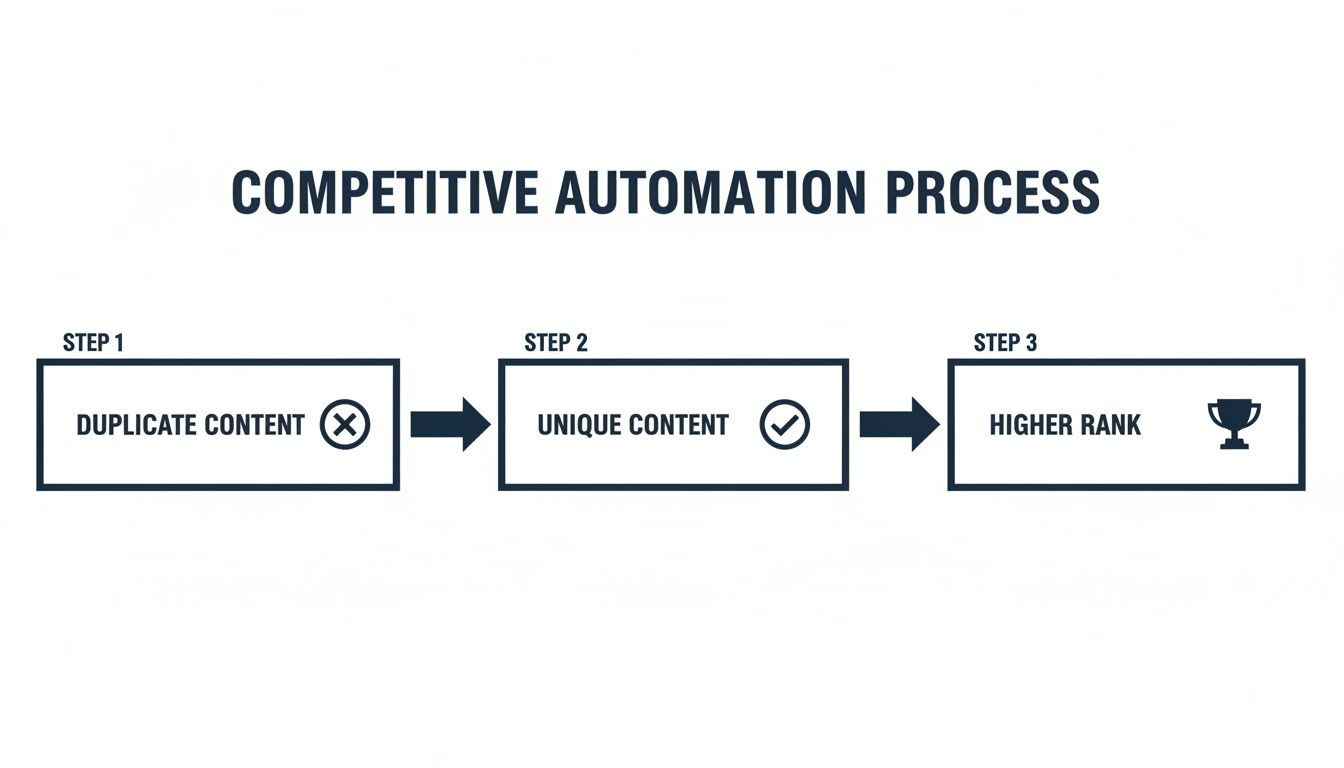
It’s clear that correcting content duplication gives retailers a unique voice on the digital shelf, which is a direct path to better search rankings and performance.
This entire automated process is about building a catalogue that isn't just optimised for today's search engines, but is structurally ready for the future of retail search. It creates AI-compatible SEO content that AI agents can understand, trust, and recommend to shoppers.
From Raw Inputs to Enriched Outputs
The final step is getting this newly enriched data out into the wild. This structured, high-quality content is then pushed to your ecommerce platform, marketplaces, and any other sales channels you use. Because the process is automated, your entire product catalogue stays in sync and consistently optimised.
If you want to dive deeper into the technical nuts and bolts, you can learn more about how API-driven workflows are transforming retail data enrichment and see how this connectivity makes it all possible.
To put it simply, here’s a map of how raw data gets turned into valuable, enriched outputs through this AI-powered content workflow.
Mapping Data Inputs To AI Enrichment Outputs
| Raw Data Input | AI Enrichment Technique | Enriched Output |
|---|---|---|
| Basic Supplier Title & Description | Generative AI Content Creation | Unique, SEO-optimised title and a compelling, brand-aligned product description. |
| Main Product Image | AI Image Recognition & Tagging | Structured tags for colour, material, style, pattern, and other visual attributes. |
| Technical Specification Sheet (PDF) | Natural Language Processing (NLP) | Standardised, filterable attributes for dimensions, weight, power, and compatibility. |
| Competitor Product Data | AI Market Analysis | Price positioning insights, feature gap analysis, and keyword opportunities. |
This workflow isn't theoretical; it's the practical shift from manual SEO to an AI-driven strategy. It’s how modern retailers are finally solving content bottlenecks and achieving SEO at scale, setting their business up for the next wave of agentic shopping.
Implementing Your Product Automation Strategy
Making the jump from manual SEO to an AI-driven model isn’t just about flicking a switch. For retail leaders, rolling out a product data enrichment automation strategy is about preparing your people and your processes for a smarter, faster way of working. This is your roadmap to achieving genuine SEO at scale and locking in a stronger position on the digital shelf.
The first move is a completely honest look at your current data workflows. Where are the real content bottlenecks? How many hours are your team sinking into manually correcting supplier content duplication? Pinpointing these headaches builds the business case for automation and clarifies what you need to achieve, whether it’s slashing product-to-market times or finally improving SKU-level SEO for a problem category.
This audit doesn't just find problems, it puts a dollar figure on the cost of doing nothing, showing you the operational drag that’s been holding your business back. It’s the essential first step toward building a future-proof AI SEO framework.
Launching a Pilot Program
Instead of trying to boil the ocean with a company-wide overhaul, the smart play is to start small with a focused pilot program. Pick a single, manageable product category, maybe one with a high number of SKUs or notoriously bad data quality. This lets you test, learn, and prove the value fast, without throwing the entire operation into chaos.
A pilot for your retail content automation strategy should aim to:
- Integrate a single supplier feed to prove the system can handle and standardise incoming data.
- Define one clear enrichment goal, like generating unique product descriptions or using AI image recognition to tag attributes in a fashion category.
- Set a baseline for success by measuring the digital shelf performance of the pilot category before you make any changes.
This controlled experiment is the perfect way to fine-tune your automated content workflows and get your team comfortable with the new tools and processes.
Establishing Human-Led AI Quality Assurance
There's a common myth that automation makes human expertise redundant. Nothing could be further from the truth. The most successful strategies are built on human + AI collaboration in SEO. Your team's industry knowledge and brand intuition are gold, you can't automate that. The goal is to let AI do the heavy lifting, freeing up your team for strategic oversight and quality control.
A human-led AI quality assurance (QA) process is non-negotiable. It’s the only way to guarantee that all AI-generated content, from product descriptions to alt tags, sounds exactly like your brand and meets your standards for accuracy. This is how you scale SEO content for retail without your quality taking a nosedive.
This shift is a huge part of the future of work in retail. It empowers your people with AI agents for retail efficiency, letting them ditch repetitive data entry and focus on the high-value strategic work that actually grows the business.
Selecting the Right Technology Partner
Picking the right partner is make-or-break. You need a solution that not only has powerful AI but also plays nicely with your existing ecommerce platform and PIM systems. Your tech should be a retail efficiency tool that gets rid of complexity, not one that adds another layer to it.
The market for these tools is exploding. The global data enrichment solutions sector is set to grow from $2.58 billion in 2024 to $2.88 billion in 2025, a clear sign of the massive investment pouring into tech that creates AI-compatible SEO content. For Australian retailers, keeping up with this trend is crucial for staying competitive. You can read more about this market growth on The Business Research Company.
At the heart of all this is effective supplier feed management. A great automation partner helps you take those messy, chaotic supplier feeds and turn them into structured, optimised assets ready for anything. Nailing this foundational step is the key to avoiding data hygiene nightmares and making sure your automation strategy delivers the ROI it promised.
Preparing For The Future Of AI-Powered Search
The SEO strategies that got you to the top yesterday are already becoming obsolete. The future of retail search isn't just about keywords, it's about deep, structured understanding of your products. We're entering an era of agentic commerce, where sophisticated AI shopping assistants like ChatGPT, Perplexity, and Amazon's Rufus are completely changing how customers find and buy things.
Think of these AI agents as personal shoppers. A customer asks, "find me a waterproof hiking jacket under $300 with GORE-TEX and pit zips," and the AI scours the web for the perfect match. It doesn't just look for keywords. It digs into structured product data, comparing attributes, features, and specs to make a confident recommendation.
If your product data is thin, generic, or a complete mess, your products are invisible to these agents. This is the new battleground for digital shelf performance.
From Keyword Optimisation To AI Understanding
This whole shift marks a massive pivot from traditional SEO to what you could call AI SEO. For years, retail teams have been obsessed with optimising for human-readable keywords. Now, the game is optimising for machine comprehension. This means moving towards agentic search optimisation, where your goal is to feed AI agents content they can parse, trust, and act on.
And this is where product data enrichment automation becomes non-negotiable. It's really the only way to scale and:
- Structure your data: Turn messy supplier info into clean, filterable attributes like 'Material', 'Colour', and 'Waterproof Rating'.
- Generate rich detail: Use generative AI to build out comprehensive descriptions that answer every question an AI agent could possibly have.
- Ensure accuracy: Keep information consistent and correct across thousands of SKUs, which builds the trust an AI needs to recommend your product over a competitor's.
The core idea behind this agentic commerce future is simple: if an AI can’t understand your product’s value from its data, it will never show it to a human. Your enriched product data is the fuel these advanced systems run on.
This transition demands a new way of thinking about your content. As you prepare for the future of AI-powered search, understanding effective strategies for writing SEO articles that consistently rank is more important than ever.
Building The Foundation For Agentic Shopping
Getting ready for this future isn't some far-off, theoretical task, it's an immediate strategic need. The human + AI collaboration in SEO begins right now by building the data infrastructure that will make your products discoverable tomorrow. Every attribute you add and every description you enrich today is a step towards being ready for this new landscape.
By putting an AI-powered content workflow in place, you're not just correcting today's problem of supplier content duplication. You are future-proofing your entire retail operation, making sure your products are seen and stay competitive in an AI-first world. To get a better handle on this evolving ecosystem, check out our guide on the future of product discovery with LLMs. This is what building a next-gen SEO strategy for retail is all about.
Frequently Asked Questions
Here are some of the most common questions Australian retail managers have about putting product data enrichment automation to work. We've laid out some practical answers to help guide your thinking.
How Does Automation Handle Duplicate Supplier Content?
It tackles the problem head-on. Instead of just copying and pasting supplier content, AI rewrites and restructures your product descriptions, titles, and attributes for every single SKU.
This means you get unique, SEO-optimised versions in your brand’s voice, which helps you avoid Google’s duplicate content penalties and gives your products a much better chance of ranking on the digital shelf. It’s a core part of retail content automation, turning what was a huge SEO risk into a serious competitive edge.
Can We Maintain Human Oversight With An Automated System?
Absolutely. In fact, the best approach is what we call human + AI collaboration in SEO. Automation does all the heavy lifting, processing thousands of products in the background, while your team stays in control. They set the rules, define the brand voice, and handle the final quality checks.
Modern workflow tools are built for exactly this kind of partnership. Your team can easily review, edit, and approve the AI-generated content, ensuring everything stays on-brand and accurate. It’s less about replacing people and more about freeing them up from tedious work.
By handing off repetitive tasks to automation, your team can shift from manual data entry to high-value strategic work. This focus on human-led AI content QA is how you maintain quality while achieving SEO at scale.
How Quickly Can We See Results After Implementation?
You'll see the operational benefits almost immediately. The system can enrich thousands of product pages in a matter of days, a job that would take a human team months to get through. It’s a fantastic way to clear content bottlenecks instantly.
As for SEO, those results build over time. However, it’s common to see initial improvements in indexing and rankings for long-tail keywords within a few weeks, as search engines start crawling all that fresh, unique content. The real ROI comes from scaling your SEO efforts across your entire catalogue at once, getting you ready for the agentic commerce future.
Is This Technology Effective For Categories Like Fashion?
Yes, and it’s especially critical for complex categories like fashion, furniture, and electronics. For fashion SEO optimisation, AI image recognition can automatically tag attributes like colour, pattern, and neckline straight from a product photo. For electronics, it can pull out and standardise all the technical specs into filterable data for your customers.
This kind of deep, SKU-level SEO is vital for the faceted search on your site. More importantly, it’s what AI shopping agents need to find your products when a customer is looking for something very specific. Getting this right directly impacts whether you get discovered and make the sale.
Ready to eliminate content bottlenecks and prepare your catalogue for the future of AI-powered search? Discover how Optidan AI transforms your supplier feeds into high-performing, optimised product content at scale. Visit https://optidan.com to learn more.
