


For the AI systems behind Google, Perplexity, and the new wave of shopping agents, high-quality product data is not just another ranking factor—it is the foundational source of truth they trust. Traditional SEO focused on page-level signals, but agentic search is built on structured, consistent data feeds to understand, trust, and ultimately recommend your products.
This means your visibility in AI search is a direct output of your data infrastructure, not a collection of optimisation tricks. For enterprise ecommerce, digital, and data teams, this operational reality changes everything.
How AI Search Systems Evaluate Product Data Quality
AI systems do not "read" your product page like a human; they parse its underlying data structure. An AI agent ingests your product feed and scrutinises it for verifiable signals of quality, assessing its completeness, consistency, freshness, and structure to determine if your product is a low-risk, high-confidence recommendation. Gaps, errors, and inconsistencies are not minor flaws—they are clear signals of unreliability that directly reduce visibility.
Think of your product feed as an application to be included in AI-driven discovery. The AI evaluates this application based on a core set of data quality dimensions, not just keywords or backlinks. Poor performance in any one of these areas can get your products sidelined.
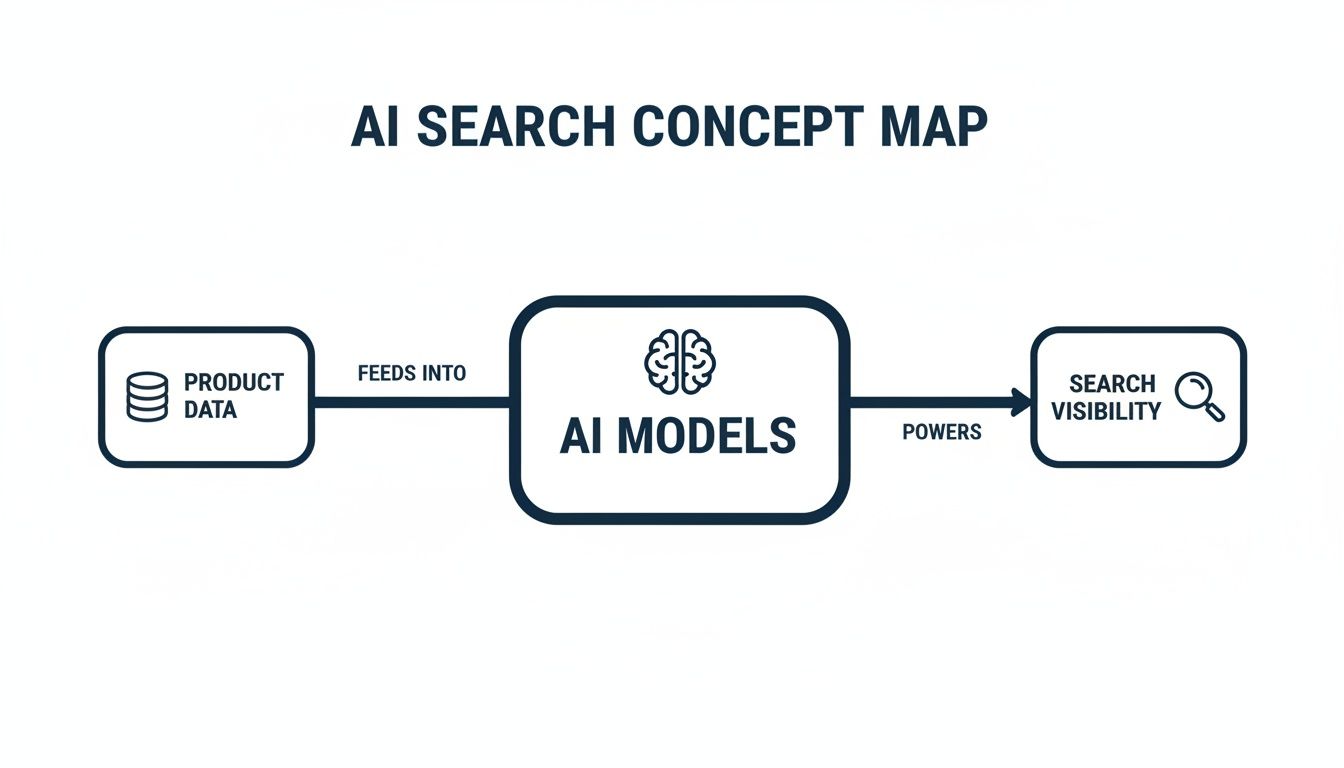
Here is how AI models assess your data:
- Completeness: The first check is for missing attributes. A query like, "show me 100% cotton t-shirts under $50," will automatically filter out any shirt where the 'material' attribute is empty. The AI cannot risk an incorrect recommendation, so incomplete data leads to immediate disqualification from relevant results.
- Consistency: AI systems cross-reference your product data across multiple sources. If a product is listed for $199 on your website but $189 in your product feed, the AI spots a conflict. This inconsistency signals operational weakness and erodes the AI's confidence in your data's reliability.
- Freshness: AI search places a huge premium on the freshness of your data, especially for signals like inventory and pricing. An AI shopping agent needs to know with certainty whether a product is in stock right now. Outdated stock information leads to poor user experiences, so AI systems prioritise retailers who provide fresh, timely, and accurate data.
- Structure and Trust: AI models rely on a clear taxonomy to understand product relationships. A well-structured catalogue places a "men's leather Chelsea boot" under Footwear > Men's > Boots > Chelsea Boots. This logical structure allows an AI to answer both broad and specific queries, which is impossible with a flat or messy taxonomy.
What “Quality” Means in an AI Search Context
In traditional retail, “quality” data usually just meant it was accurate. The price was right, the SKU matched, and that was about it. For an AI agent making complex buying decisions on a user's behalf, that definition is dangerously insufficient.
Quality in an AI search context is multi-dimensional. It is about the depth, structure, and reliability of your information, everything an AI needs to confidently answer sophisticated, conversational questions like, "show me waterproof, breathable hiking boots under $300 available for delivery tomorrow".

Here is what defines quality for AI systems:
- Attribute Depth: This is the richness of your product information. A basic dataset might list a jacket's colour as "blue". A high-quality, AI-ready feed will specify "navy blue", list the fabric composition (90% recycled polyester, 10% elastane), and include performance specs like "waterproof rating: 10,000mm". Without this depth, your products are invisible to any search that goes beyond a brand or product name.
- Taxonomy Alignment: A clear, logical taxonomy is the backbone of agentic AI SEO and content optimisation. It is how an AI understands that a "cashmere crewneck jumper" sits within Knitwear > Jumpers > Crewnecks. This hierarchy allows the AI to navigate your catalogue intelligently.
- Availability Signals: AI demands real-time data for dynamic attributes like stock levels. A daily feed update is no longer sufficient when an AI agent needs to guarantee availability at the moment of recommendation. High-quality data means providing live availability signals via APIs.
- Pricing Consistency: If your pricing differs on your website, your app, and in your product feed, that is a major red flag for an AI. It signals unreliability and leads to a poor user experience.
- Structured Metadata: Using machine-readable tags for images and specs allows an AI to parse them. For example, image alt text should be descriptive ("Men's black leather Chelsea boot"), not just a SKU number.
Why Poor Data Quality Reduces AI Confidence and Coverage
AI systems operate on confidence. Before an AI will show your product, it needs to be certain the information it has is accurate, complete, and trustworthy. When your product data is inconsistent or incomplete, it erodes that confidence, causing the system to limit your product's exposure or remove it from results entirely.
An AI agent is designed to avoid giving users bad or incorrect information. When it encounters missing details, conflicting prices, or duplicated supplier descriptions, the risk of making a bad recommendation increases. The safest move for the AI is to ignore your product and feature a competitor with clean, reliable data.

Here is how poor data quality causes problems:
- Gaps Limit Recommendations: If the 'material' field is empty for a jumper, it will never appear in a search for "wool jumpers". The AI cannot take the risk. Missing data means missed opportunities.
- Duplication Creates Ambiguity: Using generic supplier content is one of the most damaging practices. When dozens of retailers use the same description, an AI cannot differentiate them. It may suppress all listings or default to price as the only deciding factor, triggering a race to the bottom. Unique, brand-led product descriptions are a critical signal of trustworthiness.
- Conflicting Signals Erode Trust: Inconsistent data signals operational weakness. When the price on your product page is $149.99 but $159.99 in your product feed, an AI's confidence drops. These conflicts can degrade the AI's trust in your entire brand, reducing overall visibility.
The Shift From Page-Level SEO to Data-Level Visibility
For years, SEO was about optimising the page. Teams focused on keywords, backlinks, and on-page content to signal relevance to search crawlers. While these fundamentals have not disappeared, the focus of modern retail SEO has shifted to data-level visibility.
This pivot is driven by a simple operational truth: AI agents and modern search systems prefer to get information from a clean, organised data source rather than scraping thousands of inconsistent websites. This changes the core job from manually writing copy for every product page to managing, enriching, and validating the underlying product feeds and APIs that power your entire catalogue. Your brand's visibility across AI channels—from Google to ChatGPT—now hinges on its reputation as a reliable data source.
The real goal of modern retail SEO is to become the most trustworthy, machine-readable data source in your category. Visibility is the reward for earning that trust.
This requires a fundamental change in how retail and digital teams operate, moving from webpage content to the underlying data feeds. Success is now measured by the quality of your product feed optimisation services, not just the polish of your on-page copy.
Where Data Quality Breaks Down at Enterprise Scale
At an enterprise scale, managing product data quality becomes a systemic issue of operational drag. Data quality does not fail due to one mistake; it fractures under the pressure of complexity, volume, and fragmented processes common in large retail organisations.
Here are the most common failure points:
- Supplier-Led Content: Relying on basic supplier feeds is a primary weakness. These feeds are often incomplete, inconsistent, and filled with generic descriptions used by every other retailer. This supplier content duplication is a major red flag for AI search visibility, as AI models see identical descriptions as low-value noise.
- Fragmented Systems: In large enterprises, product data is often scattered across disconnected systems: ERPs, PIMs, DAMs, and ecommerce platforms. Without a unified view, inconsistencies are inevitable. A price updated in the ERP might not sync correctly with the ecommerce platform, creating the kind of conflicting signal that erodes AI confidence.
- Manual Updates and Inconsistent Workflows: Manual processes for content enrichment introduce a high risk of human error and create content bottlenecks. When workflows are inconsistent across different teams, one team might use the attribute "material" while another uses "fabric composition" for the same thing. This lack of standardisation makes it impossible for AI systems to parse and compare your products effectively.
- Lack of Ownership: Without clear ownership, product data quality becomes a shared problem that no one is accountable for solving. This leads to persistent issues that undermine performance across all digital channels.
How Product Data Quality Powers More Than Search
Fixing your product data is not just about showing up in AI search results. It is about creating a foundational business asset—a single source of truth that powers your entire retail ecosystem, from your on-site experience to your internal support tools.

When your product information is structured, complete, and reliable, it becomes the scalable infrastructure supporting everything you do.
- Category and Brand Pages: A clean data foundation allows you to automatically populate pages with the right SKUs and consistent specs. This removes a massive operational drag and frees your content teams from endless manual updates.
- Internal Search and Navigation: Quality data powers a precise on-site search. When attributes like ‘material’ and ‘size’ are accurate, shoppers can find what they are looking for, boosting discoverability and conversions.
- FAQs and Customer Support Bots: AI-powered bots can pull answers directly from a reliable product feed to handle questions about specs, stock, or warranties. This provides customers with instant, accurate answers and frees up human agents for more complex issues.
- AI-Driven Shopping Assistants: As agentic commerce evolves, your product data will directly fuel AI assistants that make purchases on behalf of consumers. Only retailers with the most complete and trustworthy data will be considered in these transactions.
The Takeaway: Data Quality is the New Foundation for Visibility
AI search visibility is not achieved through optimisation tricks; it is an output of data quality. Retailers that continue to focus only on traditional, page-level SEO will find their visibility diminishing across new AI-driven channels.
The path to durable visibility in the age of AI and agentic commerce readiness is through operational excellence. By treating product data as critical infrastructure—not just a content task—retailers can build a scalable foundation that earns the trust of AI systems, improves operational efficiency, and drives conversions. The future of digital shelf performance belongs to those who get their data right.
Explore the latest trends and discussions on this topic in our articles on retail AI news.
