


Striking the right balance between AI automation and brand voice is the new frontier for Australian retail. It's about using AI for what it does best, speed and scale, while your human team provides the final polish that keeps your brand identity intact.
Think of AI as a powerful assistant. It’s brilliant for chewing through tedious jobs like product data enrichment or untangling thousands of duplicated supplier descriptions. But the final sign-off, the quality check that ensures the content feels like your brand? That still belongs to your team. This hybrid model isn't just a nice-to-have; it's essential for staying competitive in the new era of agentic commerce and preparing for the future of work in retail.
The New Reality for Australian Retail Content
Australian retail is at a crossroads. Today, the challenge isn’t just having an online store. It's about managing and optimising content for tens of thousands of SKUs without losing the unique character that makes you, you. This guide shows retail leaders and ecommerce managers how to turn that potential conflict into their biggest strategic advantage, transitioning from manual SEO to AI SEO.
The real goal here is to shift from basic, often generic automation to a model of ‘AI-Assisted Curation’. In this framework, technology becomes the engine for the heavy lifting, giving you the efficiency and scale you need, while your team provides the critical human touch. This is the core of retail efficiency tools and scalable SEO solutions.
Core Challenges Facing Retail Leaders
Today's ecommerce managers are up against a set of pressures that old-school content workflows just can't handle. Sound familiar?
- Supplier Content Duplication: We’ve all been there. Relying on generic supplier feeds creates thousands of identical pages across the web. This not only hurts your search rankings due to duplication penalties but also completely washes out your brand message. Correcting duplicated supplier content manually is a never-ending task.
- Manual Content Bottlenecks: Your content team is probably stretched thin, struggling to keep up with seasonal collections, new product launches, and constant promotional updates. Reducing retail content bottlenecks is crucial, as delays inevitably lead to missed revenue.
- Preparing for Agentic Search: The game has changed. AI shopping assistants like Google's AI Overviews and Amazon's Rufus are here, and they feed on rich, structured, and unique product data. To get your products recommended, high-quality, AI-compatible SEO content is no longer negotiable. You can explore the massive impact of these evolving AI shopping platforms.
This isn't just a technical upgrade, it's a fundamental shift in retail strategy. Getting the balance right between AI automation and human oversight is what will define your digital shelf performance and drive scalable SEO in an incredibly competitive market.
By bringing AI-powered content workflows into the mix, retailers can finally turn thin supplier data into optimised product descriptions that actually sell. You can use AI image recognition for precise image tagging in complex categories like fashion and furniture. Ultimately, this all leads to better retail search visibility and lays the groundwork for next-gen SEO for retailers.
Building a Foundation for AI-Powered Content
Before you even think about optimising at scale to thousands of pages, you need a solid game plan. Jumping headfirst into retail content automation without laying the proper groundwork is a recipe for disaster. You’ll end up with generic, off-brand messaging that fails to connect with customers and falls flat in search.
The first step isn't about the tech; it's about defining the human element that will guide it. This is where you shift from manual SEO chaos to a structured, AI-powered content workflow. The goal is to build a system where technology amplifies your brand, not dilutes it. This foundational work gives your AI agents for retail efficiency clear instructions from day one.
Auditing Your Content and Identifying Bottlenecks
Start by taking a hard, honest look at where things stand today. Where are the real bottlenecks in your content process? Is it the task of rewriting duplicated supplier descriptions? Or maybe the time it takes to get new product imagery tagged and pushed live?
A thorough audit helps you pinpoint exactly where AI can deliver the biggest wins. It also uncovers the hidden inconsistencies in your brand voice that need to be ironed out before you can even attempt to teach an AI to replicate it. This process is essential for establishing the right AI-powered content infrastructure for scalable SEO.
The Brand Voice Bible
This is your most critical asset in the battle to balance automation and authenticity. A ‘Brand Voice Bible’ is more than just a dusty style guide, it’s a detailed instruction manual for both your human team and your AI models. It’s where you codify your brand’s personality, ensuring every single SKU sounds like it came from the same place.
Your Brand Voice Bible should include:
- Core Brand Pillars: Three to five key attributes that define your brand (e.g., innovative, approachable, premium).
- Tone of Voice Spectrum: Define how your voice adapts. For instance, your tone might be more technical for electronics SEO optimisation but more inspirational for fashion SEO optimisation.
- Lexicon and Terminology: A clear list of on-brand words to use and, just as importantly, words to banish.
- Formatting Rules: Guidelines on using headings, bullet points, and bold text to keep a consistent visual style.
- Grammar and Punctuation: Settle the debates. Do you use the Oxford comma? What are your capitalisation rules?
A well-defined Brand Voice Bible acts as the 'source of truth' for your entire content operation. It’s the difference between generating thousands of random product descriptions and creating a cohesive, optimised digital shelf experience.
This document becomes the cornerstone of your human-led AI content QA process. Your team will use it to refine AI-generated drafts, and the feedback from those refinements continuously trains the AI, making it smarter and more on-brand with every cycle.
Structuring Data for AI Success
Finally, you need to get your data in order. AI is incredibly powerful, but it can’t perform miracles on messy, unstructured supplier feeds. The process of product data enrichment starts right here, by cleaning and organising your raw product information into a logical, consistent format. This means standardising attributes, correcting errors, and creating a clean foundation for product feed optimisation.
To help you get started, here's a quick checklist of the key areas your retail content team should focus on before diving into large-scale AI implementation.
AI Readiness Checklist for Retail Content Teams
| Readiness Area | Key Actions | Success Metric |
|---|---|---|
| Brand Voice Definition | Develop a comprehensive 'Brand Voice Bible' with tone, lexicon, and formatting rules. | A clear, documented guide used consistently by both human and AI writers. |
| Content Audit | Analyse existing content for inconsistencies, performance gaps, and duplication issues. | A prioritised list of content areas where AI can have the most impact. |
| Data Structure | Clean, standardise, and enrich raw product data feeds from suppliers. | Product data is complete, accurate, and consistently formatted across all SKUs. |
| Workflow Design | Map out the human-in-the-loop review and approval process for AI-generated content. | A streamlined workflow where AI drafts are efficiently reviewed, refined, and published. |
| Team Training | Train content and marketing teams on how to prompt, review, and edit AI content effectively. | Team members are confident and competent in using AI tools within brand guidelines. |
Getting these elements in place is non-negotiable. This structured data, combined with a clear Brand Voice Bible, creates the perfect launchpad for effective retail content automation. It sets the stage for everything that follows, empowering you to confidently optimise 10,000+ pages in days, not months.
Using AI for Product Data Enrichment at Scale

Alright, let's move from theory to where the rubber really hits the road. For most retailers, using AI for product data enrichment is where you'll see the biggest and fastest wins. This is the engine room where you can finally stop wrestling with thin, duplicated supplier content and start creating unique, SEO-ready assets across your entire product catalogue. The goal is automating product descriptions and optimising product feeds efficiently without losing what makes your brand your brand.
Automated content workflows are no longer some futuristic idea, they're a must-have for anyone serious about achieving SEO at scale. Natural language generation (NLG) models, when properly guided by your Brand Voice Bible, can churn out compelling and unique product descriptions that your audience will actually want to read, all while ticking the right boxes for AI agents like ChatGPT and Rufus. It's the key to boosting your digital shelf performance.
This isn't just a niche trend. In fact, about 68% of Australian retail businesses are already using AI in some way. We saw a massive jump in early 2025 when the use of agentic AI, systems that act on their own to get things done, shot up by nearly 50% in just three months. It just goes to show how quickly retailers are grabbing onto these tools to become more efficient.
From Raw Feeds to Rich Content
It all starts with those messy supplier feeds. You know the ones, inconsistent, short on detail, and full of duplicated copy that actively hurts your search visibility. An AI-powered system can take those raw supplier feeds, standardise all the attributes, and kick off the supplier feed enrichment process.
But this is so much more than a simple rewrite. A smart AI workflow can:
- Extract Key Features: It automatically pulls critical product details from clunky supplier text.
- Generate Benefit-Oriented Copy: It flips dry specs into compelling benefits, answering the customer’s core question: "What's in it for me?"
- Optimise for Search Intent: The system can create multiple content versions for different channels, from your category pages to marketplace listings, enabling multi-channel product optimisation.
If you want to get into the nitty-gritty of how this all works, our guide on optimising product data enrichment lays out the full roadmap.
AI Image Recognition in Action
For anyone in fashion, furniture, or electronics, AI image recognition and tagging is a total game-changer. Manually tagging thousands of product images is a massive bottleneck. AI, on the other hand, can scan an entire catalogue in minutes. It identifies and tags attributes like colour, style, material, and even specific design features. This is critical for image SEO for ecommerce.
Think about it: a fashion retailer can automatically tag a dress with "A-line," "floral print," and "midi length" just from the photo, creating powerful fashion product image SEO. This creates incredibly rich, structured data that makes on-site filters a dream to use, improves internal search, and fuels powerful AI SEO by creating highly specific alt tag optimisation for retail at scale. For products where visuals are everything, this virtual staging AI guide for product visualization offers some great insights into using visuals to enrich your data even further.
By automating these granular tasks, you're not just creating better content, you're building a structured, machine-readable product catalogue. This is the essential groundwork for the future of agentic search and agentic shopping, where AI agents will rely on this rich data to recommend your products over competitors.
Creating Human-Led AI Quality Assurance Workflows
AI gives you the speed and scale, but it's human oversight that guarantees quality, protects your brand, and builds genuine customer trust. Making the leap from manual SEO to AI SEO lives or dies by your human-led AI content QA workflow. This isn't about manually rewriting everything the AI spits out, it's about refining it smartly and efficiently.
This hybrid system of Human + AI collaboration in SEO is where you nail the balance. Imagine AI agents generating initial drafts for thousands of product pages in a matter of days, completely smashing through your content bottlenecks. Your team then steps in to review, refine, and approve the output, making sure every single piece of content is strategically sound and on-brand before it goes live.
Defining Roles for a Modern Content Team
In this new model, your team’s roles have to evolve. They shift from being manual content creators to becoming strategic editors and AI managers. The focus moves away from repetitive writing and toward higher-value tasks like improving prompts, analysing performance, and guarding brand consistency. This new structure is vital for the future of work in retail.
For a smooth automated content workflow, you need clear roles:
- The AI Prompt Master: This person becomes the expert in crafting detailed prompts based on your Brand Voice Bible. Their job is to guide the AI to produce better, more relevant first drafts right out of the gate.
- The Brand Guardian: Usually a senior editor or content manager, this role holds the final sign-off. They ensure every description, alt tag, and piece of metadata optimisation at scale aligns perfectly with your brand standards.
- The Performance Analyst: This person keeps a close eye on the digital shelf performance of the AI-generated content. They track SEO rankings and conversion rates, feeding those insights back into the system to make it smarter.
This division of labour makes the QA process for scalable SEO solutions both manageable and incredibly effective, embodying the AI-powered retail transformation.
Implementing a Tiered QA Process
Let's be realistic, not all products need the same level of scrutiny. A tiered QA process lets you allocate your team’s valuable time where it actually matters most, creating a much more efficient retail content automation system.
You could set up a simple two-tiered system, for example:
- Spot-Checks for High-Volume SKUs: For lower-priority or high-volume product lines, your team can perform spot-checks on a random sample, say, 10-15% of the AI-generated content. This ensures a baseline of quality without creating a new bottleneck.
- In-Depth Reviews for Flagship Products: Your most important or highest-margin products deserve a full, detailed review. This is where your Brand Guardians invest their time, meticulously refining every word to maximise impact and conversions.
This tiered approach allows you to maintain quality control across your entire catalogue while focusing your expert human touch on the products that drive the most revenue. It’s a pragmatic way to achieve SKU-level SEO at scale.
Australian consumer expectations are changing fast, with AI interactions driving higher satisfaction. Recent data shows that Australian users of AI agents report 64% higher customer satisfaction than those who don't. On top of that, 86% of regular users said these agents have become more intelligent over the past year.
This just highlights how important it is to ensure your AI-assisted content is not just automated, but genuinely helpful and accurate, a standard that can only be guaranteed with a human in the loop. You can discover more about these Australian AI trends.
The final piece of the puzzle is creating a feedback loop. Every edit and refinement your team makes should be documented and used to improve the AI's future outputs. This continuous learning process makes your AI smarter and more aligned with your brand over time. For more on this, check out our guide on how to effectively review writing to strengthen your QA process.
How to Measure Your AI Content Success
So, you’ve rolled out an AI content strategy. Great. But proving it’s actually working requires a different way of thinking about measurement. Forget the surface-level vanity metrics. We need to get serious about tracking tangible business outcomes that draw a straight line from your retail content automation efforts to your bottom line.
The real win isn't just about how many product pages you can churn out. It's about seeing genuine improvements in organic search rankings for those niche, long-tail keywords. It's about tracking higher conversion rates on your AI-optimised product pages and, of course, calculating the hard savings from reduced content production costs. This is how you justify the investment in AI SEO services and fine-tune your AI workflows for even better results.
Key Performance Indicators for AI Content
To get a clear picture of what’s happening, you need a mix of SEO, engagement, and efficiency metrics. This gives you a complete view of how your AI-powered content is affecting your digital shelf performance and the overall health of the business.
Here’s what I recommend focusing on:
- SKU-Level Organic Visibility: Don't just track broad category terms. Get granular. Are your AI-enriched pages climbing the search rankings for specific, high-intent queries related to individual products? That’s where the money is.
- Conversion Rate by Content Type: Run some A/B tests. Pit your new AI-generated pages against the old, manually written ones. This gives you cold, hard data on what truly resonates with your customers and drives them to click "buy".
- Time-to-Market for New Products: How fast can you get a new product live with fully optimised content? Every day you shave off this process is a day you start generating revenue sooner. It's a simple but powerful efficiency metric.
- Content Production Cost Reduction: Do the maths. Calculate the savings in team hours and resources now that you're automating product description writing and metadata optimisation at scale. This often makes for a compelling ROI story.
By keeping a close eye on these specific areas, you move from "we think it's working" to "we know it's working." For a deeper dive into what to track, our guide on the top metrics for ecommerce success is a solid starting point.
The shift is already happening across Australia. As of 2025, a staggering 70% of small retail businesses in Australia have adopted AI tools, with marketing and content creation being the main drivers. This isn't a fad, it's a fundamental change allowing retailers to maintain a consistent brand voice while dramatically boosting speed and precision. You can learn more about how Australian retailers are adapting to AI right here.
Visualising Your Workflow and ROI
To give you a better idea of how this all comes together, this infographic breaks down the process of generating, reviewing, and publishing content inside a human-led AI quality assurance framework.
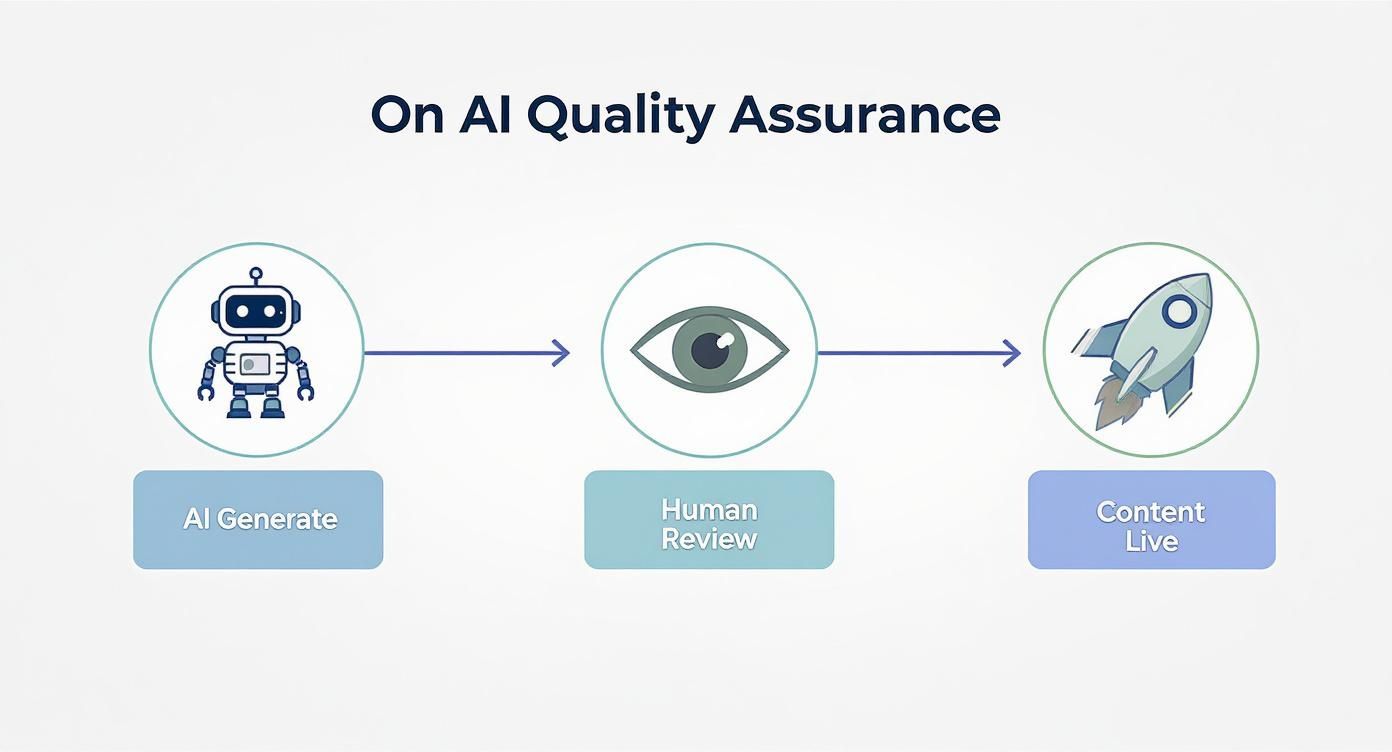
As you can see, the AI does the initial heavy lifting. Then, your team comes in to refine and polish, ensuring everything is efficient, on-brand, and ready to go live.
By setting up dedicated dashboards to track these key metrics, you create a powerful feedback loop. This data is absolutely crucial for continuously refining your AI models and proving the long-term value of your AI SEO strategy.
Your AI and Brand Voice Questions, Answered
Let's tackle some of the most common questions retail leaders have when bringing AI into their content strategy. Think of this as a practical field guide to help you navigate the shift with confidence.
How Can We Make Sure AI-Generated Content Actually Sounds Like Our Brand?
This is the big one, and the answer isn't just about the tech, it's about the prep work. The key is to start with a rock-solid ‘Brand Voice Bible’ and pair it with a human-led quality assurance process for ecommerce content quality assurance.
Before you even think about generating content, you need to document everything: your specific tone, style, approved terminology, and just as importantly, what not to say. This guide becomes the core instruction manual for any AI model you use for retail content. For a deep dive into creating a guide that works, especially when you're scaling up with AI, our ultimate brand voice guide is a great resource.
Next, you'll want to build an automated content workflow where human editors are the final gatekeepers. Their job isn't to rewrite everything from scratch, but to review, polish, and approve the AI's drafts. This creates a powerful feedback loop that continuously trains and refines the AI.
My advice? Start small. Test the process on less critical product categories, like clearance items, to iron out any kinks. Once the AI is consistently hitting the right notes, you can confidently scale SEO content for retail across your entire product catalogue.
What’s the First Step to Fixing Duplicated Supplier Content with AI?
First things first, you need to know the scale of the problem. Kick off with a thorough content audit to find out just how much duplicated content you're dealing with. To get the biggest bang for your buck, prioritise your most valuable or highest-traffic product categories. A duplicate content SEO fix on these first will have the most immediate impact on your digital shelf performance.
Once you know what you're up against, the first technical step is structuring your supplier data feeds. This means cleaning and organising all that raw product information into a consistent, machine-readable format.
Getting your data clean and structured is the foundation. From there, you can bring in AI tools for product data enrichment. This lets you rewrite thousands of unique product descriptions, generate benefit-focused bullet points, and standardise specifications, all of which wipes out supplier content duplication and boosts your SKU-level SEO at scale.
Will AI Replace Our Retail Content Team?
No, but it will absolutely change it. The future isn't about replacement, it's about a Human + AI collaboration. Think of it as a strategic shift where technology takes on the heavy lifting, freeing up your human experts to do what they do best.
AI is perfect for handling the repetitive, high-volume tasks, like generating initial drafts for thousands of SKUs or enriching messy data from supplier feeds. This means your retail teams and AI efficiency can improve, as they step away from the grunt work and focus on high-value, strategic initiatives that require human nuance and creativity.
Their roles will evolve. Instead of just writing copy, they'll become:
- Brand Voice Stewards: The guardians ensuring every piece of content, from fashion SEO to electronics product pages, is perfectly on-brand.
- Creative Directors: Guiding the big-picture content strategy and campaign ideas.
- Performance Analysts: Diving deep into the data to figure out what's resonating with customers and what isn't.
- AI Workflow Managers: Overseeing and fine-tuning the AI agents for retail efficiency to make them even more effective for your retail operations.
This human-in-the-loop approach is exactly what's needed to navigate the agentic commerce future and keep your brand ahead of the curve.
Ready to eliminate content bottlenecks and achieve scalable SEO without losing your brand's voice? Optidan AI empowers retail teams to create thousands of unique, optimised product pages in days. Discover how our AI-powered content workflows can transform your digital shelf performance.
