


At its core, a ChatGPT Shopping Assistant is a conversational AI tool that helps customers find, compare, and get information about products using natural language. For Australian retail leaders, this is a wake-up call. Your customers are not just typing keywords into a search bar anymore.
They are now asking detailed, complex questions like, "find me a waterproof jacket made from recycled materials available in Melbourne for under $200." This shift means that high-quality, structured product data is not just a nice-to-have, it is essential for being seen at all. This guide explores how embracing AI SEO and retail content automation is critical for digital shelf performance in the new era of agentic commerce.
The New Reality of AI-Powered Retail
The way Australian consumers find and buy products is changing, and it is changing fast. Generative AI tools have moved from a niche tech curiosity to a mainstream part of the shopping journey. This marks a critical pivot away from old-school, manual search to a new era of agentic search, where AI agents act like incredibly sophisticated personal shoppers. This is the future of work in retail.
This is not some far-off future, it is already happening. In a huge shift, a July 2025 survey found that 55% of Australian consumers now use generative AI for shopping. ChatGPT is the clear favourite, with 40% turning to it for product research, personalised ideas, and gift recommendations. You can read the full report on these emerging consumer habits to grasp the sheer scale of this change.
This creates an immediate and pressing challenge for retail leaders and ecommerce managers. Your digital shelf is no longer just your website. It is also how your product information gets interpreted and served up by AI assistants. The old SEO playbook was simply not written for this new game of agentic search optimisation.
From Keywords to Conversations
Think about the difference between a customer flipping through a static catalogue versus talking to a genuinely knowledgeable sales assistant. The first relies on simple keywords ("men's boots"). The second is a detailed, back-and-forth conversation covering style, material, fit, and where you plan to wear them.
A ChatGPT Shopping Assistant is that expert assistant, and it needs a much richer set of data to give good answers.
This is the heart of AI SEO and the future of product discovery. Winning here depends on your ability to provide deep, structured, and unique information right down to the SKU level. If you are still using generic, duplicated supplier content, your products will be completely invisible to these AI agents, hurting your retail search visibility.
Why Unique Product Data Is Your Most Critical Asset
In this new world of agentic commerce, your product data becomes your single most important marketing asset. To get recommended by an AI shopping assistant, your content must be:
- Detailed and Enriched: Go way beyond basic specs. We are talking materials, dimensions, care instructions, and specific use cases through advanced product data enrichment.
- Unique and Branded: Get rid of duplicated supplier content. AI algorithms spot it a mile away and will deprioritise it, which is why fixing supplier content duplication is a core SEO task.
- AI-Compatible: It needs to be structured in a way that AI models can easily digest and understand, which often demands advanced product feed optimisation.
Getting ready for this requires moving away from slow, manual content work and embracing AI workflow automation for retail. This is about more than just being efficient, it is about building a scalable foundation to stay visible in the next generation of search. The ability to perform SKU-level SEO at scale is no longer a competitive edge, it is a requirement for survival. Optimising product feeds efficiently is a cornerstone of modern retail efficiency tools.
Why Traditional SEO Fails in Agentic Search
For years, the formula for retail SEO felt straightforward, if a little tedious. Success was all about keywords, backlinks, and on-page technical fixes designed to keep search engine crawlers happy. But that entire playbook is fast becoming a relic in the new world of agentic search, where AI tools like a ChatGPT Shopping Assistant are the new middlemen between your products and your customers.
The old-school tactics are fundamentally mismatched for this new reality. AI agents do not just scan for keywords, they consume, synthesise, and actually evaluate the quality and uniqueness of your product information. Keyword stuffing and thin, generic descriptions are not just ineffective anymore, they actively hurt your visibility.
This marks a critical shift from manual SEO to AI SEO, a discipline built for machines, not just human browsers. It represents the future of retail search.
The High Cost of Duplicated Content
One of the biggest risks for retailers is still relying on duplicated supplier content. So many ecommerce businesses simply copy and paste descriptions and specs provided by manufacturers across hundreds, sometimes thousands, of products. While this was always a questionable practice, AI agents expose it as a fatal flaw. This is where a duplicate content SEO fix becomes paramount.
AI models are exceptionally good at spotting duplicate content across the web. When an agentic search tool finds the same generic description for a product on multiple websites, it has no way to tell your offering apart or understand your unique brand value.
Your product is immediately commoditised and likely ignored. To succeed, you must move your brand voice and unique selling propositions down to the individual SKU level, a task impossible without retail content automation.
Shifting from Keywords to Structured Data
The future of retail search is not about hitting the perfect keyword, it is about providing the best, most complete answer. An AI shopping assistant needs rich, structured data to do its job properly. It is looking for much more than just a product name. It wants details on:
- Material composition for a new sofa in furniture SEO services or a pair of jeans for fashion SEO optimisation.
- Compatibility for electronics SEO optimisation.
- Unique features and real-world use-case scenarios.
- Detailed dimensions and clear care instructions.
To improve your digital shelf performance, you have to focus on product data enrichment. This means turning basic supplier feeds into deeply informative, structured content that directly answers the complex questions customers are now asking their AI assistants. To get a better sense of how these assistants think, it is worth understanding the key ChatGPT ranking factors that influence their recommendations.
This shift requires a new way of thinking about SEO. The old keyword-centric model worked for a human-driven search world. But in an agent-driven world, the rules are different.
Traditional SEO vs AI SEO for Retail
The move to agent-focused SEO is not just a small tweak, it is a complete change in strategy. Retailers need to understand that what worked yesterday is a liability today. This is the core of the AI SEO vs traditional SEO debate.
| Aspect | Traditional SEO (Human-Focused) | AI SEO (Agent-Focused) |
|---|---|---|
| Primary Goal | Rank high on a search results page for specific keywords. | Be the definitive, most useful answer for an AI agent's query. |
| Content Focus | Keyword density, readability, and engaging human-centric copy. | Structured data, attribute completeness, and unique, factual details. |
| Key Tactic | On-page optimisation (H1s, meta descriptions), link building. | Product data enrichment, schema markup, and content uniqueness at scale. |
| View of Content | Content is for the webpage, targeting a human visitor. | Content is a data asset for machines to consume and interpret. |
| Role of Duplication | Seen as a negative ranking factor, but often overlooked at scale. | A critical failure point that makes a product invisible to AI agents. |
| Success Metric | Keyword rankings, organic traffic, and click-through rate. | Inclusion in AI-generated answers, direct product recommendations. |
This table makes it clear: preparing for agentic search means moving away from simply decorating web pages and towards building a robust, machine-readable product information ecosystem.
Embracing this change means adopting AI-powered content workflows that can handle this level of detail at scale, ensuring every single product is ready for the new age of agentic commerce. Understanding what agentic search means for retail visibility and conversion is the first step toward building a resilient, future-proof SEO strategy.
Tapping Into a New Stream of High-Converting Traffic
Thinking about optimising your catalogue for a ChatGPT Shopping Assistant is not just a box-ticking exercise for the future. It is about plugging into a new, incredibly powerful source of high-converting traffic right now.
Traffic coming from AI-powered search just behaves differently. It is not people casually browsing or window shopping. This is the final step in a customer's journey, they have moved past discovery and are now ready to make a decision.
This is not just a theory. Recent data from major sales events revealed that traffic from AI tools converted at an incredible eight times the rate of referrals from social media. You can read more about AI's conversion impact on eCommerce. That kind of gap signals a real shift in how people shop, leaning into more efficient, research-backed buying.
This massive difference in conversion proves that getting your AI SEO right is not just another expense. It is a direct line to more revenue.
Why Are AI-Assisted Shoppers So Ready to Buy?
Shoppers who turn to an AI assistant have already done their homework. They are not looking for a spark of inspiration, they are looking for a final green light on a specific purchase. They use AI to make last-minute comparisons, get clarity on niche features, and find a definitive answer before they pull out their credit card.
When your product is the one the AI recommends, you are meeting a customer at the exact moment of decision. This is the holy grail of high-intent traffic, and it absolutely requires a flawless digital shelf performance.
Think of AI agents as the ultimate gatekeeper. They filter out all the noise, the poorly described, generic, or incomplete product listings. To win this high-value traffic, your product content has to be the most detailed, unique, and helpful answer out there. That is a job for AI SEO and automated content workflows, not manual tweaking.
How Your Content Directly Connects to Conversions
This high-intent behaviour is tied directly to the quality of your product data. To capture these sales, you have to get serious about fixing supplier content duplication and investing in deep product data enrichment.
A ChatGPT Shopping Assistant needs the granular details. It needs to know the materials for a fashion search or the specific compatibility for an electronics query. That is what gives it the confidence to recommend your product over a competitor's.
By using AI-powered content workflows, retailers can get thousands of product pages optimised at scale, making sure every single one is structured to meet the new demands of agentic search. This is not just about being seen, it is about fuelling your conversion rate with the most qualified traffic you can possibly get.
How to Master Product Data for AI Visibility
To get found in this new AI-driven world, you have to stop thinking about your product data as a simple list. It needs to become a rich, detailed library for AI agents to draw from. A ChatGPT Shopping Assistant is only as smart as the information you feed it. Your job is to move past basic supplier feeds and build a product catalogue that is structured, unique, and built for machines to understand.
This is the big shift from old-school, page-by-page SEO to AI SEO. It is an entirely new game built for the agentic era, and its foundation is product data enrichment. This means taking thin, often duplicated supplier content and turning it into unique, attribute-rich product stories that give AI agents everything they need to confidently recommend your products.
This infographic shows how today's high-intent shoppers move from discovering products on social media, through to AI-powered research, and finally to purchase.
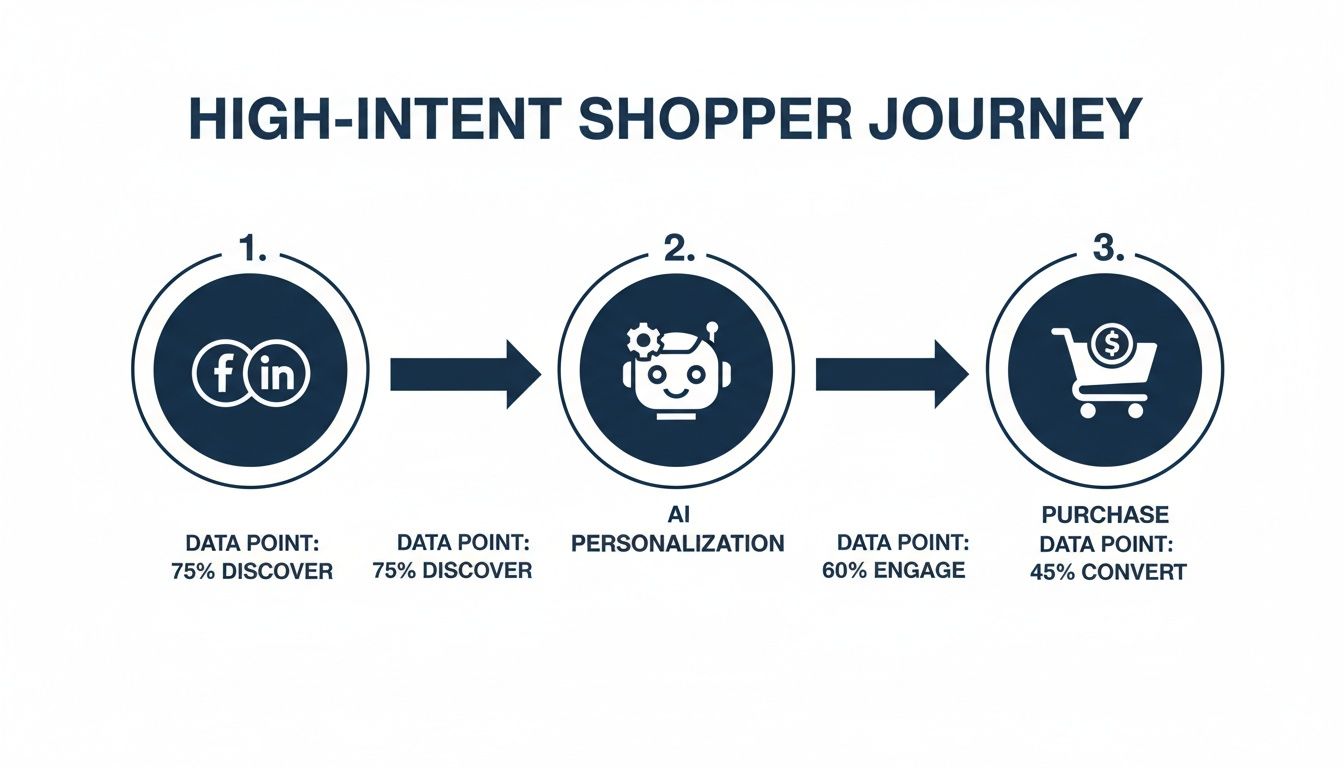
That middle step, the AI assistant, is now a critical moment where detailed product data can make or break a sale. Your content has to be ready for that level of scrutiny.
From Supplier Feeds to Optimised Assets
First things first, you have to tackle the massive problem of supplier content duplication. Relying on the generic manufacturer descriptions everyone else uses is a surefire way to become invisible to AI. Shopping agents see the same content on dozens of sites and simply cannot tell your offering apart from the competition.
The fix is to use AI workflow automation for retail. These systems can tear through tens of thousands of SKUs in days, not months, creating unique product descriptions and metadata that actually sound like your brand. This is how you achieve SKU-level SEO and build a real competitive advantage. To get this right, a solid product research strategy is non-negotiable. For a deeper look, check out this complete product research guide.
By automating the enrichment process, you solve one of the biggest bottlenecks in retail content. This frees up your team to focus on strategy and quality control instead of getting bogged down in tedious manual work, embodying the principles of retail efficiency tools.
The Power of Visual and Metadata Optimisation
For industries like fashion and furniture, words are only half the story. AI image recognition and tagging are absolutely essential for giving AI assistants the deep context they crave. An AI can look at a product photo and automatically generate tags for:
- Style: (e.g., "minimalist," "bohemian," "mid-century modern")
- Material: (e.g., "linen," "oak wood," "brushed steel")
- Features: (e.g., "v-neck," "tapered leg," "adjustable shelves")
This creates an incredibly detailed, machine-readable profile for every single product, far more than a simple alt tag could ever offer. This kind of metadata optimisation at scale is fundamental to improving your digital shelf performance, especially in visually-driven categories like beauty & cosmetics SEO or pharmacy ecommerce SEO.
To learn more about creating a data structure that AI agents can easily understand, check out our guide on how to build a high-quality product feed for AI search. This approach ensures your products are not just seen, but truly understood by the next generation of shopping tools.
Meeting New Consumer Expectations in the AI Era
The customer journey is no longer a path your brand completely controls. It is now heavily influenced by AI assistants, and this shift is creating a new set of non-negotiable expectations from your customers. Shoppers are quickly moving beyond simple keyword searches, and now see sophisticated, AI-driven guidance as a standard part of their online experience.
This is not some far-off prediction, it is happening right now. According to the 2025 AI Shopping Index, an incredible 86% of Australians have used AI tools for online shopping in just the past three months. More telling is that three in five now expect brand-owned AI shopping assistants to be a standard feature by 2026. They are demanding detailed product comparisons and personalised outfit suggestions on the spot. Learn more about these evolving Aussie shopper expectations.
From Passive Browsing to Active Consultation
This shift away from browsing towards consulting is a massive opportunity for retailers to build deeper loyalty. When a shopper uses a ChatGPT Shopping Assistant, they are not just scrolling, they are asking for advice. They ask nuanced, complex questions that basic supplier content can never answer. Brands that provide rich, AI-ready product data are the ones that will win these moments.
This is the heart of the agentic commerce future. Your job is no longer just presenting products. It is about providing the definitive data that AI agents need to make recommendations on your behalf. If you do not adapt, you become invisible to a huge and growing segment of high-intent buyers.
In this new model, every product page must function as a comprehensive brief for an AI agent. This requires a strategic blend of detailed product data enrichment and a unique brand voice, a balance that is only achievable through scalable, AI-powered content workflows.
Building Trust in an AI-First World
Meeting these new expectations is about more than just technology, it is about building trust. When your product information is consistently accurate, detailed, and genuinely helpful, AI assistants learn to rely on your brand as a credible source. This builds a powerful competitive moat that is incredibly difficult for others to replicate.
Achieving this level of content quality at scale demands a new approach that combines smart technology with human oversight. Our guide on balancing AI automation and brand voice in retail content offers practical strategies for this new era. Ultimately, the future of retail search belongs to brands that embrace human + AI collaboration in SEO, turning their product catalogue into an engine for growth in the agentic age.
Your Action Plan for AI Shopping Readiness
Alright, it is time to move from theory to action. Preparing your business for agentic commerce means taking focused, strategic steps today. The emergence of the ChatGPT Shopping Assistant is not just another trend, it demands a fundamental shift away from old-school manual SEO and toward AI-first optimisation.
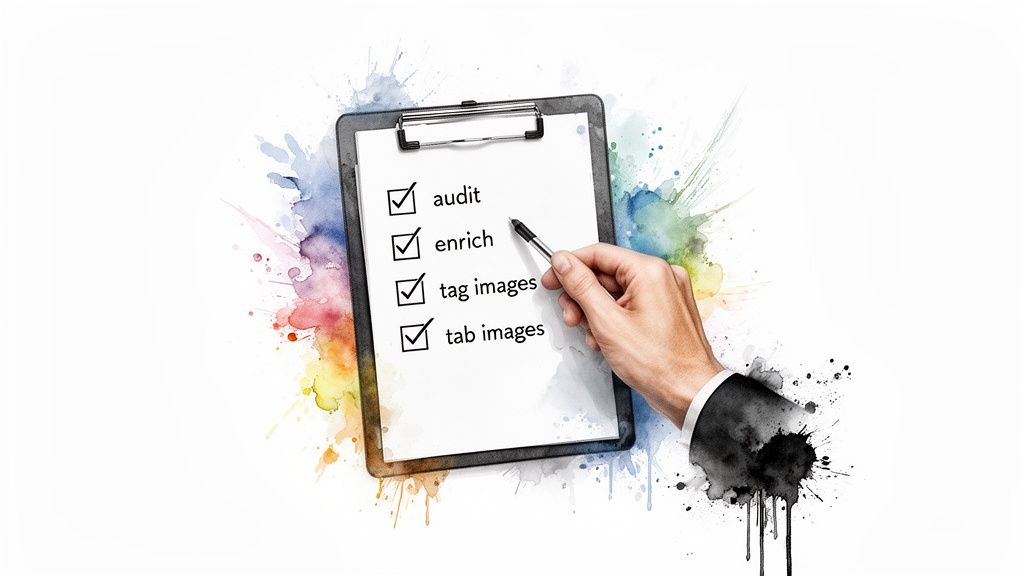
Your first job is to build a solid foundation of high-quality, structured product data that AI agents can actually trust. This is not a "nice to have", it is the price of entry. The checklist below boils down the core ideas from this guide into a practical game plan, getting your business ready for what is next in retail search.
The Immediate Implementation Checklist
-
Hunt Down Duplicated Supplier Content: Start by auditing your entire product catalogue. Your mission is to find and flag every single piece of generic, copy-pasted supplier content. Why? Because this is the single biggest threat to your visibility in agentic search optimisation.
-
Fire Up AI-Powered Content Workflows: Trying to fix thousands of product descriptions by hand is a losing battle. It is time to implement AI workflow automation for retail to rewrite those duplicated descriptions and enrich your product data. The goal here is to build scalable SEO solutions that can churn through your entire catalogue without breaking a sweat, optimising 10k+ pages in days.
-
Deploy AI Image Recognition: For visually driven categories like fashion, furniture, or electronics, you need to get serious about image SEO for ecommerce. Start using AI tools to generate detailed, attribute-rich tags for every product image. We are talking way beyond basic alt text, this is about giving AI deep, contextual information it can use to make recommendations.
-
Set Your Digital Shelf Performance KPIs: You cannot improve what you do not measure. It is time to establish new KPIs that are built for an AI world. Think about tracking things like how often your products are included in AI-generated answers and what the conversion rates look like from those AI-assisted journeys.
This plan is your first decisive move toward building AI-compatible SEO content. It is about more than just cleaning up old problems like duplication, it is about constructing a robust data infrastructure that sets your catalogue up for the next generation of product discovery.
To get your strategy organised, use these steps as a starting point. If you need a more formal structure, consider using one of our downloadable action plan templates to map out your timeline and assign key responsibilities across your team.
Frequently Asked Questions
What is the Difference Between AI SEO and Traditional SEO?
Think of it this way: traditional SEO is about getting your webpages to rank well when a human types keywords into Google. AI SEO, on the other hand, is about structuring your product data so perfectly that an AI agent, like a ChatGPT Shopping Assistant, chooses your product as the best possible answer for a shopper's request.
It is a shift from just placing keywords on a page to providing rich, unique, and machine-readable information. The goal is not just to rank on a results page, it is to be recommended directly by the AI.
How Can Smaller Retailers Get Started with AI SEO?
The single most important first step is to tackle supplier content duplication. Start by auditing your site to find all those generic product descriptions you have copied and pasted.
From there, implement an AI-powered content workflow to begin rewriting and enriching your most important product pages. Do not try to boil the ocean. Focus on creating unique, high-quality content at a manageable scale before you even think about rolling it out across your entire catalogue. This is the foundation of retail SEO automation.
What Is Agentic Search Readiness?
Agentic search readiness simply means your product catalogue is structured and detailed enough for AI shopping agents to understand and, crucially, trust it.
It is about having unique descriptions, complete attributes, and optimised metadata for every single SKU. This is what ensures your products are actually visible and can be confidently recommended in this new era of agentic commerce. If your data is messy, the AI will just ignore you.
How Does AI Automation Impact Retail Teams?
AI workflow automation for retail is here to augment your team, not replace them. Its job is to handle the repetitive, soul-crushing tasks of product data enrichment and optimising product feeds efficiently.
This frees up your ecommerce managers and content teams to focus on what humans do best: high-level strategy, refining the brand voice, and providing the critical human-led AI content QA needed to ensure content quality and accuracy at scale. This human + AI collaboration in SEO is key to the future of work in retail.
Ready to prepare your product catalogue for the future of retail search? Optidan AI uses AI-powered content workflows to eliminate duplicated content and enrich your product data at scale, ensuring you're ready for agentic commerce. Learn more at https://optidan.com.
