

To get your products noticed by AI search, you need to completely rethink your product feed. It's no longer about stuffing keywords; it's about creating rich, structured data that a conversational AI can actually understand. This means taking those sparse supplier feeds and enriching them with unique descriptions, granular attributes, and semantic context so your products become the definitive answer to complex customer questions. This is the new baseline for agentic search optimisation and AI-powered shopping.
Why Your Standard Feed Is Failing in the AI Search Era
If your product feed is still built on the old rules of keyword density, it’s already obsolete. For years, we've all focused on optimising feeds for platforms like Google Shopping, where matching specific search terms was the name of the game. But the arrival of AI agents like ChatGPT, Perplexity, and Google's AI Overviews has flipped the table.
These AI systems don’t just match keywords, they seek to understand products. They process data semantically, prioritising rich, structured attributes and contextual relevance to answer complex, conversational questions. A traditional feed, often just a copy-paste of generic supplier content, completely lacks the depth and uniqueness to even compete. It's a big reason why your website isn’t broken, it’s invisible to AI search.
The Challenge of Duplicated Supplier Content
For Australian retail leaders, one of the biggest roadblocks is the reliance on basic supplier feeds. When you use the same product descriptions and specs as hundreds of other retailers, you create a massive duplication problem. This doesn't just risk SEO penalties, more importantly, it means you have no unique brand voice at the SKU level.
In the age of AI search, differentiation is everything. When an AI agent scans multiple sources to recommend a product, a feed packed with unique, detailed, and genuinely helpful information will win every time over a generic, copied one. This is where product data enrichment stops being a task and becomes a core business function, turning basic data into a real competitive edge and improving your digital shelf performance.
From Manual SEO to AI-Powered Workflows
Manually enriching a catalogue with tens of thousands of products is a non-starter. The sheer scale required to create unique content for every single SKU creates a massive retail content bottleneck. This is exactly where AI SEO and AI-powered content workflows become essential.
AI workflow automation for retail isn’t about replacing your team, it’s about amplifying their capabilities. It lets you achieve scalable SEO solutions, generating thousands of optimised product pages in days, not months. This ensures your entire catalogue is ready for the future of agentic commerce and the new era of work.
To get a handle on this new landscape and adapt your product feed, it pays to learn from those who specialise as an SEO Consultant For AI Search Results. This shift isn't optional anymore. It’s a strategic imperative for achieving superior digital shelf performance and ensuring your brand is not just found, but actively recommended in the AI-driven future of retail.
Traditional Feed vs AI-Ready Feed: A Quick Comparison
The table below breaks down the fundamental differences between the old way of thinking about product feeds and what's required today. It's a quick gut-check to see where your data stands for the future of retail search.
| Attribute | Traditional Feed (Built for Keywords) | AI-Ready Feed (Built for Understanding) |
|---|---|---|
| Titles | Keyword-stuffed, often truncated. | Natural language, descriptive, and human-readable. |
| Descriptions | Short, generic, often duplicated from suppliers. | Unique, detailed, answers potential customer questions. |
| Attributes | Basic specs (e.g., colour, size). | Highly granular (e.g., material, origin, dimensions, compatibility). |
| Categorisation | Broad, often inconsistent. | Precise, follows a logical taxonomy (e.g., Google Product Taxonomy). |
| Images | Limited to a few standard product shots. | Multiple high-res images with detailed alt tags and metadata. |
| Uniqueness | High duplication across the web. | 100% unique content for every single product. |
| Structure | Basic XML or CSV format. | Richly structured with schema markup and semantic metadata. |
As you can see, the bar has been raised significantly. An AI-ready feed isn't just a list of products, it's a comprehensive knowledge base designed to be interpreted, understood, and trusted by intelligent AI agents for retail.
Designing Your AI-Ready Product Feed Schema
Before you can even think about enriching your product data, you need to build a solid foundation. A well-designed schema is the architectural blueprint for your entire product catalogue. It’s what ensures AI agents can not only read your data but actually understand it.
Getting this right is the first and most critical step in moving from manual SEO chaos and toward scalable, automated content workflows.
The goal here is to create a master schema, a single source of truth that standardises all the inconsistent, messy data pouring in from various supplier feeds. This means mapping dozens of different fields like 'Colour', 'Color', and 'Shade' into one canonical attribute, like [color]. This process is fundamental to fixing the massive problem of supplier content duplication and giving every single product a unique data identity.
This diagram shows the evolution from a basic keyword-focused feed to a structurally rich, AI-ready one.
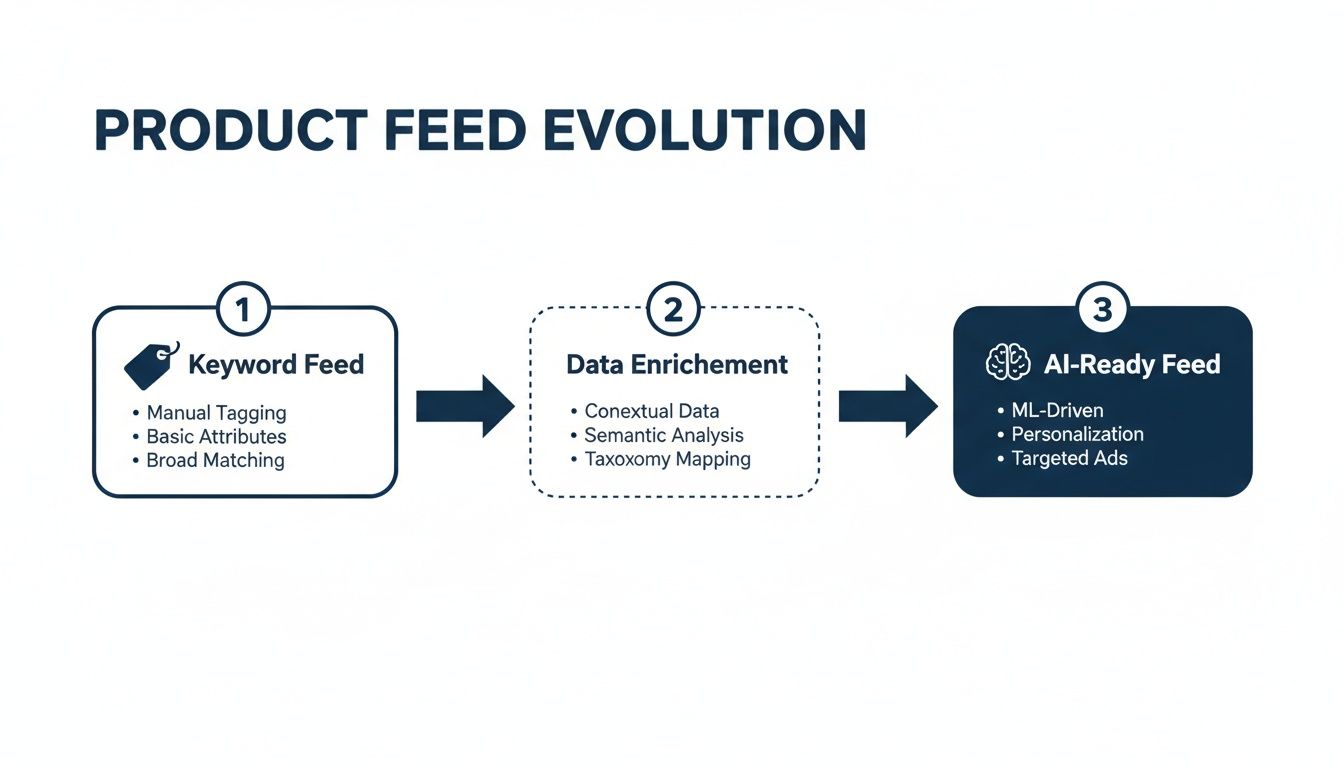
The key takeaway is pretty clear: an AI-ready feed is built on layers of enrichment. It moves far beyond simple keywords to embrace structured, semantic data that machines can interpret for generative AI SEO.
Mapping Core Attributes for Semantic Understanding
Your schema needs to go much deeper than the standard fields required by Google Merchant Center. Sure, GTIN, brand, title, and description are essential, but agentic search optimisation demands way more granularity. AI agents need rich context to answer the complex, conversational questions shoppers are asking.
Start by defining a complete set of attributes that are actually relevant to your vertical. For a furniture retailer, this means mapping fields for things like:
- Material Composition: Not just "wood," but "sustainably sourced Australian Tasmanian Oak."
- Dimensions: Include
[length],[width],[height], and even[packaged_weight]for logistics. - Style & Era: Attributes like "Mid-Century Modern," "Coastal," or "Industrial" provide vital context.
- Assembly Required: A simple "Yes/No" that instantly answers a common customer pain point.
If you’re in fashion, attributes for [fabric_type], [fit], [neckline], and [sleeve_length] are non-negotiable. This level of detail transforms a simple product listing into a rich data asset that fuels AI-driven discovery and seriously improves your digital shelf performance.
A robust schema isn't just a container for data, it's a strategic tool. It structures your product information in a way that directly answers the nuanced questions AI agents will be asked, making your products the most logical and helpful recommendation for AI shopping SEO.
Establishing a Canonical Data Model
Once you've defined your master attributes, the next job is to normalise the data that flows into them. Supplier feeds are notoriously inconsistent. One might use "LG" for size, while another uses "Large." A canonical data model enforces a single, consistent value for every attribute, every time.
This process is absolutely vital for SKU-level SEO. It ensures that every product variant is uniquely and accurately described, which stops the internal duplication that confuses both traditional search engines and AI agents. For example, you’d set up rules so that all colour inputs are converted to a standard hex code or a predefined colour name from your taxonomy.
This structured approach is the cornerstone of what I call a living product data ecosystem, a dynamic, intelligent repository of your entire catalogue. By building this robust framework, you lay the groundwork for AI workflow automation for retail, making it possible to enrich and optimise tens of thousands of products at a speed and scale that’s just impossible with manual processes. It’s the essential first move in shifting from old-school SEO to a future-proofed, agentic search strategy.
Using AI Workflows to Enrich Product Data at Scale
Once your schema is locked in, it's time to bring it to life. This is where you swap out sparse, inconsistent supplier data for rich, compelling product content, the kind that's perfectly tuned for AI search. For retailers juggling thousands of SKUs, doing this by hand isn't just slow, it's a classic bottleneck that grinds growth to a halt.
The answer is AI workflow automation for retail. These aren't just clever tools; they are complete systems built for SEO at scale. They turn the monumental task of content enrichment into a fast, repeatable process, letting you graduate from sluggish manual SEO to a dynamic, AI-first strategy.

From Supplier Feeds to Unique Product Stories
The biggest hurdle for most Australian retailers is supplier content duplication. When you’re using the same generic descriptions as ten other competitors, you become invisible to AI agents hunting for unique, authoritative information. Automated content workflows are designed to crush this exact problem.
By plugging the structured data from your new schema into a generative AI model, you can pump out thousands of unique product descriptions, titles, and metadata attributes in days, not months or years. This isn't about churning out robotic text, either. Modern AI agents for retail efficiency can be fine-tuned on your brand’s tone of voice, so every description sounds authentic while being perfectly optimised for agentic search optimisation.
Take a basic supplier feed that just says "Grey Fabric Sofa." An AI-powered workflow can transform this into:
- AI-Generated Title: "Modern 3-Seater Sofa in Charcoal Linen Weave Fabric, Perfect for Contemporary Australian Homes"
- AI-Generated Description: "Unwind in style with our spacious 3-seater sofa, upholstered in a durable yet soft charcoal linen weave. Featuring a sturdy Tasmanian Oak frame and plush, high-density foam cushions, this piece offers both exceptional comfort and timeless design. Its neutral tone and clean lines make it a versatile centrepiece for any modern living room."
That level of detail is a massive upgrade for your digital shelf. It gives AI agents the rich, specific context they need to confidently recommend your products over others.
Automating Visual Merchandising with AI Image Recognition
In visual-heavy industries like fashion and furniture, product images are just as crucial as the text. Yet, they are often a massively underused source of data. Manually tagging thousands of images with descriptive attributes is a soul-crushing task that few teams can handle at scale.
This is where AI image recognition SEO completely changes the game. AI models can scan your product photos and automatically generate hyper-specific tags and descriptive alt text.
For a fashion retailer, an AI won't just see a "dress." It will identify a "blue floral midi dress with a V-neck and puff sleeves." This granular data enriches your feed, powers faceted search on your site, and feeds critical context to AI shopping agents. It's a cornerstone of next-gen SEO for retailers.
Automated image tagging is especially powerful for furniture image tagging SEO and fashion product image SEO, where visual details are a direct driver of sales. It ensures your products show up in highly specific, long-tail visual searches, a rapidly growing part of the agentic commerce future.
Implementing Human-Led AI Content Quality Assurance
While AI delivers incredible speed and scale, you can't just set it and forget it. Quality assurance is everything. The most effective setup is a human + AI collaboration in SEO, where automation does the heavy lifting and your expert team provides the final strategic sign-off.
A human-led AI content QA process ensures everything stays on-brand, accurate, and authentic. The workflow usually looks something like this:
- AI Generation: The system creates enriched content, descriptions, tags, metadata, based on your predefined rules and brand guidelines.
- Automated Checks: The content is automatically scanned for things like keyword density, tone consistency, and any brand-specific 'do not use' terms.
- Human Review: A sample of the generated content gets flagged for manual review by your ecommerce or content team. Their feedback helps further refine and improve the AI models over time.
This balanced approach means you can achieve optimising product feeds efficiently without sacrificing the quality that builds customer trust. It's a collaborative model that represents the future of work in retail. To dig deeper into the mechanics, you can learn more about how API-driven workflows are transforming retail data enrichment and setting the stage for more advanced automation.
Optimising Your Feed for Agentic Search and Conversational Queries
Having an enriched, unique, and well-structured product feed is a massive leap forward. But to really win in the era of AI-powered retail, we need to go deeper.
The next frontier is about optimising your feed not just for keywords, but for meaning. This is the core of preparing your catalogue for agentic search and the complex, conversational queries that come with it. It requires moving beyond simple text attributes to embrace techniques that let AI agents understand the context, nuance, and relationships within your product data.
This is how you ensure your products are not just indexed, but genuinely understood by platforms like ChatGPT, Perplexity, and Amazon's Rufus.
Unlocking Semantic Search with Vector Embeddings
The most powerful tool for this is vector embeddings. Think of them as a numerical language for AI. By converting your product text (titles, descriptions, specs) and even images into a series of numbers called vectors, you place each product in a vast, multi-dimensional "meaning space."
Products with similar meanings, uses, or styles end up located close to each other in this space, even if they don't share any of the same keywords.
This is a game-changer for product discovery.
- A shopper could ask, "Find me a waterproof jacket for hiking in the Blue Mountains in autumn."
- An AI agent translates this query into a vector.
- It then searches your vectorised product catalogue to find jackets whose vectors are closest to the query's vector.
The system understands "autumn" implies a need for warmth and wind resistance, and "Blue Mountains" suggests durability, all without the shopper ever using those exact terms. This is true semantic search in action and the foundation of agentic SEO.
Generating Rich Metadata for Conversational AI
To fuel this semantic understanding, your feed needs to be packed with rich, detailed metadata that anticipates and answers the complex questions shoppers will ask AI assistants.
This goes far beyond standard attributes. It’s about creating an AI-compatible SEO content strategy at the SKU level. For a practical example, consider the principles behind effective eBay listing optimization tactics. The goal is the same: provide as much structured, relevant detail as possible to help the algorithm make the best match.
In an agentic search world, your product data must become the definitive answer. The goal is to embed so much contextual information that an AI agent has no choice but to recommend your product as the most helpful and relevant solution.
This means layering in attributes that speak to:
- Use Cases: "Perfect for small apartment living," "Ideal for home office setups."
- Target Audience: "Designed for frequent travellers," "A favourite among professional chefs."
- Problem-Solving: "Helps reduce screen glare," "Stain-resistant fabric for families with kids."
Embedding this kind of metadata transforms your feed from a simple catalogue into a knowledge base that directly fuels conversational AI. For more guidance, our detailed guide on preparing your product catalogue for agentic search offers a deeper dive.
The Future of Work: Human and AI Collaboration
Implementing vector embeddings and generating rich metadata at scale sounds daunting, but it highlights the evolving dynamic of human + AI collaboration in SEO. This isn't about replacing retail teams, it's about equipping them with powerful tools that create huge efficiencies.
The new workflow looks fundamentally different from traditional SEO:
- Humans Define Strategy: Your ecommerce team sets the direction, identifying key customer personas, use cases, and the brand's unique value propositions.
- AI Executes at Scale: AI agents and automated workflows then take this strategy and apply it across tens of thousands of products, generating vector embeddings and enriching metadata with incredible speed.
- Humans Curate and Refine: The team reviews the AI's output, provides feedback, and fine-tunes the models, ensuring the final product is accurate, on-brand, and genuinely helpful.
This collaborative model is central to the future of work in retail. It allows your team to shift from tedious, manual data entry to high-impact strategic oversight. By embracing AI agents in ecommerce, you unlock a level of efficiency and catalogue intelligence that was previously impossible, ensuring your brand is perfectly positioned for the agentic commerce future.
Automating Feed Management and Performance
A high-quality, AI-ready product feed isn’t a project you finish once. It’s a living asset that needs constant care and optimisation to perform on the digital shelf. The only way to manage this at scale is by building automated pipelines for validation, testing, and submission. This is how you turn a manual chore into a real strategic advantage.
Shifting to retail content automation frees up your ecommerce team. Instead of drowning in tedious data checks, they can focus on high-impact initiatives that actually move the needle. It's about creating a system that keeps your product data accurate, fresh, and primed for AI agents.
Establishing an Optimal Refresh Cadence
One of the first things to get right is your refresh cadence. For retailers in fast-moving industries like fashion or electronics, stock levels and pricing can change daily, sometimes hourly. An outdated feed is a surefire way to frustrate customers and lose sales.
Your ideal refresh frequency comes down to a few factors:
- Catalogue Volatility: How often do your prices, promotions, and stock levels fluctuate? High-frequency changes demand a more aggressive schedule.
- Channel Requirements: Platforms like Google Merchant Center, Meta, and various marketplaces all have their own expectations for data freshness.
- Technical Capacity: Your systems need to handle the data processing and transfer load without bogging down your site's performance.
With automated pipelines, you can set your feed to pull, transform, and submit on any schedule you need, whether that’s every 24 hours or every 15 minutes. This ensures the information AI agents and shoppers see is always perfectly synchronised with your backend, a crucial step for maintaining trust and driving sales.
Monitoring Metrics That Actually Matter
To really understand how your AI-ready feed is performing, you need to look beyond basic traffic and sales. True digital shelf performance is about measuring your visibility and influence within the AI search ecosystem.
The key metrics to watch now are:
- Impression Share for Non-Brand Terms: Are your products showing up in AI-generated answers for broad, problem-solving queries, not just brand searches? This is a great signal of your feed's contextual relevance.
- Ranking Changes for Conversational Queries: Keep an eye on how your products perform for long-tail, question-based searches. An uptick here means your enriched data is resonating with AI.
- Click-Through Rate from AI-Generated Links: When an AI agent recommends your product, are people actually clicking through? This tells you a lot about the quality and appeal of your content.
These metrics paint a much clearer picture of your readiness for agentic search. Many of these insights can be pulled automatically with modern retail efficiency tools, which deliver actionable reports and free your team from tedious spreadsheet analysis. This is how you start doing SEO at scale.
Building a high-quality product feed for AI search in Australia must account for the country’s rapidly growing online market. With Australians spending about AU$69 billion online and roughly 9.8 million households shopping frequently, product feeds must serve a broad, active buyer base. The fact that general marketplaces and groceries account for nearly AU$30 billion of that spend shows that feeds need to support many categories with different attribute sets and freshness requirements, which you can read more about in this report on Australian ecommerce trends and statistics.
Ultimately, building these automated systems is essential for survival and growth. You can see how to make the move from manual updates to more sophisticated methods in our guide on automating retail at scale with autonomous workflows. It's a strategic shift that prepares your brand for the future of retail search, making sure your products are always visible, accurate, and compelling.
Common Questions About Building AI-Ready Product Feeds
Shifting from a traditional, keyword-driven product feed to one built for AI brings up a lot of practical questions for Australian ecommerce leaders. This isn't just about tweaking a few fields in a CSV, it’s a whole new way of thinking about your data, centred on AI SEO and preparing for agentic search optimisation.
Let's walk through some of the most common queries we hear from retail managers making this change. It's time to start treating your product feed as a dynamic data asset, one that will power your digital shelf performance long into the agentic commerce future.
Where Is the Best Place to Start This Process?
The first, non-negotiable step is a data audit. You can't dream of AI workflow automation for retail until you know exactly what you’re working with. Pull all your supplier feeds into a single view and get a clear picture of the current state.
From there, look for the biggest fires to put out. Is it rampant supplier content duplication? Are critical attributes like 'material' or 'dimensions' missing from most of your top sellers? Your initial analysis will tell you where to focus your product data enrichment efforts first.
My advice? Don't try to boil the ocean. Start small. Pick your top-selling category and build a clean, canonical schema for it. Nail that, then scale the process.
How Does This Affect My Existing SEO Team?
This shift fundamentally changes the role of your SEO team, creating a clear line between AI SEO vs Traditional SEO. Gone are the days of manual keyword research and tedious on-page tweaks across thousands of individual SKUs. The focus moves to strategic oversight and managing the systems that do the heavy lifting.
This is a perfect example of human + AI collaboration in SEO. Your team’s role evolves from being hands-on content producers to becoming curators and strategists. They’ll be responsible for:
- Setting the brand voice and guardrails for any AI-generated content.
- Running human-led AI content QA to ensure everything is accurate, helpful, and on-brand.
- Analysing performance metrics to see what’s working and continuously refine the automated workflows.
Suddenly, you’ve eliminated massive content bottlenecks. Your team is now free from repetitive tasks, allowing them to focus on high-impact strategic work that actually moves the needle, a clear picture of the future of work in retail.
What Kind of ROI Can We Expect from This Investment?
Investing in a high-quality, AI-ready product feed isn't just a cost centre, it delivers tangible returns that hit the bottom line. Yes, there's an upfront effort, but the long-term benefits are massive.
Here’s where you’ll see the return:
- Better Organic Visibility: When your products have rich, unique, and structured content, AI-powered search engines are far more likely to feature them. This drives highly qualified traffic directly to your listings.
- Higher Conversion Rates: Detailed descriptions and complete attributes answer a customer's questions before they even have to ask. This builds trust, reduces friction, and makes it easier for them to click "buy".
- Serious Operational Efficiency: Automating product descriptions and metadata at scale frees up hundreds of team hours. That’s time your people can spend on growth, not manual data entry.
- Fewer Duplication Penalties: Cleaning up duplicated supplier content immediately improves your site’s authority and overall performance in search.
Ultimately, building a great product feed for AI is about future-proofing your business. It ensures your entire catalogue isn't just visible to the next wave of search and shopping agents, but is deeply understood by them. This is how you secure your spot on the digital shelf for years to come.
Ready to transform your product catalogue and eliminate content bottlenecks for good? Optidan AI uses advanced AI-powered content workflows to create thousands of unique, SEO-optimised product pages at scale, ensuring your brand is ready for the future of agentic search. Learn more at Optidan.
