

End-to-end product optimisation is a direct line to reducing your retail operating costs. It works by automating tedious manual tasks, cleaning up expensive data errors, and boosting your digital shelf performance so you can pull back on paid advertising spend.
Essentially, it gets your team off the hamster wheel of repetitive work and onto high-value strategic thinking, turning content from a cost centre into a genuine profit driver through AI workflow automation for retail.
The Hidden Costs Draining Your Retail Margins

For Australian retail leaders and ecommerce managers, rising operating costs are a constant headache. It’s easy to track the obvious expenses like wages and rent, but some of the biggest drains on your profitability are buried in messy internal processes. Think disconnected systems, manual content updates, and inconsistent supplier data. These aren’t just minor frustrations; they directly inflate your expenses every single day.
These operational drags create massive retail content bottlenecks. Picture the hours your team wastes manually correcting duplicated supplier content. Or the sales you lose when a new product launch gets held up for weeks because the content isn't ready. Every manual touchpoint is another chance for error and another drain on your resources.
The True Cost of Manual SEO
Traditional SEO workflows, which rely entirely on human effort, just can’t keep up with the scale of modern retail. The costs quickly stack up in a few key areas:
- Slow Time-to-Market: Manually creating unique, optimised content for thousands of SKUs is a huge undertaking. It can delay product launches, making you miss out on crucial sales windows and seasonal spikes in demand.
- High Labour Costs: The sheer volume of work involved in SKU-level SEO chews up a massive amount of your team's time. This pulls skilled marketers away from growth-focused activities and bogs them down in repetitive, low-impact tasks.
- Inconsistent Quality: When everything is done by hand, data quality often suffers. This leads to a poor customer experience, higher return rates, and can even do long-term damage to your brand’s reputation.
These challenges are only getting tougher in the current economic climate. Here in Australia, the retail sector is dealing with rising wages and a tight labour market. This makes efficient, streamlined strategies like retail content automation non-negotiable for survival.
An AI-powered strategy isn't a "nice-to-have" anymore, it's a critical tool for protecting your margins. By moving from manual SEO to AI SEO, you turn your product catalogue from a liability into a high-performing asset that drives both organic growth and operational efficiency.
The impact of this shift is clear when you compare old-school manual workflows with an AI-powered approach.
Manual Processes vs AI-Powered Optimisation Cost Impact
| Operational Area | Manual Workflow Cost Driver | AI Optimisation Cost Reduction |
|---|---|---|
| Content Creation | High labour costs for writers; slow production | Automation of first drafts; rapid, scalable content creation |
| Data Management | Hours spent correcting supplier errors and duplicates | Automated data cleansing, enrichment, and validation |
| Product Launches | Delays waiting for content; missed sales opportunities | Faster time-to-market with content ready at launch |
| Marketing Spend | Over-reliance on paid ads to cover for poor organic visibility | Increased organic traffic, reducing dependency on paid channels |
| Returns & Support | Inaccurate or vague descriptions lead to high return rates | Clear, detailed content improves buyer confidence and reduces returns |
This table just scratches the surface. The real magic happens when you realise that the time and money saved can be reinvested into activities that actually grow the business.
For businesses looking to make a serious dent in their overheads, it's worth exploring strategies like cutting BI spend by up to 70% with more flexible models, which can work hand-in-hand with content optimisation. At the end of the day, success is all about building smart, automated content workflows that tackle these hidden costs head-on.
Build Your Foundation with Product Data Enrichment
Before you can even think about meaningful optimisation, you need to tackle a problem most retailers are all too familiar with: messy data. Right now, your product information is likely a fragmented mess, scattered across inconsistent supplier feeds, PIMs, and various spreadsheets. This isn't just untidy, it's a major source of hidden retail operating costs, locking your team into a painful cycle of endless manual data correction.
This shaky foundation directly torpedoes your digital shelf performance. When product information is incomplete or just plain wrong, it guts your SKU-level SEO and makes it incredibly difficult to rank for anything. Worse, it creates a terrible customer experience, leading to confusion, abandoned carts, and a spike in costly product returns. The first and most critical step is to get all of this information unified.
From Supplier Feeds to a Pristine Catalogue
The fix for this is Product Data Enrichment, a process where AI-powered workflows automatically ingest, clean, standardise, and enhance all that raw data. Instead of your team manually fixing thousands of lines in a spreadsheet, AI agents for retail efficiency can spot and correct inconsistencies at a massive scale.
And this goes way beyond just fixing typos. It’s about structuring unstructured data to create a powerful, unified asset.
Some of the key enrichment tasks include:
- Standardising Attributes: Automatically converting varied formats, think 'cm', 'CM', and 'centimetres', into a single, consistent standard across your entire catalogue.
- Correcting Duplicated Supplier Content: Identifying and rewriting those generic, copy-pasted descriptions that kill your SEO and make your brand sound like everyone else. This is a crucial duplicate content SEO fix.
- Enhancing Missing Information: Using AI to intelligently fill the gaps in product specifications, features, and benefits, painting a complete picture for both search engines and shoppers.
This foundational step transforms thousands of inconsistent supplier entries into a pristine, structured catalogue. It eliminates the hours your team wastes on manual data correction, creating the solid base required for scalable content automation and preparing your catalogue for the future of agentic search.
The Role of AI in Data Accuracy
A seriously powerful use of AI in this phase is image recognition and tagging. For retailers in visually driven categories like fashion, furniture, or electronics, this technology is a genuine game-changer. An AI model can analyse a product image and automatically tag attributes like colour, material, style, and unique features.
Imagine a furniture retailer getting a supplier feed for a new sofa. The description is basic, but the image is crystal clear. AI can instantly identify it as a "3-seater navy blue velvet sofa with tapered wooden legs," adding a layer of rich, searchable keywords to the product data that were completely missing before. This automated process ensures every product is described with a high level of detail, supporting both AI SEO and a far better user experience.
To see how this works in more detail, have a look at our guide on product data enrichment strategies.
Automate Content Creation with AI Workflows
Now that your data is clean and properly enriched, you can finally tackle the biggest time-suck for any retail team: the content creation bottleneck. This is where you move from theory to practice, leaving slow, manual SEO behind for a scalable AI SEO strategy that genuinely cuts your retail operating costs. The goal is to set up AI workflows for retail that are built for speed, precision, and performance.
Forget waiting months for copywriters. Dedicated AI agents for retail efficiency can generate thousands of unique, optimised product descriptions, titles, and meta tags in just a few days. This automated workflow directly fixes the chronic problem of supplier content duplication. By creating a distinct story for every single product, you dodge SEO penalties and build a unique brand voice that isn't just a carbon copy of your competitors' supplier feeds.
Scaling Unique Content and Metadata
The real magic of AI-powered content workflows is achieving SEO at scale without quality taking a nosedive. For any large retailer, manually creating unique content for a catalogue of 10,000+ SKUs is a non-starter. AI makes it business as usual.
The process starts by training AI models on your brand's specific tone of voice, style guides, and SEO best practices. The AI then uses your enriched product data as its single source of truth, generating content that’s not only unique but also perfectly aligned with your marketing goals. It's a textbook example of human + AI collaboration in SEO, where your team sets the strategy and the AI handles the heavy lifting.
This shift from manual to AI-driven content creation is the most direct way to slash production costs while dramatically accelerating your time-to-market. It turns a major operational expense into a streamlined, efficient process that fuels organic growth.
AI Image Recognition for Richer SEO
For retailers in visual-heavy sectors like fashion, furniture, or electronics, content optimisation goes way beyond text. This is where AI image recognition and tagging become indispensable retail efficiency tools, especially for getting your catalogue ready for the future of retail search.
An AI agent can scan thousands of product images and automatically write descriptive alt tags and metadata. This ensures every single image is pulling its weight for your fashion SEO optimisation or furniture SEO services strategy.
Here's how it works in practice:
- For a dress: The AI can spot and tag attributes like "A-line silhouette," "puffed sleeves," "floral print," and "midi length."
- For a sofa: It can instantly tag "velvet upholstery," "tapered oak legs," and "mid-century modern design."
This level of granular detail is exactly what agentic search optimisation requires, making your products easy for AI shopping agents like Rufus or Perplexity to find and recommend.
The savings aren't just in labour. In the Australian consumer goods sector, where the cost of goods is a huge slice of operating expenses, data-driven optimisation helps fine-tune product offerings and cut down on purchasing costs. To explore this topic further, discover how leading retailers are implementing content automation for retailers to drive efficiency.
Get Your Catalogue Ready for Agentic Search
The way people search online is fundamentally changing. Forget just typing keywords into a search bar. More and more, your customers are using conversational AI agents like ChatGPT, Perplexity, and even Amazon's Rufus to find exactly what they need. This isn't a small tweak, it's a massive shift from simple keyword searches to complex, conversational questions about products.
Getting ready for this isn't some far-off, futuristic task. It’s a vital strategy you need to act on now to cut your long-term operating costs. Optimising for these new platforms today, a practice we call Agentic Search Optimisation, saves you from scrambling with expensive, reactive SEO fixes down the road. It’s all about structuring your product data so AI can understand it, trust it, and confidently recommend your products to shoppers.
Creating Content That AI Can Actually Understand
Traditional SEO was often a game of matching specific keywords. But AI-compatible SEO content is a whole different beast. It's about feeding the machine deep, structured, and context-rich information. AI shopping agents don't just skim for keywords; they digest and piece together every bit of data available to answer a user's very specific, and often detailed, query.
Think about it. A customer might ask their AI assistant, "Find me a three-seater sofa made from sustainable materials that's durable enough for a family with kids and pets, available in navy blue, and under $2,000." A standard product description is going to fall flat. But an AI-optimised one, packed with specific attributes, will nail it.
This is where your detailed product data becomes the fuel for Generative AI SEO. It boils down to a few key things:
- Deep Attribute Tagging: Go way beyond basic tags like 'colour' and 'size'. Think 'fabric weave', 'sustainability certifications', 'frame material', and 'assembly difficulty'.
- Contextual Information: Add details that answer unasked questions, like 'ideal for small living rooms' or 'pet-friendly upholstery'.
- Structured Data Markup: Use schema to clearly label every piece of data. This makes it dead simple for AI agents to parse and understand every last detail.
This is critical because agentic search platforms are built to provide answers, not just a list of links. For retailers, that means having structured, comprehensive product data isn't just nice to have, it's non-negotiable if you want to be seen.
Future-Proofing Your Digital Shelf Performance
When you proactively structure your catalogue for agentic search, you're not just tweaking your SEO. You're building a solid foundation for the future of work in retail. This approach directly creates scalable SEO solutions and ensures your digital shelf doesn't start collecting dust as your customers' habits change. Investing in this now means your products are ready to be discovered, not just on Google, but inside the private gardens of AI assistants and new agentic commerce platforms.
The core idea behind agentic commerce is simple: make it as easy as possible for an AI to understand your products. The more structured, detailed, and accurate your product data is, the more likely an AI agent will be to recommend it. You're effectively future-proofing your revenue.
This proactive approach turns your product catalogue from a simple list into a powerful asset, ready for the next wave of retail. If you want to go deeper on this, you can learn more about how agentic AI is reshaping retail and what it means for your business. This is the next frontier, where human + AI collaboration in SEO becomes the standard for running a smart, high-performance retail operation.
Integrate and Measure for Continuous Improvement
Getting your new AI-generated content live isn’t the finish line. It’s the starting block. Product optimisation is a feedback loop, not a one-off project, and this is where the real work, and the real gains, begin.
Once your enriched content is ready, it needs to be pushed out across all your sales channels. We’re talking about everything from your main ecommerce site to marketplaces and your social commerce platforms. This is the point where you start to see the real-world impact on your retail operating costs.
The goal isn't just to watch traffic figures climb. You're looking for tangible operational wins. Think lower product return rates because your descriptions are finally clear and accurate. Or a measurable lift in organic traffic right down to the SKU-level, which means you can dial back your spending on expensive paid ads. This is how you prove the ROI.
From Data Points to Strategic Decisions
This measurement phase is where human + AI collaboration in SEO really comes into its own. Your AI workflows are busy deploying content at a scale that would be impossible for a human team, while your people provide the strategic oversight. They’re the ones analysing the performance data, spotting the trends, and identifying the next opportunity for a tweak.
It’s a powerful synergy. For instance, if the data shows that products with a specific attribute are converting at a much higher rate, your team can tell the AI to prioritise that attribute in the next round of content generation. This is a perfect snapshot of the future of work in retail, where human expertise guides automated execution. To make this work seamlessly, businesses need to lean into solutions like real-time data integration.
By systematically integrating, measuring, and refining your content, you create a powerful cycle of improvement. Each iteration makes your digital shelf performance stronger, your operations leaner, and your business case for investing in retail efficiency tools undeniable.
This continuous cycle is all about moving from integration and measurement right back into refinement.
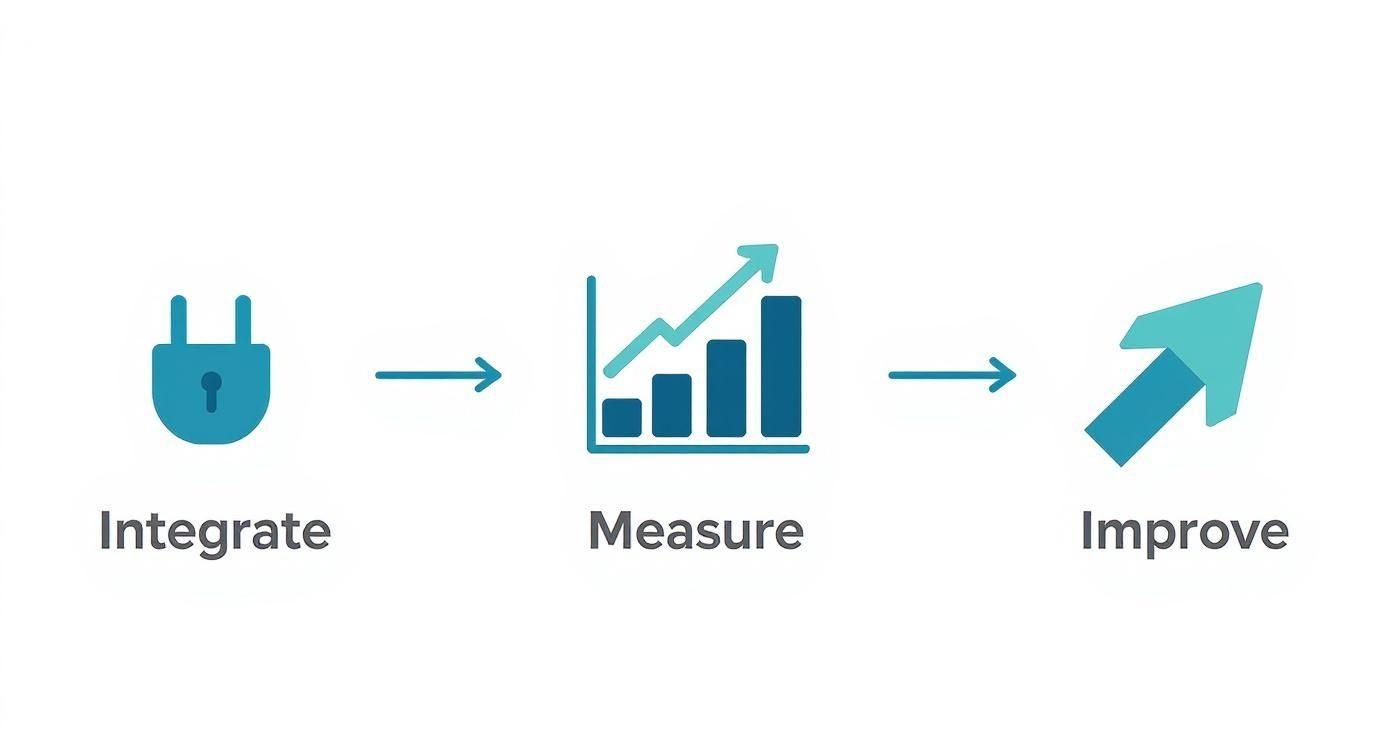
The key takeaway here is simple: the data you get from the 'Measure' phase should directly inform what you do in the 'Improve' phase. Every adjustment you make has to be backed by real performance data.
This constant analysis is absolutely critical in the current Australian market. With online retail sales trends fluctuating, you need to be optimising every corner of your digital experience to capture growth while keeping costs down. AI-driven analytics can help you predict consumer demand far more accurately, leading to smarter inventory management and less waste, a direct hit to your operating costs. You can stay on top of how Australian retail sales are trending on the official ABS website.
Ultimately, tracking these outcomes is what proves the value of all this effort. For a closer look at what to monitor, check out our guide on the top metrics to track for ecommerce success in 2024.
Frequently Asked Questions
Pivoting to an AI-powered optimisation strategy always brings up good questions. Here are the answers to the most common ones we hear from Australian retail leaders and ecommerce managers.
How Quickly Can We See a Reduction in Operating Costs?
While every retailer is different, you'll likely see initial cost reductions within the first quarter. The fastest savings come straight from retail content automation, which slashes the time and labour needed to write thousands of unique product descriptions. A job that used to take a team months can now be done in days, allowing you to optimise at scale.
Longer-term savings start to build as your improved AI SEO brings in more organic traffic, cutting your reliance on paid ads. On top of that, clearer and more detailed product data means fewer customer service tickets and lower return rates. The key takeaway is that AI-driven content workflows create compounding efficiencies, so your operations get leaner every single month.
Will AI-Generated Content Replace Our Human Teams?
Not at all. The goal here is elevation, not elimination. Think of it as Human + AI Collaboration in SEO. AI agents are perfect for the massive, repetitive tasks that are a poor use of human time, like writing 20,000 meta descriptions or tagging every attribute for a new clothing line.
This frees up your expert merchandising and SEO teams to do what they do best: focus on high-value strategic work. Their roles evolve from manual grunt work to strategic oversight, analysing market trends, setting creative direction, and providing that crucial human-led AI content QA. It makes their work more impactful and far more valuable to the business, showcasing the future of work in retail.
This shift lets your best people steer the strategy while AI handles the scale. It's about making your teams more effective, not redundant.
Our Product Data Is a Mess and Comes from Multiple Suppliers. Where Do We Start?
This is the most common hurdle we see, and it’s actually the perfect place to begin. The first move is always a full data audit and consolidation, which becomes the bedrock of your entire optimisation strategy.
Start by mapping out all your data sources, including supplier feeds, ERPs, and spreadsheets. Then, use an AI-powered Product Data Enrichment tool to pull all that messy data into one place. The system automatically standardises formats (like turning 'cm' into 'centimetres'), fixes errors, and even fills in missing attributes using logic and image recognition.
This creates a clean, unified 'single source of truth' for every product in your catalogue. Starting here is non-negotiable, because you can't get high-quality outputs, like optimised content, from low-quality inputs. Nailing this foundational step makes every ecommerce content optimisation effort that follows far more effective.
Ready to see how Optidan AI can turn your messy product data into a high-performing, cost-saving asset? Discover how our AI-powered content workflows can slash your retail operating costs and prepare your catalogue for the future of search. Get started with Optidan AI today.
