


A solid marketing automation strategy isn't just a plan; it's the engine that turns software into revenue. We're talking about more than just automating a few emails. It's about building efficient, scalable, and genuinely personal customer experiences that directly fuel business growth. For Australian retail leaders, this means moving from manual SEO to AI SEO and preparing for the future of agentic commerce.
Laying The Foundation For Your Automation Strategy

Before you even think about platforms or workflows, you need to nail down your goals. For Australian retail leaders, this is the most critical step. Forget generic metrics like open rates. Your focus needs to be on objectives that hit the bottom line and get your business ready for the future of retail search. The point isn't just to automate tasks; it's to solve specific, high-value problems and reduce retail content bottlenecks.
This isn't just theory, the market is exploding. In Australia, marketing automation already generates USD 190.0 million in revenue, with email marketing taking a huge 27.79% slice. That number is set to jump to a massive USD 544.9 million by 2030. Why? Because smart retailers are leaning into an AI-powered retail transformation to get ahead of an AI-led, agentic commerce world.
Defining Retail-Specific Objectives
Generic goals get you generic results. Simple as that. Instead, your objectives must be directly tied to real retail challenges that automation can actually solve. Think about the bottlenecks in your ecommerce operations right now. What's slowing you down and hurting your performance on the digital shelf?
Here are a few powerful, retail-focused goals to get you started:
- Eliminate Supplier Content Duplication: Make it your mission to automate the rewriting of generic supplier product descriptions across your entire catalogue. This solves major SEO headaches and helps you carve out a unique brand voice, something that's vital for both traditional search and the new wave of AI shopping agents.
- Achieve SKU-Level SEO at Scale: Set a bold goal to optimise metadata, image alt tags, and product details for tens of thousands of SKUs in days, not months. This kind of target is only possible with AI-powered content workflows.
- Enhance Product Data Enrichment: Turn those basic supplier feeds into rich, structured product content. For a fashion retailer, this could mean automating image recognition to tag attributes like 'linen blend' or 'puffed sleeves', which massively improves filtering and searchability on your site.
- Improve Digital Shelf Performance: Aim for a measurable lift in search visibility and conversions for your key product categories. This ties your automation efforts directly to revenue and market share.
A well-defined objective for a furniture retailer isn't just "increase traffic." It's "Automate the generation of unique, SEO-optimised descriptions for our top 5,000 SKUs to reduce duplicate content penalties by 95% within three months." See the difference? It's specific, measurable, and tackles a core business problem head-on.
From Manual Effort To AI-Powered Efficiency
Your strategy's foundation also has to recognise the massive shift from manual SEO to AI SEO. For large retailers, the old ways just don't cut it anymore. Manual content creation is a huge bottleneck, especially when you’re juggling thousands of products and constant updates from suppliers.
Your foundational goals should reflect a real commitment to building a scalable SEO solution. This means planning for AI agents in ecommerce and understanding how they’ll interact with your product data. By prioritising the automation of content creation, image tagging, and data enrichment, you're not just tweaking current performance. You're building a resilient framework for the agentic shopping era and the future of work in retail.
Getting a grip on what's possible with modern ecommerce automation tools, strategies, and marketing insights is a great starting point. This initial planning ensures every automated workflow you build later is purposeful and drives real results. You can also dive into our guide on how to create a solid foundation for your online store to learn more about developing a robust plan from the ground up.
Building Customer Segments For AI Personalisation
Your marketing automation is only ever as good as the customer segments that fuel it. Let's be honest, generic, one-size-fits-all campaigns just don't work anymore. To really move the needle, you have to get beyond basic demographics and build smart, dynamic segments that actually deliver a personal touch.
This shift is more than just a nice-to-have; it's essential for AI SEO. The tools themselves are getting more powerful every day. Marketing automation platforms in Australia are booming, with a projected 14.80% compound annual growth rate set to push the market from USD 1.95 billion to USD 3.21 billion by 2025. As detailed in the latest digital marketing software analysis, retailers are ditching simple campaigns for real-time, behaviour-triggered journeys. That kind of sophistication demands much smarter segmentation.
Evolving From Static To Predictive Segmentation
For years, segmentation meant slicing up lists based on static data points like age, location, or what someone bought six months ago. While that has its place, it only gives you a rearview mirror perspective of your customer. It tells you who they were, not who they're about to become. Modern retail automation needs to be more forward-looking.
This is exactly where AI-driven predictive segmentation changes the game. By churning through massive datasets of customer behaviour, AI models can spot patterns and signals that are completely invisible to the human eye.
- Spotting your VIPs: AI can predict who's most likely to buy again or have the highest lifetime value, letting you roll out the red carpet with exclusive campaigns to lock in their loyalty.
- Preventing churn before it happens: It can flag customers showing early signs of drifting away, so you can automatically trigger a re-engagement workflow before you lose them for good.
- Predicting purchase intent: You can build segments of users who are almost certain to buy a specific category, like electronics or fashion, based on their browsing patterns and recent interactions.
Making this leap from reactive to proactive segmentation is a core part of a next-gen SEO strategy for retailers, ensuring your marketing budget is aimed squarely at your most valuable audiences.
Leveraging Enriched Product Data For Hyper-Targeting
For retailers, the real magic happens when you start blending customer behaviour with deeply enriched product data. This is how you create those incredibly specific segments that power truly effective automated campaigns. A few years ago, this level of granularity was just a dream for SEO teams; now, AI makes it a reality.
Think about a furniture retailer using AI image recognition to automatically tag products with detailed visual attributes. Suddenly, messy supplier feeds are transformed into clean, structured, and searchable data through product feed optimisation.
Instead of just segmenting by "customers who bought a sofa," you can now target customers who have purchased items tagged with "walnut finish," "mid-century modern design," or "linen blend fabric." This opens the door to hyper-targeted cross-sell and upsell campaigns that feel genuinely helpful, not creepy.
A fashion retailer could do the same, using AI to identify and tag visual cues like "puffed sleeves," "floral print," or "A-line silhouette." This kind of automated product image tagging fuels a whole new level of SKU-level SEO and personalisation. An automated flow could then send a curated email showing off new floral dresses only to customers who have previously bought or browsed that exact style. As we've covered before, this is how metadata connects directly to customer intent.
This level of detail isn't just about improving the customer journey today. It's about getting your catalogue ready for the future of AI agents and agentic search optimisation. When agentic shopping platforms like Rufus or Perplexity are asked for highly specific recommendations, having this structured, enriched data will be a massive competitive advantage. It ensures your products are the ones that get found and recommended.
From Manual To Agentic Segmentation Models
The transition from traditional, manual segmentation to AI-powered models is fundamental for preparing for the coming wave of agentic commerce. The old way of doing things simply can't keep up with the speed and specificity required.
| Segmentation Type | Traditional Approach (Manual) | AI-Powered Approach (Automated & Agentic-Ready) |
|---|---|---|
| Data Sources | Relies on historical, static data (e.g., demographics, past purchases). | Ingests real-time behavioural data, product attributes, and contextual signals. |
| Segment Creation | Manually created based on predefined rules and assumptions. Slow and resource-intensive. | Dynamically generated by algorithms that identify patterns and predict future behaviour. |
| Personalisation | Broad personalisation (e.g., "customers who bought X also bought Y"). | Hyper-personalisation at the individual level based on predicted intent and visual attributes. |
| Scalability | Difficult to scale and maintain across large catalogues and customer bases. | Scales effortlessly, continuously refining segments as new data becomes available. |
| Future Readiness | Not equipped for the detailed, structured queries of AI shopping agents. | Built to provide the granular, structured data that AI agents need for agentic search optimisation. |
Ultimately, the goal is to build a segmentation strategy that doesn't just look backwards but actively anticipates customer needs. This AI-powered approach ensures your marketing is not only more effective today but is also primed for the inevitable shift to a more automated, agentic shopping landscape.
Mapping The Automated Customer Journey
With your goals set and your customer segments dialled in, it’s time to start mapping the actual journey. Forget the simple welcome email series. We’re talking about designing multi-channel workflows that guide customers from their very first interaction all the way to becoming loyal fans.
A modern automation strategy isn't just about what the customer sees. It’s also about automating the crucial internal jobs that make a great customer experience possible. This is how you build seamless, scalable journeys that boost your digital shelf performance and create real loyalty.
Beyond The Welcome Email: An Agentic-Ready Approach
The classic customer journey map usually kicks in after someone signs up or makes their first purchase. But in the age of agentic commerce, that's already too late. The real journey starts the moment someone searches for a product. Your automation strategy has to connect the dots between your content and how you acquire customers.
What does that look like in practice? It means automating the process of turning raw supplier product feeds into optimised, unique, and structured content. Getting this right is a genuine game-changer. It directly tackles supplier content duplication, letting you create unique, SEO-friendly product descriptions at scale, which is essential for ranking in both traditional search and with AI shopping agents.
Here’s a simple AI workflow automation for retail:
- Trigger: A new or updated supplier feed comes in.
- Action 1: An AI workflow spots any duplicate or thin content.
- Action 2: Generative AI for retail teams crafts unique, on-brand descriptions using enriched product data.
- Action 3: AI-powered quality checks flag any issues before the content goes live.
- Result: Thousands of your product pages become unique, discoverable assets, ready for both human shoppers and AI agents like ChatGPT or Rufus.
This first, automated content step is critical. It makes sure your products are visible and compelling right from the start.
This infographic shows how segmentation has evolved, moving from basic demographics to sophisticated, AI-driven analysis.
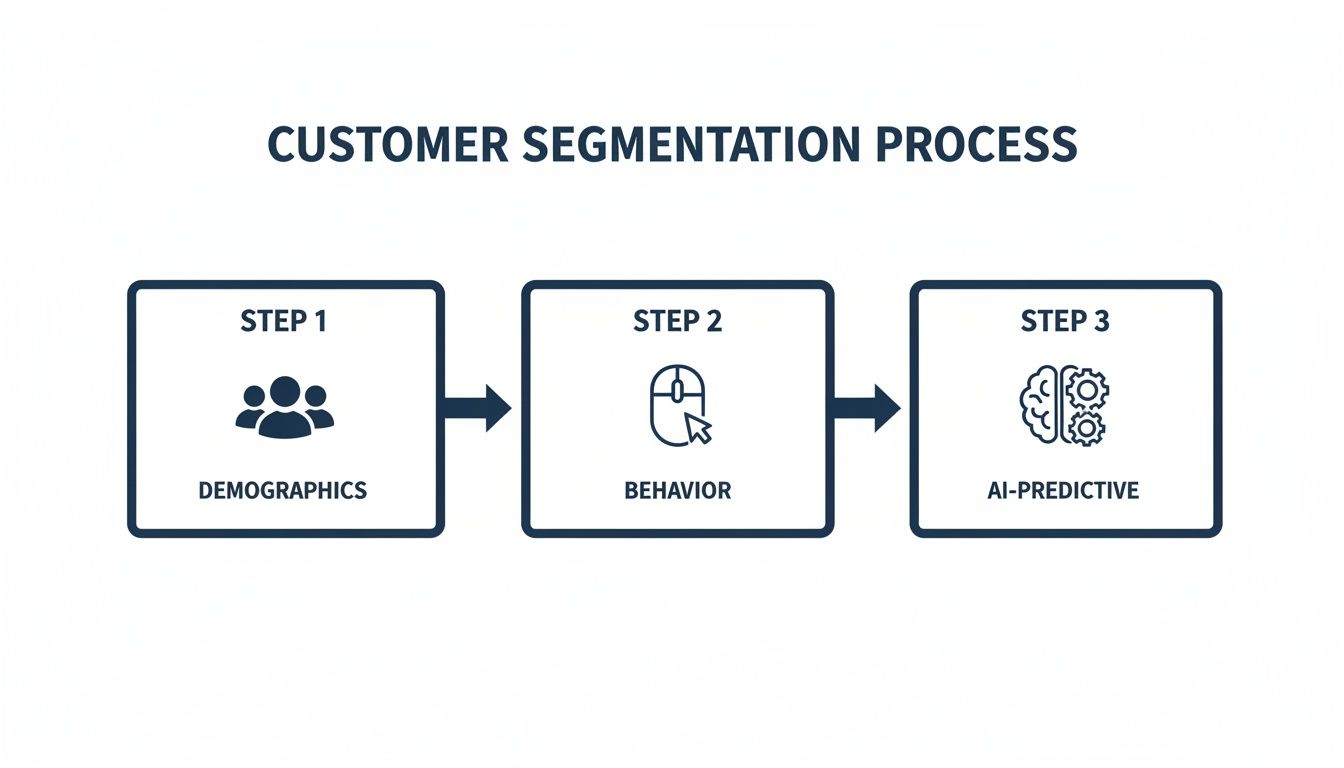
Moving from simple data to predictive insights is exactly what powerful automation enables, creating smarter and more effective customer journeys.
Automating Nurture And Re-Engagement Sequences
Once a customer finds your optimised content and interacts with it, the nurturing phase begins. This is where your AI-powered segments really shine, allowing you to deliver incredibly relevant follow-ups. Automated emails aren't new, but they still pack a punch, studies show they can get 332% higher click-through rates compared to campaigns sent manually.
Imagine a fashion SEO optimisation scenario. A customer browses dresses that your AI has tagged with the attribute "linen blend".
A powerful automated workflow wouldn't just send a generic "You left this in your cart" email. Instead, it could trigger a multi-touch sequence that showcases other linen items, shares content about caring for linen garments, and even offers a small incentive a few days later if they still haven't purchased. This is human + AI collaboration in SEO at its best.
This logic works everywhere. For an electronics SEO optimisation strategy, a user looking at a specific TV could be nurtured with content comparing it to similar models, showcasing customer reviews, and suggesting compatible sound systems. To see how these touchpoints fit into the bigger picture, you can explore the stages of the digital marketing funnel.
Mapping Internal Workflows For Quality And Speed
Finally, a truly comprehensive automation strategy has to include your internal processes. Automating content and data workflows is the secret to breaking through retail content bottlenecks and maintaining quality at scale.
- Automated Content QA: Set up AI agents to scan thousands of product pages for brand voice alignment, grammar mistakes, or missing information. This ensures every customer gets a high-quality, consistent experience through human-led AI content QA.
- Image Tagging Automation: For furniture or fashion brands, AI can automatically tag new product photos with critical attributes like "Oak Finish" or "V-Neck". This enriches your product data for SEO and on-site search without anyone lifting a finger.
- Dynamic Pricing & Stock Alerts: Connect your automation platform to your inventory system. You can then trigger alerts or launch automated campaigns when a popular item is back in stock or goes on sale.
By mapping both customer-facing and internal journeys, you build a cohesive, efficient system. This doesn't just improve the customer experience, it creates a resilient operational foundation that prepares your business for an AI-driven future.
Choosing Your Retail Automation Tech Stack
This is the point where your entire marketing automation strategy hinges: selecting the right technology. Gone are the days when a generic email platform was enough. For any modern Australian retailer, your tech stack needs to be a tightly integrated ecosystem, one that’s built for AI SEO, agentic search, and massive-scale content automation.
We’re talking about looking past the standard feature list to find platforms that actually solve core retail headaches. Your tech needs to handle the heavy lifting, like enriching raw product data, stamping out widespread supplier content duplication, and using AI for image recognition and tagging across thousands of SKUs. If it can’t do that, you’re just automating old problems.
And let’s be clear, AI adoption in Australian marketing isn't some far-off concept, it’s happening right now. A massive 91% of Australian marketing businesses are already using AI in their operations. Another 87% say AI is important for daily work like content creation. This isn’t a small shift; it’s a fundamental change that demands a tech stack built around AI from the ground up.
Core Platform Capabilities For Retail
Your main marketing automation platform acts as the central nervous system, but its real strength comes from how well it connects with specialised AI tools. When you’re vetting options, prioritise platforms that can seamlessly link your ecommerce backend, your product information management (PIM) system, and your AI optimisation tools. This is what creates the cohesive workflow needed for the future of work in retail, where humans and AI work hand-in-glove.
Here’s what to look for:
- A Content Automation Engine: You need a solution specifically designed for retail content automation. It must be able to take raw supplier feeds and use generative AI to churn out unique, SEO-optimised product descriptions at scale. This is the only realistic way to achieve true SEO at scale and graduate from manual SEO to AI SEO.
- An AI-Powered Data Enrichment Layer: The platform has to support efficient product feed optimisation. This means using things like AI image recognition to automatically tag visual details, which is absolutely critical for fashion SEO optimisation and furniture image tagging SEO.
- Robust Integration APIs: Your stack is only as strong as its weakest link. All your systems must be able to talk to each other flawlessly to create fully automated content workflows that run from data import to content publication without anyone needing to step in.
Evaluating Next-Gen SEO and Agentic-Ready Tools
The conversation is no longer about old-school SEO tools. It's about platforms engineered for an agentic future. Your tech stack must get your product catalogue ready for discovery by AI agents like Rufus and Perplexity, and that requires a much deeper level of optimisation. We're talking about structured data, content quality, and semantic relevance for AI SEO.
An agentic-ready stack isn’t about stuffing in more keywords. It’s about structuring your product information so clearly that an AI agent can instantly understand it and confidently recommend your product over a competitor’s. This is the new battleground for digital shelf performance.
When you're looking at tools, you need to ask some hard questions. Can the platform handle metadata optimisation at scale? Does it use AI for ecommerce content quality assurance? Can it produce AI-compatible SEO content that satisfies both traditional search engines and the new wave of AI shopping assistants?
To help you vet potential platforms, here’s a checklist of the features that really matter for building a future-ready retail operation.
Essential Features For A Future-Ready Retail Automation Platform
| Feature Category | Core Functionality | Why It Matters For AI SEO & Agentic Commerce |
|---|---|---|
| Data Ingestion & Normalisation | Ability to ingest raw data from multiple sources (PIM, ERP, supplier feeds) and standardise it. | AI agents need clean, consistent data. This product data enrichment step fixes errors and inconsistencies before they cause problems downstream. |
| AI Content Generation | Uses generative AI to create unique, brand-aligned product descriptions, titles, and meta content. | Eliminates supplier content duplication penalties and allows for true SEO optimisation at the SKU level, which is impossible manually. |
| Image Recognition & Tagging | Employs AI to analyse product images and automatically generate descriptive tags and alt text. | Crucial for visual search and enriching product data with attributes (e.g., "v-neck," "oak finish") that AI agents rely on for agentic search optimisation. |
| Structured Data & Schema Markup | Automatically generates and applies schema markup (e.g., Product, Offer, Review) to content. | This is how you speak the language of search engines and AI agents, giving them the structured context they need to understand your offerings. |
| API & Integration Framework | Provides robust APIs for seamless connection to ecommerce platforms (Shopify, BigCommerce) and other martech tools. | A connected stack is essential. This ensures that optimised content flows directly into your systems without manual uploads. |
| Continuous Optimisation Loop | Monitors performance and uses feedback to automatically refine content and data over time. | The digital shelf is never static. This capability allows your content to adapt to changing search trends and algorithm updates without constant oversight. |
A truly future-focused stack answers these challenges head-on. It’s about more than just software; it’s about finding a partner that can help you reduce retail content bottlenecks and build scalable SEO solutions. For a deeper dive, check out our guide on building the retail tech stack for an agentic future.
Ultimately, the right technology isn’t just a line item on a budget. It’s a strategic asset that builds a competitive moat around your brand in an increasingly automated world.
Measuring And Scaling Your Automation Efforts
Getting your first automated workflows live is a huge step, but it’s really just the starting line. The real wins come from what you do next: the constant measuring, tweaking, and scaling that turns a one-off project into a genuine growth engine.
This is all about building a feedback loop to prove the commercial impact of your efforts and refine them over time. We're not talking about vanity metrics like email open rates. For retail leaders, success is measured in tangible results that hit the bottom line. The end game? To build a smart, efficient, AI-ready automation system that grows with your business, from optimising a single product category to transforming your entire digital shelf.
Defining KPIs That Truly Matter For Retail
To get a real sense of how your automation strategy is performing, you need to track KPIs that tie directly back to your core retail goals. These metrics should tell a clear story about efficiency, content quality, and, most importantly, revenue.
It’s time to move beyond the surface-level stats. Focus on the numbers that demonstrate real business value:
- Reduction in Content Production Time: How much time are you saving on tasks like writing unique product descriptions or optimising metadata? This KPI is a direct measure of efficiency and shows you're clearing retail content bottlenecks.
- SKU-Level Conversion Rate: Start tracking conversion rates specifically for products with AI-enriched and optimised content. This is how you draw a straight line from your AI SEO work to actual sales.
- Improvement in Digital Shelf Performance: Monitor your organic search rankings and visibility for key product categories after your automated workflows are running. This proves the impact on your retail search visibility.
- Decrease in Supplier Content Duplication: A massive one for SEO health. Track the percentage of your product catalogue that features unique, optimised content versus the generic copy-paste text from suppliers.
A big part of this is knowing how to measure marketing effectiveness in a way that connects all the dots. By focusing on these retail-specific KPIs, you get a crystal-clear picture of your ROI and can easily justify putting more fuel in the automation tank.
Using AI To Refine And Optimise Workflows
Optimisation isn't a "set and forget" task; it’s a continuous process. The best way to sharpen your automated workflows is through relentless testing and analysis, and AI is your secret weapon here. Traditional A/B testing still has its place, but AI-powered analytics can uncover insights at a scale that just isn't humanly possible.
Think about an AI workflow automation for retail scenario. Let’s say you’re using generative AI to create unique product descriptions for your electronics category. Instead of testing one or two versions, AI-driven testing can analyse thousands of variations at once, figuring out which tone, length, or feature call-out clicks with different customer segments.
This isn't just about tweaking a button colour. It’s about letting AI figure out that descriptions mentioning "long battery life" convert better for one audience, while "sleek, lightweight design" works for another. The system then automatically rolls out the winning version, constantly improving performance on the fly.
This shifts optimisation from a manual, guesswork-heavy job to a data-led, automated process. It ensures your content is always evolving to meet what customers and the market demand, squeezing every last drop of performance from your digital shelf.
A Roadmap For Scaling Your Success
Scaling is about taking those initial, isolated wins and turning them into an enterprise-wide transformation. The trick is to use a phased approach that builds momentum and proves its worth every step of the way. This is how you go from playing manual SEO catch-up to running a truly scalable SEO solution.
Start small, but aim for high impact. If you’re a fashion retailer, maybe that means automating image tagging and alt tag optimisation for your best-selling dress category. For a furniture brand, it could be rewriting all the duplicate supplier content for your top 100 sofas.
Once you’ve got the data to prove the value in that first phase, you have a rock-solid business case for expanding. The goal is to scale your AI-powered content workflows across your entire product catalogue, getting you to a point where you can optimise tens of thousands of pages in days, not months.
Here’s a practical way to map it out:
- Prove the Concept: Pick one product category and automate a single, specific workflow, like product data enrichment. Measure the impact on SEO rankings and conversions for one quarter.
- Expand to Adjacent Categories: Take that successful workflow and apply it to similar product categories, tweaking the process with what you learned the first time around.
- Integrate More Workflows: Start layering on other automations, like AI-powered quality assurance checks or metadata optimisation at scale.
- Full Catalogue Rollout: Once your processes are battle-tested and running smoothly, it's time to roll the automated workflows across your entire product offering.
Following a path like this lets you manage change without overwhelming your teams, secures the internal buy-in you need, and helps you build a sophisticated automation engine that drives real, sustainable growth. To dig deeper into the mechanics, you can learn more about how the AI workflow is the real driver of ROI for retailers.
Answering Your Questions About Retail Automation
Moving towards a more automated operation always brings up good questions. For Australian retail leaders and ecommerce managers, it's not just about the 'what', it's the 'how' and 'why' behind a modern automation strategy that really matter. Here are some of the most common queries we get, with clear, straight answers.
How Can Marketing Automation Directly Improve Our SEO At Scale?
Think of marketing automation as the engine for scalable SEO solutions, especially if you're juggling a massive and complex product catalogue. Trying to fix critical on-page SEO issues manually across thousands of SKUs is a losing battle. The right platforms, especially those powered by AI, can systematically fix these problems for you.
A classic example is tackling supplier content duplication. An AI workflow can take a generic supplier feed and spin out thousands of unique, optimised product descriptions in just a few hours. This one move solves one of the most stubborn SEO headaches for retailers, helping you improve rankings and carve out a distinct brand voice.
It doesn't stop there. Automation can handle metadata optimisation at scale, generate SEO-friendly alt tags using AI image recognition, and make sure all your product data is consistently structured. This gets every single product page ready for both traditional search engines and the new wave of AI agents, boosting your digital shelf performance without burying your team in manual work.
What Is The First Step Our Retail Team Should Take?
This might surprise you, but the first step isn't choosing a tool. It's defining your problems and auditing your data.
Before you even glance at a software demo, you need to pinpoint your biggest operational headaches. Is it the painfully slow pace of content production? Is your branding all over the place because of messy supplier feeds? Or are you just not ranking for key product categories?
Once you have clear, measurable goals, your next job is to get honest about the quality of your product data. A successful AI workflow automation for retail depends entirely on a foundation of clean, structured, and enriched data.
A quick audit might show that 80% of your product descriptions are just copied from suppliers. Suddenly, you have a high-impact starting point. Your objective becomes: "Reduce duplicate content by 90% next quarter using an automated content workflow." This initial deep dive will shape every decision you make, from technology choices to campaign priorities.
How Does AI Fit Into An Automation Strategy For Fashion Or Furniture?
For visual-heavy industries like fashion and furniture, AI isn't just helpful, it's a game-changer. An AI-powered retail transformation here is all about turning your product images into valuable, structured data.
AI image recognition can automatically scan your product photos and generate incredibly descriptive tags at scale. Imagine getting 'mid-century modern oak sideboard' for a furniture piece or 'v-neck linen summer dress' for a fashion item, all without anyone lifting a finger. These tags are absolute gold for enriching product data, powering precise on-site search filters, and enabling hyper-specific SKU-level SEO. This same process also automates alt tag optimisation, a crucial task for both accessibility and image search visibility.
From there, generative AI can use this newly enriched data to write compelling, unique product descriptions that sound like your brand. It turns a slow, manual chore into an efficient, automated workflow that directly improves your ecommerce content optimisation.
Can We Implement Marketing Automation Without A Large Team?
Absolutely. In fact, that's the whole point. Modern, AI-powered automation is designed to create efficiencies that let smaller teams punch well above their weight. AI agents for retail efficiency are built to take on the repetitive, time-sucking tasks that often overwhelm lean teams.
Today's platforms offer user-friendly automated content workflows that don't require deep technical knowledge. By optimising product feeds efficiently, running content quality checks, and deploying basic campaigns, you free up your team. They can then shift their focus to high-level strategy, creative direction, and the kind of human + AI collaboration in SEO that actually drives growth.
The trick is to start small. Pick one high-impact workflow, prove its value, and then scale your efforts from there.
Ready to move from manual SEO to an AI-powered future? At Optidan AI, we help retailers build a resilient, agentic-ready foundation by transforming product feeds into optimised content at scale. Discover how our platform can eliminate content bottlenecks and prepare your digital shelf for the future of search. Learn more at https://optidan.com.
