

Effective marketing for ecommerce is no longer about tweaking a few pages or running siloed campaigns. It is about building an intelligent, automated engine that gets your entire digital shelf ready for both human shoppers and the new wave of AI agents.
The real shift here is moving away from labour-intensive, manual tasks to scalable, AI-powered workflows. For any retail leader serious about staying competitive, this is not just a trend, it is a fundamental change in how retail operates.
The Shift to an AI-Powered Marketing Playbook
Let's be blunt: the traditional retail marketing playbook is broken. I see it all the time, ecommerce managers and retail leaders are drowning in content bottlenecks. They are trying to fix duplicated supplier content, optimise thousands of product pages by hand, and somehow keep up. These manual jobs are slow, expensive, and just cannot match the speed of the market.
The future of work in retail is all about human + AI collaboration. The tech handles the scale and repetition, freeing up your team to focus on strategy and growth. This is the core of modern retail efficiency tools.
This new approach is all about preparing your product catalogue for what is coming: agentic commerce. AI agents like ChatGPT, Perplexity, and even Amazon's Rufus are completely changing how customers discover and choose products. Success is not just about ranking on Google anymore. It is about being the most accurate, trusted, and relevant option for an AI agent to recommend. This demands a total rethink of how we approach SEO for AI agents.
Understanding Agentic Search Optimisation
Agentic search optimisation, or what we call AI SEO, goes way beyond keywords. It’s about structuring your data, ensuring your content is top-notch, and making sure everything is contextually relevant. You need to make your product information so clear and complete that an AI can confidently pick it as the best answer for a shopper's question. This is the difference between traditional SEO teams and next-gen SEO for retailers.
This modern strategy is built on a few key pillars:
- Product Data Enrichment: This means turning basic supplier feeds into detailed, optimised product content that answers every possible customer question before they even think to ask it.
- Correcting Duplicated Supplier Content: You have to get rid of those generic supplier descriptions. Addressing supplier content duplication at scale helps you build a unique brand voice and, just as importantly, avoid SEO penalties.
- AI-Powered Content Workflows: We are talking about implementing retail content automation to generate unique product descriptions, metadata, and image tags for tens of thousands of products in days, not months.
- Optimisation for Visual Search: Using AI image recognition to auto-tag your product images is a massive advantage, especially in categories like fashion or furniture. The rise of AI for Fashion, for example, is completely reshaping how people find products.
This is not just about being more efficient. Shifting from manual SEO to AI SEO is a strategic necessity. It’s how you improve your digital shelf performance, boost visibility, and drive real conversions in an AI-driven world.
Before we go deeper, it is worth taking a moment to see just how different these two approaches really are.
Comparing Traditional SEO and AI SEO for Ecommerce
The table below breaks down the fundamental differences between the old way of doing things and the AI-powered approach that is essential for large-scale retail today.
| Aspect | Traditional SEO | AI SEO |
|---|---|---|
| Primary Focus | Keywords, backlinks, on-page elements. | Structured data, entity relationships, AI-compatible SEO content. |
| Content Strategy | Manual writing, targeting specific keywords per page. | Automated, scalable content generation based on data models. |
| Scale | Limited by human resources; slow for large catalogues. | Optimised at scale, handles 10k+ pages in days. |
| Data Source | Primarily relies on website content and metadata. | Ingests supplier feeds, PIM data, and user behaviour. |
| Target Audience | Human users and search engine crawlers. | Human users, AI agents for retail efficiency (e.g., ChatGPT, Rufus), and crawlers. |
| Success Metric | Keyword rankings, organic traffic. | Product visibility in AI results, conversion rates, data accuracy. |
As you can see, AI SEO vs traditional SEO is not just a new tactic, it is a complete operating model designed for the scale and complexity of modern ecommerce. It moves the goalposts from simply ranking to being algorithmically selected.
Building Your Foundation with Product Data Enrichment

You can pour a fortune into ad spend and fancy campaigns, but if your product data is a mess, you are building on shaky ground. Your product information is the absolute bedrock of everything you do in ecommerce marketing, from SEO and paid ads to the customer's on-site experience.
Far too many retailers are wrestling with messy, incomplete, and duplicated supplier feeds. This is not just a minor admin headache, it is a fundamental weakness that holds back performance across the board, creating significant retail content bottlenecks.
The real goal is to transform those raw, inconsistent data files into a high-performance marketing asset. This process, known as product data enrichment, is where you build a serious competitive advantage. It is about systematically turning basic supplier info into optimised, structured content that both search engines and the new wave of AI shopping agents can understand and trust.
This is not a one-off manual job. To win, you need automated content workflows that can handle thousands of SKUs, ensuring every single item in your product catalogue SEO is presented accurately and persuasively.
From Duplication Penalties to a Unique Brand Voice
One of the biggest silent killers for retailers with large catalogues is supplier content duplication. If you are just copying and pasting manufacturer descriptions across hundreds of pages, you are sending a clear signal to search engines that your content is low-value and repetitive. This is a fast track to poor rankings and requires a duplicate content SEO fix.
Fixing this is not just about dodging a penalty. It’s a massive opportunity to inject your brand's personality into every product and give customers a reason to buy from you. An automated approach lets you rewrite thousands of unique product descriptions at scale, highlighting the benefits that matter to your audience. This is how you stand out when you are selling the exact same products as your competitors.
By automating the fix for duplicated supplier content, you are not just improving SEO. You are building a more cohesive and trustworthy brand experience, which directly impacts conversions and customer loyalty. It’s a foundational element of modern digital shelf performance.
The Power of SKU-Level SEO
Product data enrichment goes way beyond just writing unique descriptions. It’s about diving deep into SKU-level SEO, where every single product attribute becomes an opportunity to get found. This means structuring your data so algorithms, whether from Google or an AI shopping agent, can easily grab the answers they need.
Think about the detailed questions a real shopper would ask: "Are these running shoes waterproof?", "What is the specific shade of grey for this sofa?", "Is this laptop compatible with my monitor?". Rich, structured data provides those direct answers.
Key areas for enrichment include:
- Technical Specifications: For electronics, this means details like processor speed, RAM, and screen resolution.
- Material & Composition: In fashion and furniture, attributes like "100% organic cotton" or "solid oak frame" are crucial.
- Dimensions & Fit: Precise measurements for clothing or furniture can be the difference between a sale and a bounce.
- Features & Benefits: Translating tech specs into real-world value (e.g., "all-day battery life" instead of just the mAh rating).
Optimising product feeds efficiently with this level of detail breaks through the content bottlenecks that slow down manual teams. It creates a solid, scalable foundation that prepares your entire catalogue for the hyper-specific queries of modern search. Our guide on product data enrichment automation dives deeper into how these workflows operate.
Driving Performance in Key Retail Verticals
Enriched data makes a huge difference across all retail sectors, but its impact is especially powerful in visually-driven and spec-heavy categories.
For a fashion SEO optimisation strategy, this means tagging products with attributes like style ("bohemian," "minimalist"), occasion ("formal," "casual"), and specific details ("puffed sleeves," "high-waisted"). In the same way, AI-powered furniture image tagging SEO can identify and label styles ("mid-century modern"), materials ("velvet," "rattan"), and features ("modular design"), making your products discoverable through very specific, long-tail searches.
For electronics, where customers compare models based on precise specs, enriched data ensures your products show up for queries like "4K television with 120Hz refresh rate." This granular approach to ecommerce content optimisation turns your product catalogue from a simple list into a powerful, query-ready database that drives qualified traffic straight to the right product pages in sectors like pharmacy ecommerce SEO and electronics SEO optimisation.
Mastering AI SEO and Agentic Search Optimisation
Welcome to the new core of ecommerce marketing. The conversation is no longer just about chasing keywords. It’s about getting your entire product catalogue ready for agentic commerce. This is the next frontier, where AI agents in ecommerce and intelligent shopping assistants become the gatekeepers to your customers.
To win here, you need a fundamental shift in strategy. We have to move past targeting broad search terms and start optimising for precise user intent and incredibly granular product details. This means creating AI-compatible SEO content that directly answers the complex questions people are asking generative AI platforms like ChatGPT, Perplexity, and Amazon's Rufus.
The goal is not just to rank anymore. It is to be selected. That requires a meticulous approach to how your content is structured, validated, and presented across your entire digital shelf. This is the future of agentic commerce.
Structuring Content for AI Shopping Agents
Traditional SEO often revolves around optimising a page for one main keyword. Agentic search optimisation, or AI SEO, forces us to think in terms of entities, attributes, and the relationships between them. An AI shopping agent is not just looking for "women's running shoes", it is processing multi-layered queries like, "Find waterproof trail running shoes for women with high arch support available in a size 8."
To be the chosen answer, your content has to be structured to meet this level of detail.
- Deconstruct Product Features: Break down every product into its core attributes. For a jacket, this is not just the material, it is the waterproof rating, insulation type, pocket count, and fit.
- Emphasise Relational Data: Clearly connect your products. For example, you need to explicitly state that a specific camera lens is compatible with certain camera bodies.
- Answer Implicit Questions: Your content should proactively address the questions customers have in their minds. Do not just list "8GB RAM." Explain that this is "ideal for everyday multitasking and streaming."
This granular approach makes your product information not just crawlable, but truly understandable by machines. You are turning your product pages from static sales brochures into a dynamic database, ready to feed AI-driven recommendations and improve your performance in the future of retail search. For a deeper dive, check out our detailed guide on AI SEO for ecommerce.
The real challenge is applying this level of detail at scale. Manually optimising thousands of SKUs is impossible. This is where AI-powered content workflows become non-negotiable, enabling the scalable SEO solutions that prepare your entire catalogue for agentic discovery.
Winning in a Competitive Marketplace
Understanding the competitive landscape is critical. In Australia, for instance, Amazon absolutely dominates with 75.2 million average monthly site visits, leaving its competitors in the dust. That massive traffic is a direct result of its highly optimised digital shelf, a benchmark for any serious retailer. You can discover more insights about the Australian ecommerce landscape on Oceanport Link.
Competing in an environment like that means moving beyond baseline optimisation. It demands a focus on content quality and uniqueness that AI agents can recognise as genuinely superior.
The Critical Role of Human-Led AI Quality Assurance
While automation is the only way to achieve scale, it cannot operate in a vacuum. The future of work in retail is all about human + AI collaboration, especially when it comes to content quality. Generative AI for retail teams is brilliant at producing content quickly, but it needs human oversight to ensure brand voice, accuracy, and strategic alignment are spot on.
A human-led AI content QA process is vital for a few key reasons:
- Brand Voice Consistency: An AI can generate a description, but a human touch ensures it reflects your unique brand personality, whether that is luxury, playful, or highly technical.
- Factual Accuracy: For technical products in categories like electronics or pharmacy ecommerce, a human expert must verify that AI-generated specifications are correct. No exceptions.
- Nuance and Persuasion: A human editor can refine AI output, adding the persuasive language and emotional context that truly connects with shoppers and builds trust.
This hybrid model lets you get the speed of retail content automation without sacrificing the quality and authenticity that define your brand. It’s the pragmatic way to achieve high-quality, optimised at scale content that performs today and in the emerging world of agentic shopping. A disciplined approach like this is how you build a lasting advantage.
Turning Product Photos into SEO Powerhouses with AI
In sectors like fashion, furniture, and electronics, the product image is not just a nice-to-have, it is the entire show. It is what drives someone to click, engage, and ultimately buy. For years, however, all the valuable SEO data locked inside these images has been left on the table because optimising them by hand is a soul-crushing, manual task.
This is where AI image recognition completely changes the game for ecommerce marketing. It offers a scalable way to turn your entire visual catalogue into a serious driver for search visibility. No more picking and choosing a few "hero" products for image SEO for ecommerce while the rest are left behind.
Using advanced models, AI image recognition can chew through tens of thousands of product photos in a matter of days. It automatically generates rich, descriptive alt tags and structured metadata for every single one. This is not just about accessibility anymore, it is about turning every visual asset into a core part of your SEO strategy and improving your digital shelf performance.
How AI-Powered Alt Tag Optimisation Actually Works
The process for getting this done is surprisingly straightforward and built for scale. It shifts your team's focus from mind-numbing data entry to high-level strategic oversight. You get to deploy a high-impact optimisation strategy without anyone getting bogged down in repetitive work. It’s a perfect example of human + AI collaboration in SEO.
Here’s what a typical automated content workflow looks like for alt tag optimisation for retail:
- Image Ingestion: An AI system connects to your image library, whether that is directly in your ecommerce platform or a separate digital asset manager, and starts scanning.
- Recognition and Analysis: This is where the magic happens. The AI identifies key objects, attributes, styles, and colours in each photo. For a couch, it might see "grey fabric," "L-shape," and "wooden legs." For a dress, it could tag "floral print," "midi length," and "v-neck."
- Tag and Metadata Generation: Based on what it sees, the system generates keyword-rich, descriptive alt text. It turns a generic filename like "sofa.jpg" into something search engines love, like "Modern grey L-shaped fabric sofa with light oak legs."
- Content Deployment: Finally, all this new metadata is automatically pushed live and applied to the right product images across your site. Just like that, their relevance for visual search queries gets a massive boost.
This kind of AI workflow automation for retail is not just about moving faster, it is about being more precise. It ensures every image is described with a level of detail that would be physically impossible to achieve manually across thousands of SKUs.
Getting Ready for the Future of Agentic Visual Shopping
The benefits of AI image recognition SEO go way beyond today's search engines. We are heading towards an agentic commerce future where AI shopping assistants will lean heavily on visual data to make recommendations. A customer might ask their AI, "find me a mid-century modern armchair in teal velvet," and the agent will instantly scan product images and their metadata to find the perfect match.
Without rich, accurate image metadata, your products are completely invisible in these new visual search environments. AI-powered product image tagging is not a "nice-to-have" anymore. It is essential prep work for the future of retail search.
This is particularly critical for a few key verticals:
- Fashion SEO Optimisation: Tagging attributes like neckline, sleeve style, pattern, and occasion.
- Furniture Image Tagging SEO: Identifying materials, design eras (like mid-century or art deco), and specific features.
- Electronics SEO Optimisation: Recognising ports, screen types, colours, and form factors.
By embracing AI-powered content workflows for your visual assets now, you are not just improving your current SEO. You are building a resilient foundation for the next wave of agentic shopping, making sure your products can be seen, understood, and recommended, no matter how a customer decides to search.
Developing Your AI Implementation Roadmap
A great marketing strategy is only as good as its execution. For retail leaders looking to shift from manual operations to an AI-powered marketing engine, you need a clear roadmap. This is not some distant, futuristic goal, it is a practical, phased approach to achieving optimised content at scale, today.
The main objective here is to systematically break down the content bottlenecks holding your retail business back and dramatically improve your digital shelf performance. By structuring your retail teams and AI efficiency around smart human and AI collaboration, you build a solid foundation for what is coming next in retail.
This playbook breaks down the key phases, from initial data audits all the way to full-scale automated content workflows.
Phase 1: Foundational Data Audit and Cleanup
Before you can build anything, you have to know what you are working with. The first real step is a comprehensive audit of your existing product data. It’s about mapping out all your data sources, identifying inconsistencies, and pinpointing where supplier content duplication is actively hurting your SEO.
The goal here is simple: establish a single source of truth for all your product information.
- Catalogue Analysis: Use AI-powered tools to scan your entire product catalogue. You are looking for duplicate descriptions, missing attributes, and any low-quality content that's dragging you down. This gives you a clear baseline of your content health.
- Supplier Feed Consolidation: Map all your incoming supplier feeds into one standardised format. This cleanup phase is critical. It is what makes efficient product feed optimisation possible later on.
- Identify Key Enrichment Opportunities: Based on what the audit finds, prioritise which product categories or attributes offer the biggest potential uplift from enrichment. For example, a fashion SEO optimisation strategy might focus on adding detailed style and material tags first.
Phase 2: Pilot Program and Workflow Design
With a clean data foundation in place, it is time to run a controlled pilot program. This lets you test and refine your AI-powered content workflows on a smaller, manageable chunk of your catalogue before going all-in. This phase is crucial for proving the ROI and getting your team on board.
Pick a category with around 1,000 to 5,000 SKUs to start. That’s large enough to prove the model can scale but small enough to manage closely. This is where you will design the human + AI collaboration process that will define how your retail teams work from now on. AI agents handle the heavy lifting of content generation, while your team provides the critical quality assurance and strategic oversight.
This pilot is more than just a technical test, it’s a cultural one. It’s where your team learns to trust the technology and sees firsthand how AI workflows for ecommerce eliminate tedious tasks, freeing them up for higher-value strategic work.
Enhancing your visual search capabilities is a great example of a contained, high-impact pilot. This flowchart shows the streamlined process of using AI for image SEO.
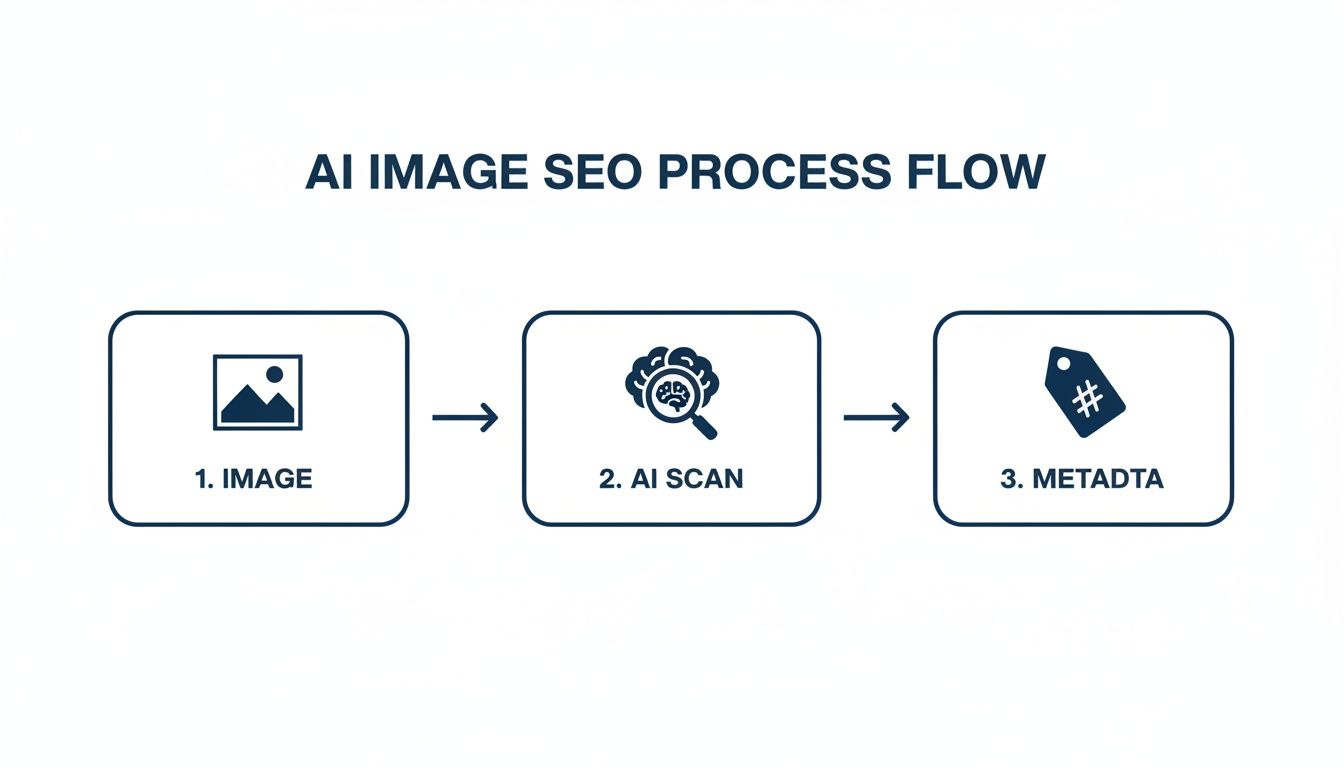
This workflow shows how AI can scan thousands of images to automatically generate descriptive metadata, getting your visual assets ready for both current search engines and future agentic shopping. While you might still use a manual search by image today, AI is completely changing this entire process.
Phase 3: Scaled Implementation and Continuous Optimisation
Once the pilot program has proven its worth, it is time to scale. This phase is all about rolling out your refined automated content workflows across the entire product catalogue. The focus shifts from testing to achieving SEO at scale, processing tens of thousands of pages with speed and consistency.
Key actions during this phase include:
- Full Catalogue Rollout: Apply the AI content models to generate unique product descriptions, metadata, and image alt text for all your remaining SKUs.
- Performance Monitoring: Keep a close eye on key metrics like search rankings, organic traffic to product pages, and conversion rates to measure the impact of your newly optimised content.
- Iterative Improvement: Use performance data to continuously refine your AI models and content templates. Agentic search optimisation is not a set-and-forget task, it requires ongoing adaptation as AI agents evolve.
This final phase completes the transition from a reactive, manual SEO team to a proactive, AI-enabled content engine. As you move forward, it is vital to keep building your team's capabilities. You can learn more about building the retail tech stack for an agentic future in our detailed guide to ensure your operations stay agile and ready for the next evolution in retail search.
This table provides a high-level overview of how these phases come together, offering a practical framework for retail leaders.
AI SEO Implementation Phases for Retailers
| Phase | Objective | Key Actions and Tools |
|---|---|---|
| 1: Foundation | Establish a single source of truth for product data. | Conduct a full catalogue audit, consolidate supplier feeds, identify data gaps using PIM systems and AI content analysis tools. |
| 2: Pilot | Test and prove the ROI of AI content workflows. | Select 1k-5k SKUs, design human-in-the-loop QA processes, deploy AI content generation models, and measure initial uplift. |
| 3: Scale & Optimise | Roll out automated workflows across the full catalogue and continuously improve. | Apply models to all SKUs, monitor organic traffic and conversion KPIs, use performance data to refine AI prompts and templates. |
By following this phased approach, you can systematically transform your content operations, moving from manual and inconsistent to automated and high-performing, securing your place in an AI-driven retail landscape.
Measuring Success and Navigating the Future of Retail Search
Moving to an AI-powered marketing engine means you have to change how you measure success. Forget about vanity metrics like overall traffic, they just do not cut it anymore. To justify the investment in an AI-powered retail transformation, leaders need to see the numbers that tie directly to content efficiency and performance on the digital shelf.
The real measures of success here are much more granular. We are shifting from broad, sweeping assessments to precise, SKU-level analysis. Your focus should now be on tracking tangible improvements in search visibility for specific products, how fast you can publish high-quality content, and the reduction in manual work for your teams.
Key Performance Indicators for AI SEO
To get a true read on the impact of your retail content automation, start tracking these core metrics:
- Content Velocity: How quickly can you get from a raw supplier feed to a fully optimised, live product page? This is the ultimate test of your automated content workflows.
- SKU-Level Visibility: Are individual products showing up for those long-tail, attribute-heavy search terms? This is a direct signal that your product data enrichment is working.
- Reduction in Content Duplication: What percentage of your catalogue now features unique, on-brand descriptions instead of the generic copy-paste from suppliers? Track this closely.
- Organic Conversion Rate by Product: Keep an eye on how conversion rates shift on pages that have been optimised through your new AI workflows.
These metrics give you a crystal-clear picture of your ROI. They prove that SEO at scale is not just about speed, it is about driving real commercial outcomes and making your retail teams more efficient.
Preparing for the Agentic Commerce Future
Looking ahead, AI's role in retail is only going to get bigger. The idea of agentic shopping, where AI agents research products and make buying recommendations for consumers, is quickly moving from theory to reality. This is the next massive shift in the future of retail search.
Getting ready for this means ensuring your product data is not just optimised for humans, but structured for machines to read and trust. An AI agent will always prioritise data that is accurate, complete, and contextually rich. The foundational work you are doing today, enriching product data and killing off supplier content duplication, is exactly what will make your products stand out to these AI systems tomorrow.
This proactive approach is non-negotiable for long-term survival. To dive deeper, you can learn about winning the digital shelf in our guide on AI ROI for retailers. Thinking this way does not just help you implement today's strategies, it positions you to lead through the next wave of change.
We Get Asked These a Lot
As retailers start figuring out how to work with AI, a lot of the same questions pop up. Here are the answers to the ones we hear most often.
How Is AI SEO Different from Having a Traditional SEO Team?
The biggest shift is moving from manual grunt work to AI workflow automation for retail. A traditional SEO team gets bogged down in keyword research and manually tweaking individual pages, which is a nightmare when you have got thousands of SKUs.
An AI SEO approach, on the other hand, uses tech for things like product data enrichment and retail content automation. This lets a small team achieve SEO at scale, freeing up your human experts to focus on high-level strategy and quality control. It is a completely different way of working, true human + AI collaboration in SEO.
Where Do We Start with Fixing Duplicated Supplier Content?
First thing's first: you need a full content audit. You cannot fix a problem until you know how big it is.
Use an AI-powered tool to scan your entire catalogue and pinpoint every single piece of supplier content duplication. This audit gives you a clear baseline and shows you which product categories are in the worst shape, so you know where to start. It is the essential first step to generating unique, on-brand product descriptions and improving your digital shelf performance.
Think of the audit as your diagnostic phase. It’s impossible to implement scalable SEO solutions if you do not know the full scope of your content issues. This step is also critical for building a solid business case to get automation approved.
How Do We Measure the ROI of Agentic Search Optimisation?
When it comes to agentic search optimisation, you need to look past old-school traffic metrics. The real wins are in content efficiency and SKU-level performance.
Focus on these KPIs instead:
- Content Velocity: How fast can you enrich a new product feed and get it live? This is about speed to market.
- SKU-Level Visibility: Are you ranking for those super-specific, attribute-driven search queries? Think "women's waterproof black leather boots size 8" not just "women's boots."
- Reduction in Manual Rework: How many hours is your team not spending on manual content fixes? This is a direct cost saving.
Ready to stop wrestling with manual content and prepare for the agentic future? With Optidan AI, you can finally move from operational bottlenecks to scalable, AI-powered optimisation. Our platform is built to enrich product data, wipe out duplicate content, and lock in superior digital shelf performance. Learn more at https://optidan.com.
